In which The Gay Recluse reaches into the mailbag.

Today we received a letter from Reader J___ B___:
I agree with the reader who took exception the the multiple image thing.
One pic is fine, write what you want beneath it.
A finger to me, and I’ll never bother with you again.
J____ B____ is a name I use to protect the innocent. I hope you like it. I have others.

When we first read this, we wanted to shred this jerk, as if he represented all of the assholes over the years who have ever tried to tell us how to live our life. We wanted to scream: who the fuck made you god of the internet? We wanted to post 100 repeating images of us giving you the finger, because what right do you have to tell us what or what not to do on our blog? Do you really think we give even the slightest shit what you think, who you want to “protect,” and whether you’ll “bother” with us? Srsly, fuck off and die!
But that passed, and left us with a more ambivalent sense of pity. Imagine the agony of going through life with such a terrible, narcissistic need to correct others (and to anonymously send them such creepy and vaguely threatening words)!
It’s true that we may live with our head in the clouds, but there are clearly worse fates.
Thank you for making that clear to us.
Filed under: City Pattern Project, Conspiracy, Disease, Drivel, Letters, Weather | 9 Comments
Tags: Assholes, Clouds, Creeps, Jerks, Letters, Narcissists, Sunsets, Threats
On Old Spice’s 2008 “Art of Manliness” Man of the Year Matthew L. Chancey: Right-Wing Nutjob!
In which The Gay Recluse says wtf.
Somewhat cruelly, a reader just tipped us off about several things that we’d rather not ever have learned about, but which we are now compelled to share, to both shock and amuse you.
1) There is a blog called the Art of Manliness. Wtf, we could try to explain it, but why reinvent the wheel? In their words:
So basically, thousands and thousands are flocking to this site, and not just for laffs? We couldn’t believe it, either.
2) The Art of Manliness decided to hold a “Man of the Year” contest, which Old Spice — yes, sadly they still exist — sponsored to the tune of $2000 for the winner and assorted other Old Spice junk that would be good to regift if you were ever invited to say, Dick Cheney’s birthday party. But they’re very inclusive:
- Looks out for and is loyal to his friends and family.
- Does the right thing, even when it’s not convenient.
- Is proficient in the manly arts.
- Serves and gives back to his community.
- Sacrifices for the good of others.
- Works hard and never complains.
- Has a confident swagger, but isn’t a pompous jerk.
- Has a sense of humor but doesn’t cut people down.
- Embraces instead of shirks responsibility
3) A bunch of men were nominated, there were votes. Whatever! The winner was Matthew Chancey, who was nominated by his wife: “In short, Matt is a far cry from today’s ‘metro-sexual’ or video game addict. He is a true man’s man.” Wow, good for him!
4) [This from our reader, and we really couldn’t be bothered to fact-check, but none of it seems implausible!]: Chancey and his wife Jennie run a misogynistic site called Ladies Against Feminism, which promotes the idea that women should not attend college, work outside the home, or have the right to vote. They are also proud members of the racist, homophobic cult Vision Forum, whose statement on homosexuality includes the following: “Homosexuality is not a victimless crime. It is a cruel moral perversion that wreaks moral, physical and spiritual havoc on men, women, children, families and institutions. The Bible makes no distinction between homosexuals, pedophiles, bestials and rapists. All are criminals, the toleration of which brings judgment on the land and devastation to children.”
Thanks a lot, Art of Manliness and Old Spice. It’s great to give homophobic nazis as much exposure as possible! I’m sure this will be great PR for both the site and the venerable Old Spice brand. Congratulations to all on such a great way to end the year.

A final note from our reader: Please contact Old Spice’s parent company, Procter & Gamble, and tell them you will not be buying Old Spice products while their company is being represented by a radical, right-wing extremist.
Update: Queerty also posted about this, and has some interesting (by which we mean nauseating) information about Chancey and Vision Forum.
Filed under: Conspiracy, Disease, Retail | 5 Comments
Tags: Art of Manliness, Homophobia, Matthew Chancey, Nazis, Old Spice, Vision Forum
In which The Gay Recluse becomes increasingly obsessed with the George Washington Bridge.
For most of us, repetition is an unavoidable facet of modern life; we might even go as far as to say that it’s been like this as long as we have lived in one village or town or city.

When we were young, we craved the opposite of repetition; we wanted to travel to fifty different countries, to work in multiple professions, to have a different favorite band every week; we made friends and when they displeased us, we cast them aside for new ones.

But eventually we became disillusioned with this constant quest for change; for one thing, we weren’t making any money — even a base-level amount that would pay for food and rent — and for another, we realized that what we were running from was the thought of spending an entire life in our skin, so to speak. Once acknowledged, it was (relatively) easy to stop. Within a week or two — sufficiently chastened — we interviewed for and obtained our first “real” job.
These days, of course, we are more resigned to both the tedium and pleasure of repetition; the days and weeks and years meld into one another with barely any change at all, along with the certainty that we are nothing but mindless cogs in a huge capitalistic machine that shows no sign of ever slowing down. All of our food and clothing and toys — by which we obv mean Powerbooks and iPods — are mass-produced and identical. Our cats are both gray, and many people can’t tell them apart.
We might be more inclined to regret this state of affairs if it weren’t for the certainty that it’s also the foundation of the metropolis; and that if we were still making our clothes and food and laptops with our own hands — the way they used to do 4000 years ago — we probably wouldn’t be alive; we would have been stoned to death for the usual offenses. It’s not that we love repetition per se, but we have learned to live with it; we find interstices within these motifs — the city blocks, the windows of a skyscraper, the boxes of cereal or flocks of circling birds — in which for a few seconds we slip away. In effect, we become anonymous; we lose all sense of self and feel the dissonant pulse of something unknown and dangerous yet artistic, destructive and creative, humbling and empowering. For these few seconds, we no longer fear death, and on some level — though obv not the most literal — even crave it.
And then we are woken up by the passage of more time or some practical necessity, at which point we return to daily life and all the longing and torment that implies.
Sometimes we try to reflect this dissonance here.
We understand that like all beauty, it’s completely subjective; and if you don’t like it, you’re always free to leave.
Ladies and gentlemen: tonight we offer you the George Washington Bridge.
Filed under: Addiction, Architecture, Benefits of Being Gay, Capitalism, City Pattern Project, Communism, Conspiracy, Dissonance, Faith, Gay, GWB Project, Infrastructure, Obsession, Pessimism, Resignation, Travel | 1 Comment
Tags: Cities, iPods, Laptops, Powerbooks, Repetition, The George Washington Bridge, The Will, Villages
In which The Gay Recluse seeks to vex.
Oh noes! It seems that we’ve upset Reader Arundel with our obsessive-compulsive need to repeat the same or similar photographic images over and over! Here’s what Arundel wrote:
Hi. I forget where I first came across your blog, but I enjoy your posts and insights.
Thank you.
However, this strange thing of repeating the same picture fifteen times in a post is a damned eyesore, an affectation that beats the casual reader over the head with the same repeated image in such a distracting way it’s impossible to concentrate on what you’re saying.
Repeating the same photo over and over implies there’s some importance to the image- believe me, once is enough. We’re not stupid. Repeating it so pointlessly is irksome.
I hope you keep writing insightful things. But readers have to work to find them between the same goddamn picture, breaking up the text for no reason.
Best to you.
Umm, well, ha ha, thank you for reading and sending in that lovely comment, Arundel. We hope you’ll write more, because it’s great for laffs! And srsly, this post is just for you, because it only has one picture (albeit from the archives!). Best to you, too.

Filed under: Addiction, Dissonance, Dream, Drivel, Letters, Pessimism, Sickness | 6 Comments
Tags: Affectations, Causual Readers, Distractions, Eyesores
On The Book of Getting Even
In which The Gay Recluse files a book report.*

In The Book of Getting Even (a title we love, btw!) by Benjamin Taylor, we meet some interesting characters: first (and last) there is Gabriel Geismar, a Jewish — and notably, unapologetically gay! — teenage boy from New Orleans with a horribly abusive father (a rabbi) and long-suffering mother. (Oh and he is obsessed with numbers and has — why not? — two left thumbs.) Fortunately Gabriel manages to escape his sad house for college at Swarthmore, where he meets a pair of twins (brother and sister) who somewhat inexplicably both fall in love with him over a single meal at the cafeteria, even though they’re seniors and he’s a pathetic little freshman. Whatever! They invite him home, and he discovers that their Hungarian/Jewish parents are the opposite of his: intellectual, generous, warm, cultured; in short, we like them. Years pass and Gabriel becomes like another son, and like his “adoptive” father — who helped invent the atomic bomb — he’s very smart at science; he gets a PhD and by the end of the book is teaching physics/astronomy at the University of Chicago (don’t worry, not a spoiler).
Which is a good thing, because their own son — the boy twin — is srsly fucked up! Although he’s gay for a while with Gabriel — which maybe sort of upsets the sister — he ends up drifting away from home (and the narrative) to protest the U.S. occupation of Cambodia and then basically goes completely AWOL before inevitably getting into serious trouble with the authorities. The girl meanwhile, after getting over her crush on Gabriel, becomes his bff, and we see her suffer through a relationship with a waspy, judgmental poser meant to epitomize/symbolize the east-coast literary establishment, which by this point has entered the narrative with a heavy thud in the form of yet another couple who are — at least from our perspective, because we are led to hate them — frenemies with the adoptive parents.
The book is set in the 1970s — a strange and horrible decade, as Taylor makes clear by periodically listing external news flashes — but for which Taylor displays an insidious (by which we mean unconscious) nostalgia that results in some tedious reading — e.g., all the zany kids in the dorms at Swarthmore, a digression into the politics of The New Yorker fifty years ago, stereotypical street characters in New York City — that seem to presume on the reader’s part a shared understanding (and interest) in this version of the dark ages, without ever making a case for why we should really care.
As the book progresses, there are fortunately some compelling scenes with Gabriel’s pseudo-adoptive parents. Gradually we learn about their deeper pain and conformity, and the book ends by unveiling a startling series of tragic events in Holocaust-era Hungary that perhaps explains some of the anguish we’ve been hearing about with regard to the wayward twin son.
Unfortunately, as compelling as these ingredients are in theory, they are glossed over in just a few pages, so that like an undercooked meal the impact is not as pungent as we might have hoped. And sadly for us, this frustration carried through much of the book, i.e., we wanted more depth! At only 166 pages, Taylor’s narrative left us speculating about the exact import of certain peripheral characters/developments (and there are far too many) or symbols — e.g., two thumbs! twins! — and worse, exactly what these are supposed to mean to the development of the main characters. Instead of analyzing these events (many of which — suicides, disease, assassinations! — are inherently epic in scope) with passion and texture, the author often delivers the news between much smaller and pedestrian scenes that focus on say, an awkward comment at a dinner party, the failure to get a joke, the painful remark overheard from the next room.
While there are a few moments of psychological insight delivered with great beauty and finesse — e.g. “Gabriel reeled quietly with the realization that someone he was ready to like simply didn’t like him…” — on the whole, Taylor seems a bit too concerned (particularly as he skewers the east-coast elite) with post-war literary pyrotechnics — tense changes! second person! — than conveying substantive truth. As Taylor flits from one character to the next, the risk of the omniscient narrator is made clear at the end — and even with Gabriel — when we don’t really know or understand the characters much better than we did at the beginning; or maybe that’s not entirely true; rather, we don’t get a sense that the characters understand themselves to any greater extent, which leads us to ask exactly why we were taken on this short but traumatic trip.
*Any negative reactions notwithstanding, we encourage readers to buy this book and form your own opinion because wtf do we know?
Filed under: Gay, Literature, Nostalgia, Writers-American | Leave a Comment
Tags: Benjamin Taylor, Book Reviews, Gay Fiction, The Book of Getting Even
In which The Gay Recluse regrets not seeing Waltraud Meier’s Isolde.

Before Friday night’s show at the Met, both the lead Isolde and her cover were sick and had to cancel. This sometimes happens!
At the last minute, the Met was able to track down Waltraud Meier, who agreed to fly in from Munich for the show.
Though a very experienced Isolde — and who has recently worked with Barenboim* — this production was new to her; and then the weather was horrible and the plane circled JFK for five hours! (Omg jet lag!) By the time she arrived backstage, there was no time to rehearse, so the director quickly coached her through the staging as the minutes ticked down to the prelude.
It was a sold out house: adrenaline was running high on both sides of the curtain.
It could have been a disaster, but by most accounts (except sadly, ours!), Waltraud Meier’s performance was filled with a remarkable fury and vulnerability made all the more incredible by the fact that she hadn’t slept or rehearsed.
Though sorry to have missed it, we’re consoled by the idea that even at the highest levels, things in the theater can and do go wrong, yet can sometimes be restored with such serendipitous brilliance.
It gives us hope as we consider the inevitable mishaps our own life, to understand that an alchemy exists by which these failures can be transformed — at least for a little while — into something better than we could have ever expected.
*Here’s a clip of Waltraud Meier from last year’s production at La Scala.
Filed under: Longing, New York City, Opera | 5 Comments
Tags: Alchemy, Isolde, Jet Lag, Marathons, Waltraud Meier
In which Dante takes over The Gay Recluse.

1 Cat + 1 Sunset =

The Catset!

Friends! Not every cat is a lolcat.
Filed under: Animals, Not Every Cat a Lolcat, Photography, Stereotypes, The Russian Blue | 3 Comments
Tags: Cats, Catsets, Dante, Editorial Assistant, Lolcats, Sunsets
In which The Gay Recluse fails to deliver the sun.

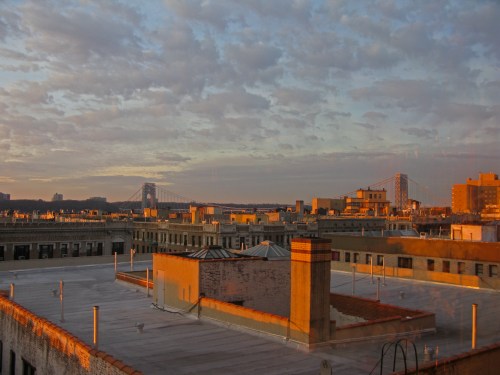
Yesterday it rained so hard that we felt sure today would arrive bright and sunny, as so often happens in New York City, where weather really doesn’t tend to linger the way it does in say, Pittsburgh or Ithaca. We had visitors in from out of town and told them our theory: then in an act of bravado — and the bad forecast notwithstanding — we promised that the weather would be perfect today, just like in the above photograph.
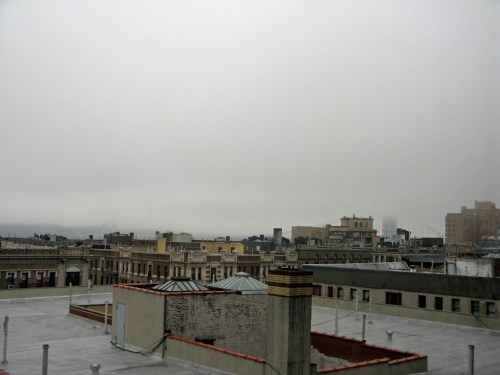
Sadly, this is what it looked like when we woke up. We were embarrassed until a few hours later, when it finally did clear up a little, although it had turned cold. Next time, we’re going to try to restrain ourselves from promising more than we can deliver, in the event that it concerns something more important than the weather.
Filed under: Architecture, Capitalism, Conspiracy, Longing, Memory, New York City, Weather | Leave a Comment
Tags: Cold, Fog, Ithaca, Pittsburgh, Promises, Rain, Sun
In which Dante and Zephyr take over The Gay Recluse.
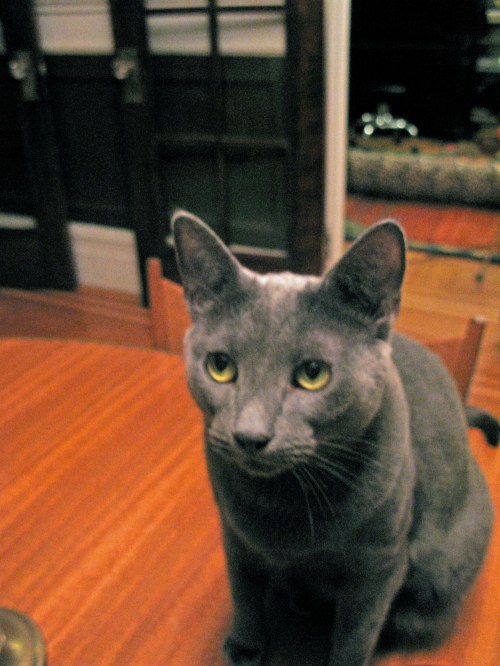
Friends! The government may be embroiled in scandal, and the legislation you seek may be decades away from the governor’s desk! Obviously these are not good economic times, unless you’re a professional athlete or a high-powered financial executive or really pretty much anything not related to old media and real estate and the auto industry. Whatever! Through good times and bad, we must always remain cognisant of one essential truth!

Yes, friends, not every cat is a lolcat.
Filed under: Animals, Government, Not Every Cat a Lolcat, Politicians, The Russian Blue | 1 Comment
Tags: Dining Room Tables, Lolcats, Paper Boxes, Pleasing Things To Sit On
In which The Gay Recluse remembers old plants.

Growing up in the 1970s, there were a lot of plants in our house.

Having plants was a sign of liberal thinking: our mother, of course, was involved in the women’s movement, so she had a mix of spider plants, cactus and marginata; our dazed-and-confused sister did macrame and partied a lot with our dazed-and-confused brother*, so they both had a lot of plants, too, although for reasons that escaped me even at the time they favored waxy philodendrons.

And ferns, in the case of our brother, although he didn’t exactly have a green thumb: even our mother — not one to ever be critical of her children — used to refer to his “magnificent collection of brown ferns.” We can still remember them lined up on his window sill, and how we used to sneak up there when he was out of the house. His room smelled faintly of the cigarettes and joints he used to smoke while locked in his room, but we braved this to touch the dessicated fronds, the dust from which would mix with the ash on the sill. All of it — the dead plants, the smoking — felt impossibly illicit to our five-year old brain; we couldn’t understand what would ever lead our brother to be so “bad,” at least with regard to our parents. (We weren’t bothered at all by the idea of spying on him!)

Our favorite plant was a potted bamboo that our mother had bought before we were born. It lived in an enormous terra cotta pot, and was the focal point of our mother’s 1970s living room (yes, the one with orange shag carpet). Once when we were six or seven, we pulled up a dead stalk and found an earthworm; it never occurred to us that the natural world could live undetected in the suburban one! For many years after, whenever the subject of the bamboo came up, we were always compelled to point out that an entire civilization probably existed in that pot, if you knew where to look.
As the 1980s approached, however, she wanted a change of scenery, and the interior decorators (terrifyingly gay!) thought a well-trained ficus would be more in keeping with the new decor. With no place to put the bamboo, it was sent off to college with my brother, where somewhat miraculously it survived four years of hard partying — there are photographs of my brother, his friends and the bamboo, all drunk! — and then came back to our basement. By that point we were ready to leave home, so it went with us to boarding school and then college, where it lived by our side for seven years.
Rather than come to New York, though, it ended up back with our mother, who by this point was in a new house with room for a ficus and the bamboo. She cut it down to nothing, but unlike The Giving Tree, it grew back, fuller than ever! Which is to say it’s still alive, and we make a point of saying hello — or maybe just nodding, because we’re not very good with hellos and goodbyes — whenever we go back to visit.
It’s easy to make fun of those who aren’t capable of loving other people, and instead resort to plants and animals.
But any love that’s honest, no matter how small, is better than one that’s fake, no matter how big it seems to be.
*Note that the entire teenage population was dazed and confused at this time; we don’t mean to single out our brother and sister for special treatment in this regard: to the contrary, we admire them for having experienced this suburban anarchy firsthand.
Filed under: Animals, Dissonance, Gay, GWB Project, Memory, Nostalgia | 4 Comments
Tags: Cactus, Cigarettes, Dazed and Confused, Houseplants, Joints, Love, Marginata, Philodendron, Ponytail Palm, Terra Cotta, Women's Movement
On Senso
In which The Gay Recluse loves Luchino Visconti.

After scouring the globe, we were finally able to obtain — from South Korea! — a copy of Senso, Luchino Visconti’s 1954 film about the Austrian occupation of Venice during the war for Italian independence.
In what is arguably the most operatic of Visconti’s films, we follow a beautiful-but-aging Viennese countess (which in the 1950s meant that she was about 26 or so), who against her better judgment falls in love with a younger Viennese officer. The story is not complicated: as the officer flits in and out of her grasp, she increasingly longs for him, until after a series of encounters she impulsively gives up her entire life — at this point, with political tension escalating, she has been safely sequestered in the countryside — to flee through a war-torn country to be with him. But the affair is doomed: we learn that the officer essentially played her, and when she arrives, he is drunk and cruel; he flaunts a young prostitute who emerges from his bedroom and lectures the countess on the impossibility of attaining happiness in such a detestable era of history. In a fit of vengeance she leaves and immediately turns him into the Viennese army — from which he had used her money to get a fraudulent discharge — and a few minutes later he is executed as she staggers through the streets of Venice while drunken soldiers leer at and molest her.

It hardly matters that you know the plot: rather, to watch this movie is to enter into a reflective state similar to what we sometimes experience at the opera; it’s almost as if your mind is bifurcated, but in the least neurotic of ways. You take in the sumptuous colors and costumes (Technicolor!); the decadent, decaying walls of Venice; the lush score, which employs Anton Bruckner and Giuseppe Verdi (trivia: Senso was used to reconstruct/renovate La Fenice after it was scandalously burned down — arson! — in the 1990s); and as you do this, you are somehow able to ponder the the threads of your own life as if you were viewing it serenely, like a piece of art, instead of pulling and tugging at this tapestry, as so often happens in the course of our daily travails.
As much as we loved Senso, however, it’s not our favorite Visconti film. We would never argue with those who claim that his greastest works — The Leopard, The Damned and Death in Venice — all came after.
But we watch Senso anyway, to understand what turned Visconti away from the neorealism upon which he built his career and led him to the intoxicating, extravagent decadence and — somehow — resignation that permeate his later works. We want to reconcile the idea that the same man who made the La Terra trema, the Sinclairian documentary of a small village ravaged by capitalism, also created Ludwig, for example, the obsessive rumination on the last (and even more obsessive) monarch of Bavaria.
In fact, we are never convinced by Visconti’s embrace of communism, any more than we would say he was a monarchist; in this respect, Visconti brings to mind Walter Benjamin, who — as much as he would flirt — was similarly incapable of embracing a political ideology. Just as Benjamin lingers over the fruit sellers on the snowy streets of Bolshevik Moscow in prose that can only be described as romantic, Visconti allows his camera to caress his young male actors just a little too much for us to ever consider them political statements.
Much like reading Benjamin, when we watch Visconti, we are left with the sense that all great art is rooted in a philosophical pessimism, a constant dissatisfaction with the present and everything it has to offer, but one that ironically enough leaves us oddly joyous and satisfied as we take it in.
Filed under: Dissonance, Film, Gay, Longing, Obsession, Pessimism, Resignation, Ruins, Writers-German | Leave a Comment
Tags: Communism, Gay Film Directors, Luchino Visconti, Senso, Walter Benjamin
In which The Gay Recluse remembers art class.

Yesterday we read about Alton Dulaney, who won the gift-wrapping championship of the world in a wrap-off at Rockefeller Center. Watching Alton’s performance, we couldn’t help but regret all the hours we spent growing up watching football and hockey and baseball on teevee, when we could have been watching wrap-offs (assuming they showed that sort of thing, which they obv didn’t)! Except that would have been way too gay for a closet-case like us, right!? But fine, like so much in our life, let’s just file in the better-late-than-never folder.

What’s depressing interesting is how many people — mostly men, but not always! — seem to assume that because sports like football, baseball, basketball and hockey (hereafter the “Big 4,” and let’s leave aside women’s professional leagues for purposes of our observations here) are dominated by men, and because 100 percent of current participants at a professional level in the Big 4 are not openly gay, that to watch these men somehow transmits to the viewer an inviolable shield of straightness, i.e., watching “the game” on Sunday afternoon is never considered gay, whereas watching a gift-wrapping competition maybe probably most definitely is! But why?
It seems to us — and we’ve probably spent more time watching sports than even being gay — that short of having a cock in your mouth, for men, watching professional sports on teevee (or really anywhere) — especially the Big 4 — is pretty much the gayest, most homoerotic thing you can do! After all, what exactly do you think is going on while you’re sitting around for hours and hours and hours ogling and drooling over a bunch of young, athletic guys with hot, firm asses, bulging shoulders/arms, and — especially in baseball, thanks to the cups they wear — enormous-looking cocks? Plus all the steroids they take make a good percentage of them look like Tom of Finland! Srsly, you might as well be cruising the internet.
Or perhaps you’re fascinated by the announcers, those big macho daddies sitting around exchanging nothing but the most vapid cliches but so in love with each other it doesn’t even matter? Oh, so you played sports in high school and that’s why you need to spend ten hours every weekend watching it? Umm, yeah ok, whatever.
It’s not even an argument, but a conclusion: watching football (or baseball, etc.) is definitely gay. Which is not a bad thing! We just want people to start admitting it, i.e., so that “gay” won’t so often be associated with “stupid” as it will be with something closer to “homoerotic,” which is an impulse that everyone should acknowledge, whether you’re totally gay like us or not. We envisions conversations around the country going something like this (and ladies, we’re counting on you to instigate!):
Wife/GF: “You’re watching the game again? That’s so gay!”
Husband/BF: “I know, but I can’t resist because these guys are so smokin’ hawt! Get me a beer, would you?” [Farts]
Ha ha, ok, we’ll stop this stupidity now. The truth is, to see gift-wrap champion Alton Dulaney — who was the only male contestant among what appeared to be nine or ten other ladies — reminded us of when we were like ten years old and loved to spend an inordinate amount of time gift-wrapping our family’s presents and adorning them with stark, angular ribbons — or perhaps a single loop — for reasons that were not really ever explored beyond attributing the behavior to any number of other similarly obsessive ones (e.g., reading bird books, making thousands of paper snowflakes, our pencil collection, etc). And how one summer around the same age we signed up for art class and were the only boy out of about 20, because somehow without noticing, we had reached the age where the idea of art was “gay,” and so most boys didn’t do it. The same thing happened to us in seventh grade when art became an elective, and we were the only boy in the class. But in a way it was easier for us, because we played travel hockey and were already on the junior varsity high school team — the only seventh grader! — and we watched a lot of sports on teevee, so how could we be gay?
It’s pretty safe to say that growing up like this almost destroyed us, because underneath our easy athleticism and somewhat inexplicable — and to some, exasperating — interest in art and music, we were filled with an implacable loneliness that came from the certainty — although we couldn’t acknowledge this — that we were completely alone in the world. It was quite painful to realize that our older siblings would never really understand us, and the day this occurred — although again, we didn’t understand what was happening — we spent hours staring out the window in tears, but with no idea of exactly why we were crying beyond a vague sense of disappointment over something quite trivial. We hated crying, of course, because that was gay, too.
This is also why — more than anything — we used to hate it when people assumed things about us. There was a period of time — like most of our twenties, by which we mean some of our thirties, too — when we pretty much tried to throw our life away, just to prove them wrong. But we weren’t really even capable of embracing that role, which also felt like a cliche. This sort of explains how we graduated from Cornell and watered plants and then NYU Law School before becoming a record-store clerk. Basically we wanted to replicate the unresolved, ambiguous conflict of our youth. Had we been straight, there’s not much doubt we would have been trapped forever, doomed!
All of which brings us to the bridge, which on this cold December afternoon beckons with the certainty of taking us to places we’d rather not go.
Filed under: Athletes, Benefits of Being Gay, Competitions, Dissonance, Gay, GWB Project, Memory, Photography, Resignation | 3 Comments
Tags: Art Class, Bows, Cocksucking, Daddies, Football, Gift Wrapping, Hockey, Steroids, Teevee, The George Washington Bridge, Tom of Finland
In which The Gay Recluse holds a competition. Sort of.
Remember how we said that one good reason to move to Washington Heights is that it’s home to the hottest gay statues? While this remains undoubtedly true, we have some groundbreaking news for our gay lady friends! This just in from Reader Roberta:
Hi TGR, I thought you — or actually your lesbian readers, coz I know there’s at least a few — might like to know that there’s a gay couple, by which I mean two gay ladies, on display on Broadway in the Heightz. I’ve taken a few shots over the past couple of months, which I attach for your consideration, with captions (my gf Suzanne helped)! Feel free to post, because these gay gurlz are hot and I’m never going to have the time to start my own blog!
Ok, Roberta, you’re on! Let’s check these gay ladies out, shall we?
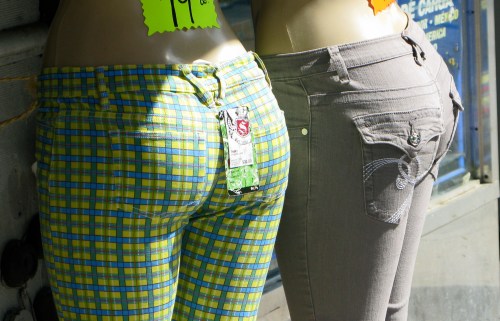
Hi girls! So you’re new to the neighborhood? And you’re a couple? Love it!
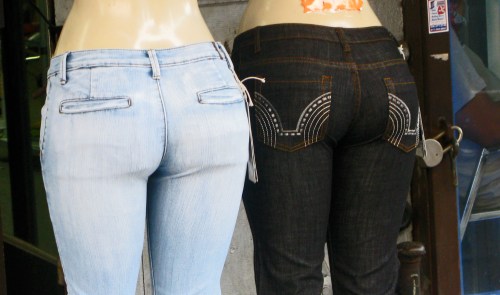
(Delicious buns!)

So are those jeans painted on or what!? (To be twenty again!)
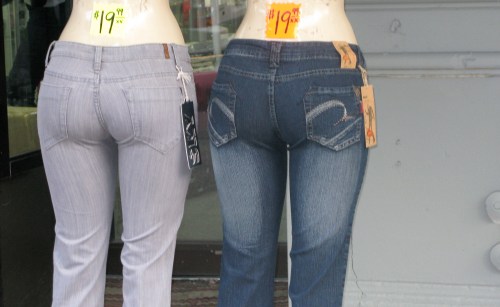
Welcome, ladies! It’s good to see more lesbian couples in da Heightz!
Thanks Roberta! We think you should start a Tumblr like us, but in the meantime, we’re more than happy to post for you! You definitely opened our eyes to a world we hardly knew existed…
The Hot Gay Statue round-up:
- Rules and Guidelines
- Dan Savage Endorsement
- Washington Heights (New York City)
- Washington, DC
- The London Eye Clarifies an Important Issue
- Florence (Italy)
- The Park Avenue Amory (Upper East Side/NYC)
- Murray Hill (New York City)
- Madrid (Spain)
- Los Angeles
- Philadelphia
- The London Eye: “In Your Face”
- The J-Man Inspires
- George Washington
- Georgia (Republic of)
- New Orleans
- Columbus Circle (New York City)
- Two Davids (Florence)
- Franco Harris Statue (Pittsburgh)
- London Firefighters and Other Heroes
- Columbus Circle Mall (New York City)
- Miami
- Paris
- Grand Central Station (New York City)
- Albany, New York
- Chicago
- Albany, New York (Hot Gay Statute)
- The Metropolitan Museum (New York City)
- University of Southern California (Los Angeles)
- More Getty Villa (Los Angeles)
- Union Station Centurions (Washington, DC)
Filed under: Capitalism, Gay, Hot Gay Statues, New York City, Washington Heights | Leave a Comment
Tags: Hot Lesbian Statues, Lady Couples, Lesbians, Tight Jeans
On Seduced and Abandoned
In which The Gay Recluse watches movies.

Tonight we watched Seduced and Abandoned, the 1964 film by Italian director Pietro Germi. Set in a small town in Sicily, it follows a family with a 15-year-old girl who in a moment of passion sort of consents (but sort of not) to have sex with her older sister’s fiancé. In short order she’s pregnant and her parents find out, after which the father is yelling and hitting and throwing things, while the mother weeps and plots with her husband to save their daughter’s honor. Lol, crazy Sicilans!

But underneath the exaggerated stereotypes that provide much of the film’s comic humor — and at times it definitely could be considered madcap or rollicking — there’s an equally cutting satirical element rooted in the family’s complete disregard for the truth as they attempt to arrange a marriage between the daughter and a man she doesn’t love. Increasingly elaborate measures are taken to ensure that the rest of the gossipy town have no reason to think that she’s a “whore” or that her father is doing anything less than begrudgingly giving her hand in marriage to the most ardent of suitors.

As the movie continues in this vein, the characters — including the town itself, filled with garish priests and nasty old men in the square — begin to acquire a grotesque quality that effectively undermines all of the conventions the family is trying to uphold: marriage, justice, honor and even the law, in which a marriage (if it can be arranged) can trump any other charge, including statutory rape or kidnapping. As for the man who initially persuaded the girl to have sex with him, he claims he no longer wants to marry her because she’s “impure” and he wants to marry a virgin! Eventually we end up hating everyone in the movie — even as we laugh at them — except for the girl, the sullen and serenely beautiful Stefania Sandrelli, who resists her parents’ plans and dreams of escaping to the city.
The genius of this movie lies in the fact that by the end, you’re not quite sure whether to laugh or cry.
It makes us think of the 1960s and how society in many respects went through a revolution. You can’t watch this movie and not think that marriage is a ridiculous institution, clearly on its last legs!
To see it now is painful to the extent that we understand how far we’ve regressed — how sickeningly conventional we’ve become, and in more subtle, odious ways than Germi could have ever depicted — but at the same time it makes us eager for a new revolution.
Filed under: Dissonance, Film, Obsession, Ruins, Search, Sickness | 2 Comments
Tags: Italian Directors, Marriage, Pietro Germi, Seduced and Abandoned, Sicily, Stefania Sandrelli
In which The Gay Recluse reads dead flowers.
When we first read about The Northern Clemency by Philip Hensher, we were excited! Not only was it short-listed for the Booker Prize, but it was rated the #1 Editors’ Pick for Best Book of 2008 by Amazon.com.* And oh yeah, Hensher is “openly gay” — kinda hate that expression, but whatevs — and has written trenchantly about the lack of gay actors in Hollywood, so without knowing that much about the book, we expected some insight into what we tend to think about as gay identity, or the gay voice.
The first quarter of the book is stunning. In exquisitely lyrical prose, Hensher describes the interactions among and between two families in a northern British suburb, one that has lived there for some time and another that is relocating from London. It’s the early 1970s, and as Hensher easily shifts perspective — at his best, reading him is really like getting wrapped up in a good teevee series — from the mothers to the daughters and the sons, he perfectly captures a sense of suburban ennui on one hand, and a kind of crushing terror of adolescence on the other. There are a few scenes — e.g., one of the mothers sort of loses her shit after her husband goes A.W.O.L. and kills her son’s pet, another in which a boy’s leg is broken during an elementary school recess — that are shockingly disturbing and brutal and ultimately heartbreaking, because we are taken back to the inexplicable cruelty and horror of youth as it plays out under the tranquil sheen of the suburbs.

Moreover, we are left with the sense that one or both of the youngest boys in the families are — or will be — gay, because they are nervous and obsessive and uncomfortable in ways that resonated with our own 1970s suburban upbringing, and so as the first section of the book ends, we look forward to learning more, not only about the boys, but about their older siblings, each of whom has appealing quirks and charms and less-appealing faults.
At this point, however, the tone of the book completely changes as we jump the shark lol ahead perhaps a decade into the future. We briefly meet the boys — both are out of high school — but they are now beyond our empathy: one is sort of a freakish communist/Marxist who now hates his parents and agitates with some snobby leftist students on behalf of the local union, and the other has dropped out of college and moved back to London, where we don’t learn much about him except that he occasionally dates women (but without success), likes classical music and works a boring job. In short, we kind of suspect that he’s probably gay, but we don’t really get any insight or exploration into his condition, just a kind of blanket denial — at one point he sort of holds out that he’s asexual — that ultimately fails to hold our interest. Meanwhile, none of the other characters are developed with greater resolve, so that as we trudge forward, we find ourselves longing for the beginning of the book.
Also, instead of focusing on his core characters, Hensher allows the plot to seriously drift and instead offer pages and pages and pages — to give what is perhaps the most pointlessly egregious example — of a subplot involving a drug-dealing/money-laundering scheme. (We cannot help but wonder: did anyone edit this book? It could have easily been 200 pages shorter without losing anything.) True, the mother had an affair with a man in the scheme, but do we really need to follow him to a country house and meet his mafioso boss and family, when all we’re interested in is the fact that the woman had the affair and the ways it has impacted her relationship with her husband (i.e., the father of one of the boys)? If Hensher’s objective was to elevate the mundane into the dramatic — and he does this brilliantly at the beginning — why introduce a cheesy teevee plot device like this?
Which — i.e., the drug-dealer subplot — may have been forgivable except the rest of the book never recovers from similar digressions — e.g., an Australian we meet on one page kills himself in act of auto-eroticism ten pages later! someone starts dating a working-class girl, whose parents of course are sweet and lovable and dance the tango and earnestly offer tea in their best china — so that by the end, we don’t really have much sense of — or feelings for — any of the characters (much less insight into questions of gay identity).
We’re not saying that Hensher — or any gay writer — has a responsibility to explore these issues, but after setting them up so beautifully, he seemed to miss an opportunity to explore the truth as it’s so rarely done.
If the book at its best feels like it was made for teevee, this is also its flaw; it’s like one of those series that starts out with promise, but quickly drifts into hackneyed melodrama, leaving us with a longing — even if we choose to watch — to change the channel or perhaps fall asleep, where we can dream in images that while at times blurry at least hold some sign of our true selves.
*Despite our mixed feelings, we still encourage everyone to buy this book and judge for yourself.
Filed under: Dissonance, GWB Project, Language, Literature, Photography, Stereotypes, Writers-British | 4 Comments
Tags: Book Reviews, Dead Flowers, Gay Writers, Philip Hensher, Roses, The Northern Clemency
In which The Gay Recluse becomes increasingly obsessed with birds.

Today we left work and had to walk crosstown in the drizzle. It was completely dark and we didn’t have an umbrella.
Plus we were running late, and had overdressed; we regretted that it wasn’t snowing, as it would have been before global warming.
But our bad mood didn’t last more than a few steps.
Immersed in the pulse of rush hour, we were swept along by the prospect of an entire evening removed from the tedium of work.
People poured into the streets through revolving doors as cabs swerved down the avenues, tires hissing on the wet pavement. Everyone we passed looked intense and interesting; we were all characters in a noir thriller!
For a few seconds we forgot about all of our problem$ and fear$: we imagined ourselves welcoming the recession if it could be counted on to deliver such a frisson of insight and — somehow — anticipation, a sense that perhaps the best in life was not quite behind us if we could just harness some of this energy for our own purposes.
We walked past the buildings and thought of all the people who had lived and died within, and how as time passes and their names sink into the sands, the mutating city is really the only monument to all the dreams we ever held.
Filed under: Animals, GWB Project, Longing, New York City, Pessimism, Weather | Leave a Comment
Tags: Cities, Gotham, Rain, Rush Hour, Sand, Time, Walks
In which Dante and Zephyr take over The Gay Recluse.

Friends! Aren’t you tired of getting on the subway and listening to two teenage assholes engage in a loud debate about whether it’s “gay” or not to touch shoulders in the kind of “bro-hug” you see on the teevee when a team scores a goal/point/tee-dee? Wtf? And aren’t you sick of watching all the other asshole passengers — even a few who “looked” pretty fucking gay if you ask us — laugh and smile at these two cut-ups, as if they were really fucking hilarious? And aren’t you sick of having to stand there quietly, pretending to be above this constant barrage of unchecked bullshit, knowing that in 2008 you can still be mocked and stereotyped as if you were a _____ fifty years ago or a _____ before that? Aren’t you sick of living in the dark ages?

Yeah, well we’re pretty fucking sick of it too, which is why today we leaned over to these assholes and said: “Why don’t you STFU because from now on, to be ‘gay’ means one thing: having your cock in another guy’s mouth or ass or vice versa, which is basically the most awesome thing ever, and if you have a problem with it, keep your mouth shut or you’re gonna find it on the floor, got it?” Lol. We wish.

Friends, not every cat is lolcat.
Filed under: Animals, Gay, New York City, Not Every Cat a Lolcat, Pessimism, Resignation, Stereotypes, Subway, The Russian Blue | 3 Comments
Tags: Daily Grind, Dark Ages, Ghetto Life, Homophobia, Teenagers
In which The Gay Recluse remembers Sergio Leone.

Recently we watched the director’s cut of Once Upon a Time in America, Sergio Lione’s epic Jewish/New York City gangster movie from 1984. When originally released in the United States, the producers imposed a chronological sequence onto the movie to shorten it, whereas Lione intended it to dreamily drift back and forth between three eras (roughly: youth, middle and old age) through the prism of one man’s memory.
There is much in the film to admire: Lione creates beautiful atmospheres in almost any context, and Robert De Niro is always a pleasure to watch. Even James Woods — who often bothers us — is well cast here, and his homoerotic obsession with the De Niro character is a compelling subtext.
There are problems, though! All of the childhood scenes are coated with an annoying sheen of nostalgia that makes them difficult to endure, so that while watching, we long for the return of De Niro & Company. Although at times brilliant — e.g., the Muzak version of “Yesterday” with exactly two words sung — the music too often crosses the line into a sort of dated kitch (two hours of Peruvian flute is perhaps one-hour and forty-five minutes too many?) that distracts from the unfolding story. Finally the Jewish component of the movie — primarily in the form of a few Yiddish phrases here and there, some Hebrew-lettered Lower East Side storefronts and a penchant for deli meats — did not really resonate for us. The problem is that there’s enough that (brilliantly) cuts against the grain of stereotype (namely, De Niro’s crushing melancholy and his opium addiction) that we are less forgiving of Lione when he succumbs to cliche.
The greatest flaw of the movie, however, is one that we’re beginning to suspect is intrinsic to the medium, i.e., the difficultly of conveying both the weight of memory along with its magic. Several times in the movie, Lione attempts to draw us into Proustian episodes of the “memoire involuntaire,” triggered by a range of objects and settings familiar but long lost to the De Niro character; ultimately, however, these transitions feel awkward and forced, and it takes several seconds for the narrative to recover from the jarring (but in the wrong way) effect of these memory sequences.
We are reminded of Visconti’s ill-fated attempts to similarly capture memory in Death in Venice, and are left to conclude that the novel is the best form to capture the subtle mix of real and unreal as we shift in and out of the present. For this reason, we don’t hold it against Leone that he failed where nobody else — at least that we know of — has ever succeeded.
Filed under: Dream, Film, Gay, History, Memory, Writers-French | 1 Comment
Tags: Bad Film Scores, Death in Venice, James Woods, Jewish Stereotypes, Luchino Visconti, Once Upon a Time in America, Robert De Niro, Sergio Leone


 The Gay Recluse
On Some Thoughts on Milk (Reader Comments)
In which The Gay Recluse turns to the mail bag.
Chances are if you’re geigh, you’ve heard about this movie called MILK! You might even feel guilty if, like us, you haven’t gone to see it yet because you’re gay and it’s about someone who’s gay and you should be eternally grateful that Hollywood would deign to tackle such a dirty and disgusting topic, although it’s great for laffs when the straight actors go on late-night teevee and asshole comedians groan and squirm about what it’s like to — ewwww! — kiss and “play gay.” But we digress! The point is, your editors at The Gay Recluse live in an actual (as opposed to gay) ghetto, with no movie theaters, and are too lazy to go see any movie in the theater, which means we probably won’t see MILK for ten years, when it reaches the top of our NetFlix queue.
Fortunately for us, Reader CB went to see MILK and provided the following analysis (in part a reaction to our post about subway homophobia), which we wanted to reprint in full.
I went to see “Milk” tonight. It is, as the New Yorker and Charlie Rose had promised, quite well done.
I know the story from the excellent 1984 documentary, “The Times of Harvey Milk.” So I can’t say any of it came as a surprise. What did catch me off guard, however, was the degree of fury that rose in me as the picture neared its climax. I was literally shaking in my seat, and my fingers went numb, until I caught myself hyperventilating.
When I thought about it after, I connected to two, internal sources of anger:
1) The awfully ignorant, intolerant world of Anita Bryant, the Briggs Initiative, and the equation of homosexuality with bestiality, pedophilia, and worse, was the world in which I passed my formative years and adolescence. In my “sheltered” upbringing, I knew nothing of the hope and triumphs of the gay rights movement. It was rough going, and scars remain. The kind of violent hate crime touched on in the movie was very much a threat in my early adulthood, throughout the eighties, even in the supposedly more-enlightened world of Manhattan. One always had to be wary, and bashings were a regular fact of gay city life. So was suicide (a topic also woven into Milk’s story). The film coalesced feelings I haven’t visited much of late, but have certainly grappled with in my life: how much damage and pain was caused — to me, to people I knew and loved, to our culture — by dumb, hateful, or murderously insane people who felt strangely entitled to dictate the course of my life and other people’s lives, and of history? How is it that such people got away with the havoc they wrought?
2) How come they still get away with it? There are simply too many parallels between the world in the movie, with its obstinate, heartless, self-appointed “normals,” and our experience today. Recent statewide ballots (not to mention the past eight years of American government) make plain the ongoing co-opting of American sensibilities by homo-ignorant bullies. (As does the Recluse’s subway moment.) On the other hand, there’s little of the activism of Milk’s era today, nor the hope of setting an example: much of the civilized world has passed us by on civil rights. The cozy gay couple I saw the movie with provided cold comfort: they exist in complete and willing ignorance of the history “Milk” tells, and of the fragility and cost of the insulated, ghettoized “freedom” in which they live their material, suburban lives.
I came home from the movie to the Recluse’s sad subway saga. It was all too familiar, and too, too old a story. Not exactly an antidote to feeling that the gap between 1978 and 2008 is only a football field wide, perhaps, rather than a Grand Canyon which cannot be easily crossed back over.
“Milk” is an important, humanizing piece about a recent, pivotal moment in American (and gay) civil-rights history. The story is moving. But its reminder that the Dark Ages are far from over is chilling. I’m not so much sick of that, as shaking in my seat with rage.
Thank you for sharing, CB. As we always say: celebrate the new dark age.*
*Also the incredible title of an equally incredible Polvo record.
Filed under: Film, Gay, Letters, Politicians, Washington Heights | 3 Comments
Tags: Comments, Dark Ages, David Letterman, Ghettos, Homophobia, Milk, Polvo, Rage