In which The Gay Recluse holds a contest. But not really.
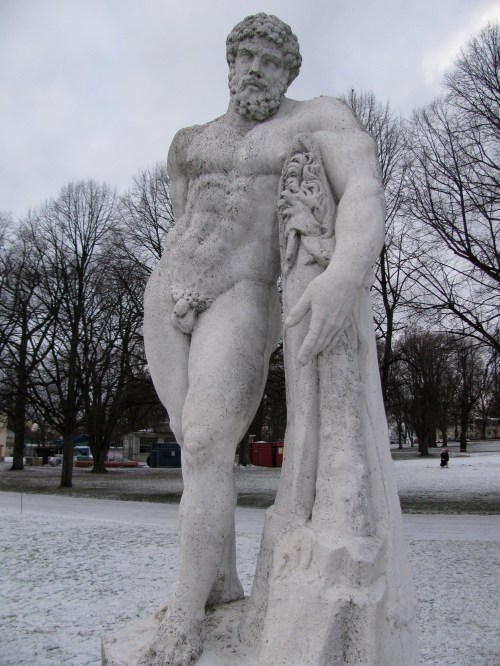
Today we received the above (and well, below) photograph from Eric Patton of Sore Afraid. (Which btw we recommend for anyone — like us! — interested in refreshingly unrelenting pessimism, literary angst, truthful travel writing and related rumination.)
This statue, obv one of the hottest and most smokin’ dads ever is from Drottningholm Palace in Stockholm (Sweden). Question: can a statue be NSFW?
Having also just returned from Europe, it makes us think about how the United States is in fact the worst country in the western if not entire world has an embarrassing dearth of hot gay statues. In our case, we were overwhelmed by the literally hundreds of hot gay statues we encountered; and how, for this reason, it was actually a relief to get a single photograph, because we’ve yet to wrap our mind around what we witnessed abroad, much less the obsessive documentation we brought back with us, as if to prove to ourselves that such things really do exist after they have faded from our memory.
To explore the realm of hot gay statues — something we started as really nothing but a traffic-whoring joke — can be surprisingly depressing in this regard, to the extent it confirms our continued existence in the new dark ages. Was life better 200 years ago? Although it’s ridiculous to ever generalize, in some ways, it seems like it probably was! (And here’s Exhibit A.)
But as often happens, the melancholy fades as we resign ourselves to our inability to change anything; we are consoled by the understanding that these places exist somewhere, even if thousand of miles away or hundreds of years in the past, which for our purposes now is pretty much the same thing.
The Hot Gay Statue round-up:
- Rules and Guidelines
- Dan Savage Endorsement
- Washington Heights (New York City)
- Washington, DC
- The London Eye Clarifies an Important Issue
- Florence (Italy)
- The Park Avenue Amory (Upper East Side/NYC)
- Murray Hill (New York City)
- Madrid (Spain)
- Los Angeles
- Philadelphia
- The London Eye: “In Your Face”
- The J-Man Inspires
- George Washington
- Georgia (Republic of)
- New Orleans
- Columbus Circle (New York City)
- Two Davids (Florence)
- Franco Harris Statue (Pittsburgh)
- London Firefighters and Other Heroes
- Columbus Circle Mall (New York City)
- Miami
- Paris
- Grand Central Station (New York City)
- Albany, New York
- Chicago
- Albany, New York (Hot Gay Statute)
- The Metropolitan Museum (New York City)
- University of Southern California (Los Angeles)
- More Getty Villa (Los Angeles)
- Union Station Centurions (Washington, DC)
- Hot Gay Ladies in Washington Heights (New York City)
- Honolulu
Filed under: Architecture, Decay, Dissonance, Hot Gay Statues, Landscape, Search, Sickness, Traffic, Travel | 3 Comments
In which The Gay Recluse helps to spread the word.
This note came in from Savona Bailey-McClain, a Harlem resident/community leader (and TGR reader!) who’s involved in uptown planning.
In addition to the West Harlem Art Fund [which btw sponsored these awesome storefront installations — ed.], I also chair Waterfront & Economic Development for Manhattan Community Board 9 in West Harlem. We are being given permission from the Mayor’s Office to begin a community planning dialogue for the former 135th Street Marine Transfer Station. The 1st dialogue will be will be held at Broadway Housing, 583 Riverside Drive @ 135th Street, 7th floor, on Tuesday, January 6th at 6:30 p.m. It will include presentations on “green” jobs, infrastructure and projects. President-elect Obama stated that he wants to support a “green” future for the country — why not in West Harlem?
Thanks Savona, and why not, indeed? We encourage all of our uptown readers to attend to help the 135th Street Marine Transfer go green!
Filed under: Gay | Leave a Comment
Tags: 135th Street Marine Transfer, Community Board 9, Community Meetings, Green Technology, Harlem
In which The Gay Recluse produces a teevee series on the internets.
The Chaos Detective: City of Dreams (Part 1)
In this episode, CHAOS — the quasi-governmental entity “Computer Hardware and Operating Systems” (or so he has been told) — has given Detective Lasalle his first assignment, which is to go to Vienna and follow a man in a fur hat. Lasalle has taken this job without knowing exactly who he’s working for and exactly what he’s trying to find; these questions and others will be explored and maybe answered in subsequent episodes.
We hope you enjoyed it. Obv we’re just taking baby steps here, so bear with us! xoxo TGR
PS. Umm, we’re already aware of KAOS…
Filed under: Conspiracy, Dissonance, The Gay Recluse, Travel | 4 Comments
Tags: City of Dreams, Final Cut Express, Laffs, Teevee, Vienna, Webisodes
In which The Gay Recluse wanders the streets of Munich.
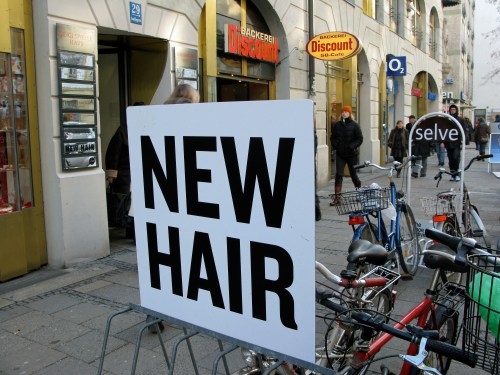
To visit Europe in 2K9 is to understand that we have a new lingua franca; to say it’s English, however, would be something of an exaggeration.
Whatever. We want new hair, and we want it now.
Filed under: Capitalism, Dissonance, Photography, Travel | 1 Comment
Tags: Fonts, Lingua Franca, Munich, New Hair
In which The Gay Recluse finds remnants of the 1860s 1960s.

It’s difficult to write about a city of the past without succumbing to nostalgia, given the grandeur of the dead monuments that have survived and the (philosophical) certainty that no time is worse to be alive than the present.

Some friends of ours came down from Berlin for a few days and booked a room in this cheap hotel just off the horrifyingly neon/commercialized Kärntner Straße. We laughed at the kitschy glass brick in the hallway outside of their room, but were nevertheless pleased to be away from all of the horrible merchandise on the street outside.

When we returned a few hours later, the sun had set and the wall was black; we felt a mix of relief and remorse knowing that we would almost certainly never see it lit up again.
Filed under: Capitalism, City Pattern Project, Communism, Gentrification, History, Nostalgia, Travel | 1 Comment
In which The Gay Recluse lands.
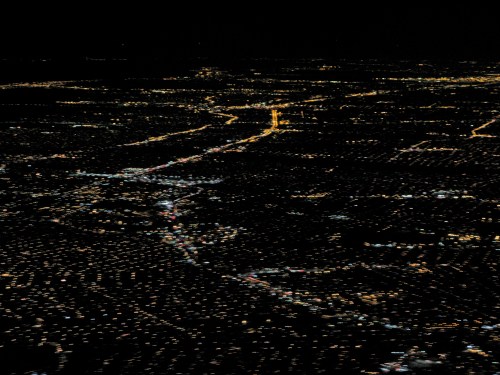
We finally descended through the clouds, and — while looking out at the approaching city — were confronted by two questions.
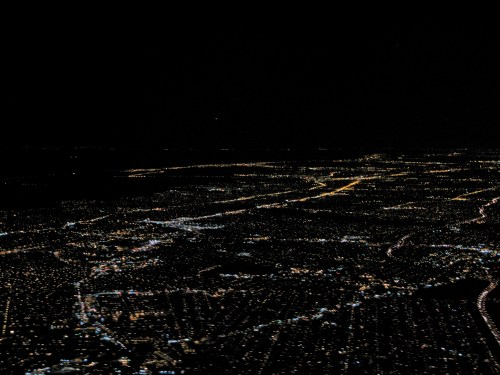
Is it possible that we actually live here?
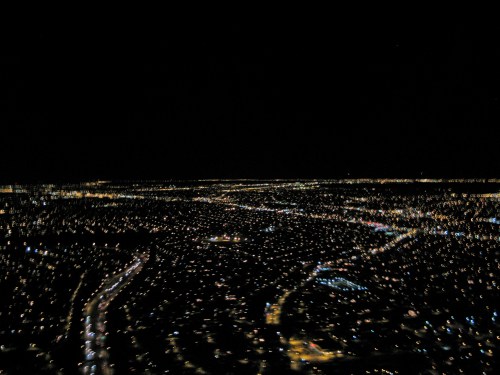
And could it really be 2009?
Filed under: Conspiracy, Decay, Dissonance, Dream, Landscape, Travel | Leave a Comment
Tags: Air France, Europe, Flights, Middle Age, Modernity, New World, New Year's Day, New York City, Old World
On Les Vacances
In which The Gay Recluse goes abroad.
Dear readers, we are off to “the Europe” through New Year’s, and so will not be posting here until 2009. During this time, we encourage you to read (gay) novels, watch Visconti, take long walks in Washington Heights and send us as many smokin’ hot statues as you can find (we’re obv expecting great riches where we’re headed!). Oh and but for those seeking a more sustained connection, feel free to follow us on Twitter. (<3 u!)
In the meantime, we invite you to enjoy this short holiday-greeting v-card from the staff here. Although it’s just over a minute long, it collectively took us like 46 hours to figure out how to even begin to use Final Cut Express 4.0.1, so we’re very proud of everyone involved, and particularly those on the technical side!
Happy New Year! xoxo TGR
Filed under: Animals, Science, Technology, Travel, Video, Washington Heights | 1 Comment
In which The Tsarina takes over The Gay Recluse on Christmas Eve.
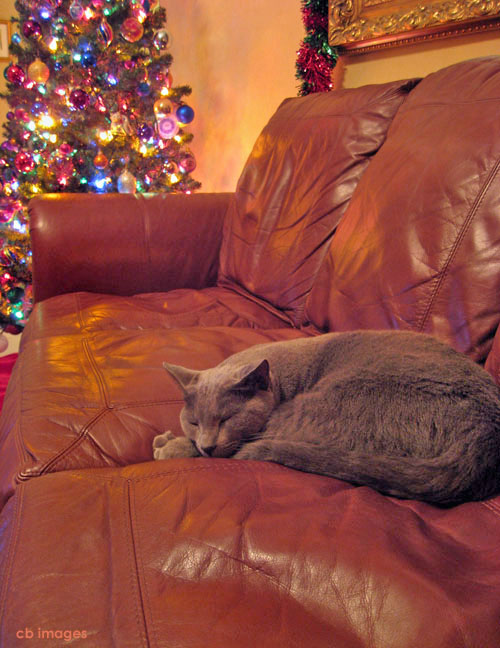
The Tsarina would like to extend her holiday greetings to her fellow Russian Blues, Dante and Zephyr. (As for human beings, she remains extremely ambivalent.) She notes that she prefers the full sofa to the smaller love seat.
Filed under: Animals, Conspiracy, Faith, The Russian Blue | Leave a Comment
On the Scent of Cinnamon
In which The Gay Recluse files a book report.
After we read Keith Banner’s The Smallest People Alive, we could not have imagined a more fucked-up society/culture than the low-class Midwest (US) described so effectively by Banner; imagine our surprise then, when we turned to another set of short stories — The Scent of Cinnamon by Charles Lambert — and discovered something even more warped! Lambert’s stories — all set in the U.K. or continental Europe — generally concern an educated class of people, which makes their brutal actions (or just as often, reserve) all the more horrifying (sometimes literally). Like Banner, Lambert likes to narrate from a dizzying array of perspectives — i.e., male/female, gay/straight (though he carefully avoids such terminology, thankfully) — and also like Banner, Lambert’s characters are not ones you’d like to consider friends; rather, he offers a vivid depiction of dark-ages society in which straight men are always cruel and emotionally distant, while the women are neurotic and conniving and dangerous (again, sometimes literally). Meanwhile the gays — having grown up under this regime — seem to have inherited the cruelness of their fathers and the weakness of their mothers, and so drift hopelessly damaged through whatever sordid adventures life has to offer.
Whereas Banner uses sick humor to draw you through his narrative, Lambert employs a similar trick with his use of suspense; we cannot read any of these stories without a sinking feeling that something bad is about to happen, leaving us with the question of whether the damage will be psychological, physical or some combination. In Lambert’s best stories, there is a haunted quality to the prose that makes his vision seem strangely universal, which is the most terrifying effect of all, because we understand that this is a world that we, too, have inhabited, but from which we are never quite certain of having escaped.
Filed under: Disease, Dissonance, Gay, Landscape, Literature, Ruins, Sickness, Writers-British | 1 Comment
In which The Gay Recluse holds a contest. Sort of.
Today reader (and blogger and Twitterer par excellence) Atherton Bartelby kindly sent in the following note, just days before leaving Hawaii for the mainland (or whatever we’re called over here). Atherton writes:
I finally snapped a photograph of one of the Hot Gay Statues on Oahu. It’s SO not a perfect image, but I thought you may want to use it anyway as a representative HGS for Honolulu. It’s of Duke Paoa Kahinu Mokoe Hulikohola Kahanamoku, who is regarded as the father of surfing.
Whoas — sounds promising! Let’s check this guy out, shall we?

Whatevs. A lil blurry, but this duke of surfdom is obv smokin’.
Thanks, Atherton — Hawaii beckons in many ways!
The Hot Gay Statue round-up:
- Rules and Guidelines
- Dan Savage Endorsement
- Washington Heights (New York City)
- Washington, DC
- The London Eye Clarifies an Important Issue
- Florence (Italy)
- The Park Avenue Amory (Upper East Side/NYC)
- Murray Hill (New York City)
- Madrid (Spain)
- Los Angeles
- Philadelphia
- The London Eye: “In Your Face”
- The J-Man Inspires
- George Washington
- Georgia (Republic of)
- New Orleans
- Columbus Circle (New York City)
- Two Davids (Florence)
- Franco Harris Statue (Pittsburgh)
- London Firefighters and Other Heroes
- Columbus Circle Mall (New York City)
- Miami
- Paris
- Grand Central Station (New York City)
- Albany, New York
- Chicago
- Albany, New York (Hot Gay Statute)
- The Metropolitan Museum (New York City)
- University of Southern California (Los Angeles)
- More Getty Villa (Los Angeles)
- Union Station Centurions (Washington, DC)
- Hot Gay Ladies in Washington Heights (New York City)
Filed under: Architecture, Competitions, Hot Gay Statues, Infrastructure, Landscape, Search | 3 Comments
On the City Pattern Project: On the Internet, the Lost Dreams of Youth Are Just One Click Away
In which The Gay Recluse remembers life as an indie rocker.
After obsessing about the Hipster Runoff review of TV on the Radio for the past two days, we realized that it had sent us into a retroactive identity crisis. It was as if it were fifteen years ago, and we were just starting a band, and — as “entry levelers” — we were first trying to assess the boundaries of what was hip and what was not hip, and how there were certain bands we hated but who we dared not criticize — even to ourselves — because say, Gerard Cosloy or Tim Nye or Gail Chickfactor had ordained them as worthy. Which isn’t really remarkable; we were 25 years old, new to the city, in the closet and too insecure to have the confidence to cultivate any kind of aesthetic instinct, either in terms of listening to music or making it.
What is remarkable, however, is to see this kind of fearless vision in someone like 22 or 23, or whatever the HRO guy is. Imagine writing something like this at that age:
I remember when I was an entry-leveler/pure altbro, I went to a TV on the Radio concert. The white guitarist guy made every one in the audience take out their keys to ‘use as percussion.’ I looked all around me. The crowd began dangling their keys in rhythm with a babbly TV on the Radio song, grinning with delight as they ‘authentically appreciated the venue’s acoustics.’ I immediately walked out of the venue. While my life is meaningful, a part of me realized that it wasn’t meaningful enough to participate in a collective concert experience. (Bold ours.)
Here — in one sentence — is what could be the essence of our own existence at 40. Or at least an idealized, philosophical existence, i.e., leaving aside all the boring compromi$e$ we’ve made for all the u$ual rea$on$.

While there’s an effortless quality to youth we regret having squandered, it’s a relief to know that everything we dreamed of back then was lost, and so will no longer burden us going forward.
Filed under: Architecture, Bad Rock, City Pattern Project, Conspiracy, Decay, Memory, Nostalgia, Obsession | 3 Comments
Tags: Hipster Runoff, Music Reviews, Teevee on the Radio, The Olds, The Youngs
In which The Gay Recluse watches weather fronts.
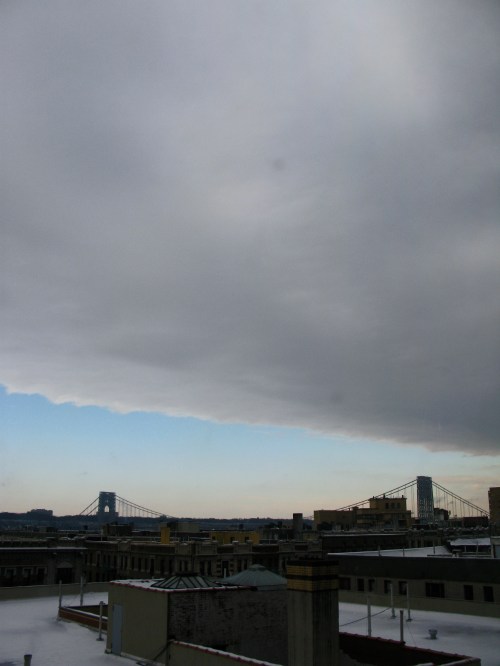
Yesterday when we woke up, it was freezing rain; but suddenly in the afternoon, the front lifted.

Within minutes, the sky was bright. As we observed this, our thoughts also began to seem less muddled; we could breathe easier. No problem was insurmountable!
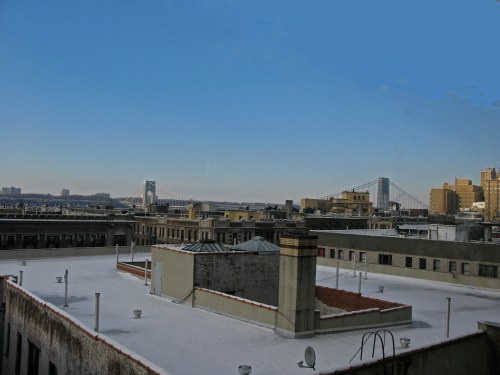
Little did we know that the clear skies would usher in a new cold front, which cruelly turned everything to ice.
Filed under: Architecture, GWB Project, Obsession, Pessimism, Weather | 2 Comments
Tags: Clear Skies, Ice, Overwrought Metaphors, Problems, The George Washington Bridge
On the Smallest People Alive
In which The Gay Recluse files a book report.

The Smallest People Alive is a collection of short stories by Keith Banner, published in 2003 by Carnegie Mellon University Press. Set in the cultural wasteland of the Midwest, the characters live in rental apartments, housing projects and trailer parks; they work at mental institutions, amusement parks and fast-food restaurants; they eat junk food, are often obese and wear sweat pants and tube socks; they are alcoholics and drug addicts; they have low IQs and broken families; they have guns and sometimes use them! When we first started, we were a little repulsed; not so much by the subject matter, but because it seemed to us that Banner — whose prose, perhaps in keeping with the world he describes, tends to be the opposite of ruminative — was going a bit overboard in his attempts to put the edge in edgy, so to speak. It seemed that he hated all of his characters, and we hated them too.

But as we continued reading, we found ourselves increasingly wrapped up in Banner’s world, particularly in some of the longer stories, such as the one about the man who takes a bus to Tennessee (sad Johnson City) one Christmas to visit his two daughters (including an obese lesbian who somewhat hilariously invokes the spirit of Matthew Shepard when fighting with her mother) and his ex-wife; after hooking up with another man in the station, he returns home to his girlfriend, his head swimming with unrequited longings for a life he can’t really begin to imagine. Or the fat teenage boy who has sex with his cousin, who has maybe just killed his ten-year old mentally retarded half-sister. Or the obese guy, just engaged, who sucks off his married friend after taking psychadelic mushrooms. Let’s just say that these are not your stereotypical sit-com gays, which is not to say we ever had the sense that Banner is reacting against sit-com gays, either, i.e., there’s nothing overtly political going on here. (Phew.)
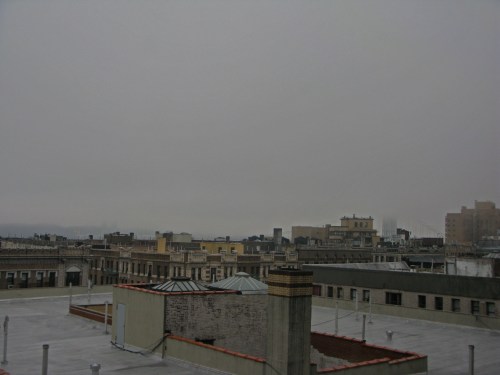
All of these stories are written in the first person, but one of Banner’s most remarkable talents is his chameleon-like ability to write in the voice of a man or a woman, a gay or a straight or a bisexual, not that he ever uses such labels (or at least earnestly). (We will note that almost all of his characters are fat or obese, which is obv our society’s other great “shame,” and one Banner effectively uses for his own purposes.) But what ties these characters together, more than their fucked-up friends and families and neighbors and jobs and towns and bodies and minds, is — at the risk of being banal — a search for love; and — most miraculously — finding it. Though it’s almost always degrading or disgusting when it arrives, love is often accepted by Banner’s leads with a nobility and forgiveness that makes even these most despicable of lives seem worth living.
Filed under: Disease, Dissonance, Gay, Literature, Writers-American | 7 Comments
Tags: Book Reports, Keith Banner, Ohio, On the Smallest People Alive, Short Stories, Wastelands
In which The Gay Recluse maybe becomes slightly more technically adept.
Yesterday we took some footage of the snowstorm — or actually the aftermath — and made two vidoes with commentary. We had some technical diffs, though, so wanted to post them again in case anyway tried to click through and was harshly rebuffed!
1) Our walk to Jumel Terrace, where we saw the geese flying south.
2) Our tour through the garden, to admire the snow and ice dripping from the trees.
Filed under: Architecture, Subway, Technology, The Winter Garden, Video, Washington Heights, Weather | Leave a Comment
Tags: Housekeeping, Snowstorms, Technical Diffs, Vlogging
In which The Gay Recluse becomes increasingly obsessed with birds (and vlogs about it).
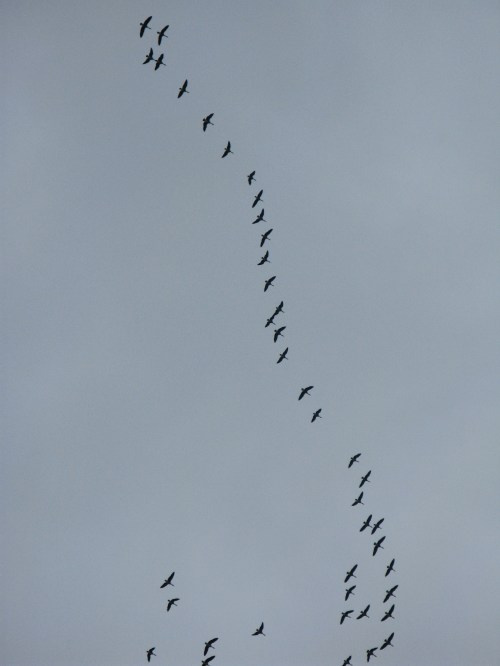
Today we decided to go on a walk with our video camera. The streets were slushy and frozen after the snow; the magic of the previous night had dissipated with the sullen day.

We trudged along, not really thinking about anything except how ugly everything looked, even on Jumel Terrace. But then we heard something in the sky — birds! — and we looked up and saw the geese flying in formation. To hear them suddenly made the noxious sounds of the city — the relentless traffic and thud of music — seem trivial.
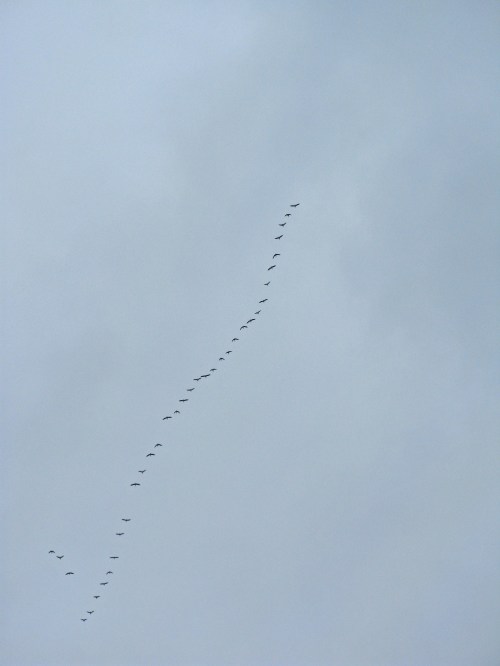
We weren’t looking for these birds, of course, but we weren’t not looking for them either.
[Redacted]
Here’s the vlog. Sorry about the shitty quality (.mp4) and the typo, but we can’t seem to figure out how to upload anything decent (.mov or .avi) onto YouTube, and we’re too lazy to fix the typo right now. All suggestions welcome! (We’re working in Final Cut Express on a Mac Powerbook.) We’re still kind of clueless, obv!
Update: This one should be better! (Still has the typo, though!)
Filed under: Animals, Gay, Graffiti, New York City, Traffic, Video, Washington Heights, Weather | Leave a Comment
Tags: Birds, Geese, Snow, Vlogging, Walks
In which The Gay Recluse vlogs.
It’s been almost a year since we posted any video, but we decided to give it another shot: after all, we now have a Powerbook, which we were planning to use for all sorts of clever and witty entertainment. As you’ll see, we still have a long way to go! Still, after four hours with Final Cut Express, three temper tantrums, two breakdowns and a partridge in a pear tree, this is what we came up with — a snowy morning in Washington Heights!
Filed under: Obsession, Technology, The Winter Garden, Video, Washington Heights, Weather | 2 Comments
Tags: December, Ice, Snow, Trees, Vlogging
In which The Gay Recluse writes a book report.
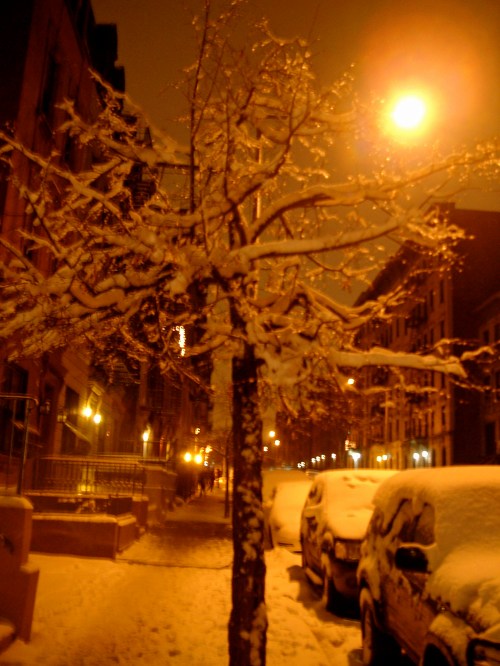
Just as the snow began, we finished Among Other Things, I’ve Taken Up Smoking, a 2007 debut novel by Aoibheann Sweeney. The book is about a girl — Miranda — who grows up with her father on a tiny island off the coast of Maine; her mother died when she was an infant and her father spends most of his time translating Ovid’s Metamorphoses. Given that the characters are loosely inspired by The Tempest, Sweeney presents us with a very compelling juxtaposition between what superficially appears to be a slender “coming-of-age” story and the heavy-duty literature that resonates through the work; in short, reading this is like going to a restaurant where the chef has successfully transformed a traditional boring dish into something surprisingly light and delicious, so that the second you finish one bite, you already want another.
The book is “gay” from pretty much the first page to the last, but in a way that recalls early 20th century writers such as Virginia Woolf and Willa Cather, i.e., it’s most often a subtext or perhaps even a viewpoint, and so never descends into the more tedious trappings of genre fiction. There is a lyrical quality to the writing — and ultimately the themes of love and truth — that transcends the need to apply the kind of labels — gay, lesbian, bisexual, etc. — that so often seep out of the political arena into art with such unfortunate consequences. Sweeney gives us a story, and though she deftly deconstructs (and adheres to) any number of gay stereotypes, her characters always feel more like people than statements.
The story is not complicated; Miranda finishes high school and her father helps to get her an internship for the summer in New York City; while there, she meets a boy she likes well enough but for whom she feels increasing ambivalence as she concurrently falls in love with a Dominican girl from Washington Heights.(!) From a very young age, Miranda understands that she is an outsider, and the suspense of the book relates to her gradual understanding of exactly why. We are drawn through this process by Sweeney’s amazing ability to infuse small and often awkward moments — attending a party, flirting with a stranger, making stiff dinner conversation, getting lost in the city — with poetic insight and mystery.
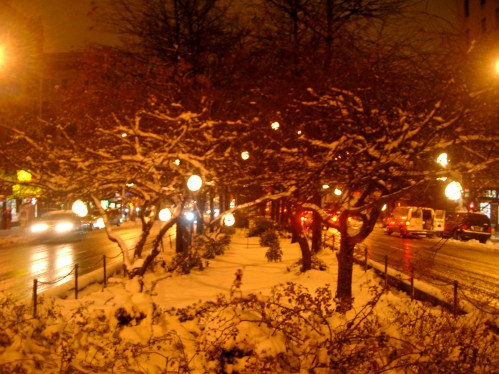
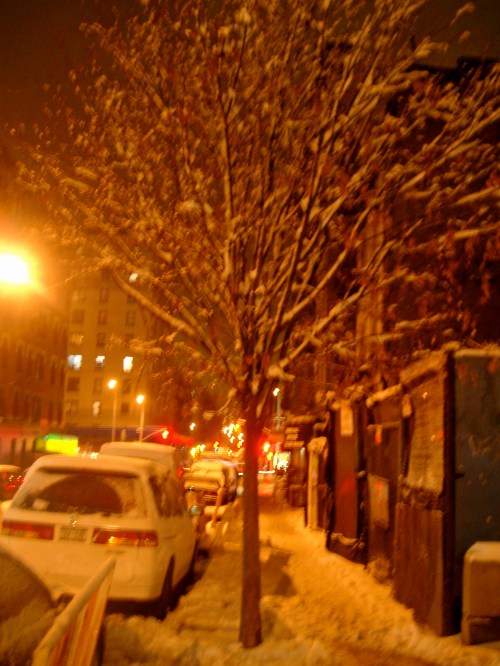
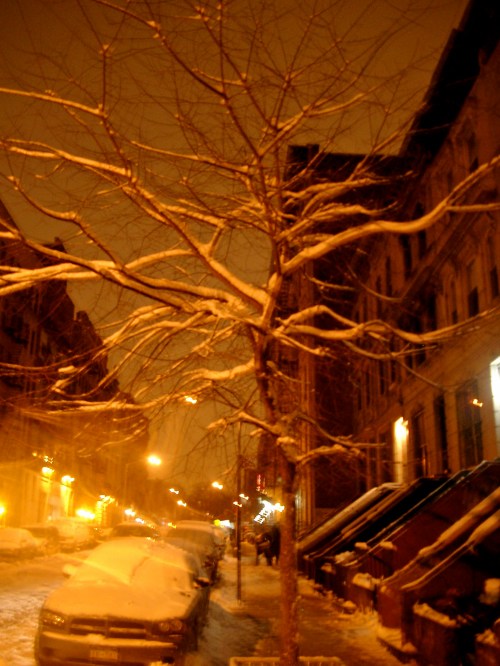
That she ultimately finds herself — in both literal and metaphorical senses of the expression — in Washington Heights is something we not only appreciated but understood, particularly today, when the snow fell on all of us, equally.
Filed under: Gay, History, Literature, New York City, Washington Heights, Writers-American | 2 Comments
Tags: Aoibheann Sweeney, Gay Voice, Ovid, Shakespeare, Snow, Virginia Woolf, Willa Cather
On Ludwig
In which The Gay Recluse loves Luchino Visconti best.
In Ludwig, Luchino Visconti’s four-hour treatment of the 19th-century King of Bavaria, we are introduced to the king as a young man, but learn almost immediately — in what feels like a flash-forward — that he will eventually be dethroned by the state legislature for maybe being insane. So with the question of what happens effectively taken off the table — as it should be in all biopics — this gives Visconti the opportunity to explore exactly how this earnest young monarch slips away.
Helmut Berger, both handsome and delicate, plays Ludwig with a brittle yet manic elegance that showcases both his beauty and optimism in the early part of the movie and a grotesque deterioration — including his horribly rotting teeth — with which it is gradually replaced. Throughout he possesses a nervous intensity that makes his descent into madness — or disillusionment? — completely convincing. That Berger was also Visconti’s off-screen lover makes sense; at a certain point the movie is less about the historical character — i.e., the tormented homosexual, the builder of castles, the financier of Richard Wagner — and more about Visconti’s obsession with Berger. As we watch, we become similarly entranced by Visconti’s depiction of a world that aches with fragile and untenable beauty, so that as the music — from Tristan and Tannhauser — repeats over and over, we are immersed into something close to a feverish dream state, in which even the smallest shift of our eyes away from the screen threatens to induce a searing pain.
The bright colors of the royal uniforms, the damask wallpapers and gilt interiors are contrasted throughout with barren, wintry landscapes; yet both are equally dream-like here. Visconti likes nothing more than to slowly pan across a landscape, often leaving the foreground blurry as we slowly fix our gaze on what may or may not appear in the distance. Eventually someone appears, we somehow understand that in the middle of this decadence they are doomed; that much of the cast — and particularly Romy Schneider as Ludwig’s cousin, the Empress of Austria — are exquisitely, almost painfully beautiful, both doleful and sensual, makes us forget the film’s more obvious and superficial flaws, i.e., its many loose ends, abrupt edits and pointless conversations. Once we succumb to Visconti’s vision — his “music,” so to speak — we understand that we are watching an opera, where language — at least in its most literal form — becomes secondary, and perhaps even irrelevant, to the piece as a whole.
It is for this reason that we are not bothered by the somewhat ridiculous dubbing of the actors’ words into Italian; just as Ludwig himself preferred the artificial beauty of his exotic interiors to anything in the real world, the film is an exercise in artifice; at no point do we lose sight of the fact that we are watching.
There is no “escape” watching Visconti; rather we are presented with the certainty that even the greatest and most sumptuous works of art — the ones that kings have literally died for — will like icebergs eventually melt into the sea and be lost to us forever.
Filed under: Architecture, Decay, Dissonance, Film, Gay, Obsession, Opera, Resignation, Ruins | 3 Comments
Tags: Bavaria, Kings, Luchino Visconti, Ludwig, Richard Wagner
In which The Gay Recluse reads a book of signs.
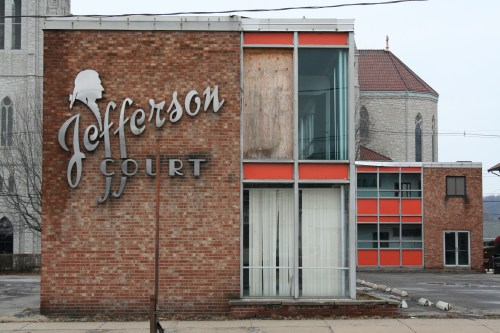
One strange thing about growing up in Pittsburgh was that even before we lived anywhere else, we used to say that it — i.e., Pittsburgh — was haunted. But when people would ask us why, we were at a loss to explain: either you got it, it seemed, or you did not.
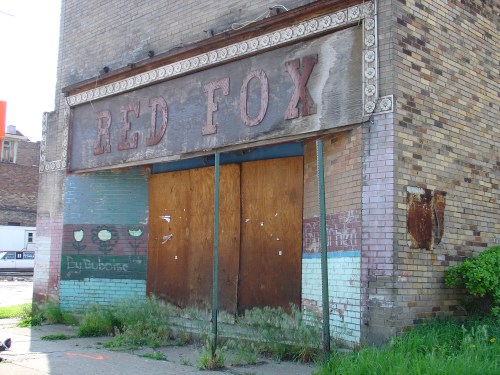
But now that we live in the equally haunted neighborhood of Washington Heights, we’re in a better position to explain. Like Washington Heights, Pittsburgh — or at least many parts of it — resonates with a decrepitude that can only be attained after the big show has ended, so to speak, after the spotlight of “development” and capital and investment has moved to newer and more exciting venues, leaving the hulking wrecks from the old production to languish in the shadows. Nowhere is this contrast greater than upper and lower Manhattan, but Pittsburgh — like so much of the Midwest — has also been left behind in the last twenty years; to spend even an hour or two driving across its bridges and through its tunnels is to be shocked by the deterioration, the sense that the bridge you are crossing might just fall into the river at any second, and most of all, a sense that you are not in the United States of freedom and equality, but some mockery of this, some communist blok country from the 1980s, even down to the ridiculou$ new sports arenas that have recently replaced the old ones.
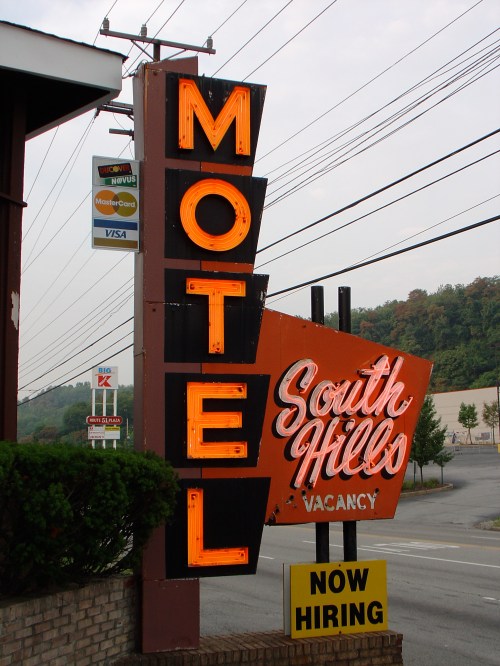
There is, of course, an exhilaration that comes from being removed from the toxic streams of money that circulate around and through us so constantly, at our downtown corporate jobs, and in the lives of those we read about in The Times or watch on The Hills teevee. There’s an uncanny feeling of safety here, not unlike what we used to experience as a child when we would retreat to the back of our mother’s closet for a few hours, just to escape the mayhem of the family. You walk through these streets and see the cracked building facades, the crumbling letters of a dead marquis, and the windows that are somehow never quite square, and you know that these are places of survival, where luxury of any kind — except perhaps the most base — is only a taunting echo across the lost decades. But underneath the despair, there is also for us — the observer — relief.

We of course have always preferred this backstage environment, where the rules of normal society may or may not apply, where there’s a certain code of conduct that arises out of the need to scratch out an existence in these corrupted hills. It’s not that people aren’t conservative, but there’s less pretense and optimism — and consequently, public judgment — than what you find in the West; even the mountains around Pittsburgh are more stoic than angry; they seem old and resigned to their fate.

The Pittsburgh Signs Project — a new book being published by CMU Press — beautifully documents this fading existence in a series of 250 photographs by Jennifer Baron, Greg Langel, Elizabeth Perry, and Mark Stroup. We can’t help linger over this pleasingly obsessive record of a neglected and disappearing past, not so much with a thought to save or preserve any of it, but simply to consider the transforming power of time and erosion; objects here that would have once inspired disdain now possess a dignity that thankfully transcends the more tedious elements of nostalgia or kitsch that sometimes threatens to ruin our appreciation of pop culture, especially those mass-produced elements of it. Rather, we get the sense that each of these signs is a unique artifact recovered from the bottom of the ocean. Or you might think of it like strolling through a graveyard in which you have no personal relation with any of the dead; with each one, we try to imagine what life was like when it was new, when it was shining with the dreams of those who created it, and seemed to offer an escape that’s all but unthinkable now. This of course is not done with condescension or pity, but rather jealousy that those who once lived could have been offered so much more than what we are left with today.

The Pittsburgh Signs Project, just named one of Pittsburgh Post-Gazette’s books of the year can be purchased here or contact the editors directly at 250signs [at] gmail [dot] com. Read more here and here.
All photographs courtesy of and by Jennifer Baron, editor and contributor to the Pittsburgh Signs Project (click for PSP website or here for the PSP Facebook), except for South Hills Bowl by Dan Buczynski and Twin Hi-Way Drive-In by Corey LeChat.
Filed under: Architecture, Capitalism, Communism, Disease, Dissonance, Dream, Faith, Knockbusters, Landscape, Obsession, The Times, Washington Heights | 4 Comments
Tags: Books, Pittsburgh, Pittsburgh Signs Project, Pop Culture, Signs, Walter Benjamin
In which The Gay Recluse is taken over by Zephyr.
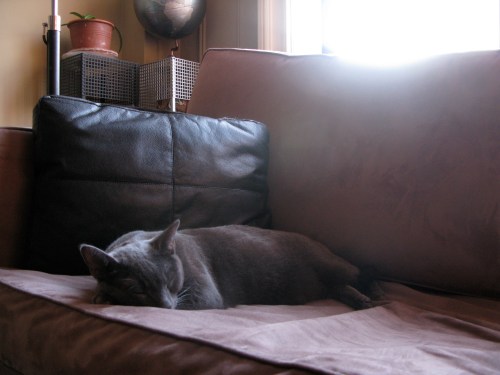
This December is even more stressful that usual, thanks to the economy. Everyone keeps canceling their holiday parties!

And so what if you don’t get paid very much or have to work nights and weekends? At least you have a job!
Maybe some day the economy will improve.
Until it does, we’d most often rather be sleeping.
Filed under: Animals, Conspiracy, Not Every Cat a Lolcat, Pessimism, The Russian Blue | 2 Comments
Tags: Catsets, Couches, Jobs, Sleeping


 The Gay Recluse