In which The Gay Recluse files a special investigative report.
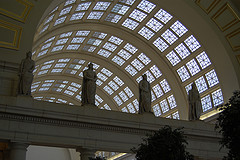
Recently Reader Lloyd put us on notice about the existence of an entire army of hot gay statues gracing the colonnade at Union Station in Washington, DC. Which ok is awesome, but his note also contained a scandalous rumor, which we reproduce in full:
I was told about the statuary in Union Station by a friend in San Diego, now 65, who attended seminary in Washington, DC, as a youth. Floods of seminarians used to go to Union Station to view the statues before the shields were installed. The statues, all similar, ring the second level of the atrium-like entrance lobby, maybe 25 to 40, and are over life-size. They all hold shields which cover their bodies from feet to chest level. Once when waiting for a train, I tried to check them out, but access to the gallery behind them was not possible.
We wondered if this could be true, and found some pix on Flickr of the statues in question:

Hey, who are those hot guys on top of those columns? (Photo by mattherbison on Flickr)
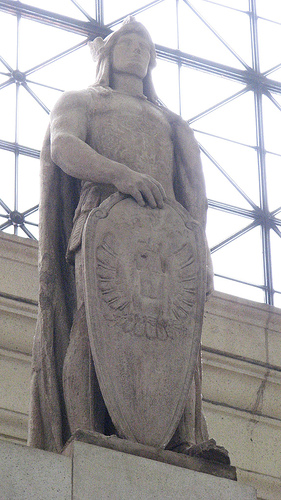
Whoas! This guy’s pretty hot. Definitely gay, too.
(Photo by jcolman on Flickr)
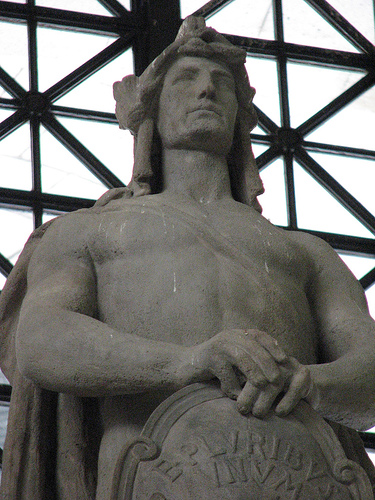
Pretty smokin, frankly. (Photo by jcolman on Flickr)
Ok then, so there’s like a hundred of these smokin’ Romans milling around, but srsly, what’s up with the shields? According to one DC art blog, the shields were added after a public outcry in 1907, when the station was opened. Here’s the full story:
Apparently when the sculptor, Augustus Saint Gaudens — who was a pretty popular public art and monument sculptor at the turn of the century — received the commission for the centurions, he asked if he was to make the Roman soldiers historically accurate.
He was told yes.
When Saint Gaudens delivered the models for the sculptures, Washingtonians on the arts panel were a little shocked to discover that some of the centurion maquettes were fully nude in uncircumsized splendor for all to see.
And so a hundred years ago Saint Gaudens was told to cover them up. In the arguments that I am sure followed, the solution came in the form of shields (which to me look historically inaccurate by the way), which would cover the Italians’ willies. They remain naked beneath them.
Really!? True or apocryphal? So far the only photograph we could find even hinting at this most tantalizing state of affairs is this one:
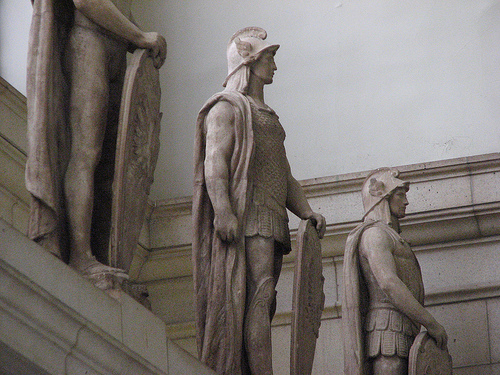
These guys are srsly hot, but the question remains: why the shields? (Photo by jcolman on Flickr.)
We want to extend a big thanks to Lloyd who turned us on to what conceivably could go down as the biggest scandal in the history of hot gay statues! That said, we are left with important questions: Will some kind reader in DC send us an even hotter pic of one of these centurions (and what hides behind the shields)? And if it turns out to be true, will President-elect Obama finally restore these hot gay statues to their intended glory? There can be no doubt that the world is holding its collective breath…
The Hot Gay Statue round-up:
- Rules and Guidelines
- Dan Savage Endorsement
- Washington Heights (New York City)
- Washington, DC
- The London Eye Clarifies an Important Issue
- Florence (Italy)
- The Park Avenue Amory (Upper East Side/NYC)
- Murray Hill (New York City)
- Madrid (Spain)
- Los Angeles
- Philadelphia
- The London Eye: “In Your Face”
- The J-Man Inspires
- George Washington
- Georgia (Republic of)
- New Orleans
- Columbus Circle (New York City)
- Two Davids (Florence)
- Franco Harris Statue (Pittsburgh)
- London Firefighters and Other Heroes
- Columbus Circle Mall (New York City)
- Miami
- Paris
- Grand Central Station (New York City)
- Albany, New York
- Chicago
- Albany, New York (Hot Gay Statute)
- The Metropolitan Museum (New York City)
- University of Southern California (Los Angeles)
- More Getty Villa (Los Angeles)
Filed under: Architecture, Conspiracy, Government, Hot Gay Statues, Memory | 6 Comments
Tags: Augustus Saint Gaudens, Censorship, Centurions, Investigative Reports, Scandals, Shields, Union Station, Washington DC
In which The Gay Recluse loves Robert Bresson.
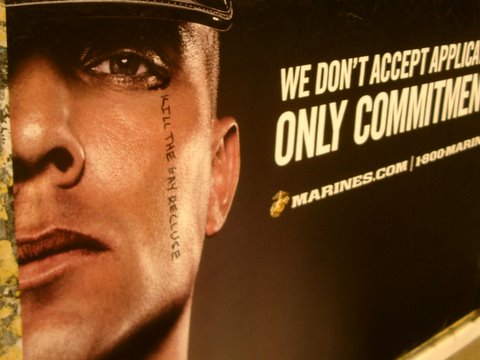
In Diary of a Country Priest (1951), Robert Bresson offers us a portrait of a beautiful and painfully sensitive young priest who has just arrived to his new parish. For reasons that are never quite explained, the priest is mocked and detested by the local citizens; those who hate him include a rich young aristocratic heiress, her father the count, and a mob of ignorant young teenage farm girls (i.e., it’s not a class issue).
At one point, he does make a connection with the aristocrat’s wife — who in her grief over a dead son has shut herself off from the world — but she dies the next day and her evil daughter spreads malicious rumors that the priest caused this, when in fact he had guided the countess to a place of solace and peace.
The genius of Bresson in this film is less in the story than the seamless transitions between the priest’s awkward conversations with others and his own mental dialogue, in which he narrates for us — i.e., the audience — his discomfort and seeming incomprehension with regard to the pain the world never ceases to bring to him, despite his best intentions.
For some reason, nobody interprets this as an allegory of a gay man, striving to come to terms with his humanity in the dark ages.
But we know better, particularly when the priest flees the country to the city, where he is blessed by those like him who have fallen from grace, and in this way returns to it.
Filed under: Conspiracy, Film, Gay, Search, Sickness, Stereotypes, Writers-French | 2 Comments
Tags: Counts, Diary of a Country Priest, Farm Girls, Grief, Priests, Robert Bresson, The Dark Ages
In which The Gay Recluse scores selected opinion pieces in The Times.
Charles Blow/Gay Marriage and a Moral Minority
The Short Version: The gays are not about to win over black women — who statistics show are stupid, bitter, homophobic cows — by appealing to equality. Better to appeal to reproductive health!
In his words: “More specifically, blacks overwhelmingly say that homosexuality isn’t morally acceptable…So pitch it as a health issue.”
The Score: F (Fuck off!). In this piece, Blow displays a remarkable insensitivity w/r/t the premise of civil rights generally and the gay version specifically. Let’s begin with his premise that gays need “to pitch” the idea of marriage to anyone, and especially the few hundred intolerant, hypocritical black church ladies upon whom Blow obnoxiously ruminates. (And here we cannot resist offering another lol-quote: “Women who can’t find a man to marry might not be thrilled about the idea of men marrying each other.” Ha ha, that sounds like a SATC episode, Charles!). While it’s undoubtedly true in the most mercenary sense that gays do in fact need to sell the concept of marriage (or as we prefer, civil unions for all) to various constituencies, in a representative democracy, we are not obligated to appeal to those most hostile to our cause (and we certainly don’t need to hear it blithely framed in these terms from some tool making questionable extrapolations from a CNN poll). What Blow — who from his pic appears to be an African-American dude and from his bio appears to be straight (or at least a father of three children) — might like to consider is how he would have felt if in say, 1958, we had suggested that black leaders reframe the fight for desegregation in more palatable terms to a group of KKK members, whom surveys revealed to be omg rather racist. In short, just as the promulgation of civil-rights laws were not dependent on changing the views of asshole racists, enlightened observers will understand that the same should hold true for asshole homophobes; it’s not our job to teach or sell the idea of equality to those who are obviously incapable of grasping it and for Blow to suggest otherwise is insulting.
Filed under: Drivel, Gay, Government, Politicians, Stereotypes, The Gay Recluse, The Times | 1 Comment
Tags: Charles Blow, Church Ladies, CNN, Cows, Extrapolations, Gay Marriage, Homophobia
In which The Gay Recluse considers a southern exposure.
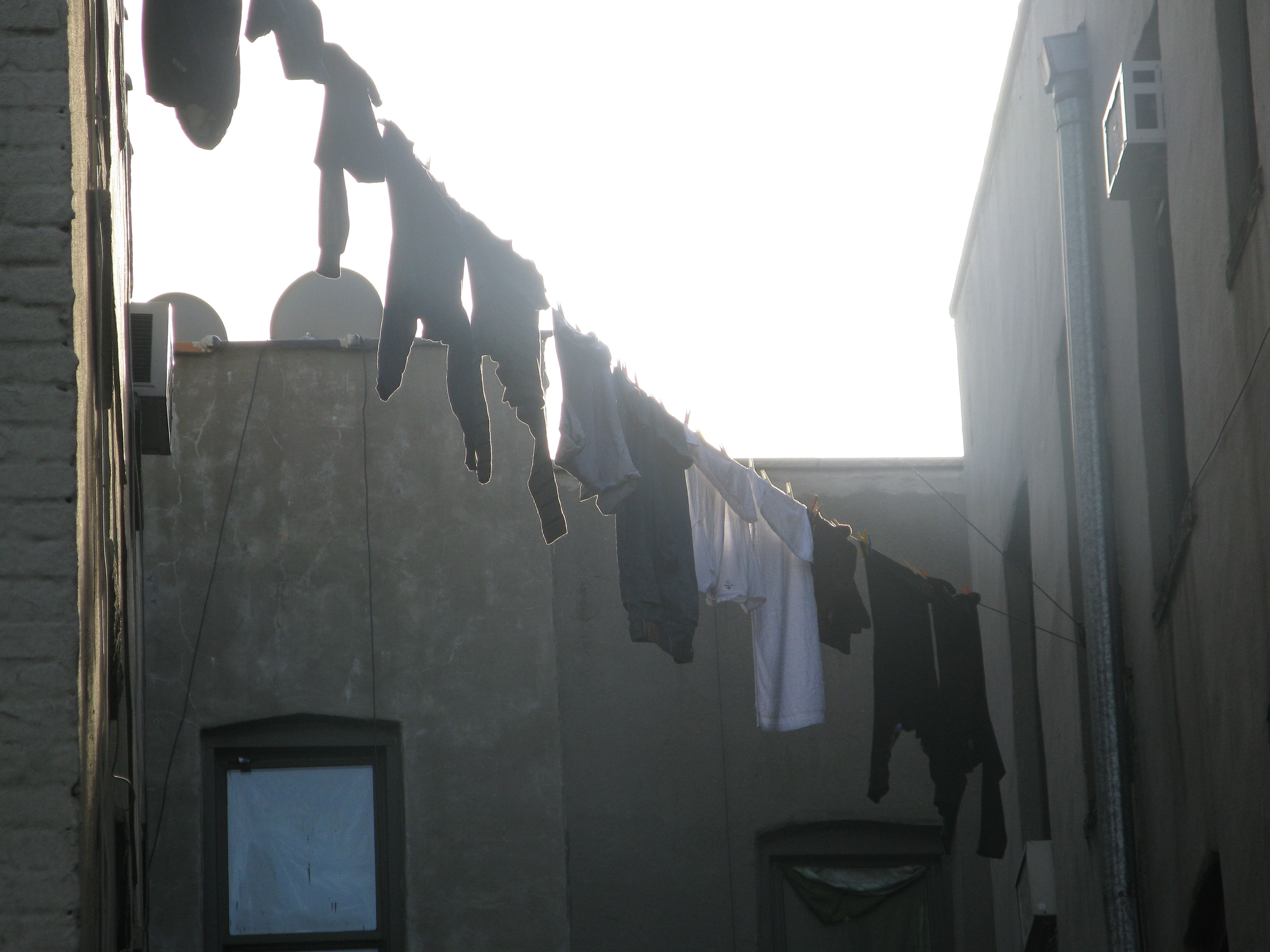
Admittedly, we have often cursed the apartment buildings that face the southern side of our garden. In addition to casting a shadow, they are sometimes the source of crushingly loud (and bad) music and garbage thrown from their windows. Also, it’s hard to escape the feeling of being watched at all times (except of course when we’re hidden under our bamboo).

Yet there are moments when we appreciate them; when we look up and understand that we could have seen these same clothes drying in the air 50 or 100 or 200 years ago.

Temporarily blinded by the iconic quality of this urban vista, we forget how much we hate them.
Filed under: Capitalism, City Pattern Project, Communism, Conspiracy, History, Knockbusters, Washington Heights, Weather | 1 Comment
Tags: Apartment Buildings, Clotheslines, Gardens, Hate, Shadows, Southern Exposures, Sun, Urban vistas
In which The Gay Recluse ponders gay marriage literary equality. (Ed: we accidentally published an earlier version of this piece with a lot of unfinished crap at the bottom — please disregard in favor of the below!). UPDATE: please check out this post for gay-oriented 2008 book recommendations from those better informed than us!
Last November, we published an essay on the suffocation of the gay voice in American literature, and not much has happened in the past year to change our opinion of this bleak, dreary landscape. The New York Times Book Review recently published its annual selection of notable books for 2008, and although we’re not familiar with all of them, as so often happens when confronting such lists, we were struck by an apparent lack of anything on the fiction half of the list — characters, themes, authors — that could be considered even remotely gay. Similar observations hold true for Janet Maslin and Michiko Kakutani‘s respective top-ten lists.
[A few preliminary notes/disclaimers: On the non-fiction side, there is a biography of Rudolph Nureyev, whose relatively unapologetic and well-documented appetite for men and death from AIDS makes the issue impossible to ignore completely (this is somewhat akin to real gays we sometimes see on reality teevee, which are so different than the usual stereotypes offered up by the networks, see e.g., every show ever made except maybe Six Feet Under!); in terms of the fiction list — our primary concern here — it’s possible that some of these books do in fact deal with gay subtexts and themes (and if so, we’d like to hear about it!), but we could not glean anything along these lines from the capsules included.]
Which — i.e., this lack of “gay” — is kind of telling, given the range of other topics and themes we encounter while glancing through the list, e.g., we find authors confronting racism and ethnic stereotypes and politics and war and crime and terrorism (9/11!) and suburban/domestic ennui and the usual host of marriage/love problems. While all of these are admittedly compelling (or can be, in the right hands), we cannot help but ask: “If we were an alien coming to earth and knew nothing about humans except for these books, would we have any clue about the existence of homosexuality?” In this case, sadly enough, the answer is no, we wouldn’t.
This begs the question of wtf why, which in turn suggests three possible answers: 1) gay themes don’t really lend themselves to literature, 2) gay themes are less important than all of the above, and so we shouldn’t be any more disappointed not to find them covered here than we would if say, we were passionate about golf and found no novels on the topic in any given year; or 3) whether important or not, there were no outstanding works of fiction published in 2008 dealing with questions of gay identity.
As to whether gay themes are appropriate to literature, to say they are not would seem quite plausible if you were relying on the post-war American literary canon, because hey, there’s nothing gay about it, so it couldn’t be that important, right? This of course is casuistry; beyond obvious reference to literary masters both near (Michael Cunningham, Andrew Holleran) and far (Marcel Proust), there is a case to be made that homosexuality is the most universally reviled trait in the history of humanity — cutting across class, ethnicity, organized religion, gender and nationality — and thus the perfect window through which to examine well, pretty much anything, or at least anything related to a fundamental understanding of who we (collectively) are, which is certainly one plausible purpose (or at least effect) of fiction. (And we would go so far as to say that writers who ignore this do so at their peril, and that their works will be dismissed and forgotten as epitomizing the unenlightened tendencies of the dark ages in which we now but perhaps will not always live.)
Moving on to the importance of question number two, beyond the obvious hey-we’re-gay bias we bring to the table, we cannot help but look at the national socio-political-economic landscape of the past twenty years or and wonder if the issue of homosexuality — as much as race, class or gender — has not defined (albeit in many cases, in a largely unconscious manner) the national “dialogue” in ways that have had disasterous effects on all of us. We think back to how Reagan and Bush actively ignored the holocaust of gay men that took place on their watches, and then we observe the manic behavior of our country under the Clinton and Bush II administrations — the economic frenzy, the ascendancy of Moral Politics, the embrace of the sickeningly masculine culture of SUVs and rigidly stereotypical gender roles in Hollywood movies, etc. etc. — and we wonder if, at least in part, this could not be attributed to the failure of our country (outside of a few marginalized communities, obv) to truly acknowledge what happened twenty years ago, much less grieve or examine it in a meaningful way. Maybe it’s just us, but when we consider New York City, we are often left with the sense that there’s still a pervasive grief that hovers over a city where something like 100,000 people (mostly gay men) died, many at a brutally young age; it’s the skeleton in our closet that nobody really wants to talk about because it’s painful and depressing, but our guess is that until we address this in a broad, public forum, we will continue to be srsly fucked up in ways that both are and aren’t obvious.
As gay forces mobilize in the fight for marriage equality (or as we like to refer to it, civil unions for all), there seem to be practical implications to the sadly straight state of American literature in 2008, namely in the startling lack of stories (by which we mean the literary fictive kind) upon which this movement can turn for solace and inspiration; where, for example, is our James Baldwin? Sure, there are big gay filmmakers on the cultural landscape, but isn’t there something a little unsettling about throwing money at an industry where out gays cannot be considered for leading roles? Where we have to rely on Sean Penn — who omg was willing to “play gay” — for distribution? Whatever the case with movies, the desperate fervor with which these crumbs are gulped down by the gays suggests a strong demand that is largely unmet in the literary context.
Moreover, what books offer that movies do not is the ability to present characters as multifaceted, complex distillations (or reflections) of the kind of people we meet in the real world, i.e., those who do not conform to stereotype and generalization. Relevantly, this includes depictions of gay sex! Because high-minded notions of equality to the side, it’s also important for some significant percentage of the population — i.e., certainly more than could be said to exist now — to understand that cocksucking and assfucking (and whatever gay ladies do) are — or can be — equally valid means of sexual expression, as much as anything our straight peers might want to entertain among themselves, even if it leads to procreation. Bottom line: to be successful politically, we gays need to fight the “ew” factor, and having straights pretend on film is more of a disorienting spectacle than an honest depiction of this fairly serious aspect of our humanity (i.e., something that both separates us and brings us together, to be kind of “Hallmarky” about it!).
Except all of that said — and most depressing of all for us to consider — we have no obvious candidates for inclusion on the sad NYT “notably straight” list. It’s not like we’re outraged that ______, the new novel by _______, in which issues of gay identity are eloquently explored in the context of ______, was left off the list. (But if we’re missing something here — and it’s possible, because we’re not professional critics — please let us know!) The point it, it seems like a ridiculous state of affairs that there are not at least a handful to pick from every year, and we find the absence of gays no less startling that we would if the same were true of women or ethnic minorities. Until we see these books written and accepted (i.e., both critically acclaimed and commercially successful), and in a consistent, regular manner, there will continue to be a somewhat grotesque quality to how we’re viewed by those on whose good will (at least in part) we depend for the political reform we seek.
Filed under: Disease, Gay, Government, Health, Landscape, Language, Literature, Politicians, Stereotypes, The Gay Recluse, The Times | Leave a Comment
Tags: Assfucking, Cocksucking, Fiction, Gay Marriage, James Balwin, Janet Maslin, Marcel Proust, Michiko Kakutani
In which The Gay Recluse lives in the past.

Our favorite part of Thanksgiving this year was not the food, but the table,* particularly after it was set and waited patiently in the late afternoon sun.

Accompanied by the cats, we spent quite a few minutes quietly circling the table, observing the way the light reflected off the crystal and the silver and imagining the many souls who had sat down in this room on Thanksgivings past.

We felt as if our recurring dream to be transported into another era — less cruel and more beautiful than our own — had at last come true.
*We would like to note that all credit for this presentation goes to Stephen.
Filed under: Architecture, Capitalism, Communism, Food, GWB Project, History, Memory, New York City, Nostalgia, Washington Heights, Weather | 1 Comment
Tags: Bygones, Community Plate, Grosvenor, Table Service, Thanksgiving
In which The Gay Recluse is annihilated by a soundtrack for the recession.
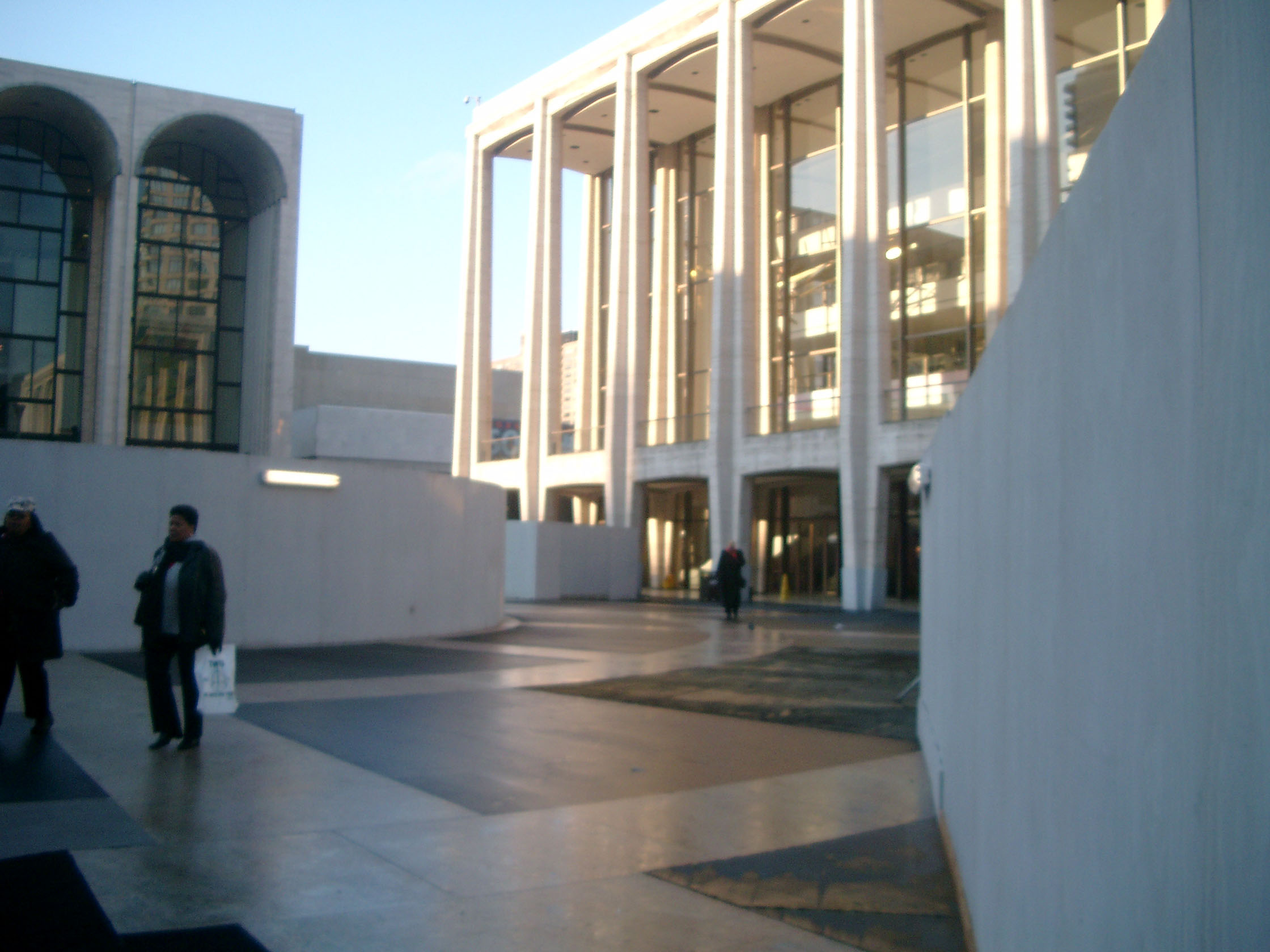
When we arrived at Lincoln Center for yesterday’s final dress rehearsal of Tristan und Isolde, we were required to walk through a maze of corridors to find the Metropolitan Opera; this somehow seemed appropriate, as if to demonstrate the point that no great work of art can be enjoyed without some degree of sacrifice that extends to the audience as well as the artist.
In this regard, we were reminded of conductor Daniel Barenboim’s recent comments in the Times about active and passive listening, and how the former requires a breadth of knowledge that is perhaps less common than in the past, when e.g., “the same people who knew Schoenberg’s music knew Kandinsky’s art.”)
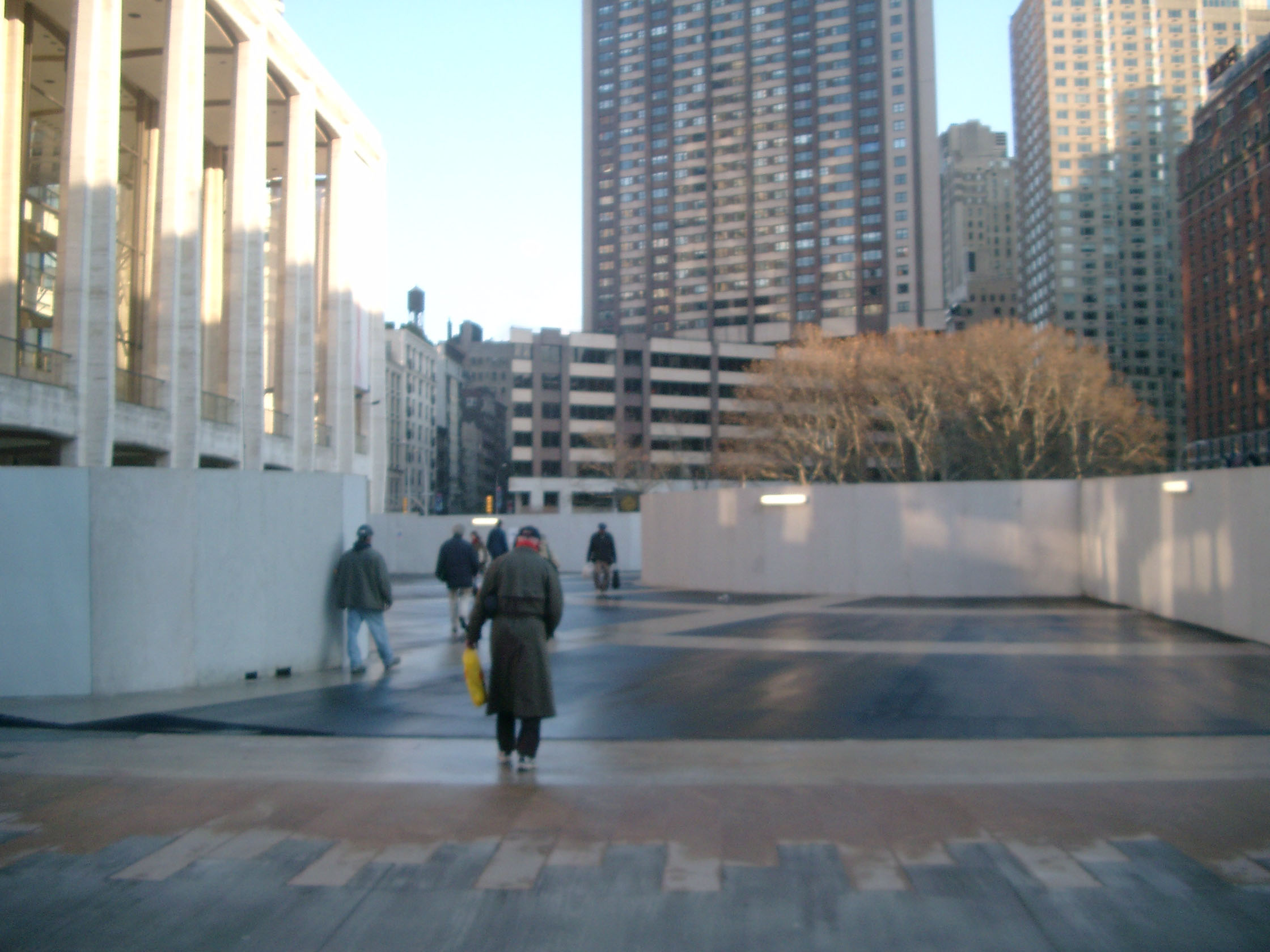
We even noted a haggard, haunted expression on several of our fellow travelers who rushed to and fro past these outdoor construction barriers, and for a second felt as if we could have been in any city with a great opera house, where even the merest association with artistic transcendence, or the potential of such — no matter how brief — may or may not make the cost worthwhile in retrospect, but never fails to draw those who are searching for it like moths to a flame.
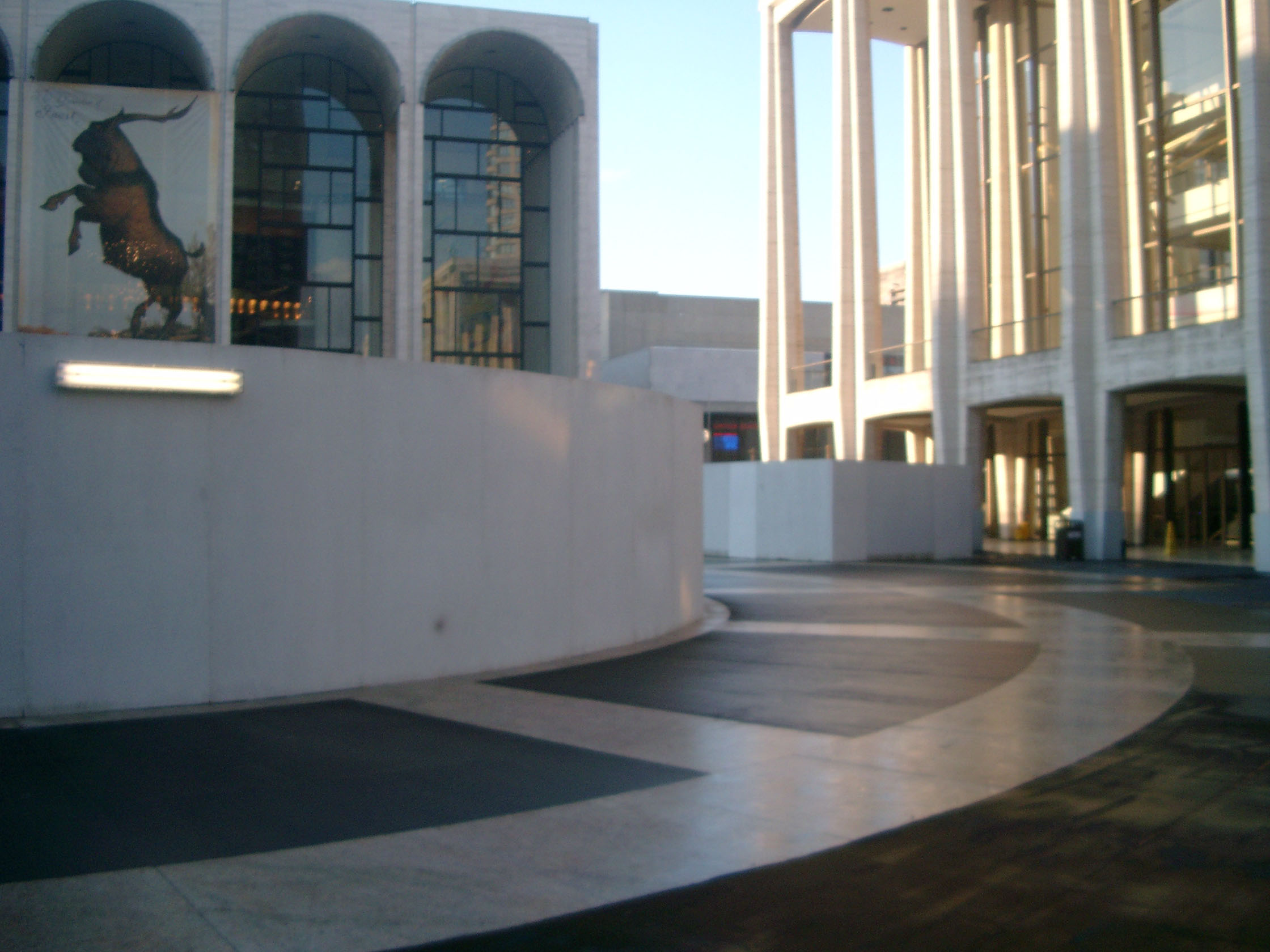
As we entered the Met, our expectations for the opera were high. True, we had never seen Daniel Berenboim conduct, and only knew him by his reputation as a prodigy and a genius and a living legend (and well, umm, sort of a jerky character in that sad biopic — with Emily Watson and Brenda from Six Feet Under ! — about DB’s deceased wife Jacqueline Du Pré). But our excitement had really begun to grow after we read the article about him in The Times, in which he so eloquently discusses Tristan as a work of becoming and transition, as opposed to being.
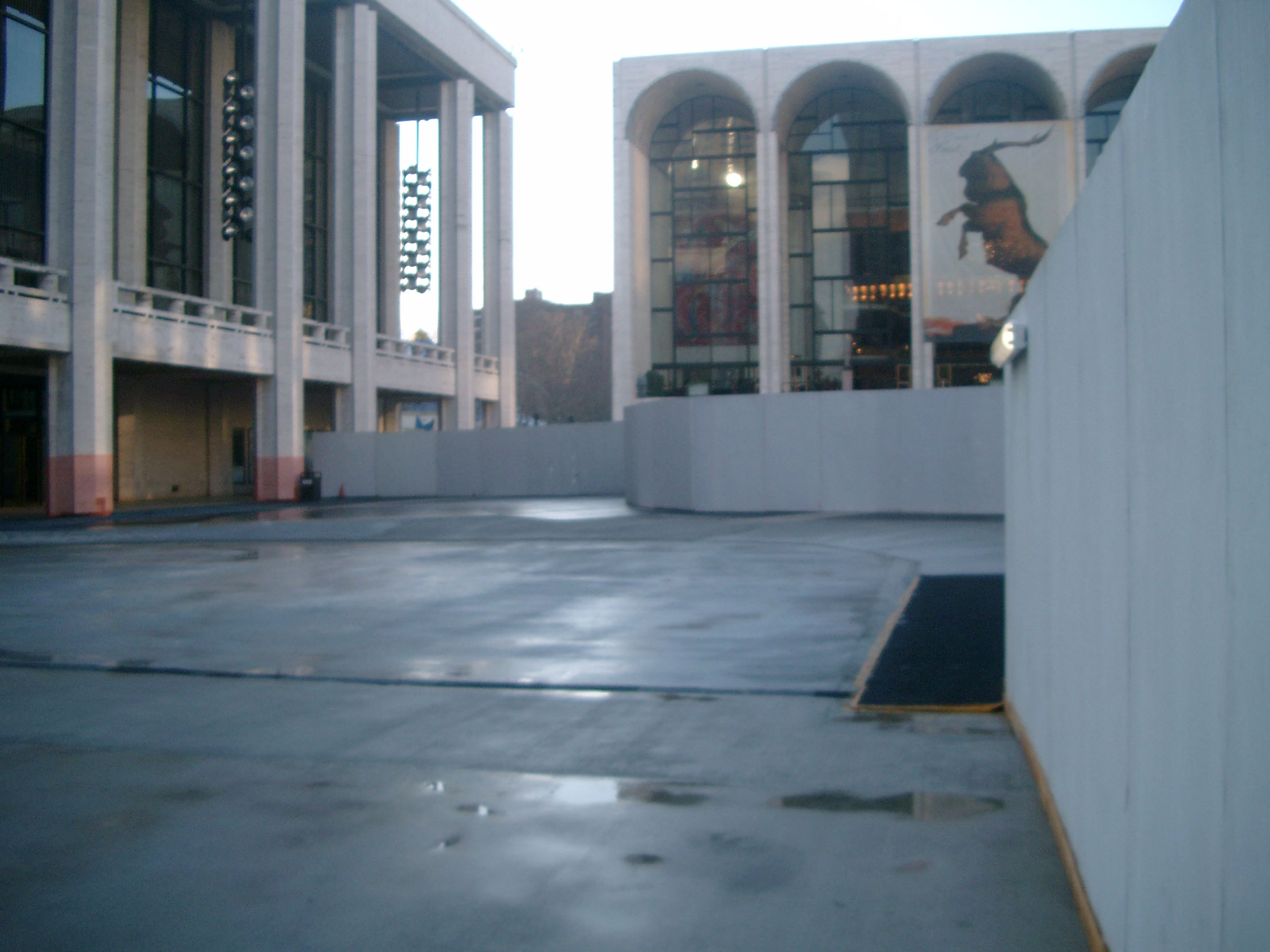
And then we had also heard reports of his rehearsals at the Met, where our sources described the admiration and affection on display between DB and (fellow prodigy and genius and living legend) James Levine — said to have happily attended every session — and how DB suggested rearranging the instruments in the pit and how Levine endorsed the idea, and how DB gave the orchestra the same sorts of direction that JL has long given them — e.g., “less press, more bow!” — to get the sound and dynamic he was after, and how exciting and perhaps even awe-inspiring it was for all present to take part in a process led by these two masters where the integrity of the music superseded all other concerns, and how this reminded everyone why they had given themselves to this, even if — as is so often the case with Tristan — to be immersed in such heavy, draining music day after day was slowly crushing their souls.
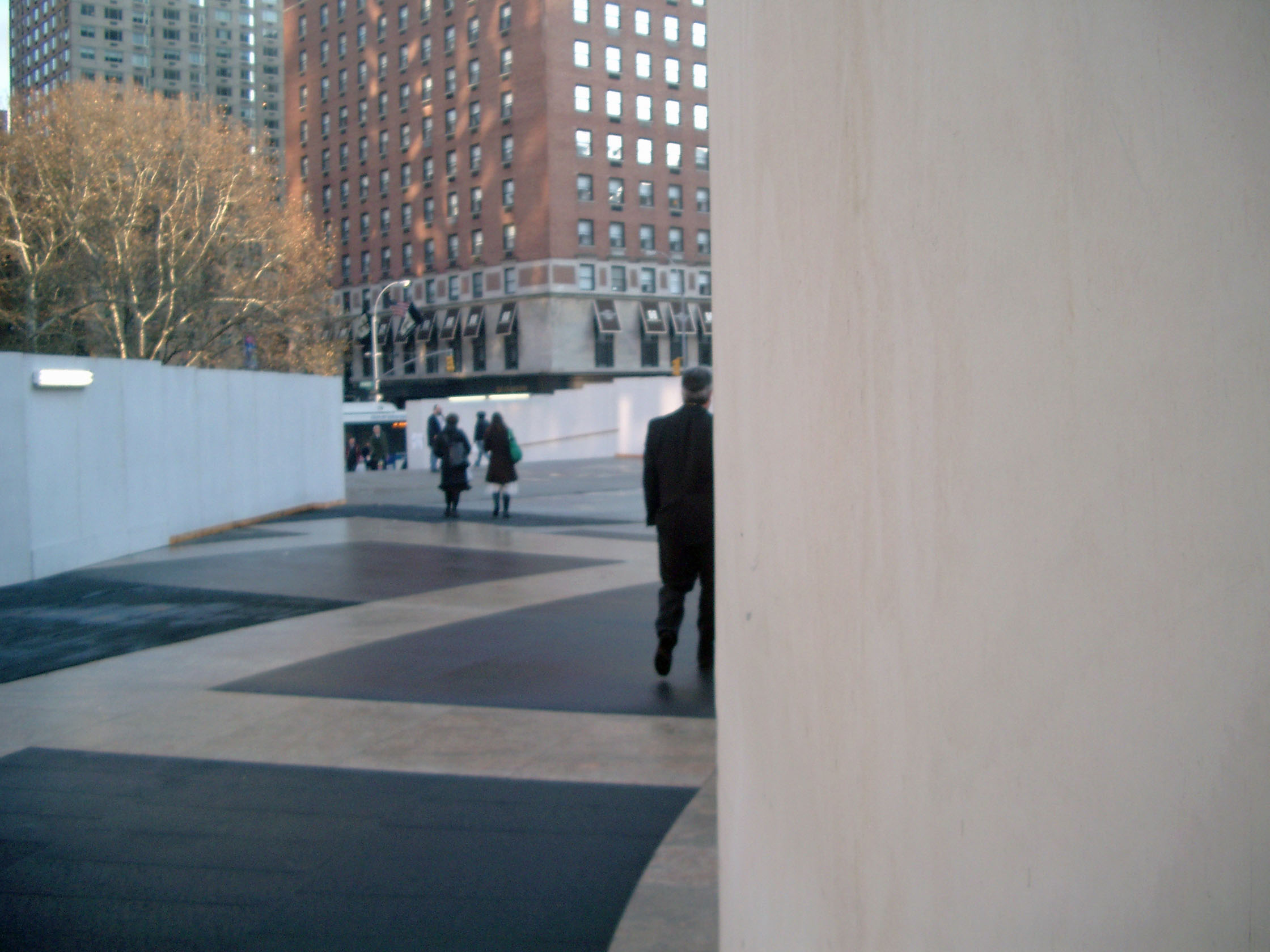
Inside, we found our seat and watched the usual assortment of school groups and retired opera lovers complete the audience and prepare for what was about to unfold. The music began, and the first notes were even quieter than expected, almost undetectable, a single ray of light in the eastern sky, but which quickly gave way to the famous swells and dissonance of the prelude; and as this happened, it became increasingly apparent that we were hearing something remarkable; already our mind reeled as we tried to fathom how the music could be so lush and textured yet so clear, so that every instrument seemed distinct in the mix; if — as so often happens at a Tristan performance — we were given the impression of being under water, it was not into the murky depths we had been submerged but down to a tropical reef, where uncountable schools of fish moved in and out of our field of vision in a vivid kaleidoscope of color.

As for Barenboim, he moved with the magnetic allure and fluidity of one possessed, which is not to say he was distracting or showy, but rather seemed to both refract and reflect the music as it ebbed and flowed. (It can be noted that he conducted the entire piece from memory.) Though Tristan always runs the risk of becoming lugubrious and unwieldy for all concerned, in DB’s deft hands, it was shaped it into something powerful and fleeting but — somehow, at the same time — suspenseful in the most sensual of ways; at times it seemed as if everyone present, i.e., the orchestra and the singers and even the audience, we were all being lulled and prodded by DB to give something of ourselves to this music, this performance, that we might not otherwise have thought ourselves capable.
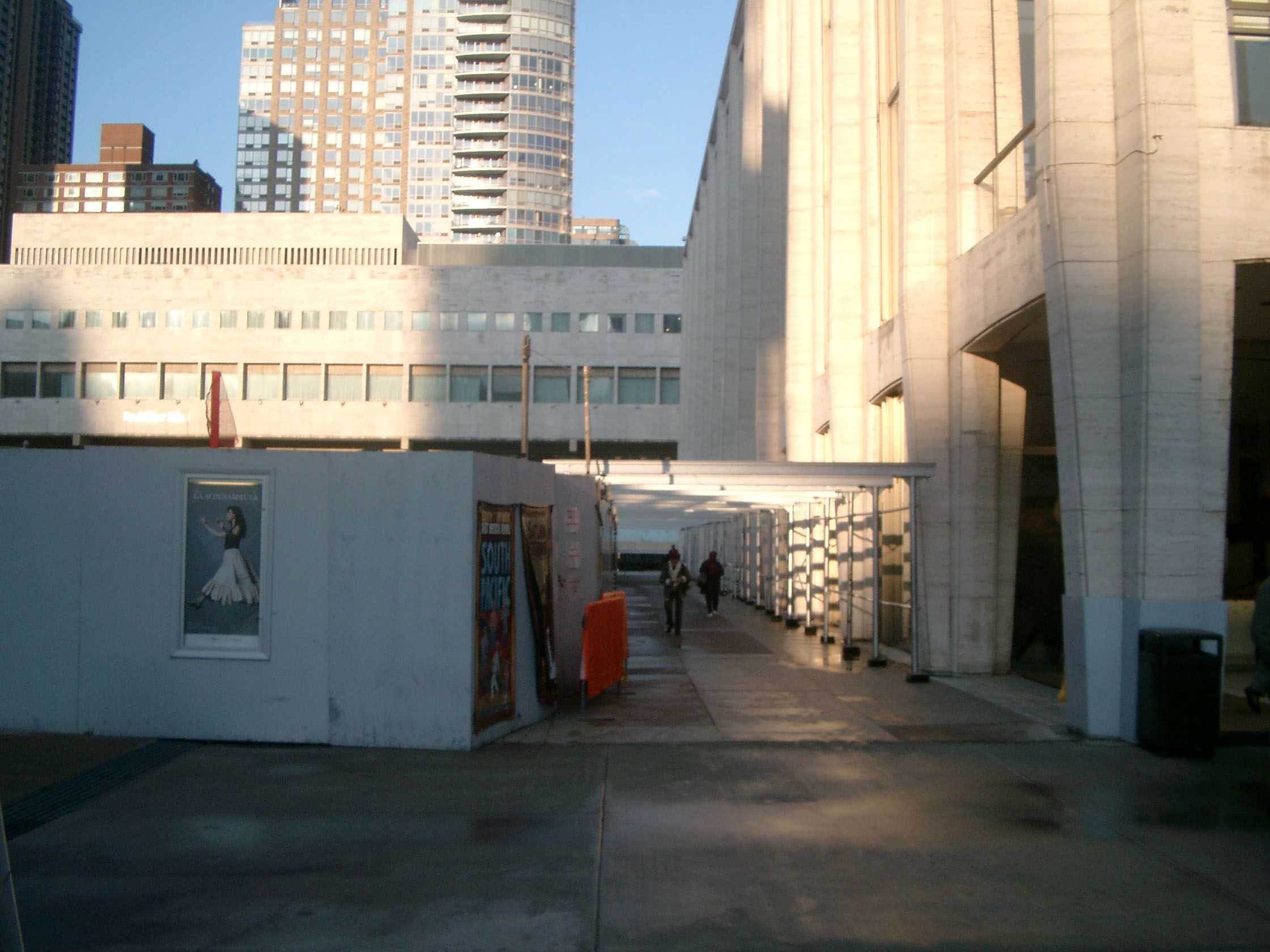
At the same time, all of the other ingredients of the opera seemed to magically fall into place; the clean, geometric production and the effortless look of the singers as they moved across the stage was perfectly aligned with the music on this afternoon; you had the sense that everything was crafted with just the right amount of expectation and restraint to maintain the preposterous-in-theory but ultimately necessary tension for three acts and more than four hours (!) of music. The lighting was ethereal but bold, moving from whites to blues and grays that mirrored the acceleration and deceleration of time in the opera itself, which though chronological floats in and out of the story like a dream.
In the second act, during the long love duet, we again found ourself mulling over images of water, but this time we saw tidal flats; there were waves flooding in and out of the rocks, leaving eddies in which so many forms of life can — like love itself, obv — flourish in such astounding instability. We admired the Tristan (Peter Sieffert) and the Isolde (Katarina Dalayman) — as they slowly merged into a single silouette in the blue night they so desperately craved, and then we were shocked by the crushing indignation of the King Marke (René Pape), who sounded as if he could tear down mountains.
Nor in Act III did our attention waver during the long and impossibly difficult soliloquies, in which Tristan — in an episode of memoire involuntaire that foreshadows the famous Madeleine of Marcel Proust — ruminates on the pain of not only his life but of all those who came before him.
As the ending approached, a part of us was already beyond exhausted, and as Isolde began her liebestod it seemed — like the beginning of the opera — almost too soft and too distant; we wondered how a single flickering match could ignite such a gigantic landscape. But here again we were at the mercy of DB and his Isolde, for the thought had barely crossed our mind when the music — for the final time — began to expand and accrete, precariously building to indescribable heights before finally — finally! — crashing over us, so that as the last notes quivered off the stage, we were left stunned and contemplative, for a few brief seconds not wanting anything, content with what we had just lived.

Word on the street is that these performances are not yet sold out!
Filed under: Capitalism, Decay, Dissonance, Good Rock, Longing, Memory, New York City, Opera, Pessimism, Ruins, Search | 10 Comments
Tags: Annihilation, Daniel Barenboim, Final Dress Rehearsals, Lincoln Center, Recession, The Metropolitan Opera, Tristan and Isolde
In which The Gay Recluse considers the dark ages.

So today we were reading about the new Thomas Pynchon novel, which is going to be released next year.
Like so many adolescent boys we’ve known, we went through a serious Pynchon phase.
His maddeningly complex yet (somehow) crystalline prose managed to resonate with the best of 1960s counterculture while nevertheless steering completely clear of the empty ideals of the hippies (or better yet, mocking them!).
He wrote about sex and drugs and punkish rock (although music was never a strength, because his prose was too frigid and aloof to describe anything with true emotion, as good music-writing must), and his obvious mastery of high-minded science (omg physics!) seemed to predict our cultural obsession with the titans of Silicon Valley. He made paranoia and conspiracy — particularly as these forces manifest in corporate America — seem fun! Also: his characters had “hilarious” names (our favorite was always Helga Blamm). We drifted through many classes in college making up Pynchonesque character names for all the Pynchonesque novels we planned to write at some point.
Yet as much as we once loved him, we’re almost never inclined to revisit the works we read (V, Gravity’s Rainbow, The Crying of Lot 49, Vineland). Perhaps our memory is cloudy, but we’re struck by a certain disdain Pynchon seems to hold for his characters, and by extension, his readers. His unrelenting emotional distance seems emblematic of a society we’ve come to think of as srsly fucked up; true, he’s deconstructing this same society, but not in (the psychological) ways that ultimately interest us.
There’s also the fact that nothing/nobody he ever described resonated with anything we would describe as gay in any good sense of the word. In a way, we think this explains in part his popularity among boys of all ages in our obsessively homophobic culture: he’s a relentlessly straight literary writer who it’s quite “safe” to admit to liking — much like (huge asshole) David Mamet in the theatrical context — without calling into question your own sexual orientation. Which is very important for guys who want to express some creativity or emotion without seeming gay!
In short, Thomas Pynchon might be a recluse.
But he’ll never be a gay recluse, which places him — like so many others from his generation — firmly inside the fortress walls we are still dreaming to tear down.
Filed under: Capitalism, Conspiracy, Gay, GWB Project, Literature, Memory, Science, Technology, The Gay Recluse, Writers-American | 2 Comments
Tags: Adolescents, Boys, Conspiracy, Dark Ages, Entropy, Physics, The George Washington Bridge, Thomas Pynchon
In which The Gay Recluse becomes increasingly obsessed with birds.
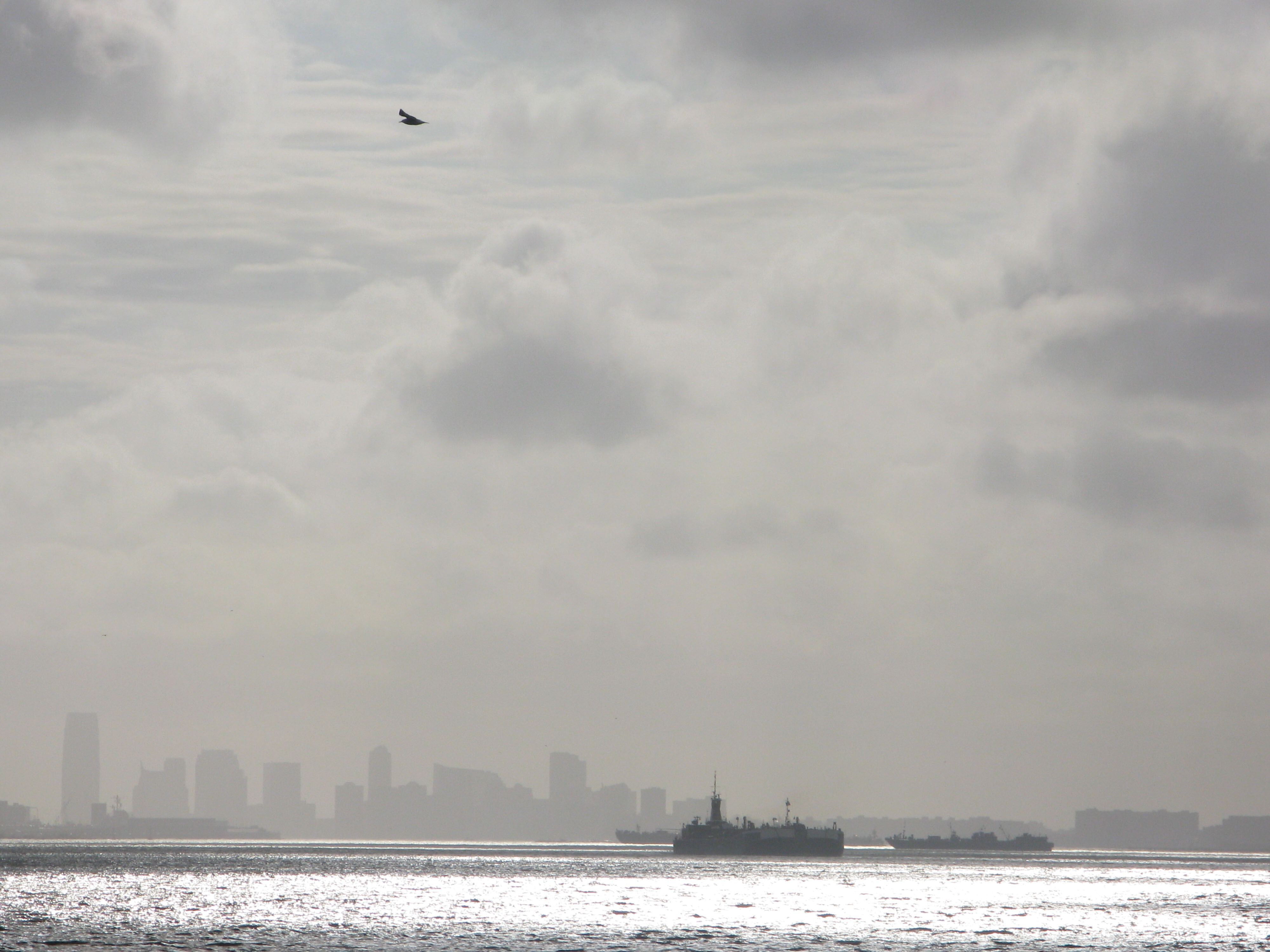
So guess what? We now have a Twitter and a Tumblr and a Facebook!
Sometimes we feel like the oldest person in the blogosphere.
If we were a bird, we’d probably just fly away.
Filed under: Animals, Drivel, Gay, Obsession, Photography, Resignation, The Gay Recluse | Leave a Comment
Tags: Birds, Facebook, Old, Tumblr, Twitter
In which The Gay Recluse remembers the fall.

This weekend we visited family and spent time remembering what a weirdly obsessive kid we were in many ways, some of which involved books about birds and spiders, others of which involved stuffed animals, and still others of which involved a crippling fear of birthday parties. Perhaps this wasn’t so weird after all!

We were also obsessed with leaves, and each fall we used to like to make an enormous pile of them over a series of carefully disguised cardboard boxes at the base of the maple tree in our front yard.

Then we would quietly sit in the dark, earthy air, peeking through the slots and listening to the men as they walked home from work, hoping that we would learn some secret about the strange world they inhabited.
Filed under: Animals, City Pattern Project, Landscape, Memory, Obsession | 2 Comments
Tags: Birds, Birthday Parties, Commuters, Fall, Leaves, Spiders
In which The Gay Recluse remembers an old obsession with the color red.
Years ago, we went through a phase when we wore only red shirts.
But here’s the thing: you couldn’t find any good ones that were new, so we were required to scour used-clothing shops all over the country in a mostly vain attempt to find the perfect color. Fortunately we were touring a lot at the time in our band, so this wasn’t a problem.
Obviously it couldn’t be quite flannel-shirt/pajama-top red, but even the slightest trace of burgundy ruined the effect, and inevitably we would place these shirts back on the rack.
We finally found a couple of shirts in Seattle; they were used, but someone had recognized the rare perfection of the color and priced them accordingly at over $100 each. What did we care? Even though we hadn’t spent $200 in clothes in the previous year, we had to have them!
We wore them a lot, too! For a while, red shirts were our trademark. That was pretty much the extent of our stage presence: one red shirt. (In certain indie-rock circles, this was considered outré; or maybe that was just our twisted, closet-case perception of it.)
But that phase passed, and we now realize that our obsession with red was really a manifestation of the anger we felt toward so much, but which we had yet to acknowledge, even to ourselves.
It’s a relief not to be so obsessed with the color red anymore, although we still have about fifteen shirts quietly hanging in the back of our closet (just in case!).
Someday a vintage store is probably going to make a killing, selling them to a young closet-case like us.
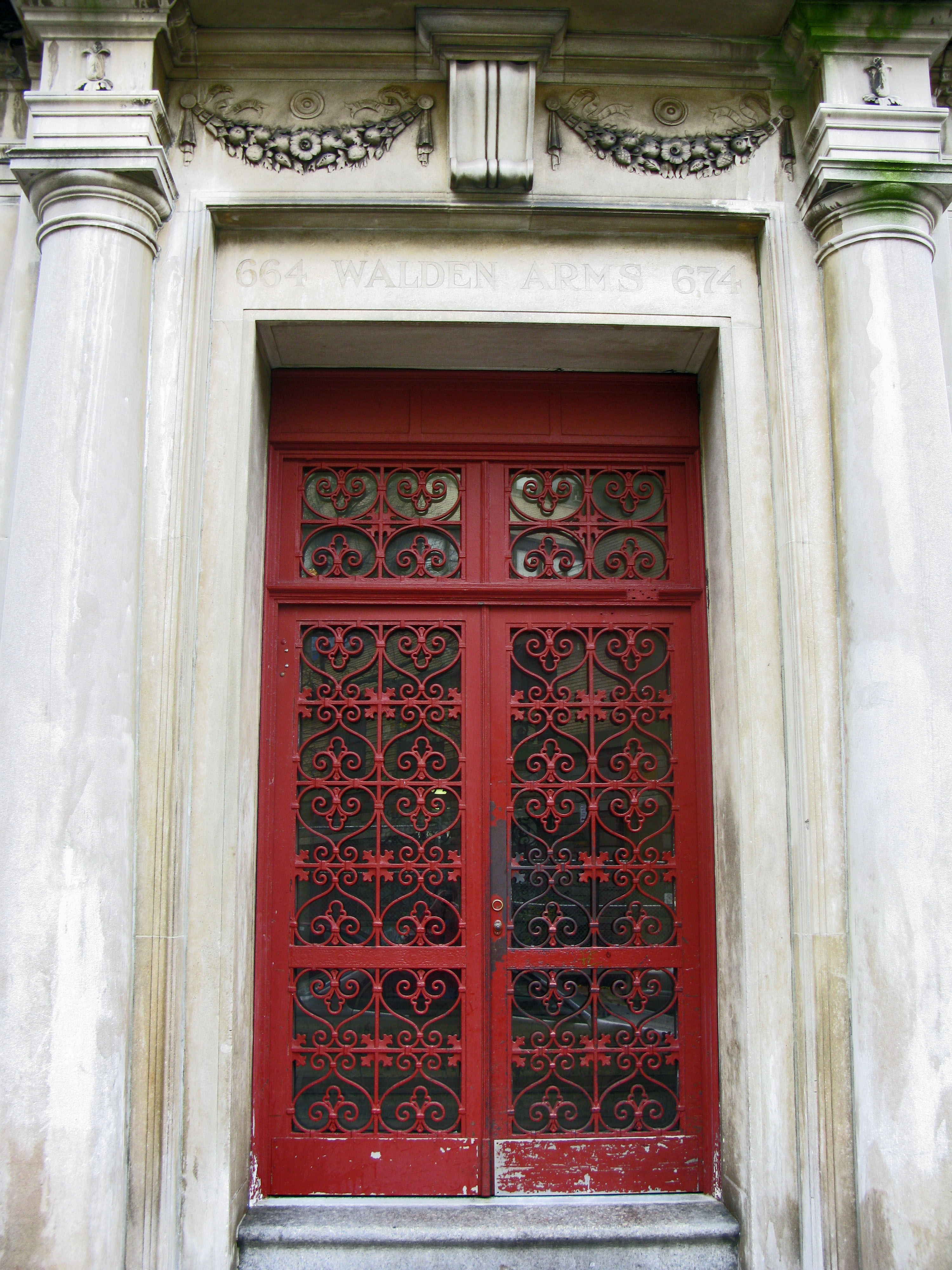
We fell in love with this door the second we passed it.
But we are kind of relieved not to live here; it was better to simply appreciate it for a few seconds and then continue our walk.
Filed under: Architecture, Gay, Health, Longing, Memory, New York City, Obsession, Ruins, Washington Heights | 1 Comment
Tags: Art Nouveau, Doorways, Flannel, Red, Seattle, Shirts, Tours, Vintage Clothing Shoes, Wrought Iron
In which Dante and Zephyr take over The Gay Recluse.
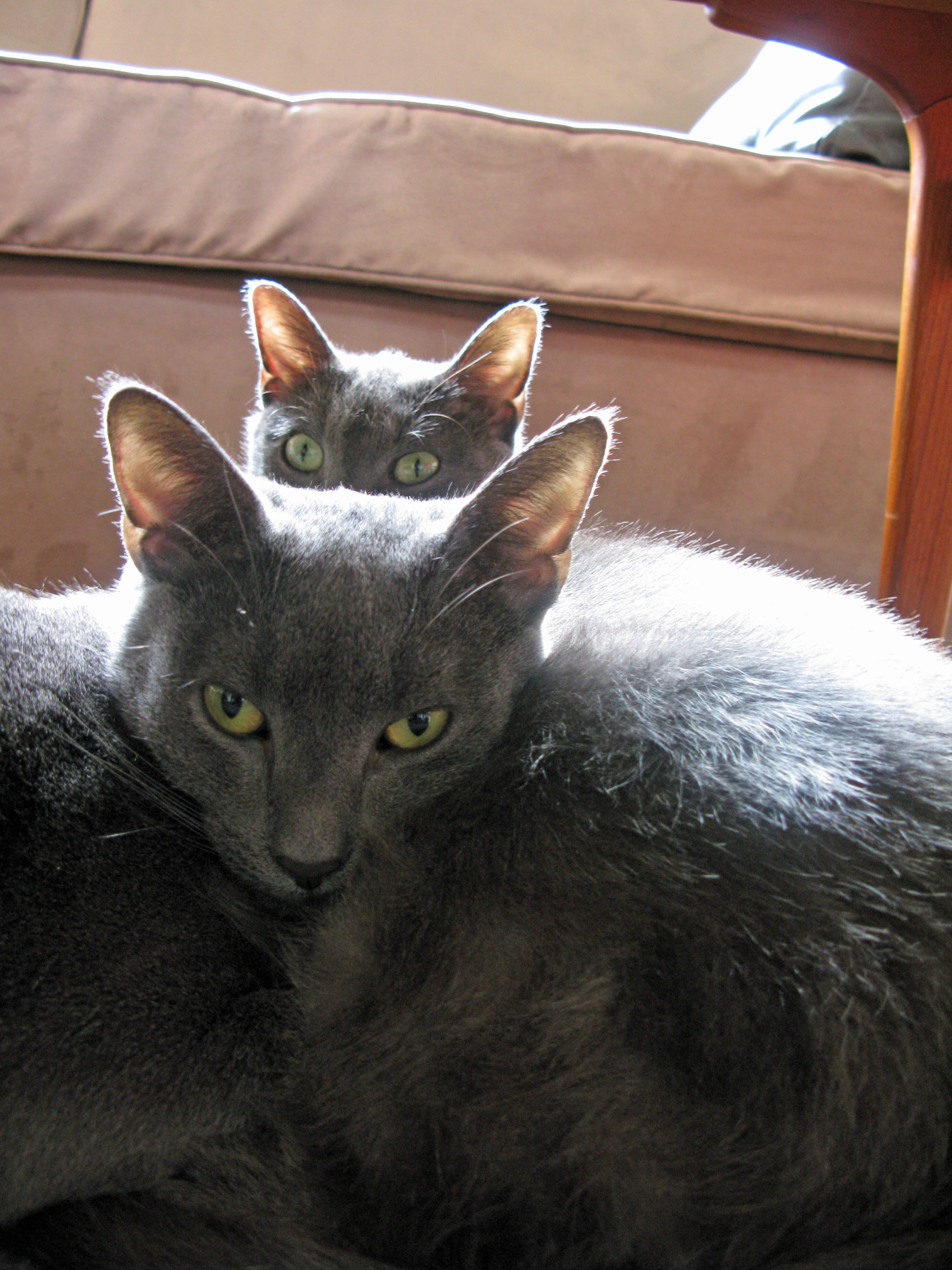
Friends, you can be safe in assuming that we spend more time together than any human couple on the planet!
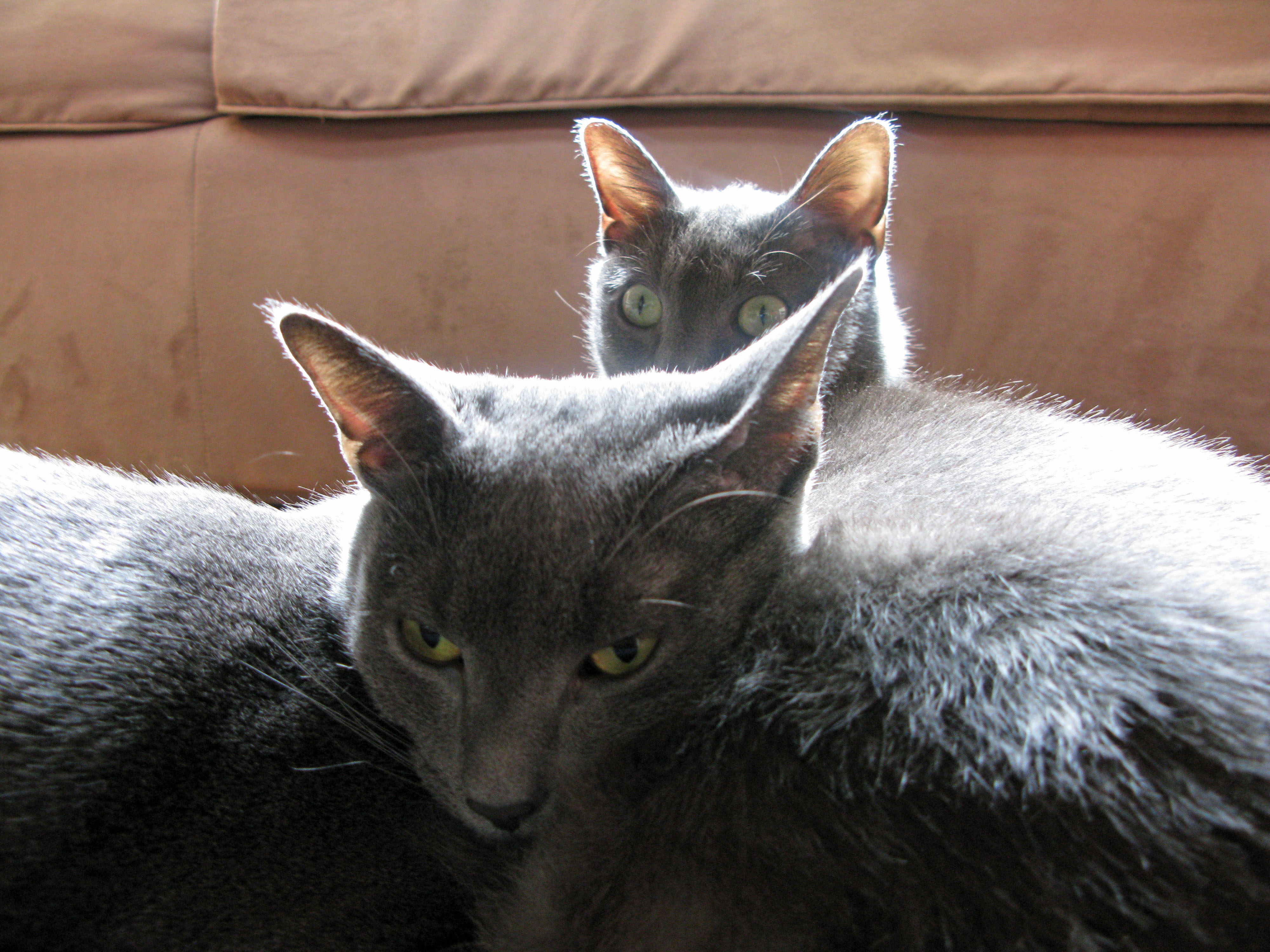
That’s why we rushed out and got our federal civil union license, which gives all couples — gay or straight! — the same rights and benefits! We were really looking forward to filing a joint tax return this year!

But then we were told that federal civil unions for all haven’t even been enacted yet, and moreover that cats aren’t included, to which we have one response: “Friends, not every cat is lolcat!”
Filed under: Animals, Not Every Cat a Lolcat, Resignation, The Russian Blue | 2 Comments
Tags: Assistants, Couches, Federal Civil Unions for All, Sunlight
In which The Gay Recluse becomes increasingly obsessed with birds.

So today we read a most excellent post on marriage at Emily Magazine, which we strongly recommend (and not just because we’re quoted at some length in it, lol!)
We have to wonder, is it a coincidence that the only two bloggers to link into our post against marriage are both (straight) lady writers (Emily Magazine and the always eloquent Writer’s Block)? We think not! If there’s anyone who’s suffered more at the hands of this odious institution, we’d like to hear about it. But alas, why aren’t the gays more attuned to this? And why aren’t more straight ladies joining in the fight for their own sakes as much as their gay bffs?
One obvs theory is that both groups have been too oppressed for too long to really think clearly. Let’s face it: the women’s movement has struggled with homophobia since the beginning; it’s not hard for us to remember how our own mother — co-president of her N.O.W. chapter in the late 1970s! — had to confront accusations from certain factions in her organization who did not want to be associated with “a bunch of lesbians,” lest this interfere with the quest for (mainstream) acceptance, which was deemed critical to the passage of the (sadly doomed, by just three states!) E.R.A. As for the gays, we too (or at least the men) have long tended to objectify women in a way that frankly does not help form potent political alliances with femiladyist orgs, and a quick scan through the leading “gay culture” blogs doesn’t exactly give us hope that this is changing. (Which is not to say our hands are exactly clean in this regard, either!)
But as Emily points out, the fight against marriage extends well beyond the political and into the psychological (the crushing pressure to be “happy,” which for girls in particular is so cruelly tied to marriage) and philosophical (what it means to be alone, and how this both cripples and releases us).
This makes us remember how, for most of high school and college, we spent all of our time ingratiating ourselves to the cool and artistic crowd — the MFAs who dyed their hair and shoplifted and took acid on school days — and then in our twenties, we could never understand how these same friends could so easily succumb to conventions like marriage and children: did they really want to become new versions of their parents so soon? We were so disappointed, and in turn they hated us (and in many cases, still do) for being so judgmental!
But we understand why they did it. Life is exhausting enough without having to think about the implications of marriage, and — except under the most unusual and often dire circumstances — the majority of people are not interested in being revolutionaries. But for gays like us who do want to dispense with it entirely, we would be smart to pay close attention to our feminist allies; like so many revolutions, this one may be led not by outsiders but by those who have seen firsthand everything society has to offer and responded with a “no fucking thanks.”
Filed under: Capitalism, Communism, Dissonance, Faith, Gay, Government, Language, Pessimism, Philosophers | Leave a Comment
Tags: Civil Union for All, Ellie Smeal, Femiladyism, Gay Bffs, Gay Marriage, Marriage, N.O.W., Seagulls, The Hudson River
In which The Gay Recluse holds a contest. Sort of.
We are quite pleased to tell you that our favorite art blogger C-Monster has recently been documenting the hot-gay-statue scene in Los Angeles, where in addition to the University of Southern California, some of the hottest gay statues in history have been cropping up at the Getty Villa. Of course, longtime readers will no doubt remember our first entry from the Getty Villa, which proved to be quite gay and almost insanely hot; thus, we expect that you’ll be as shocked (yet pleased) as we were to learn that there are possibly even hotter — yet just as gay! — statues to be found in the same environs. Let’s check ’em out, shall we?

Whoas…here’s the Greek “Victorious Youth,” dating from 300-100 BC, which as we all know was the pinnacle of hot gay living (and not coincidentally, western civilization)! (Photo by C-Monster.)

Srsly hot. (Photo C-M.)
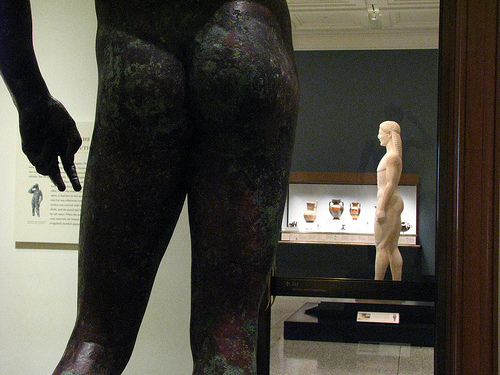
Note the commentary on the wall, which seems a bit too long? How about: “Smokin’ Hot!” Also! We have more pix of that guy in the back (and — we promise — you won’t be disappointed). (Photo by C-M.)

Here’s someone else, clearly gay — hello toga! — and above all super smokin. We have to imagine those patrons leaving the scene are some satisfied customers! (Photo by C-M.)

Wait, what!? There’s more? Is this the hottest (and gayest) collection of statuary outside of Washington Heights? (Photo by C-M.)

Apparently so! This guy is obviously in the running for hot gay twink statue of the year. (Photo by C-M.)
Thanks again, C-Monster! We’ll look forward to seeing any other hot gay statues you happen to see on the left coast. As for everyone else, it’s not too late to submit your entry for the 2008 Hot Gay Statue of the Year.
The Hot Gay Statue round-up:
- Rules and Guidelines
- Dan Savage Endorsement
- Washington Heights (New York City)
- Washington, DC
- The London Eye Clarifies an Important Issue
- Florence (Italy)
- The Park Avenue Amory (Upper East Side/NYC)
- Murray Hill (New York City)
- Madrid (Spain)
- Los Angeles
- Philadelphia
- The London Eye: “In Your Face”
- The J-Man Inspires
- George Washington
- Georgia (Republic of)
- New Orleans
- Columbus Circle (New York City)
- Two Davids (Florence)
- Franco Harris Statue (Pittsburgh)
- London Firefighters and Other Heroes
- Columbus Circle Mall (New York City)
- Miami
- Paris
- Grand Central Station (New York City)
- Albany, New York
- Chicago
- Albany, New York (Hot Gay Statute)
- The Metropolitan Museum (New York City)
- University of Southern California (Los Angeles)
Filed under: Capitalism, Communism, Gay, Hot Gay Statues, Infrastructure, Travel | 4 Comments
Tags: Bronze, Getty Villa, Greek Statuary, Los Angeles, Victorious Youth
In which The Gay Recluse covers the teen beat.
We first noticed this trend at the beginning of the summer, when we were walking past a group of kids — including some girls, which was extra cool! — on Fort Washington Avenue, all of whom were messing around with skateboards. Then we noticed a regular crew skateboarding on the median around 166th Street and Broadway, where the A-train exits, and then further uptown under the George Washington Bridge, across from the bus terminal. This is where we took the following pix a few weekends ago.
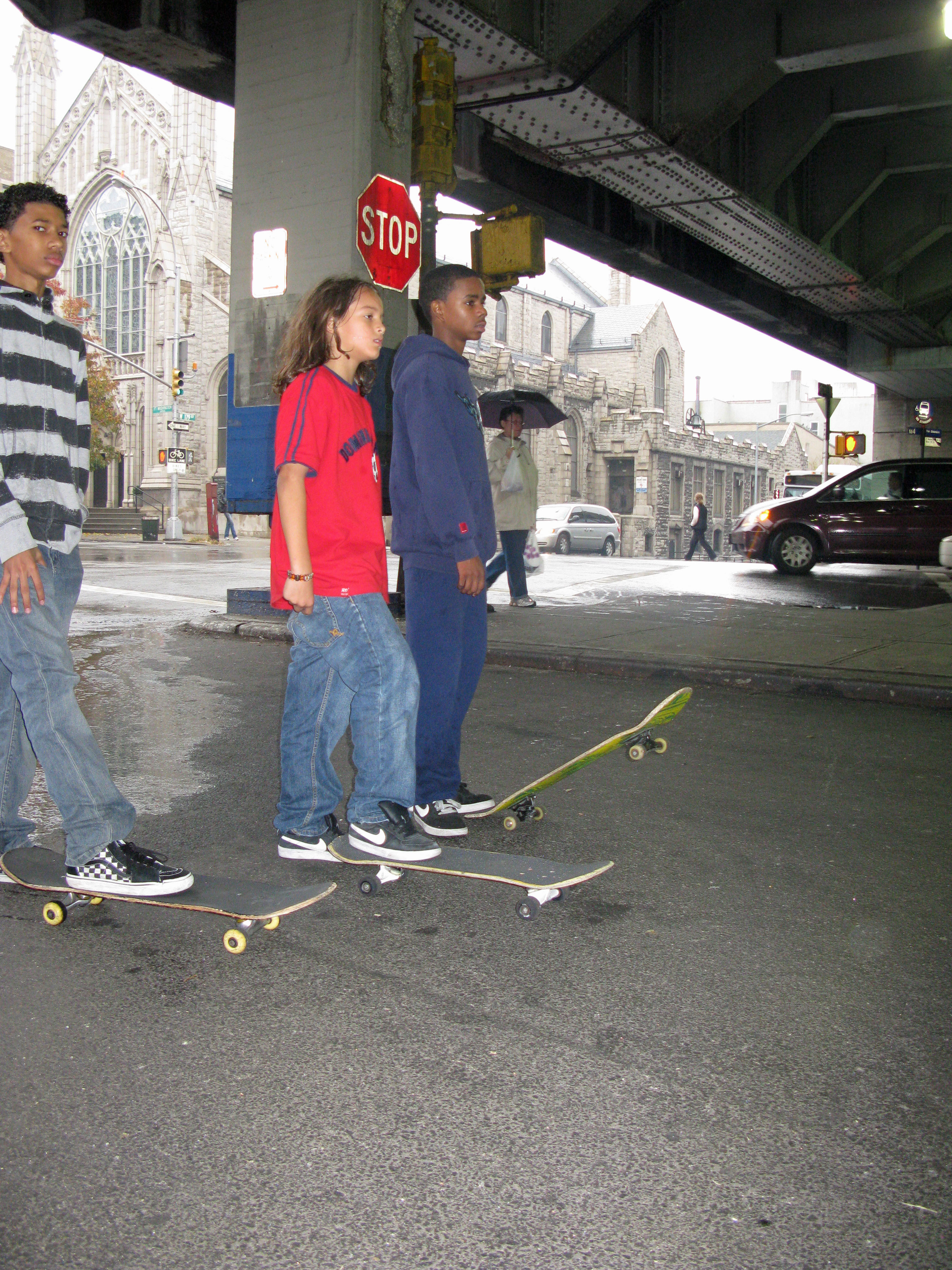
We were like: “So umm, hey guys, can we take some pix?” and they didn’t respond beyond the merest shrug, a gesture of disdain, suspicion and — yet! — acknowledgment that conveyed the impossibly wide gulf in age/culture that exists between a dorky forty-year old gay recluse like us and a bunch of ass-kicking skateboard kids. But this being the 21st century in the USA — or really, NYC — they both ignored the camera and played to it, perhaps wondering if this could be the day they became stars.
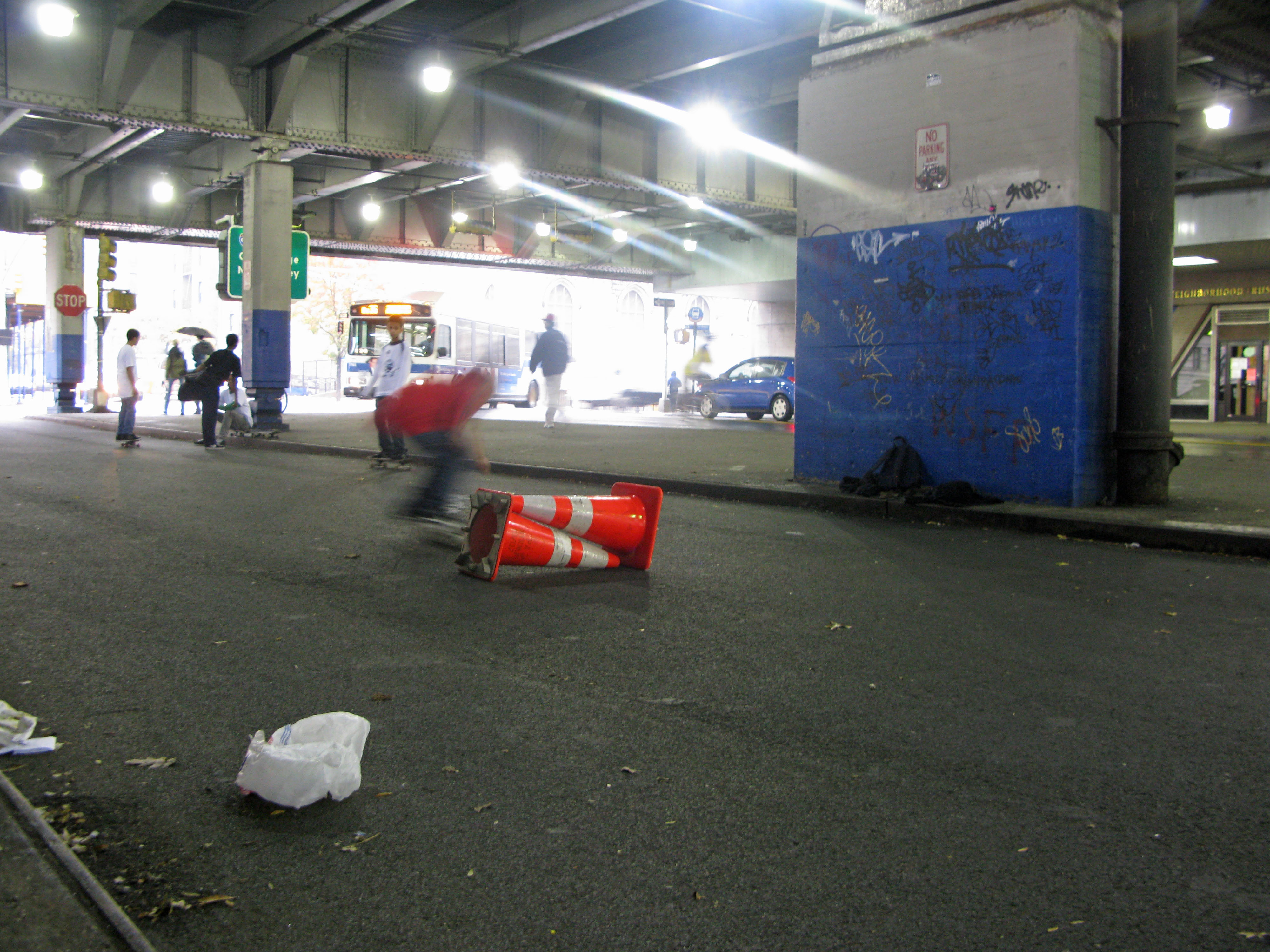
Here’s that excellent kid in the red shirt and long hair heading into a jump.
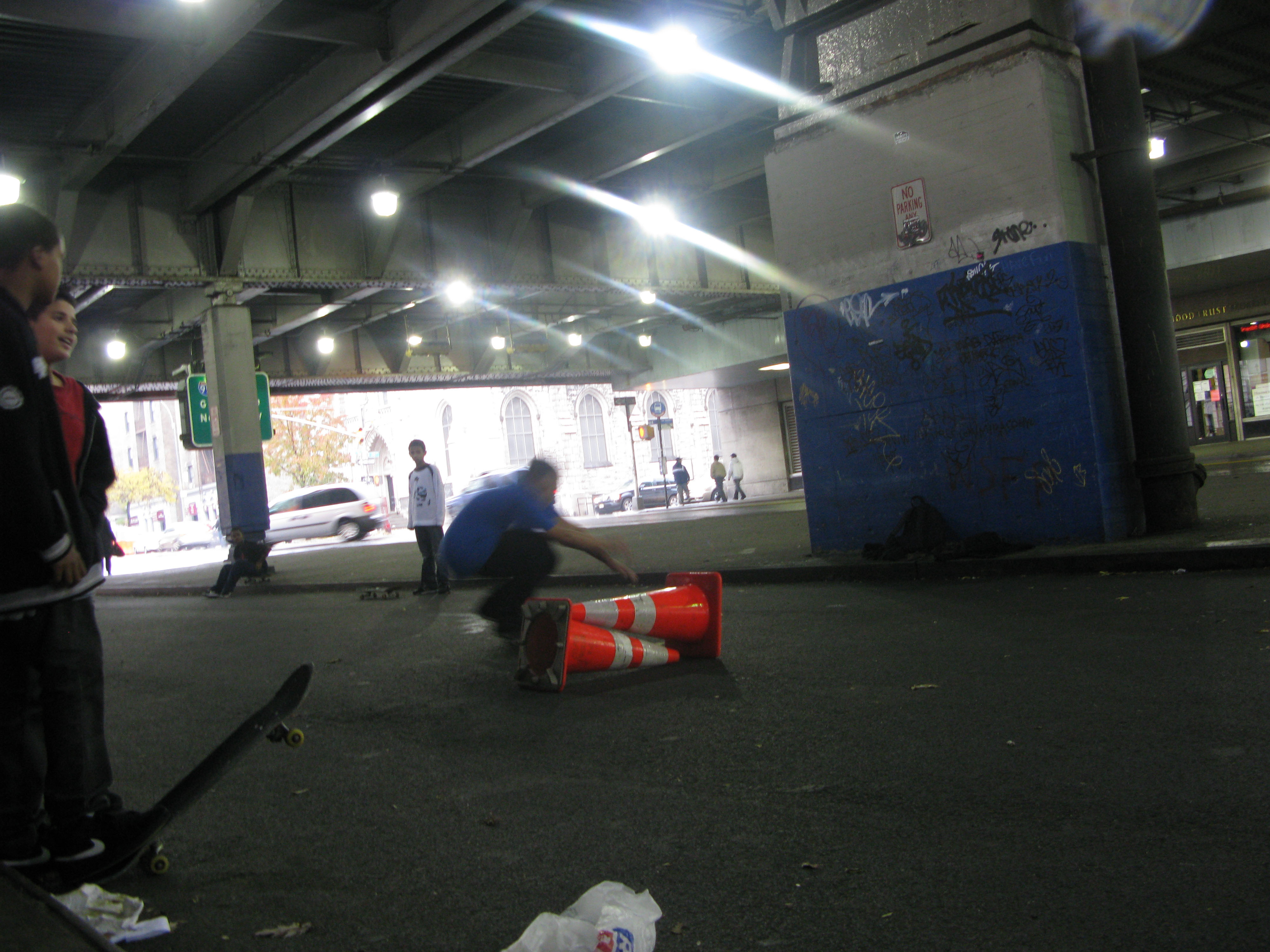
And another guy doing the same… We ask ourselves why it’s so awesome to see these kids skateboarding, and admittedly, some (much?) of the answer is contextual, to the extent we wouldn’t get nearly as excited seeing the same thing in say, a parking lot of a mall in the suburban wasteland where we grew up. But here — in the “ghetto” — it defies the prevailing stereotype of the teenage hoodlum, the kid who hangs around on the corner in baggy pants and baseball hat, dealing shit, fucking beyotches and talking shit about shit. Or hey, is it possible that these are Dominican kids who don’t give a shit about the Yankees? It kinda seemed that way! Ponder that, mainstream media, next time you write about Washington Heights — “where baseball is almost a religion” — and imply that every kid growing up here wants nothing more than to be the next Manny Ramirez. Whether true or not, we imagine these kids to be rebellious in the best way, we imagine them saying: fuck baseball, let’s head up to the bridge.
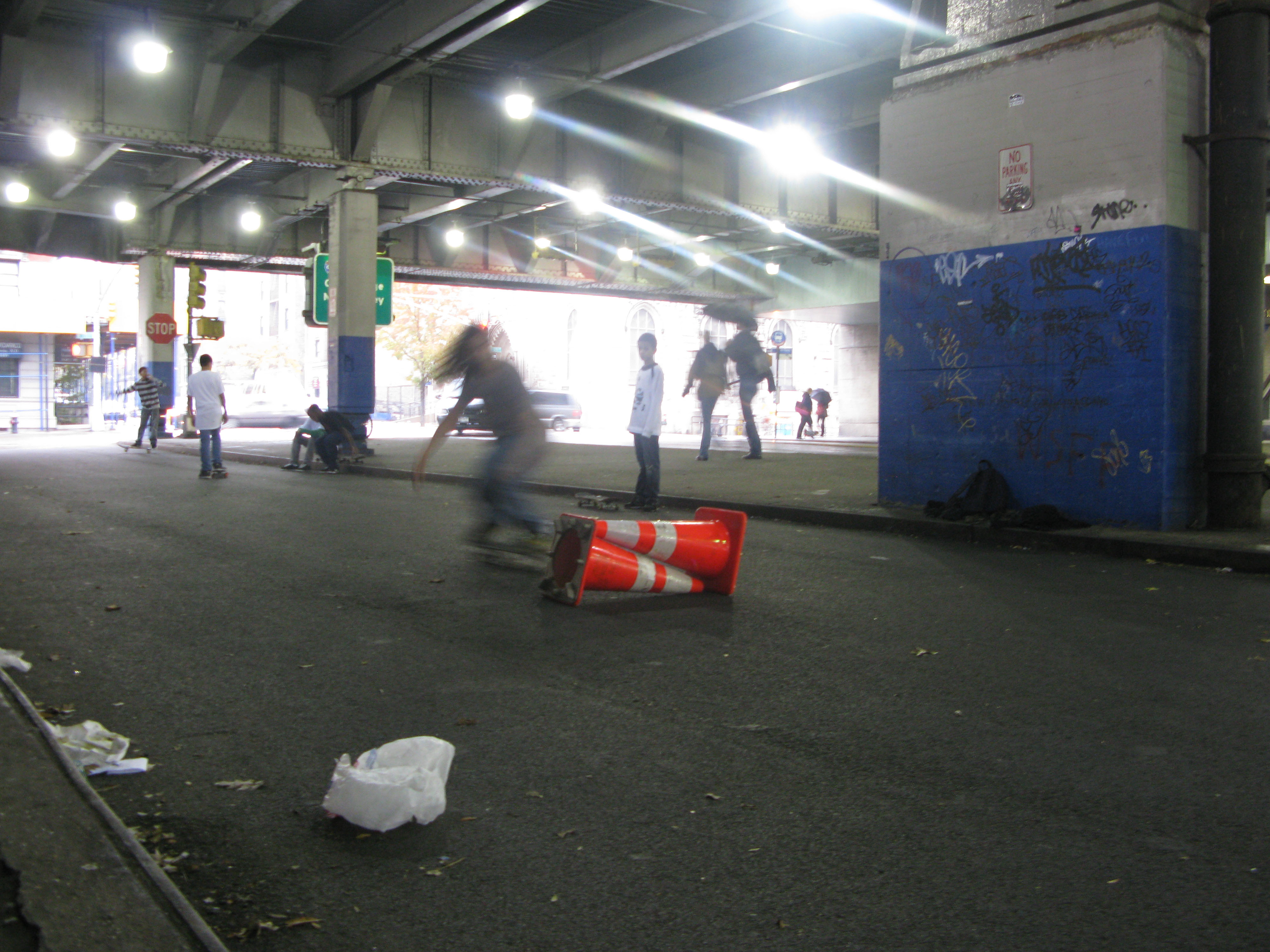
We also loved the performance aspect of it, the way those not skating stood around with an air of casual disinterest, when of course they were watching every beat, with the certainty that they would eventually have to take the stage. It reminds us of when we were learning to surf, the way we would straddle the board with our back to the shore, watching intently until a wave came, and a couple of kids would go after it and — because we weren’t very good — we would just sit there terrified, trying to figure out the exact etiquette — not only of surfing, it seemed, but our entire existence — except without ever asking.

To be around these kids was to remember the terror and confusion of adolesence, the desire to both rebel and conform, without understanding the deeper meaning of either impulse. Perhaps this is another reason we romanticize these skateboarders: they seem so fearless! The guy in this shot is — what? — like four feet in the air and he didn’t exactly land gracefully. But he seemed oblivious to the pain; this is how we used to be, too, at least until we realized that turning off the physical side of pain doesn’t necessarily do the same with regard to the (inevitably worse) psychological side of it.
Here’s the little guy in the red shirt taking the jump; he didn’t make this one, but he just picked himself up and skated back. Admittedly, this made us a bit nostalgic; it’s only when we’re older that we realize that second and third chances are not always so forthcoming.
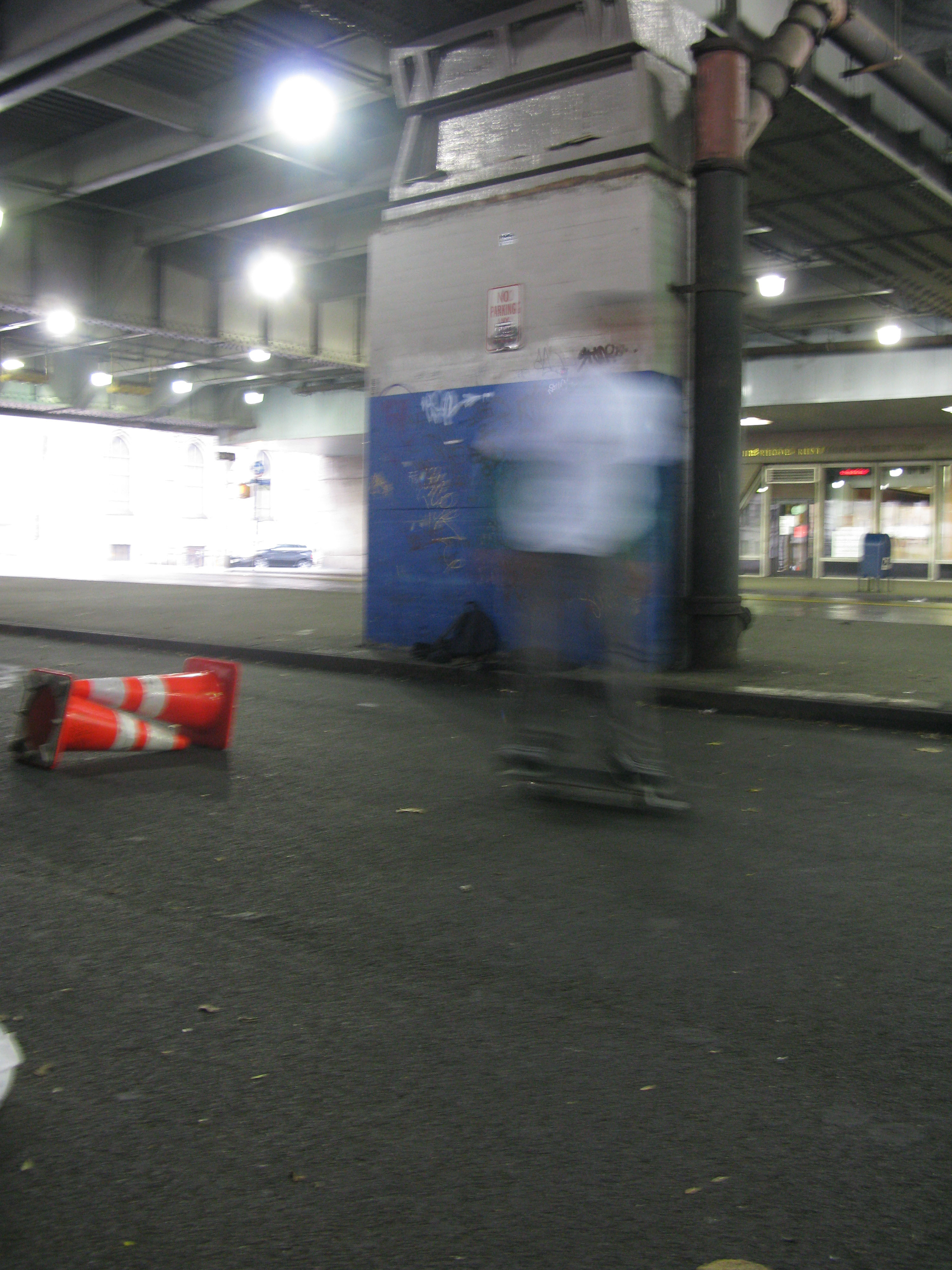
But some people don’t need second chances. This skater — clearly the best of the bunch — made it look easy. He was flawless and smooth, and we could tell that everyone was like “fuck, he’s good,” (or whatever the equivalent of that would be) even though they didn’t clap or yell or anything. Or maybe we were just projecting our own impressions. In any event he sailed through.
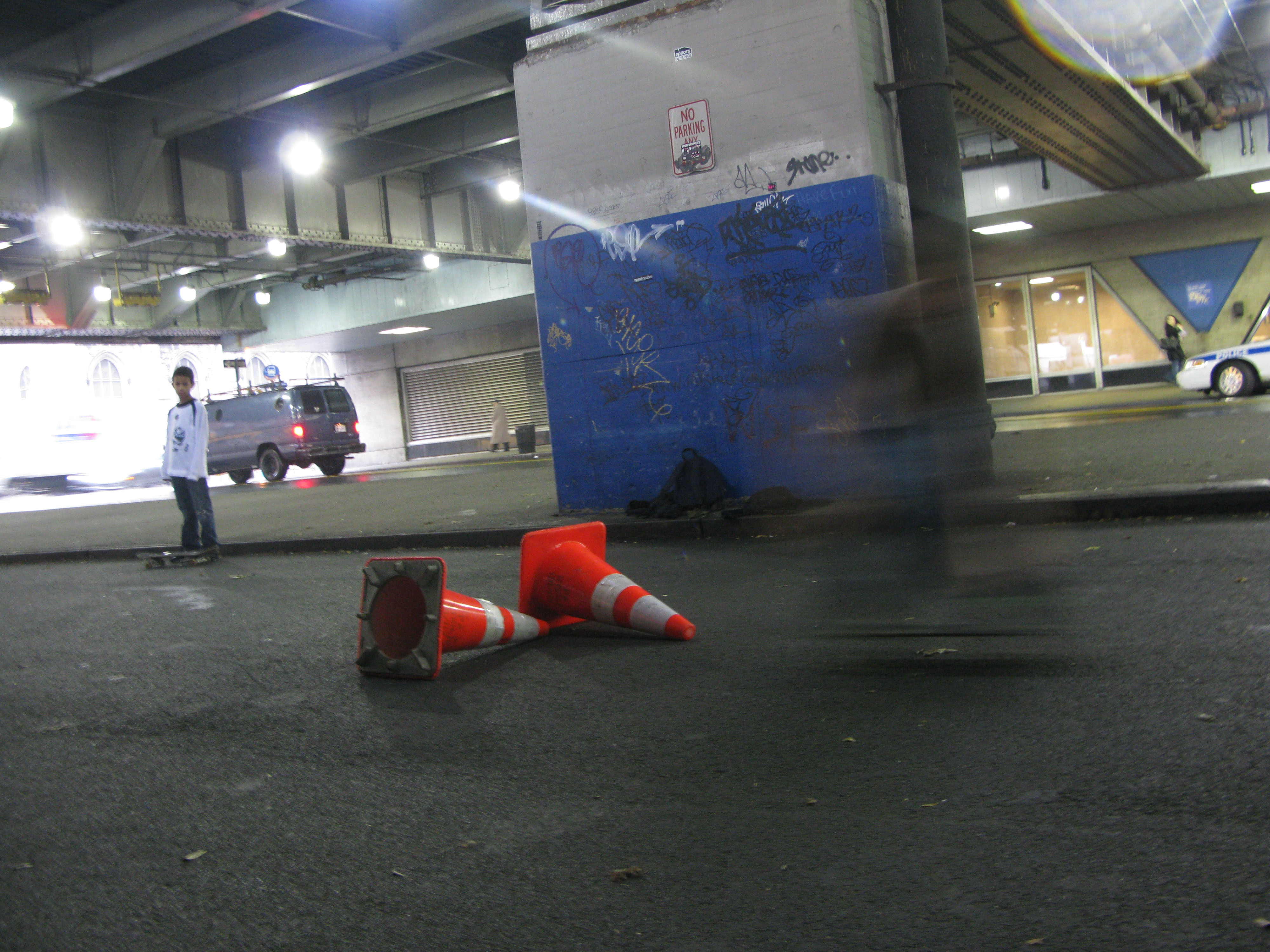
This guy also made it, and went by in a complete blur. Notice the little kid and how forlorn he seems: when you’re eight, things the big kids do can seem so crushingly unattainable.
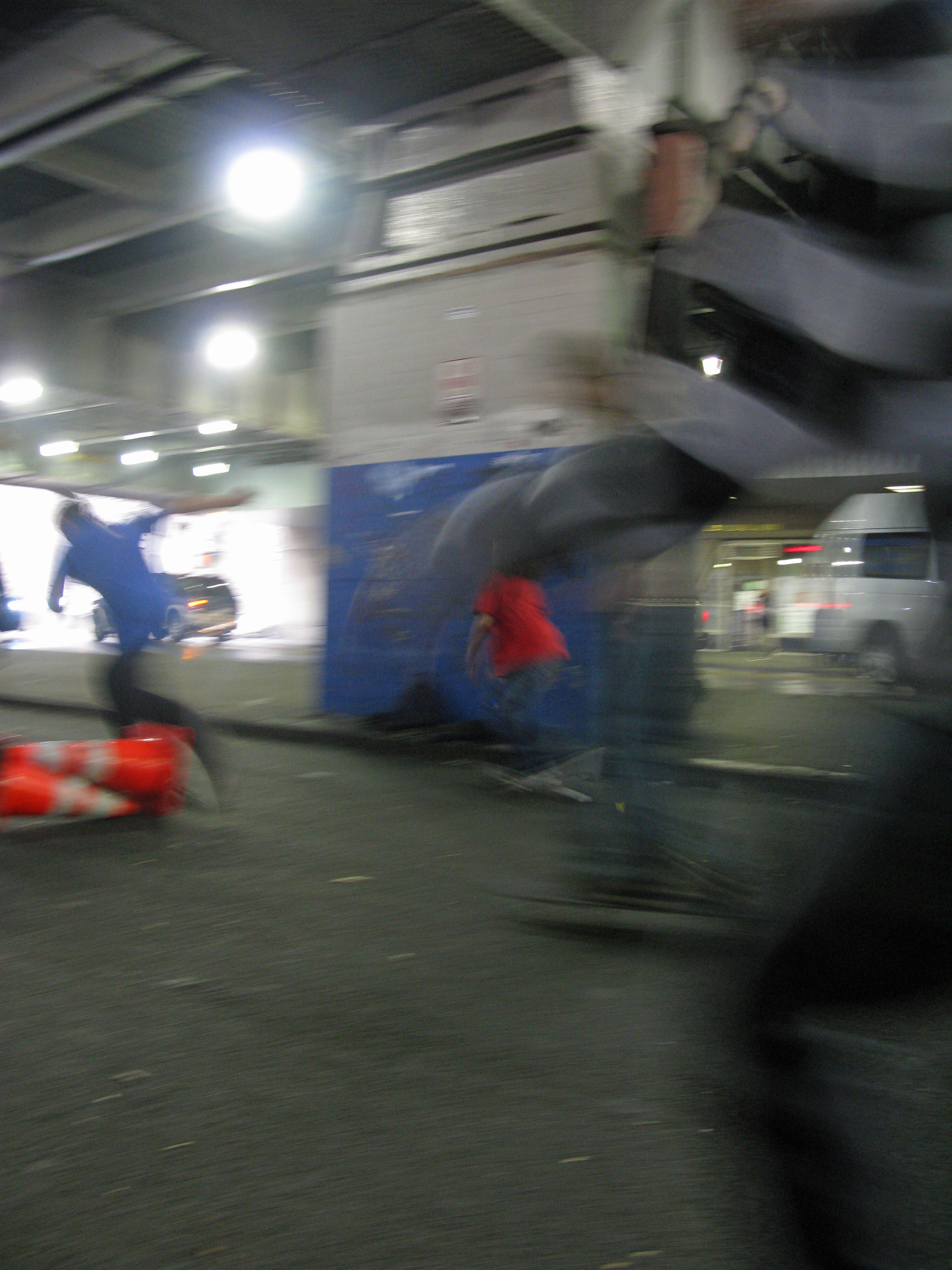
At some point, after they had all taken a turn at the jump, they turned and sprinted back to the top, as if heeding some collective signal that a part of us longed to hear but which we knew — and really, after an instant of regret, to our larger relief — had long since been lost to us.
Filed under: Architecture, Athletes, Memory, New York City, Photography, Stereotypes, Washington Heights | Leave a Comment
Tags: Baseball, Ghettos, Skateboard, Surfing, Teen Beat, Teenagers, The George Washington Bridge, Trends
In which The Gay Recluse watches French film.
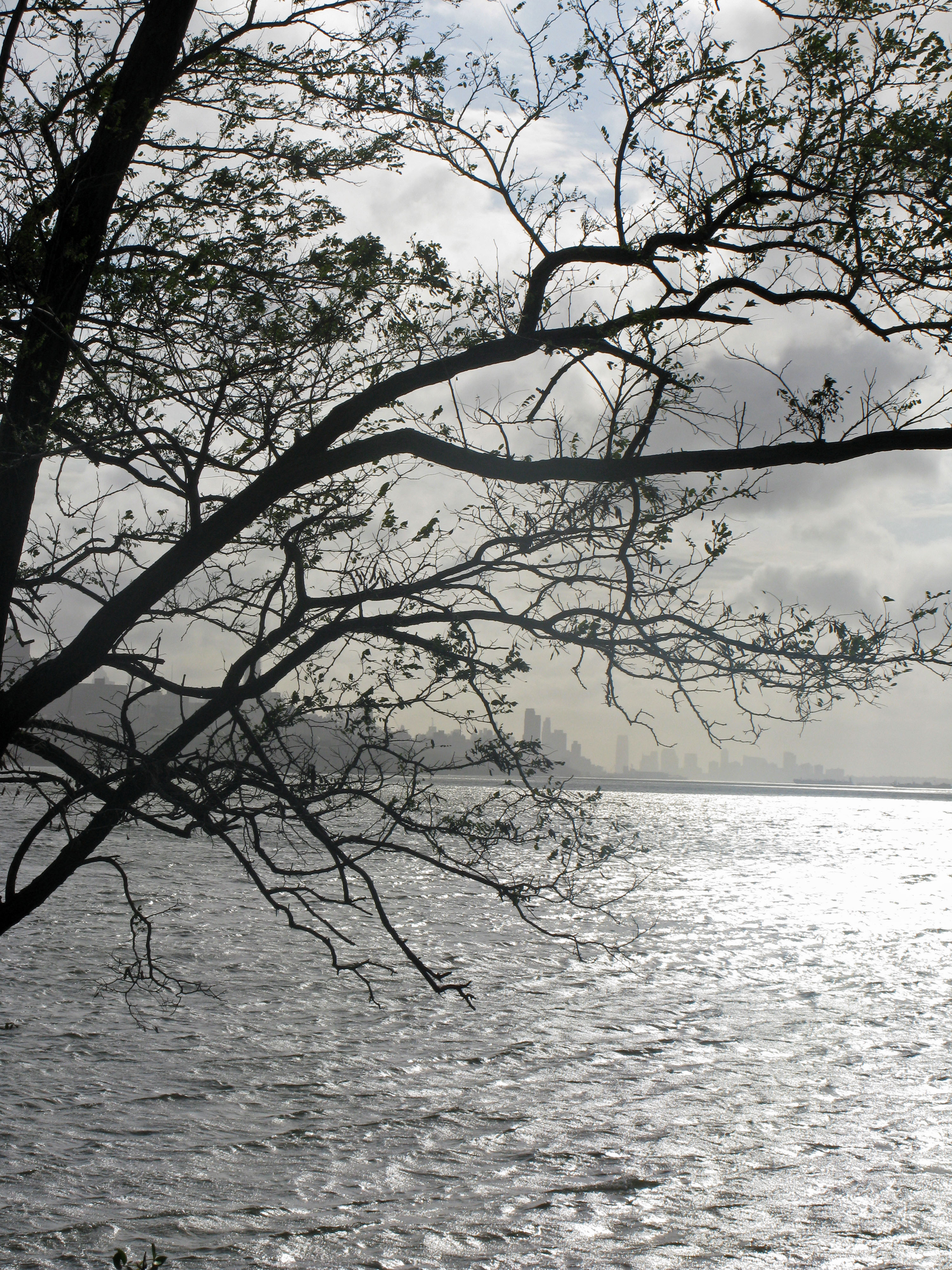
In Robert Bresson’s Pickpocket, the young (and kinda hot, in an aloof, cerebral way) lead is given to wandering the streets of Paris, looking into the eyes of men with whom he has the briefest and most exhilarating (but ultimately soulless) encounters. Surprise: at least superficially, this movie is not about gay sex! Released in 1959, during the dark ages of post-war western civilization, the film deftly — and we mean this in the most literal sense, given the amazing choreography of wallets being lifted from the marks in question — presents a society of underground pickpockets to serve as a metaphor for the gay underground with which Bresson was obviously on very familiar terms. Even the ending, where the lead is supposedly redeemed through his love of a woman, makes much more sense when viewed through a gay lens, and here’s your first clue: the guy’s now in jail, and thus separated from his “love” by a literal set of bars! (Ha, this is like the long-distance relationship ploy used to such great effect by so many modern closet-cases, who will only confess their love to a woman when she’s in another city.)
While we were initially tempted to dismiss the work as the dated and agonized confession of a tortured soul (i.e., Bresson), the fim ultimately moved and — like his other work that we’ve seen — haunted us for many hours after it was done. The reason for this, we have come to realize, is that while Bresson in no way was prepared (or permitted) to literally deal with the question of homosexuality, his exploration through means of the pickpocket metaphor likewise released him from the burden of stereotype, so that the film ultimately resonates with a degree of truth and candor lacking in 98 percent of movies made today.
As with our dreams, Bresson speaks to us only in symbols and metaphors, and like the characters in his film, we find ourselves gripped by longing to understand not only his intentions, but our own, as if by doing so, we will be given clues to our larger fate.
Filed under: Addiction, Film, Longing, Obsession, Writers-French | 4 Comments
Tags: Dark Ages, Gay Film, Pickpocket, Robert Bresson
In which The Gay Recluse rather quickly dies of lung disease.
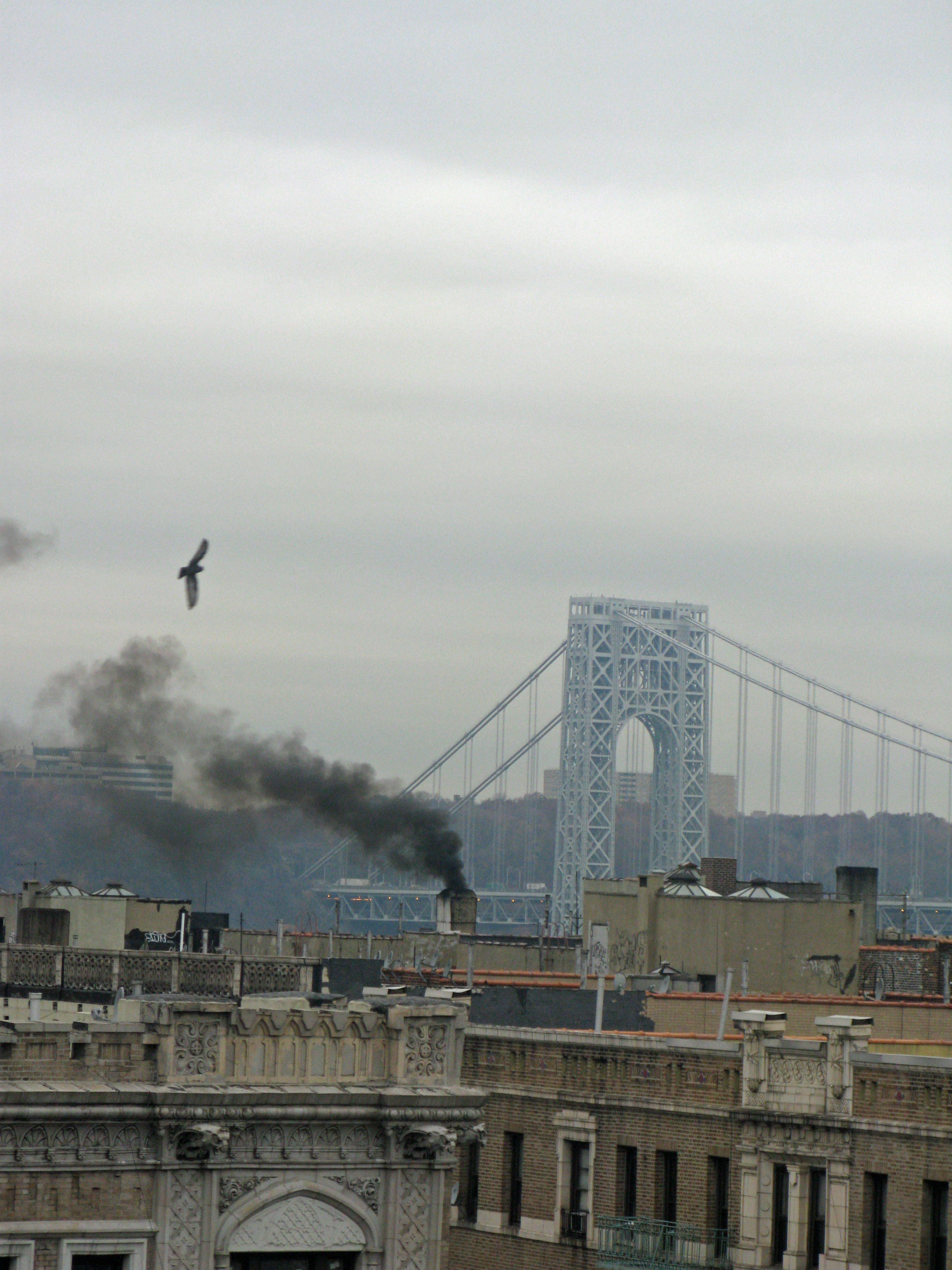
Although there are countless slumlords offenders in Washington Heights, this building is one of the worst.
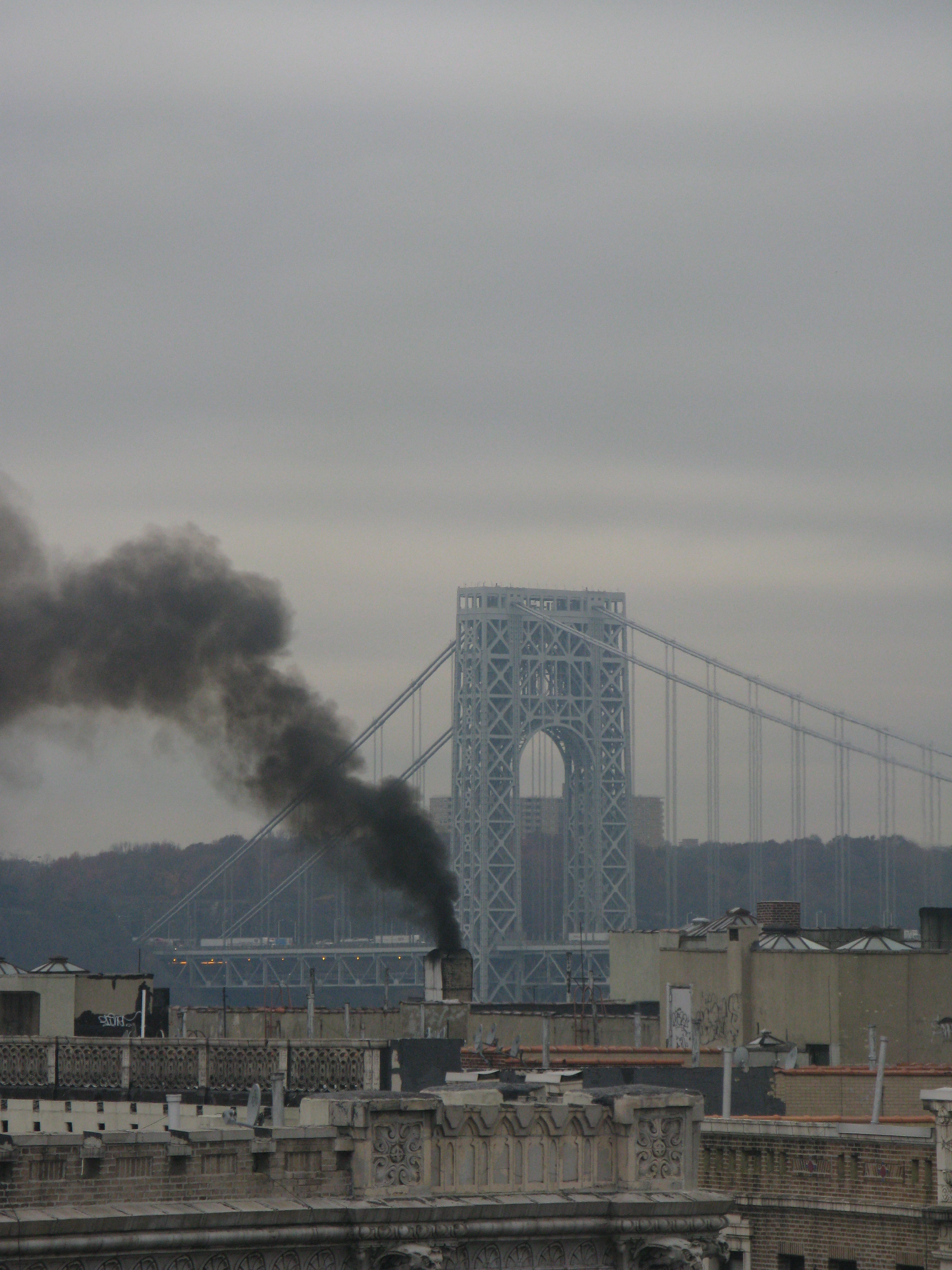
We’ve written about this building before — and for a while it seemed to get better — but now that it’s getting cold, the smoke is getting worse, i.e., it’s a constant stream of thick, black exhaust.

We just got off the phone with 311, which is supposedly going to file a complaint with the DEP.
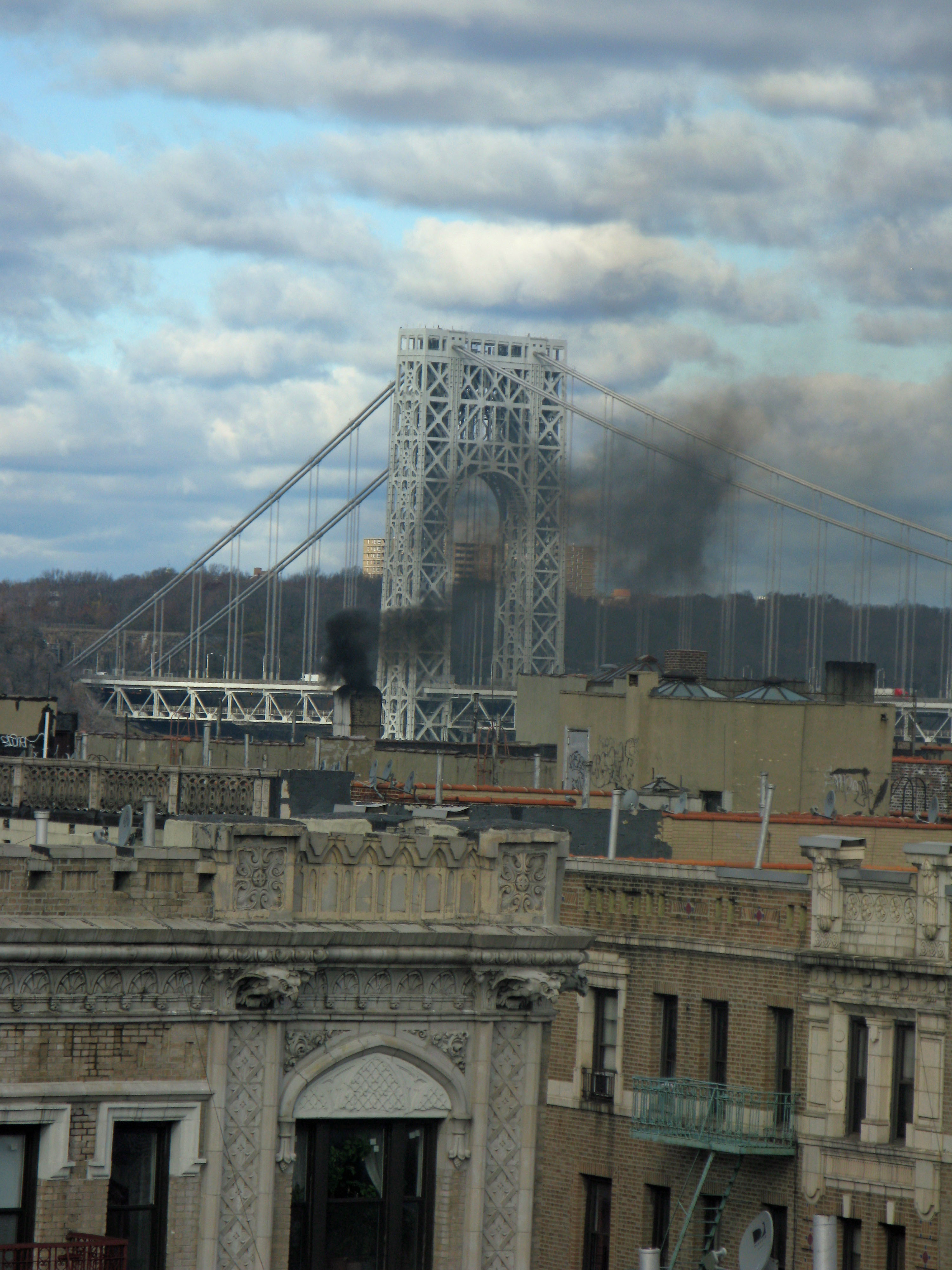
If you see this, we encourage you to call, too! If nothing else, they will monitor the number of complaints, and perhaps act when it’s obvious that there’s a problem (as if local asthma rates were not obvious enough).

The only reason for this is because landlords are either 1) not maintaining their boilers properly, or 2) using low-grade oil to save money. Bottom line: if you see it, call 311 and let them know that you’re dying of lung disease.
Filed under: Capitalism, Health, New York City, Washington Heights | 2 Comments
Tags: 311, 672 West 162nd Street, Asthma, Boilers, Cheap Oil, Department of Environmental Protection, Pollution, Slumlords
On Beatrice, 2008
In which The Gay Recluse remembers Beatrice, two years later.

We don’t have too many photographs of Beatrice; although we owned a camera, it was a particularly trying period of our life, so that we were almost never inspired to memorialize it. (All of these pictures were taken by Stephen.) You can tell that this is an early one, though, because her ears were still infected; we remember bringing this to the vet’s attention and she told us to swab her ears with a salve: for some reason, the vet couldn’t quite seem to grasp that Beatrice never let us hold her, even for a second. (And we tried everything!) Fortunately Dante — always an exceedingly careful groomer — spent a lot of time licking her ears, and they gradually got better.

This is another shot, where you can see the improvement.
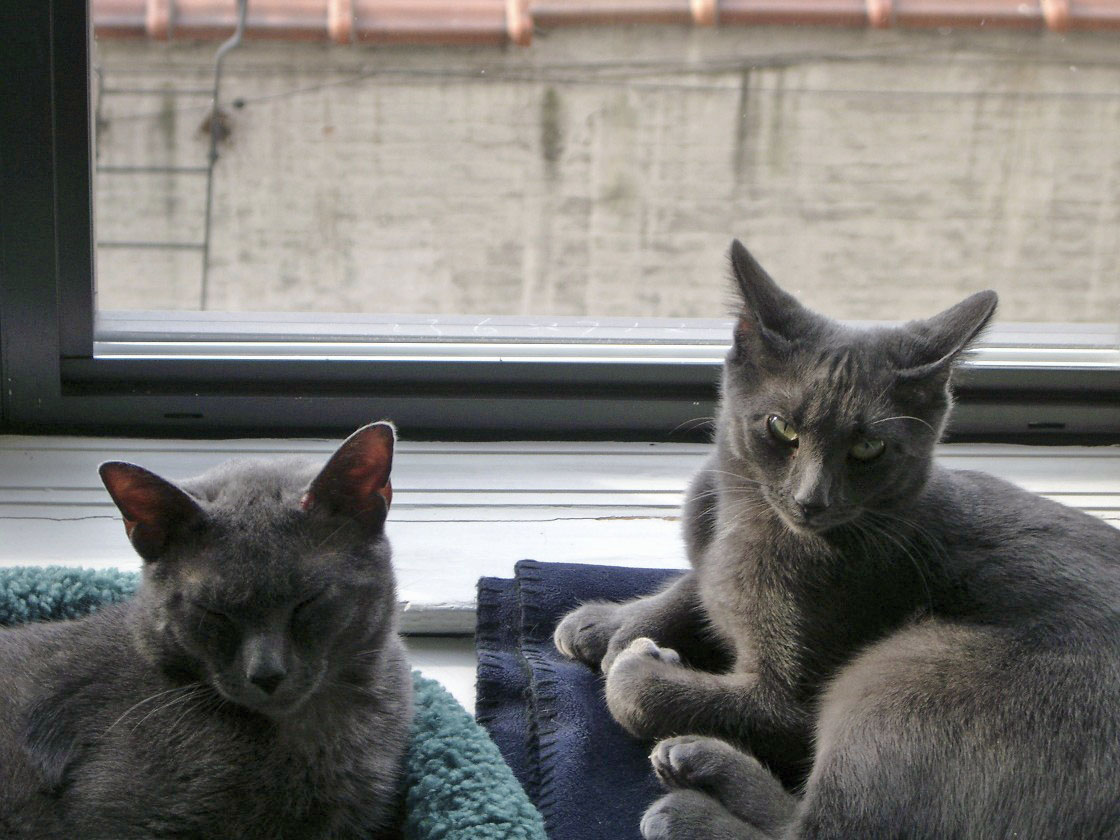
Dante and Beatrice liked to take naps near each other on the window sill in the afternoon.

When they woke up, they would have a “lick-lick session.” We always assumed that Dante taught Beatrice some of his grooming techniques, because she smelled a little “off” in the beginning, but that too went away over time. We always assumed that we, too, would gradually be allowed to get closer to her; what we didn’t realize is that we didn’t have very much time.

Beatrice had the plushest coat; it seemed to compensate for her stunted body, chopped-off tail and mitten paws (not to mention the horrible life she must have had before being adopted). At times, as in this picture, she glowed with an otherworldly aura, an idea made all the more plausible and painful by the knowledge that we never got to hold her until after she got sick. The most she ever allowed was a brief touch, just beyond arm’s length (a distance she could always judge with maddening perfection).

At other times, though, she was more cat-like. She certainly didn’t appreciate being told what to do, either by us or Dante: sometimes he would try to play with her and she — clearly not in the mood — would scream at him before running under the bed, after which he would walk around the apartment moaning and sulking. But then she would reappear an hour or so later, carrying her “kitten” — a bright yellow stuffed-animal dog, almost as big as she was — as if to imply that she really didn’t need anyone else to amuse her, although she clearly liked the attention.

Hardly a day passes when we don’t look at the window sill with longing, as if we might find her there, still staring at the world outside with a certain mix of contemplation, wonder and disdain, knowing she was all too soon destined to leave it, and us, behind.
For the long version of Beatrice’s story, click here.
Filed under: Animals, Disease, Dissonance, Longing, Memory, The Russian Blue | Leave a Comment
Tags: Beatrice, Dante, Grooming, Requiescat in Pace, Windows
In which The Gay Recluse loves The Manhattan Times.
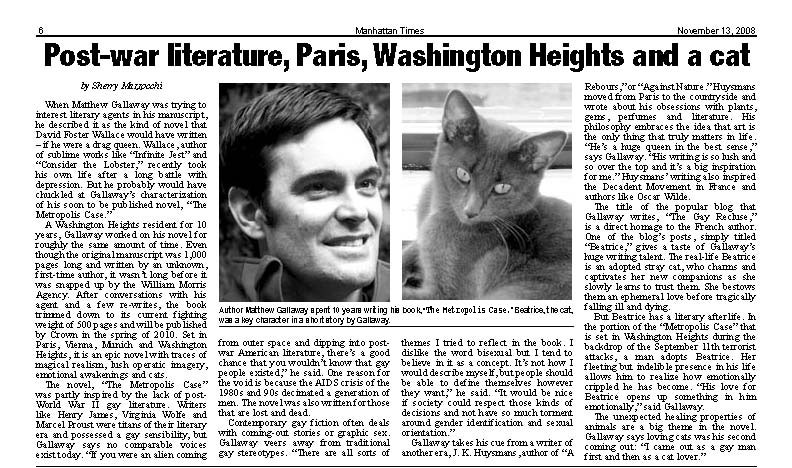
Hey, so The Manhattan Times wrote a charming (if we say so) piece on The Metropolis Case. If you’ve never read the uptown weekly, you’re missing out (and really, we’re not just saying that!). In this week’s issue alone, there are excellent articles about Andy Linares of Bug Off (at St. Nicholas and 163rd), who coincidentally we were just talking to last night (sadly buying glue traps to catch a mouse), and another about Tony Serio, yet another George Washington Bridge obsessive/artist. You can pick up a free copy pretty much anywhere uptown — it’s kind of like reading the Internet, except on paper! — or catch up with a PDF version by clicking here. Below is the cover of this week’s issue, which features your favorite gay recluse on Page 6 (but not that Page 6, obv).

A shot of the article can be found below. It was pretty much perfect in our opinion, except for the heading under the photo where they wtf refer to the book as “The Metropolitan Case.” (Maybe that’ll be the sequel, ha ha.) Oh well, whatevs, it kind of adds to the charm. In the version below, we used Photoshop to somewhat clumsily paste in the correction, but if you’re having trouble reading it, you can click on it for larger version or check out the PDF here: post-war-literature-paris-washington-heights-and-a-cat.
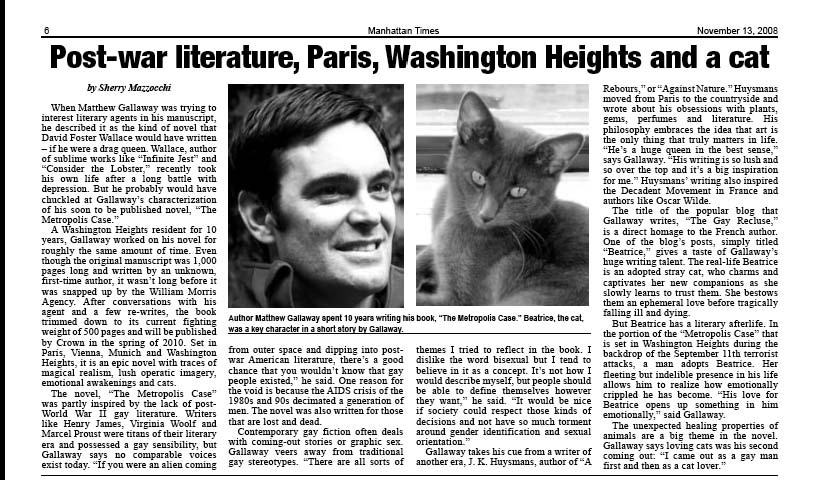
Thanks for press, Manhattan Times! (And best of luck in this economy — god knows, we all need it!)
Filed under: Animals, Literature, The Gay Recluse, The Russian Blue, Washington Heights, Writers-American, Writers-French | 4 Comments
Tags: Beatrice, Book Deals, Novels, The Manhattan Times, The Metropolis Case, Uptown
In which The Gay Recluse becomes increasingly obsessed with birds.
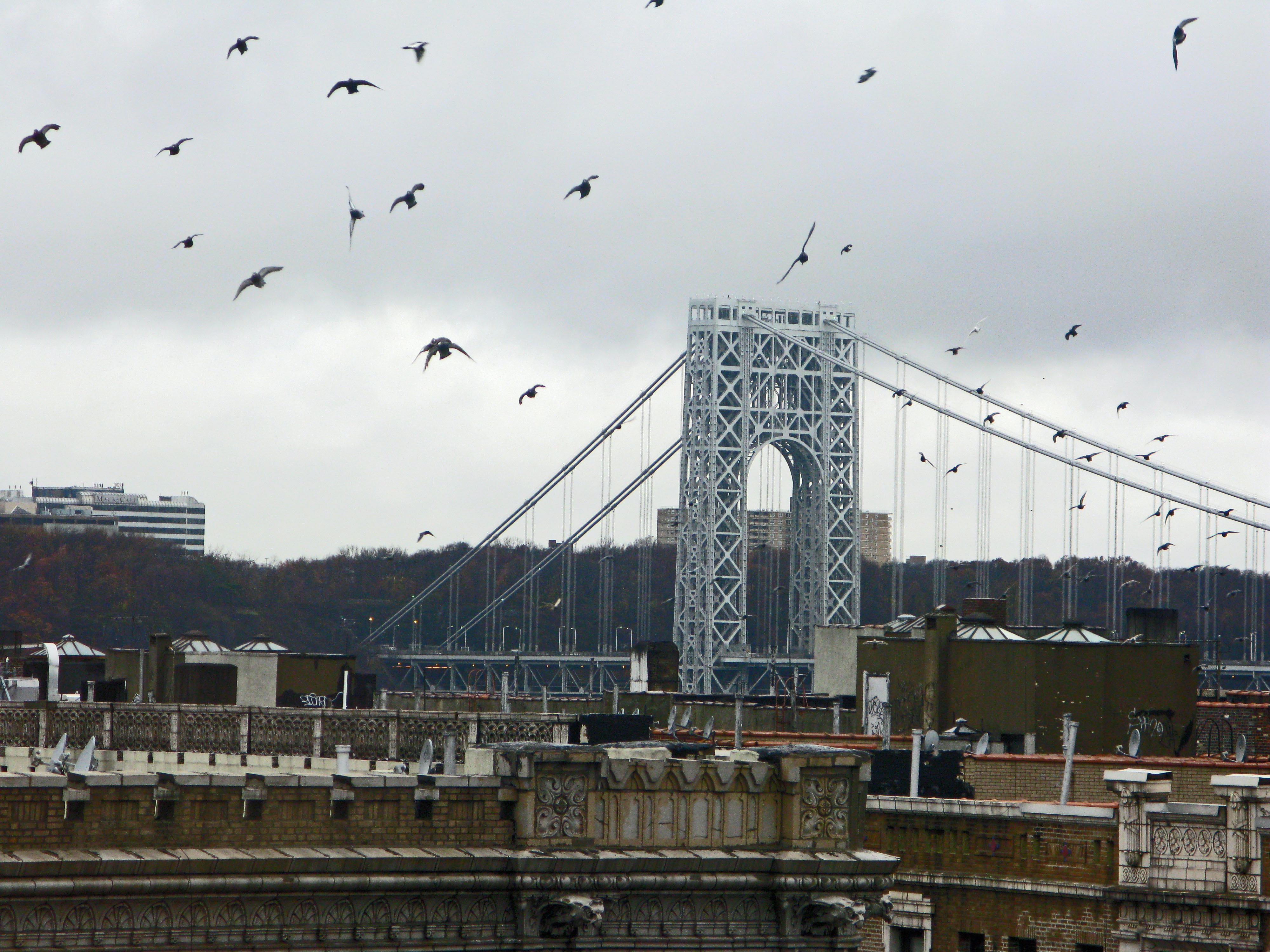
Some mornings the pigeons arrive en masse and circle the rooftops over Washington Heights.
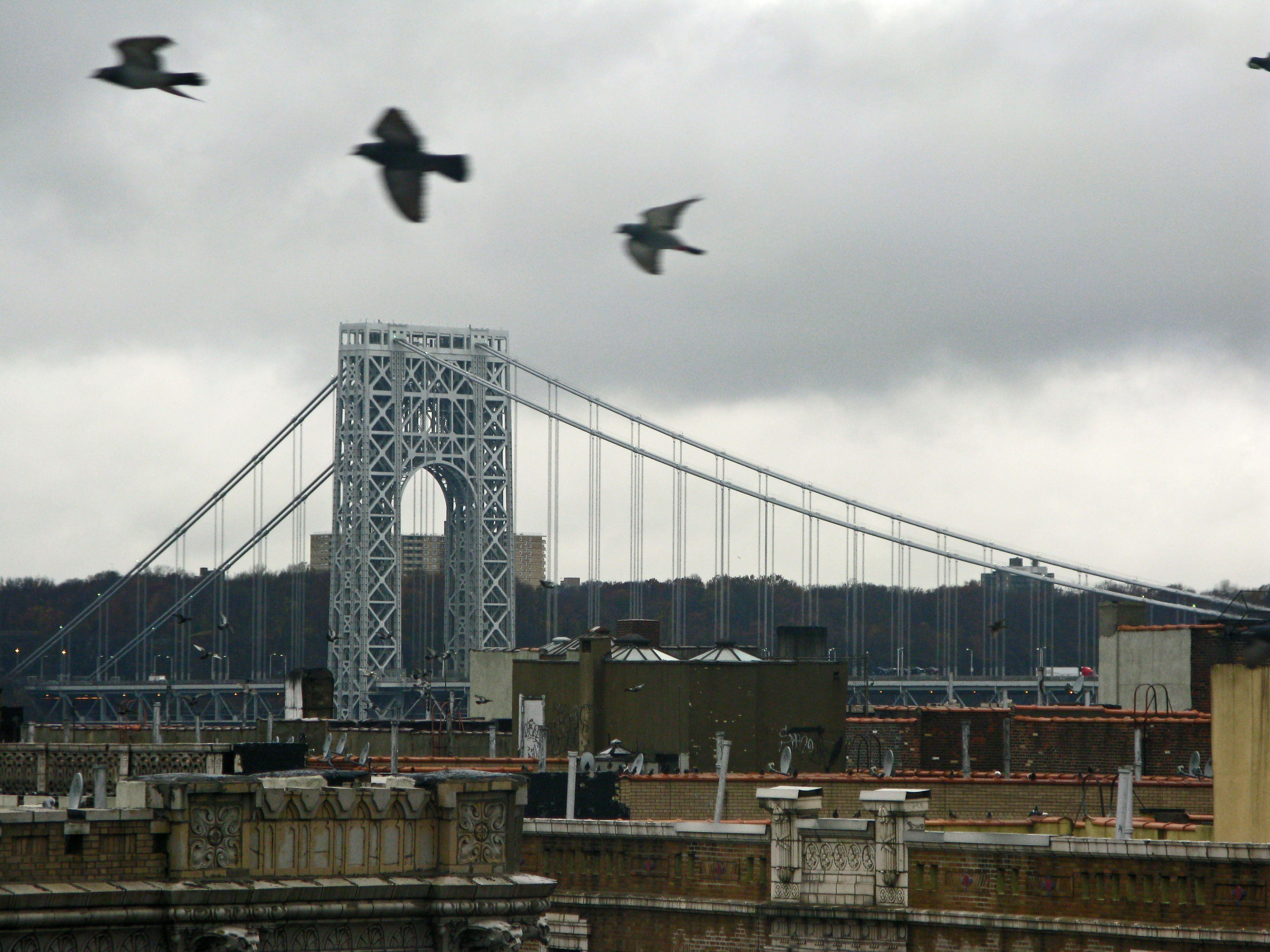
One minute the sky will be blank, and the next it will be filled with birds — somehow they move as a single entity — careening like a speed boat on a wide arc across the water.
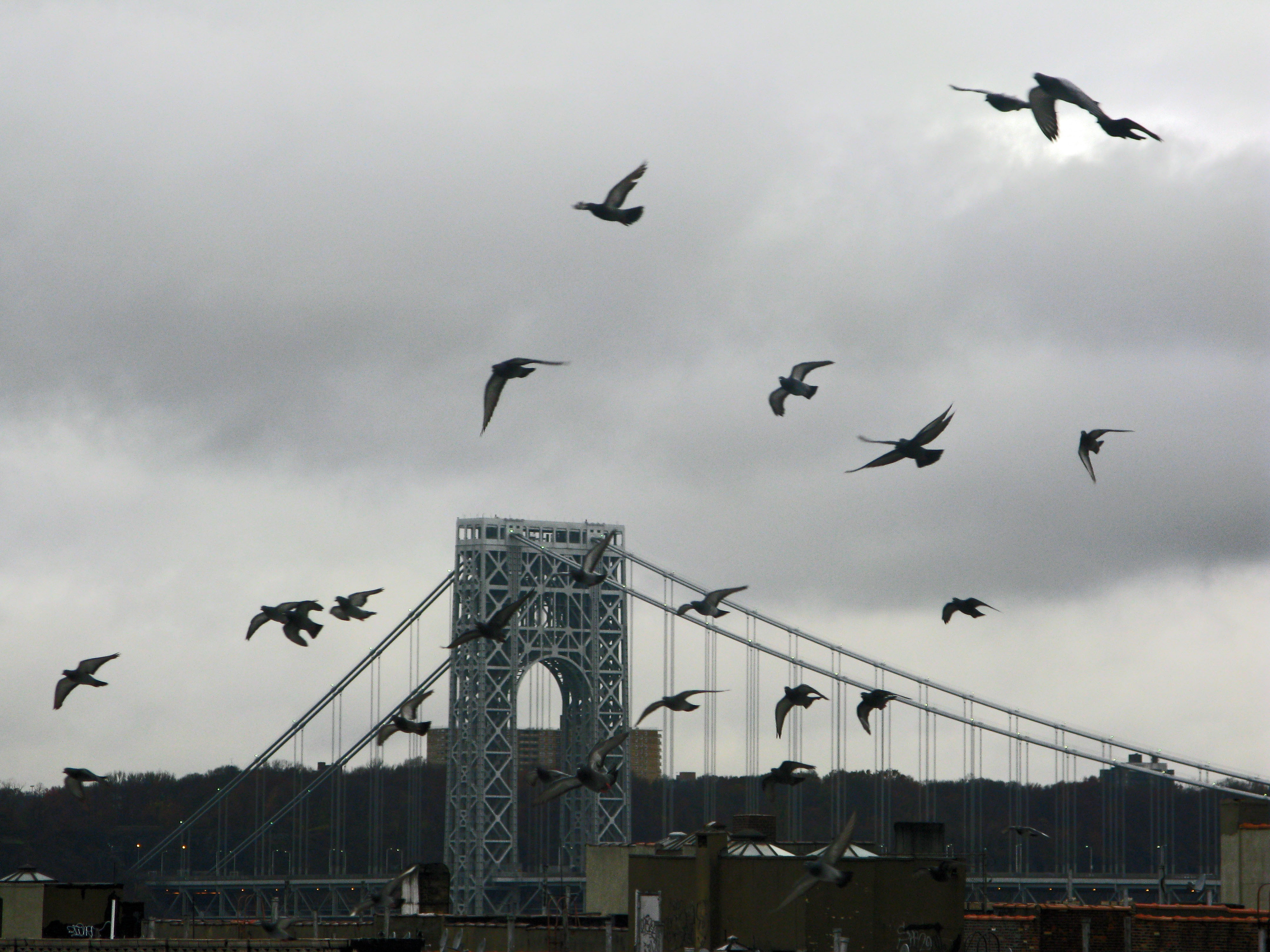
The bridge watches this silent and passive but monumental, like a god.
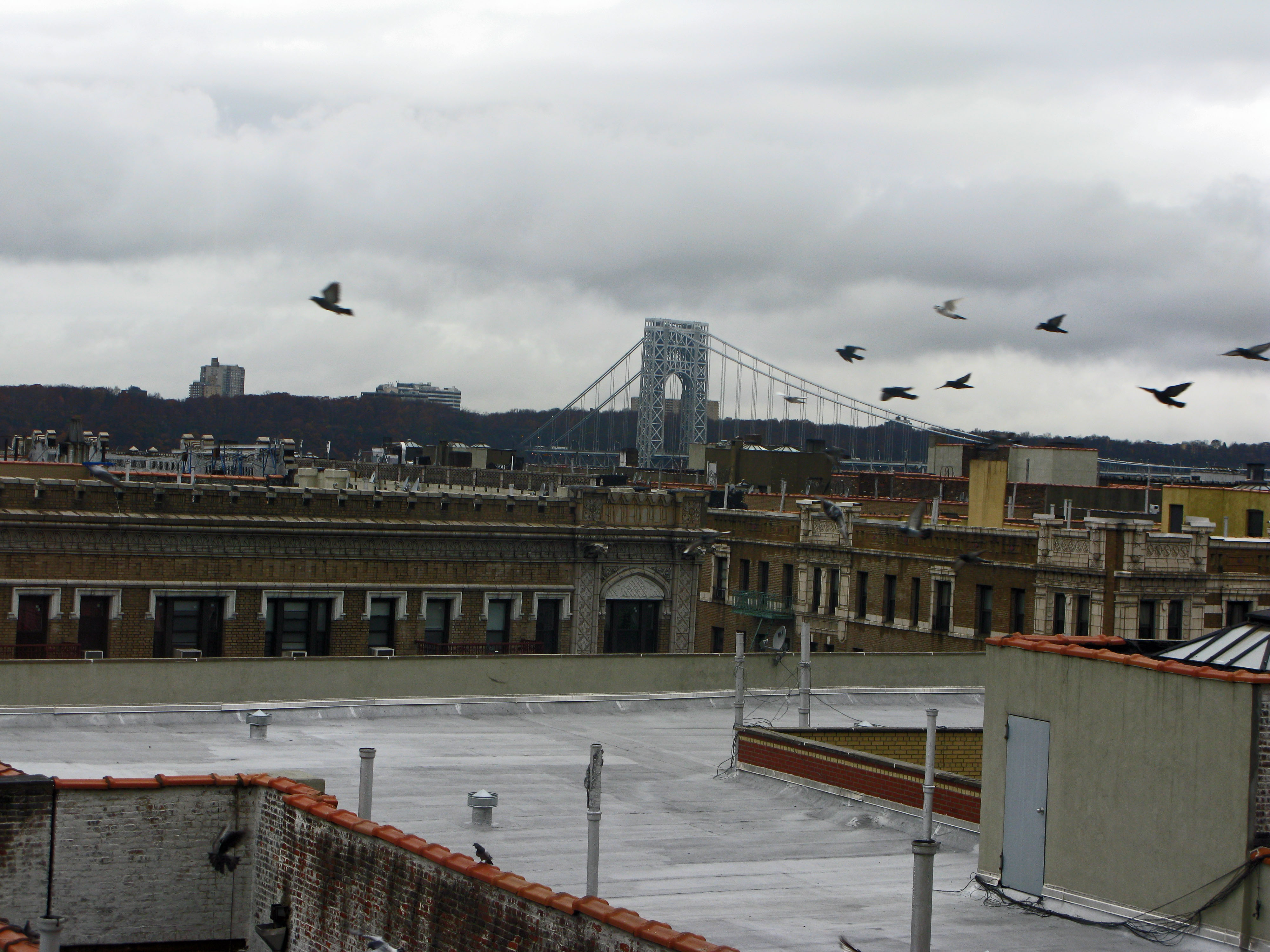
The birds seem frantic, endlessly searching for something they will never find.
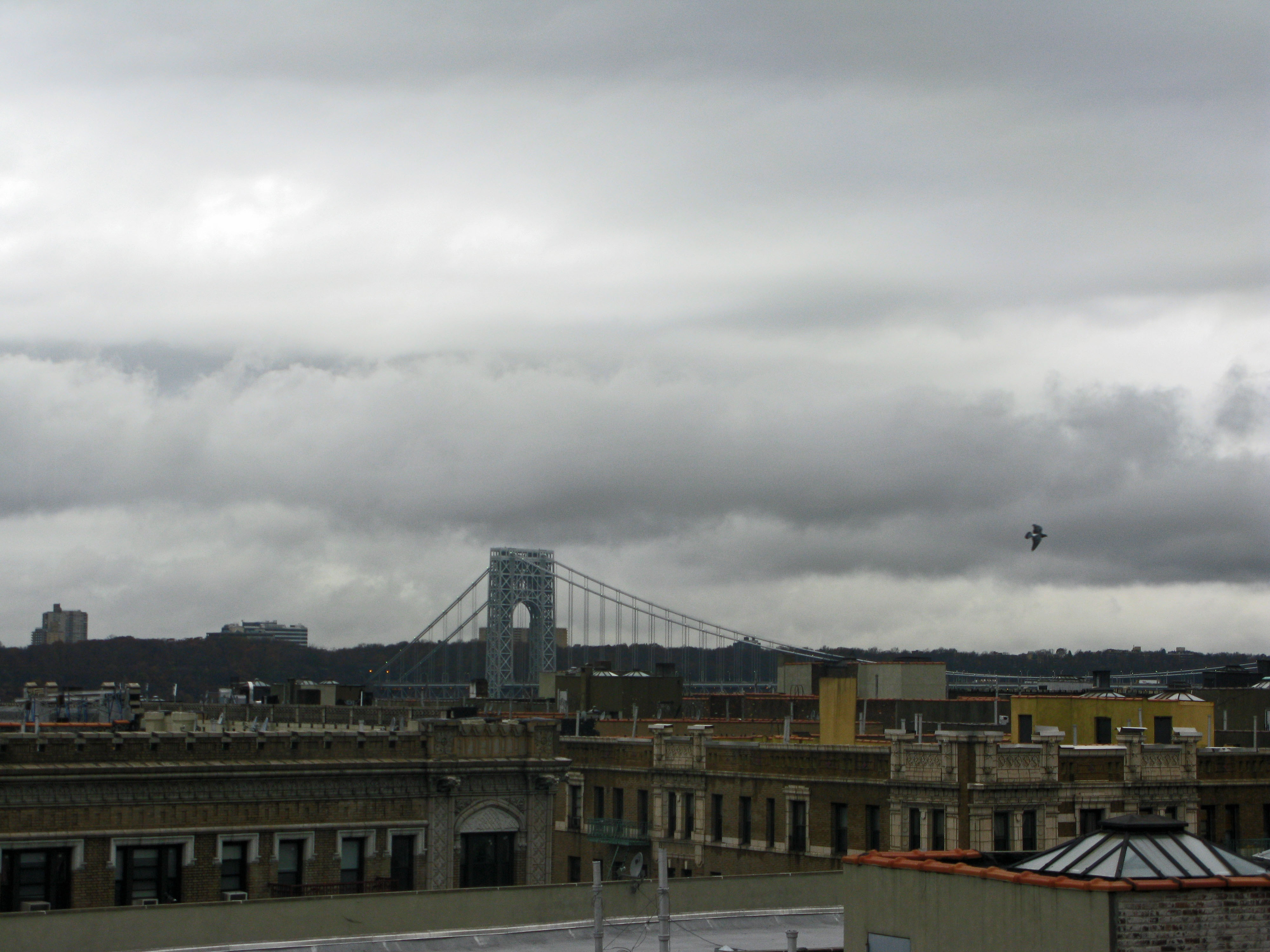
Except for this one, perhaps, who flies alone across the angry sky.
Filed under: Animals, Architecture, GWB Project, Landscape, Washington Heights | Leave a Comment
Tags: Flocks, November, Pigeons, The George Washington Bridge


 The Gay Recluse