In which The Gay Recluse ponders a sampling of recent search terms used to find the very pages you are now reading. Note: All search terms listed are in the exact form provided by WordPress.com, which is the host (at least for a while) of this blog. Hyperlinks to relevant posts included.
Search: disaster + january 21st
Comment: The day the toothpaste died (“and we were singing…”).
Search: gay architecture
Comment: Sometimes people disappear when they’re needed most.
Search: fag hag
Comment: As long as you’re not gay, feel free to contact Daniel Jones at The Times.
Search: Terry Bradshaw gay
Comment: That would be reasonably hilarious.
Search: california cuties clementine
Comment: The debate rages on.
Search: gays scientific research (see also: “science of gaydar is it real” and “tufts gaydar”)
Comment: Why spend research money on AIDS or cancer when you can reinforce gay stereotypes?
Search: architecture spacemen 3
Comment: Spacemen 3 were true masters of the sonic architecture of repetition, dissonance and aesthetic revolution. (Uhh, they also took many drugs.)
Search: huckabee “gay people”
Comment: One thing we can be sure of: he knows a lot of them and doesn’t even realize it.
Search: baudelaire and chinese
Comment: We too have spent many hours contemplating our favorite cats.
Search: gay bear bully fiction
Comment: This was a page-11 Google search result for our review of Gore Vidal’s classic work. On a different note, we also find it is a very apt description of Andrew Sullivan’s political views.
Search: cascadilla suicides
Comment: Sadly, Ann Coulter was not among their ranks.
Search: “tote stadt”
Comment: This describes large swaths of the United States, unfortunately.
Search: ad campaign gay stereotype
Comment: Seriously. Our hatred of ESPN. On behalf of pottery.



Filed under: Architecture, Gay, Politicians, Search, Stereotypes, Technology, The Gay Recluse, The Times, Writers-American, Writers-French | Leave a Comment
Tags: Andrew Sullivan, Baudelaire, Bully, Cascadilla, Cornell, Cuties, Daniel Jones, Dead City, Disaster Footage, Don McLean, ESPN, Fiction, Gay Bears, Gaydar, Herbert Muschamp, Huckabee, Modern Love, Pottery, Spacemen 3, Spleen, Suicide, sweeties, Terry Bradshaw, Toothpaste
In which The Gay Recluse, with very little sarcasm or irony, reports on real estate in Washington Heights.
Description: Triple-lot vacant land, long used as an illegal outdoor parking lot.
Address: 573, 575 and 577 West 161st Street, between Broadway and Amsterdam. Total lot size = 60′ by 100′.
Remarks: This site first sparked our interest almost five years ago when we walked by one Saturday and observed a revival-style tent — complete with candles and earnest people praying — and learned that the property (or some portion of it) had been purchased by a religious organization with intentions to put up a church with some housing on top to help fill the coffers. The ground — as it were — was being blessed.
Further research (via Property Shark) revealed that two of the lots (575 and 573) had in fact been purchased by the St. Mary Magdalen Orthodox Church, a Christian Orthodox organization (please don’t ask us to explain the nuances of this denomination in ecclesiastical terms) whose rector is affiliated with Columbia University. This seemed promising; at least it wasn’t a fly-by-night “religious” outfit similar to the ones that have been implicated in so many of the uptown housing scandals over the years.
The third lot — 577 — was owned by a pair of doctors who were using the lot as parking for their offices a few doors down and renting out the remaining spaces in all three lots to local residents. At the time, we were told that the St. Mary folks were negotiating to buy out the doctors, which would obviously make the most sense from any number of angles.
Fast forward to last week, at which point nothing had changed in terms of the lot itself — which had continued to operate as a parking facility these many years — but much had apparently happened behind the scenes. Records revealed that 1) the church had transferred ownership of 575 and 573 to Rohan Development by way of Mehta Real Estate, two corporations that — no surprise — are affiliated with a condominium development on 107th Street and Columbus Avenue where the church is headquartered, and 2) 577 remained in the hands of the doctors, but in 2007 they had applied for — and were denied — a permit to transform their lot into a parking facility. (Bravo, Department of Buildings — this site — a gap in row of beautifully detailed pre-war townhouses — is so not meant for parking!)
On Friday morning — in the event that sparked this report — small bulldozers arrived at 575 and 573 and ripped up the concrete base, essentially ending the possibility that any of the lots — even 577 — could be used for parking. Whoever manages 577 responded by cutting a new hole through the fence and — somewhat ridiculously — lining up a short convoy of SUVs.

At this point, no construction permits have been issued for 575 and 573. Our theory is that we are witnessing hardball negotiation by the church, whose attempts to purchase 577 have obviously not come to fruition. But now that any form of parking has been taken off the table, we would expect the doctors to have more reason to sell. (Of course logic may play only the most minimal role in either party’s thought processes.)
Whatever’s going on, we’re excited to see new ground broken on a relatively charming but moribund block. Stay tuned for further news as developments warrant.

Saturday morning. We’re curious to see what happens.
Filed under: Architecture, Capitalism, Decay, Gentrification, Landscape, Monopoly, Washington Heights | Leave a Comment
Tags: 10032, Christian Orthodox, Columbia University, Department of Buildings, DOB, Monopoly, Real Estate, St. Mary Magdalen, Uptown
In which The Gay Recluse, with very little sarcasm or irony, reports on retail in Washington Heights.
Development: Cigar Shop
Address: 609 West 161st Street between Broadway and Fort Washington
Remarks: Except for the famous quote — likely apocryphal — attributed to Sigmund Freud, we don’t know shit much about cigars except that they are a major export of the Dominican Republic, so it makes sense that there would be a shop in Washington Heights. What we like about this place — which we’re pretty sure went in just a few months ago — is not only that it seems to meld elements of Dominican and American culture in a way that’s very reflective of the neighborhood, but that it does so in such an understated and appealing manner. The colors — a warm taupe and muted blue — the sturdy, unpretentious font, the cloth awning and the storefront display — just a few wooden cigar boxes — provide a thoughtful, cohesive and ultimately inviting design that works for us in a way that the more garish offerings on Broadway almost never do. We can almost see ourselves this summer, strolling up Riverside Drive, puffing on a stogy and pretending to be Sigmund Freud himself as we take in the glorious ruins of Washington Heights.

Filed under: Architecture, Capitalism, Gentrification, Retail, The Gay Recluse, Washington Heights | Leave a Comment
Tags: 10032, Cigars, Dominican Republic, Eileen Alexander, Sigmund Freud, Soberano Cigars, Uptown Gentrification, Washington Heights
In which The Gay Recluse ponders the transformation of the monumental into the mundane (and vice versa).
Date of Incident: January 26, 2008
Time: 4:38 pm.
Causes of Disaster: Failure to follow implemented routines; boredom, malaise.
Remarks: Clean-up of the disaster area had already begun when workers were attacked by a savage, rampaging beast. There were no survivors. One blurry photograph of the scene was recovered. It is expected that further development of the territory in question will exacerbate conditions; precautions should be taken, but some casualties are inevitable.

Dear readers, we invite you to submit your own disaster footage along with any relevant information (background conditions, attribution, etc.) to thegayrecluse@gmail.com.
Filed under: Animals, Government, Technology, The Gay Recluse, The Russian Blue | Leave a Comment
Tags: Cats, Disaster Footage, Homeland Security, Mess, Toys, Zephyr
On Gay Sex in the Seventies
First, it’s a great title for a documentary; just to say Gay Sex in the Seventies makes us a little more forgiving than is perhaps our natural tendency. Plus you get to see some great shots of vintage Big Apple; the west-side piers, the notorious truck bays across the highway, the Upper West Side when it still had a soul gay bars, and of course the legendary bath houses and discos that have since been relegated to history. This alone makes the film — released in 2005 — worth seeing. Still, it is about (male) gay sex, and soon we are informed — and have no reason to disbelieve — that there was a LOT of it happening in the 1970s at these venues (and pretty much everywhere else in the city), and all of it enhanced by a LOT of drugs.
The narrative is thus established: the 1970s = sex + drugs; hardly news, but we are curious to see what the rest of the film might have to say about this. Unfortunately, the answer is less than nothing. The bulk of it consists of interviews of five or six veterans (survivors) of the scene whose comments — thanks in large part to the filmmakers — quickly become a collective reinforcement of the above calculation, but with the added component of the looming AIDS epidemic, which of course has been the pink elephant in the room. But once it is addressed, we are given a somewhat modified though equally familiar (and disheartening) narrative: the 1970s = too much gay sex + too many drugs, ergo AIDS.
This is the real tragedy of the film, because it makes it seem as if AIDS really was delivered as a moral judgment from the hand of some divine power who had seen enough. How we wish that the filmmakers would have fought this impulse, which caters to the most homophobic and degrading elements of our society! Rather than shrugging their creative shoulders, as if to say “well, we had it coming,” why not point out that the rest of the country was also on a sexual, drug-addicted rampage, and (to the extent we can talk of a collective) wasn’t rewarded with a lethal epidemic? Or why not talk about lesbians, whose relative immunity to AIDS so effectively trumps the morality card? Is there any reason to think they too weren’t having loads of free love in the 1970s? (And we’re willing to bet that there are still one or two around that would have been happy to talk about it.)
As it is, we are left with the sense that every single gay man who died of AIDS was the recipient of a collective punishment for a collective crime. This is a disservice, for it perpetuates a myth that helps to fuel so much of the hatred we feel from the Fox-News wing of the country; on the other hand, it exposes the danger of unthinking adherence to any form of “community,” which no matter how politically expedient can destroy the individuality of those whose stories we still desperately want to hear.
Filed under: Film, Gay, Gentrification, Health, History, New York City, Nostalgia, Sickness, Stereotypes | Leave a Comment
Tags: Disco, Gay Sex, Gay Sex in the 70s, Gay Sex in the Seventies, Poppers, St. Mark's Bathhouse, Studio 54, The Saint, Vintage New York, West Side Piers
In which The Gay Recluse updates his informal but rather telling quantitative analysis of Modern Love, the weekly Style Section (of The Times) column in which openly gay writers almost never appear, and even less frequently describe a romantic relationship.
This week’s piece: Closing Night for My Bit Part
Subject: Woman looks longingly at famous male television actor with whom she once had a summer fling.
Filed under: Straight Woman on “Looking for Love”
The updated tally: 6 out of 164 columns by openly gay writers; 1 out of 164 on female gay relationships; 0 out of 164 on male gay relationships.
Outstanding question to Daniel Jones, editor of Modern Love: wtf?
Straight Woman on Relationships iiiii iiiii iiiii iiiii iiiii iiiii iiiii i (36)
Straight Woman on Family iiiii iiiii iiiii iiiii iiiii iiiii iiiii (35)
Straight Woman on “Looking for Love” iiiii iiiii iiiii iiiii iiiii iiiii ii (32)
Straight Woman on Breaking Up iiiii iiiii iiiii iiiii iii (23)
Straight Man on Relationships iiiii iiiii (10)
Straight Man on Breakup iiiiii (6)
Straight Woman on Gay Men iiiii i (6)
Straight Man on Family iiiii (5)
Straight Man on “Looking for Love” iiii (4)
Gay Man on Family ii (2)
Gay Woman on Relationship i (1)
Gay Woman on Family i (1)
Gay Man on Self-Hatred i (1)
Gay Man on Prom Date i (1)
Ambiguous i (1)
Filed under: Gay, Language, Stereotypes, The Gay Recluse, The Times | Leave a Comment
Tags: Daniel Jones, Fashion & Style, Gay Stereotypes, Gay Voice, Gay Writers, Homophobia, Modern Love, The New York Times
In which The Gay Recluse contemplates an uncommissioned masterpiece from the walls of an uptown subway station.

Dear readers: we invite you to submit any particularly inspiring (or any particularly uninspiring) examples of subway graffiti to us at thegayrecluse@gmail.com.
Filed under: Graffiti, Infrastructure, New York City, Subway, Washington Heights | Leave a Comment
Tags: Graffiti, MTA, Networks, Sundance, Sundance Film Festival, Television
While we are the first to admit to possessing character traits that would regularly be described as obsessive, addictive and quite possibly manic — and is this not part of our charm? — we nevertheless take no small consolation in having never descended into the ranks of the toilety neurotic and insane. We were just today reminded of the existence of this sad condition at our place of work, which — and you will have to take our word for this — is an old and venerated establishment, staffed by pleasant, earnest and cordial souls, all of whom exude a collective scent of healthy youth and idealism that is quite frankly inspiring to behold. [Before we proceed with our account, and to prevent any confusion with regard to the issue at hand, we would like to make it quite clear that we do not allege that any of our professional colleagues — or at least the male ones (and we have no knowledge of the women, for reasons that will soon enough be obvious) — are toilety neurotic and insane, for the incident in question is not a recurring one.]
So then, who is this interloper? We suspect that he was most likely a job candidate who — despite being toilety neurotic and insane — somehow managed to secure an interview and thus was required to meet with a representative from HR, whose offices are adjacent to the facilities. If we were conducting an interview with this guy — and somehow knew what he had done — we would like to ask him a few questions; namely, are the cheeks of your ass so pristine that you must shield them from any contact whatsoever with the outside world, even in the form of polished white porcelain that gleams like a mirror? And if so, why is that? Perhaps you were given repeated swirlies as a lonesome boarding-school student and were irreparably damaged by the experience? Or more logically, have you ever picked up any form of sickness from sitting on such a throne, or even one that was perhaps slightly more worn? (Here we think of a few legendary examples we have personally known in rock clubs all over the country.)
Let’s assume that the answer to at least this second question is no, that you have never contracted anything unpleasant from one of these sessions, because logic — not to mention scientific research — tells us that your chances of getting hit by a car are much much greater. But hey, we are the first to defend an emotional response over a logical one, and if you happen to be toilety neurotic — and whether the cause is traumatic or not — that’s fine by us; as we said before, we have our own issues to contend with, and the last thing we want to do is impose our own standards on anyone else. Still, and that said, we remain disturbed by the manner in which you simply left the stall without any regard for those equally toilety souls who would be next in line.
Whether the decision to flee was conscious or not, we cannot speculate, for both are equally problematic in different ways; if unconscious — that is, if you simply didn’t notice what you were doing — we are somewhat moved by the extremity of your case, and we try to imagine how you can possibly function in a city of millions; we think of you suffering something along the lines of the Catherine-Deneuve meltdown in Roman Polanski’s Repulsion. But if conscious — that is, if you knew exactly what you were doing and did it anyway — it strikes us as a form of inconsiderate denial that must also be classified as insane, although in the popular sense of the word, so that you must confront the question: wtf — are you insane?
Sadly, the answer seems to be yes, because who do you suppose gets to clean up after you? And why do you think anyone deserves this fate? And if this is any indication of how you treat the rest of the world, is it any wonder people look at you with a brand of hatred that only comes from a place of degradation? Nice going, friend, and good luck! You’re definitely going to need it.

Filed under: Addiction, Capitalism, Health, Infrastructure, Obsession, Sickness | Leave a Comment
Tags: Degradation, Hatred, Insane, Interviews, Manners, Neurotic, Toilet, Toilet Covers, Toilet Seats, Toilety, Toilety Neurotic, Work, WTF
On The Rainmaker
As we watch the first few minutes of The Rainmaker (some fifty years after its release, in 1956), we are impatient and judgmental; the set is generic Hollywood Western, while the men in the family — a father and his two sons — come off as caricatures (stern older brother, mischievous younger, wise dad). Even Katherine Hepburn (the sister — Lizzie — on the verge of becoming an old maid) seems at once too book-smart and too docile to be believed. The movie feels dated and two-dimensional, and even the Technicolor blue of the open sky seems less panoramic than garish; it makes us want to turn away, as if we were embarrassed by such an earnest, overreaching display.
But just as we are about to check the time, we become intrigued by Burt Lancaster; in the early scenes, he too was unimpressive, merely a con artist somewhat preposterously hawking “tornado vanes” before he is run out of town by the authorities. When he first meets our drought-stricken (but not exactly suffering) family, we are as eager as Lizzie to dismiss him, for we understand that there’s no way he’s going to bring rain, and any money spent on his services might as well be thrown to the wind. Similarly, we see Lancaster as little more than a big Hollywood-handsome lout who we feel sure will eventually win over Lizzie and then — because this is the 1950s — settle down and have a family. Yawn.
Except what’s the deal with that red scarf he has tied around his neck? And what about his black shirt? Although we’re usually not moved by this sort of thing, we begin to notice how nicely fitted it is — it’s basically painted on — and how he doesn’t even flinch when he spills half a glass of water down the front, so for a second his chest glistens under the light. His unwavering intensity is almost freakish — yet disturbingly familiar — and so we can’t stop watching. As for Lizzie, she too begins to exert more influence, and we are increasingly moved by her plight (which is much more complicated than we had initially been led to believe by her shallow brothers); we even wonder why she won’t give in to the Lancaster charm to which we have already proven so susceptible.
The movie continues; as the brothers and the father bumble around the town, we suddenly understand that they are meant to be two-dimensional; they are symbols of three competing elements in American society — the scornful, the idealistic and the resigned — and it is against this backdrop that we watch the relationship between Lizzie and Starbuck (Lancaster) unfold, knowing that as outsiders they must come to terms with each other and the society around them. This is a complicated proposition, and Hepburn and Lancaster never make it anything but, so that their exchanges are filled with mounting desire, frustration — and not just with each other — and regret. Most incredibly the plot stays equally true to this conflict right up to the very end, when even as the rain comes pouring down, there are no easy answers for any of them. Or for that matter us; suddenly we understand that we too have been conned by The Rainmaker, but in the best way possible.
Filed under: Film, Gay, Landscape, Longing, Technology | Leave a Comment
Tags: 1956, Burt Lancaster, Con Artist, Drought, Katherine Hepburn, Old Maid, Spinster, The Rainmaker, Western
Perhaps you saw the news story making the rounds today about the science of “gaydar”? Apparently a couple of geniuses affiliated with Tufts University came up with an “experiment” in which they showed participants “90 faces belonging to homosexual men and heterosexual men for intervals ranging from 33 milliseconds to 10 seconds.” When the participants were given a minimum of 100 milliseconds, they “correctly identified sexual orientation nearly 70% of the time.” (We learned about this groundbreaking research on The Daily Dish via Three Quarks Daily).
Thus we are told that “people can accurately judge the sexual orientation of other individuals by glancing at their faces, according to new research. The finding builds on the growing theory that the subconscious mind detects and probably guides much more of human behavior than is realized.” Not that we want to read too much into this, but Andrew Sullivan’s reaction seemed pretty typical — or perhaps typically gullible — to us: “[Gaydar] exists,” he proclaims in the tone of a local news anchor, “and we’re pretty good at it.”
We understand the reaction, because on its most superficial level the study seems to reaffirm what any thinking person already knows, i.e., that we react to and judge others on a gut level. But as much as we love to indulge in our own (need it be said: flawless) gaydar over drinks at a bar — or really, pretty much anywhere — we hesitate to embrace any pseudo-science passed off under a cloak of objectivity, particularly when it seems to play on and perpetuate a stereotype about “gay” physiognomy, which has as much validity as its racial counterpart.
Questions we’d like to ask: were the homos “manly” fags — like Rock Hudson or Tom Cruise — or were they “girly” fags like Chris Crocker or Lady Bunny? And how exactly did the researchers determine that these men were gay or straight? Did they have sex with them, or did they just take their word for it? (Because unless it’s the former, we’re not inclined to believe anyone.) The fact that the men even allowed themselves to be photographed and identified as “homosexual” means that — if nothing else — they were not closeted and “straight-acting,” i.e., the kind of men who are known to engage in 99.5 percent of homosexual acts at any given moment around the world, yet — more to the point — are never, ever the kind who allow themselves to be photographed for a study, even one in the name of “science” underwritten by an elite safety school like Tufts.
Having seen too many scientists proclaim verdicts from an ivory tower instead of opening their eyes to the real world, we have a nose for bias; often completely unacknowledged, it’s the kind of bias that implies that the best option is to be straight and anything else is a shortcoming. Unfortunately — but as usual — something smells very wrong here.
Filed under: Athletes, Drag Queens, Drivel, Gay, Memory, Science, Stereotypes, The Gay Recluse | Leave a Comment
Tags: Andrew Sullivan, Chris Crocker, Gay Stereotypes, Gaydar, Homosexual Stereotypes, Ivory Tower, Lady Bunny, Matt Kaplan, Nalini Ambady, Nicholas Rule, Rock Hudson, Safety School, ScienceNow, Three Quarks Daily, Tom Cruise, Tufts University
In which The Gay Recluse ponders a sampling of recent search terms used to find the very pages you are now reading. Note: All search terms listed are in the exact form provided by WordPress.com, which is the host (at least for a while) of this blog. Hyperlinks to relevant posts included.
Search: rambo gay
Comment: Sadly, denial can lead to a lot of anger-management issues.
Search: bad things about gays in brazil
Comment: We need to ask Roger Cohen about this, since he was just there on vacation, and by all appearances raging pretty hard.
Search: gay city
Comment: Like milk chocolate and peanut butter.
Search: dancer from the dance Andrew Holleran
Comment: No book in post-war American literature is more romantic, tragic and visionary.
Search: difference between a clementine and a cutie
Comment: The question is not quite logical — it’s like asking about the difference between a cat and a Russian Blue — but not everyone can be an expert.
Search: sexual suffocation stories
Comment: Our use of the word “suffocation” was purely metaphorical.
Search: is the musician peter green still a recluse
Comment: The real question is whether he’s a gay recluse.
Search: gay nietzsche
Comment: “My name’s Edward Rothstein and I’m a ‘culture’ critic for The Times, so you should all take note when I say that Nietzsche was NOT gay! I mean it — he was NOT!!! I don’t care what you heard, he just wasn’t! I’m serious!!!”
Search: “picea abies hillside upright’
Comment: One of our favorite spruces, it features an exceptionally dark green needle.
Search: short quotes about memories
Comment: A Book of Memories by Peter Nadas is a masterpiece, but for those not inclined to make the commitment, we offer a list of quotes.
Search: to throw garbage
Comment: The vacant lot next door was filled with it; the abandoned house still is.
Search: peter is a gay sad loser go away
Comment: Here we see the insidious effects of our favorite ESPN advertising campaign.
Search: gay for it
Comment: Please do send us your homeland security disaster footage!
Filed under: Gay, Language, Memory, New York City, Search, The Gay Recluse, Traffic | 1 Comment
Tags: Andrew Holleran, Brazil, Clemetines, Edward Rothstein, ESPN, Internet, Nietzsche, Picea Abies, Rambo, Roger Cohen, Search, Spruce, Vacant Shell
In which The Gay Recluse ponders the transformation of the monumental into the mundane (and vice versa).
Date of Incident: January 21, 2008
Time: 1:35am.
Causes of Disaster: Failure to implement long-term planning procedures; budget overruns; bureaucratic miscommunication.
Remarks: It was long ago noted that the tube in question was reaching dangerously low and unsustainable levels; procurement requests were initiated at two respective departments but neither exercised adequate oversight of the mounting problem; the loss of the cap excascerbated the situation, as did psychological denial induced at the prospect of a trip to the dentist within less than a week. As a consequence, teeth were not brushed.

Dear readers, we invite you to submit your own disaster footage along with any relevant information (background conditions, attribution, etc.) to thegayrecluse@gmail.com.
Filed under: Government, Infrastructure, Language, Resignation, Technology, The Gay Recluse | Leave a Comment
Tags: Cinnamint, Digital Photography, Disaster Footage, Homeland Security, Technology, Tom's of Maine, Toothpaste
Let’s imagine that your name is Rex Cole. You were born in 1887 in Port Huron, Michigan. You drop out of school at the age of 16 to become an electrician. Dissatisfied with the provincial life, you fight the tide of many millions and head east to New York City, where you save enough money to open up a small lamp-manufacturing facility. Time passes; deals are made and broken and made again, until in 1926 — switching gears — you win an exclusive franchise from General Electric to sell its fabulous new Monitor Top refrigerator.
In less than five years you grow from one small office with four sales reps to a massive operation with over 1000 employees who work in and around the fantastic showrooms you are building all over New York City. These are modern, deco-inspired atriums added to the tops of existing buildings, with high vaulting steel arches and acres and acres of plate glass. People come just to look at the sprawling urban panorama that lies beyond the shining white brilliance of your enamel-coated product. Is it “too much”? Is it extreme and obsessive? There are whispers and innuendos — what kind of man does this sort of thing? — but what do you care? Revenue is over $15 million a year and you want to give your customers — and the city you love — something to remember.
The Depression is not kind to your business; in 1935 you file for bankruptcy and watch as your holdings are sold off to pay your creditors. You emerge from this horribly shaken, and at times shattered: each one of these showrooms seems to have held some irretrievable part of your soul, and even though you offer promises of redemption, the words feel hollow in your mouth. You begin to long for nothing as much as sleep.
You turn fifty and resign yourself to the fact that your affair with power and money has ended. One by one your showrooms are dismantled or covered in aluminum siding, while the trademark billboards you had also put up all over Manhattan and the Bronx — in white enamel with the classic GE logo and your name below in a modern sans serif font — are taken down to be discarded and recycled.
But now you feel oddly unmoved, as if you are now only watching a movie about your past. You are relieved that nobody recognizes you on the street or asks you for money or autographs. As still more time passes and you enter the final decades of your life, you look back with even greater distance at the ruins of a personal destiny that seems to coincide with the city around you, which is increasingly marked by violent chaos and abandonment; entire swaths of neighborhoods you once knew so intimately are set on fire and left to burn. It’s not that you don’t love the city as much as you once loved your life, but neither lies within your grasp; you are eighty years old and there’s nothing more you can do. The year is 1967.
Forty years later almost every trace of your vast empire is gone; occasionally someone will look up and see one of the last of your weather-beaten signs — the enamel now streaked with rust and grit — hanging near the top of one of those grand, forgotten apartment palaces in Washington Heights.
“Who was Rex Cole?” someone will ask, and nobody but you will know the answer.

Filed under: Architecture, Capitalism, Decay, History, New York City, Resignation, Washington Heights | Leave a Comment
Tags: Art Deco, Billboards, Biography, Economic Depression, General Electric, Refrigerators, Rex Cole, Showrooms
We have long suspected that “Modern Love” — the weekly column in the Sunday Styles of The Times — has been a startlingly barren landscape for gay writers, particularly when you consider its location in what is undoubtedly the “gayest” section of the newspaper (and — oh yeah — the gayest city in the world), where queens of all ages are regularly hoisted up and gawked at for our incredible skills in the decorative arts.
At the outset — in the fall of 2004 — we enjoyed these short but literary treatments of “real-world” love scenarios; the prose was witty and urbane, even when the subject matter was “heavy.” In the words of editor Daniel Jones, the concept of the column is to “[cover] a wide range of relationship experience: marriage, death, divorce, parenthood, dating… the complexities of love in all its forms, often through a contemporary lens.”
On the gay front (and what is more “contemporary” than being — umm — openly gay?), one of the first columns was written by a gay woman about her Ozzie-and-Harriet lesbian relationship, which seemed promising; we looked forward to seeing more gay-authored love stories, which — as an added bonus — seemed like the perfect antidote to the more brittle (if occasionally amusing) stereotypes that marked the rest of the style section.
Yet as time passed (and as much as we enjoy hearing from our straight female friends, with whom — just to be clear — we have no axe to grind), we became increasingly frustrated by what seemed to be the relative dearth of gay writers, as if we (speaking broadly here) somehow were not qualified to write on — and again we quote Jones — “marriage, death, divorce, parenthood, and dating.” (Note that gay marriages were already being listed in the wedding section by this point, and with much greater frequency than gay “Modern Love” columns.) Occasionally something would be published by or about a gay man or woman, but the rarity of these columns — which in no way seemed to reflect the population of our city — felt insulting. As Morrissey once sang: “It says nothing to me about my life!”
We wondered if we were purposely being ignored, or if we were just oversensitive. Could it really be possible that Jones received so few submissions from openly gay writers? Time passed; the situation did not improve; the question festered: what was up with “Modern Love”? Was it a snake-pit of insidious homophobia? We had to figure it out.
So today, with an eye to prove or disprove our long-held conspiracy theory, we decided to perform an informal quantitative analysis of the column. We found the results quite telling, and wanted to share them with you as soon as possible. First a word on methodology: we broke authorship and subject matter down into a range of categories — listed below — and assigned each of the 163 columns to one (and only one) category. While this entailed some very subjective line-drawing (e.g., did a column fall into “straight woman relationship” or “straight woman break-up”), with only one exception it wasn’t difficult to identify the gender and sexual orientation of the author, i.e., the straight/gay line was very bright indeed.
Now for the actual results: Listed are the categories in order of popularity, followed by tallies/hash marks and absolute totals, along with with descriptions/summaries of gay content and links:
Straight Woman on Relationships iiiii iiiii iiiii iiiii iiiii iiiii iiiii i (36)
Straight Woman on Family iiiii iiiii iiiii iiiii iiiii iiiii iiiii (35)
Straight Woman on “Looking for Love” iiiii iiiii iiiii iiiii iiiii iiiii i (31)
Straight Woman on Breaking Up iiiii iiiii iiiii iiiii iii (23)
Straight Man on Relationships iiiii iiiii (10)
Straight Man on Breakup iiiiii (6)
Straight Woman on Gay Men iiiii i (6)
—My Father Came Out and Died of AIDS
—I Married My Gay Best Friend To Save Him from Being Exported
—I Was a Surrogate Mother for a Gay Couple
—I Was a Fag Hag at My Gay Friends’ Wedding
—I Married a Fag and Still Regret it Even Though I’m Getting Remarried
—I Tried To Convert a Fag and I’m So Hot it Almost Worked
Straight Man on Family iiiii (5)
Straight Man on “Looking for Love” iiii (4)
Gay Man on Family ii (2)
—Dan Savage: My Son’s Birth Mother Is a Really Shitty Mom
—God Help Me I’m Moving in with My Dying Mother and Sleeping in Her Bed
Gay Woman on Relationship i (1)
—We’re a Lesbian Couple But We Act Like Ozzie and Harriet
Gay Woman on Family i (1)
—I Wish I Had Used an Old Gay Friend of Mine Instead of an Anonymous Sperm Donor
Gay Man on Self-Hatred i (1)
—To Be More Manly I Started Following the Patriots
Gay Man on Prom Date i (1)
—High School Senior: I’m Helping Out All My “Girlfriends” Who Can’t Get Dates
Ambiguous i (1)
—Judging from the Illustration I’m Probably a Gay Male Nurse — I Definitely Overprescribed Painkillers to a Crazy Bitch
So — to sum up — a whopping total of 6 (out of 163!) columns were written by openly gay writers. What is even more telling — and really, more disturbing — is that to date not a single piece has been written by a gay man describing what it’s like to be in a gay relationship, or even looking for one. We were further dismayed that more straight women have written about gay men than gay men! All of this makes us feel like animals in the zoo.
Rather than speculate about exactly what’s going on here, we would like to suggest that these numbers represent (to put in legal terms) a prima facie case of a biased editorial policy (to say the least). We think that Daniel Jones and his editors at The Times owe New York City an explanation, and we hope that you’ll join us in asking for one.
Filed under: Gay, New York City, Sickness, Stereotypes, The Gay Recluse, The Times | 4 Comments
Tags: Daniel Jones, Fashion & Style, Gay Stereotypes, Gay Voice, Gay Writers, Homophobia, Modern Love, Morrissey, The New York Times
In which The Gay Recluse ponders a sampling of recent search terms used to find the very pages you are now reading. Note: All search terms listed are in the exact form provided by WordPress.com, which is the host (at least for a while) of this blog. Hyperlinks to relevant posts included.
Search: gay stereotypes
Comment: If you’re crafty and enterprising, there’s a lot of grant money out there to perpetuate this sort of thing. Go for it!
Search: Frank Rich, January 13 2008
Comment: A lot of the biggest stars of the gay “blogosphere” — most awesomely Dan Savage and even Andrew Sullivan — are finally waking up to the danger of Huckabee and Company, which is awesome to see. (Not that we’re keeping score or anything, but a careful examination of the record will show that we were close to the front of this parade.) As for Frank Rich, he still has a lot of explaining to do.
Search: gay sad story
Comment: We will always miss you, Little Beatrice.
Search: opera gay
Comment: We occasionally attempt to dip our toes into the operatic waters, and we thank your for indulging us. Those seeking a more regular fix, however, should turn to La Cieca at Parterre.com — aka the “Matt Drudge of opera” — whose technical knowledge and insight far exceeds our own.
Search: a boy’s own story
Comment: We love Edmund for being such an affable and eloquent star, but in terms of his fiction, let’s just say we’re looking forward to The Flâneur, which is next on our list.
Search: old washington heights
Comment: The ghost of George is everywhere.
Search: clementine peel lamp
Comment: We’re not sure we like this concept.
Search: “theta drug”
Comment: Ah yes, memories of Cornell, where we pretended about so many things, one of which was our affection for the Grateful Dead.
Search: gay encapsulated in a bag
Comment: No comment.
Search: geraldine ferraro president candidate
Comment: We thought this post was going to make us a star. Sadly, most people seemed to think we were serious. More sadly, they were right.
Search: crack house gay
Comment: We’ve said it before, but it bears repeating: to live in Washington Heights is to be haunted by something.
Search: SUV drug lords NY Times
Comment: Many drug lords park in our garage. We’re obsessed with The Times. If you see the connection here, please let us know.
Search: St. Nicholas elm
Comment: Older than any of us, a survivor to be admired and pitied.

Filed under: Architecture, Gay, Infrastructure, Language, Memory, Opera, Search, The Times, Traffic, Washington Heights | Leave a Comment
Tags: Beatrice, Clementines, Cornell, Crack House, Drug Lords, Edmund White, English Elm, Frank Rich, Gay Stereotypes, Geraldine Ferraro, Opera, SUV, Theta Drug
Dear ESPN, we wanted to take a few seconds to let you know how much we hate your pottery-themed ad campaign. It might not even be running anymore; we first saw it in the back of a cab two months ago, or maybe it was even longer than that, but we saw it again last week and it all came flooding back. Sometimes we see things that make us so angry that we really don’t even know how to wrap our minds around it until enough time passes.
But we remember now; the first time we saw it was on Halloween weekend. We were coming back from that dive bar that used to be called “Saints” — on Amsterdam and 109th, near Columbia — but which has since had a sleazy makeover and, incredibly enough, is even more of a dive than ever. That night they had the worst drag queen in New York City; she went on at midnight and even though she was lipsyncing you would have sworn it was the first time she had ever heard the song because there wasn’t even the semblance of a “routine” and she clearly didn’t know any of the words. But we weren’t looking for perfection; it was Halloween and half the people were dressed up as freaks and aliens, which made us wish that every weekend could be like that, because even in the city, sometimes you need to see something really different for a change. Not that you, ESPN, would know anything about that.
So we’re in the cab and completely amazed by the new credit-card machines (and still a bit drunk) when your spot comes up on the monitor and we see all the usual ESPN meatheads from “Sunday NFL Countdown.” The set is a replica of one of those ridiculous pre-game “studios” with the desk and bad carpet everywhere and the large screen television, except the backdrop features pottery and shelving, similar to what you’d see in a real pottery studio; the next thing we know Chris Berman is like: “We’re back with breaking news about clay and a huge stoneware show down in Seattle,” before he turns it over to Mike Ditka, who despite possessing a single-digit IQ somehow manages, “the entire pottery community is gonna be watchin’ this one,” before it cuts back to Berman, who asks: “What can we look forward to as we jolly around the wheel?” as the background monitor superimposes this loathsome phrase — in a very “girly” 1970s font — over an image of a spinning pot. (As if any potter in the history of the universe has ever used the phrase, “jolly around the wheel.”) So then we’re taken to a couple of field correspondents who are actually sitting at a wheel — one mutters something about “guilds” — and then another at a kiln who promises a “special update” on slip-casting techniques before a final one promises to give us “glaze of the week” — again we see this written in that same girly font — at which point, ESPN, you jump in and deliver the smackdown: “LUCKY FOR US, THEY CHOSE FOOTBALL.”
Which brings us to our response on behalf of pottery: Fuck you, ESPN, for not only implying that football is somehow “better” than pottery, but for implying that pottery is “wussier” or “girlier” than football, which is a real man’s world untainted by aesthetic choices about glazes and clays and form, i.e., all that art shit. Look, we understand that you only meant to “joke around,” and we should stop being so “sensitive,” but fuck you anyway, ESPN, because we’re not stupid, we get the real joke, which is that from where you stand, pottery is “gay” — just like fashion and opera and hairdressing and the publishing industry (if not very many of the books, sadly) — and so like the schoolyard bully you think it’s hilarious to prance around like a little queen for a few seconds, mocking and taunting, before you punch him in the gut; his ambivalence makes you angry, doesn’t it, ESPN, because it strikes at the core of what’s most important to you, which is that everyone in the whole fucking world should be just like you, mean and angry and vicious; anything less is for girls and faggots.
As for us, ESPN — in case you’re wondering — we won’t be watching any professional sports, especially on your stupid station (not that the others are any better). Who’s in the playoffs? Who cares? Who’s in the Super Bowl? Who cares? We don’t, that’s for sure. And just to be clear, ESPN, we’re not interested in censoring you or seeking any kind of “apology”; we believe in free speech as a rule — even when we find it insulting — and this is no exception. So advertise away to your idiotic fans, ESPN, but rest assured we won’t ever be among them. We’d rather look at a single piece of pottery for ten days than watch ten minutes of your self-aggrandizing macho bullshit.

Wanna see the ad? Click here.
Filed under: Capitalism, Drag Queens, Drivel, Gay, New York City, Stereotypes, Television, The Gay Recluse | Leave a Comment
Tags: Advertising, Ceramics, Chris Berman, ESPN, Glazes, Mike Ditka, National Football League, Pottery, Sunday NFL Countdown
On The City and the Pillar
In which The Gay Recluse looks back at a classic of post-war American fiction written in a gay voice.
Admittedly, to read Gore Vidal’s 1946 novel The City and the Pillar is to be thrown with startling efficiency into what has to be one of the bleakest periods in history, the post-war era of the United States. What we see in this story is not the superficial optimism exhibited by a young country making its debut as a world power, however, but the stifling conformity that comes with it, so that we as readers (if we want to have any fun here) must pretend to be shocked — as the rest of the world apparently was 60 years ago — by Vidal’s stiff descriptions of a most ordinary affair between a couple of dim-witted high school jocks.
Which is not to say it isn’t an enlightening read; what we love about this book is Vidal’s unflinching attachment — already present at the age of 21, when he wrote it — to a truth that resonates as much today as it did then, namely the idea that homosexuality is more often than not located in the domain of the otherwise unremarkable lives led by those less flamboyant souls who shun the spotlight and seek only the most ordinary pleasures life has to offer. Vidal, it should be noted, did not set out to create anything otherwise; he wanted his prose to reflect the “normal” (which is to say, stereotypically masculine) appearance of his characters, and their reluctance to engage in anything resembling introspection.
If there is torment to be found — and there is, as “Jim” drifts through the book pining for his old friend “Bob” (yes, even the names are dull) — it is a torment closer in spirit to a seventh-grade crush than anything we might describe as existential, and so leads to quite a few scenes that — even when rendered with Vidal’s flat prose — tread dangerously close to camp when taken in by a more modern eye. (One example: Jim and one of his sailor buddies are on leave and go home with a couple of girls they picked up in a bar; Jim tries his best to play along, but abruptly leaves the scene after being too disgusted by the sight of a naked woman. “Let the queer go! I got enough for two,” growls the buddy, who is already busy with the other girl.)
So yes, there’s a temptation to smile throughout much of this book, particularly if we think of the spirit of say, John Waters or Paul Morrissey hovering about, recreating these same wooden, trashy scenes with a cast of incredible freaks. Of course it’s unfair, but it’s almost impossible to resist drawing on such an arsenal, when it’s so much more potent in exposing the ludicrous nature of suburban convention than the dreary (if more realistic) style of Vidal (at least in this novel; we must remember that he is only 21 and has many great books in front of him).
But any smiles quickly give way to a pervasive melancholy as we envision Vidal writing this book, particularly in his attempts to emulate his hero Thomas Mann, as he admits having done in an essay published in the mid-1980s (included in a new edition of the book published by Vintage in 2003). “I was struck by the use of dialogue in The Magic Mountain,” Vidal writes, “particularly the debates between Settembrini and Naphta, as each man subtly vies for the favors of the dim but sexually attractive Hans Castorp.” What’s telling here is that these scenes from The Magic Mountain were — at least for us — by far the least compelling in the book, for they consisted of Mann’s pedantic summaries of two competing strains of German philosophy, and so offered almost nothing to the underlying drama of the book. For Vidal, it seems that the beauty of Magic Mountain — namely Mann’s descriptions of the otherworldly sense of time and geography, of literally hovering above one’s former life in a cloud of malaise (not to mention the lush language in which Mann describes all of this) — was completely lost on him. The City and the Pillar comes across as the work of a young writer working in a world bereft of magic or potential, and it is this world he so faithfully reproduces on the page.
To put in another way, we finish the book not with a sense of being transported by great literature but of having just watched a very disturbing documentary. What’s even worse — and more tragic — is the creeping suspicion that, sixty years later, not much has really changed in this regard; of course we’re inured to the sexually explicit, but what is still lacking in so much of modern life (and the literature that reflects it) is a sense of — for lack of a better word — magic, the illogical means by which we escape what is both painful, and painfully obvious.
For more discussion of The Magic Mountain, click here for our interview on the topic with Iranian President Mahmoud Ahmadinejad.
Filed under: Drag Queens, Gay, Literature, The Gay Recluse, Writers-American | Leave a Comment
Tags: Gay Classics, Gay Literature, Gay Writers, Gore Vidal, John Waters, Paul Morrissey, Same-Sexers, The City and the Pillar, Thomas Mann
In which The Gay Recluse ponders the role of technology in the transformation of the monumental into the mundane (and vice versa).
Date of Incident: January 15, 2008
Time: 6:34pm.
Causes of Disaster: Narrow countertop; careless placement of container; fatigue; needless “multi-tasking.”
Remarks: After much debate about whether to even supplement the salad in question — upon which it can be noted that dressing had already been poured — the decision was hastily made to go ahead with the plan; unfortunately the container did not survive the impact with the floor, and tomatoes were scattered everywhere.
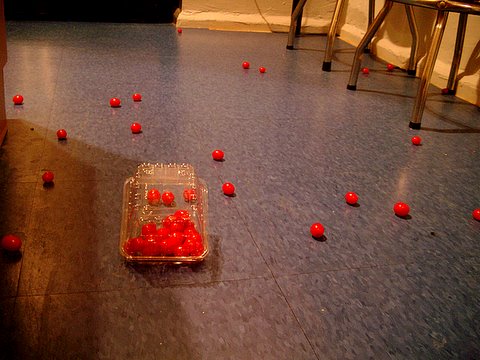
Dear readers, we invite you to submit your own disaster footage from the department of homeland security, which we will reprint as part of a regular feature on The Gay Recluse. Send photographs and any relevant information you would like us to be aware of (background conditions, attribution, etc.) to thegayrecluse@gmail.com.
Filed under: Gay, Government, Landscape, Technology, The Gay Recluse | Leave a Comment
Tags: Cherry Tomatoes, Cooking, Digital Photography, Disaster Footage, Grape Tomatoes, Salad Dressing, Salad Preparation
In which The Gay Recluse writes in highly attenuated metaphors about the Democratic primaries in Michigan.
Regular readers of The Gay Recluse may remember when — a long time ago, perhaps even as many as ten days — we wrote about our preference for Sweetie® Clementines from Mulholland Citrus after a high-stakes “taste-off” with Cuties® California Clementines from Sun Pacific. Rather than settling the matter, however, our decision only fueled the proverbial fire, and to this day — as you all know — debate rages over which Clementine offers the most delightful and refreshing citrus “experience.”
Now, ten days later — time we spent reflecting on this important issue — we were eager to see if and how the situation had changed. We had placed our order with Fresh Direct and the delivery had arrived. As we unpacked the goods, our mind raced with questions: Would the Cutie peels still be saggy and withered? Would the fruit swim with seeds, any one of which can cause a most disturbing crunch? Would each segment be uniformly sweet? As for Sweeties, would they still be delightfully juicy, with a zesty flavor and fragrance that make it impossible to eat just one?
Alas, we regret to inform you that a definitive response on this most critical of issues must wait. Although the Clementines arrived as scheduled, they were not delivered in a box of white balsa wood and paper adorned with our favorite Clementine slogans — “So Sweet!” “Easy To Peel!” — but were carelessly jammed into a generic mesh bag that gave no indication at all as to their origin. Furthermore, all of the fruit was horribly lumpy and misshapen, and the taste was not much better, with segment after segment exhibiting a hard, fibrous texture that made us think of apples! True, based on our prior assessment, we were inclined to say these sad specimens were Cuties, but it hardly seems fair to castigate without the hard evidence we so clearly lacked. By the same token, we doubted that these could be Sweeties, but isn’t history filled with victories that in retrospect are the harbinger of steep decline?
We admit disappointment but not defeat; we have ordered more Clementines and expect them to arrive soon.

Filed under: Communism, Government, Politicians, The Gay Recluse | Leave a Comment
Tags: Barack Obama, Clementines, Cuties, Democratic Primaries, Hillary Clinton, Michigan, Mulholland Citrus, Sun Pacific, Sweetie Clementines
In which The Gay Recluse ponders some recent search terms used to find the very pages you are now reading. Note: All search terms listed are in the exact form provided by WordPress.com, which is the host (at least for a while) of this blog. Hyperlinks to relevant posts included.
Search: where to find sweetie clementines in nyc
Comment: We got ours from Fresh Direct, but be forewarned: they have also been known to stock inferior varieties.
Search: rodentologist + Texas
Comment: An underrated but useful career.
Search: philosophers + opera
Comment: Some are decidedly obese.
Search: is leonard cohen gay?
Comment: Sadly — because we will always love him — we have no reason to believe he is.
Search: decay and neglect
Comment: One reason to live in Washington Heights.
Search: peter nadas gay
Comment: Michael Kimmelman, among others, doesn’t seem to think it’s appropriate to speculate.
Search: die walkure metropolitan opera blythe
Comment: Timeless and beautiful voice.
Search: washington heights next gay area
Comment: We expect to see some very nice corners in the upcoming year.
Search: velcro jeans for gay
Comment: Is this a relevant detail in the context of a murder trial?
Search: “michael kimmelman”
Comment: Not a proponent of what we like to affectionately refer to as the “gay voice.”
Search: is spectacular gay
Comment: Someone else looking for Corsican mint.
Search: was george washington gay?
Comment: We already know about Abraham Lincoln, of course, and have heard rumors about George. For one, he was known to spend a lot of time “alone” at the Morris-Jumel mansion.
Search: gay philosophers
Comment: Anyone who thinks that Arthur Schopenhauer and Friedrich Nietzsche — to name two of our favorites — were anything but needs to think again. Evidence? Friends, you can feel it in the text.
Filed under: Architecture, Gay, Longing, Obsession, Search, The Gay Recluse, Traffic | Leave a Comment
Tags: Arthur Schopenhauer, Corsican Mint, Die Walküre, Friedrich Nietzche, George Washington, Leonard Cohen, Metropolitan Opera, Michael Kimmelman, Peter Nadas, Stephanie Blythe, Sweetie Clementines, The Gay Voice, Velcro Jeans


 The Gay Recluse