In which The Gay Recluse updates his informal but rather telling quantitative analysis of Modern Love, the weekly Style Section (of The Times) column in which openly gay writers almost never appear, and even less frequently describe a romantic relationship.
This week’s piece: The Steep Price of Our Forbidden Kiss
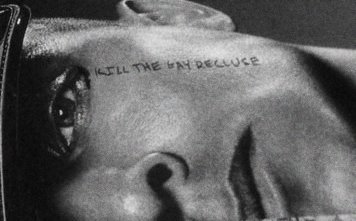
Subject: A young woman with cystic fibrosis falls in love with a man with the same illness; tragically, they can never be together without heightened risk of literally killing each other. This piece is compelling on its own, but we have also provided a “gay” version here in which we emphasize somewhat more overtly the symbolism of disease and sexual orientation (Magic Mountain, anyone?).
Filed under: Straight Woman “Looking for Love.”
The updated tally (or why we feel like animals in the zoo): 6 out of 170 columns by openly gay writers; 1 out of 170 on female gay relationships; 0 out of 170 on male gay relationships. In what is arguably the “gayest” section of The Times, more women have written about gay men than gay men have. And now more women with cystic fibrosis have written about falling in love (not that we don’t applaud that) than openly gay men have; statistically, this seems rather odd.
Outstanding question to Daniel Jones, editor of Modern Love: WTF?
Straight Woman on Relationships iiiii iiiii iiiii iiiii iiiii iiiii iiiii iiii (39)
Straight Woman on Family iiiii iiiii iiiii iiiii iiiii iiiii iiiii (35)
Straight Woman on “Looking for Love” iiiii iiiii iiiii iiiii iiiii iiiii iii (33)
Straight Woman on Breaking Up iiiii iiiii iiiii iiiii iii (23)
Straight Man on Relationships iiiii iiiii i (11)
Straight Man on Breakup iiiiii (6)
Straight Woman on Gay Men iiiii i (6)
Straight Man on Family iiiii (5)
Straight Man on “Looking for Love” iiiii (5)
Gay Man on Family ii (2)
Gay Woman on Relationship i (1)
Gay Woman on Family i (1)
Gay Man on Self-Hatred i (1)
Gay Man on Prom Date i (1)
Ambiguous/Nurse on Drugs i (1)


Filed under: Disease, Dissonance, Language, Resignation, The Gay Recluse, The Times | Leave a Comment
Tags: Cystic Fibrosis, Daniel Jones, Fashion & Style, Gay Modern Love, Stereotypes, The New York Times
In which The Gay Recluse provides a gay alternative to this week’s Modern Love offering in The Times. (Note: For Kayla’s response, please click here.)
By KAYLA RACHLIN SMALL and THE GAY RECLUSE
THE rules forbade me from being within three feet of her. I knew those rules; she knew them. Sharing a drink meant coming a yard too close. But I wanted to touch something of hers, to claim my territory. So with an inch of her ale remaining, I reached for Toma’s glass and said, “Let me have a sip.”
She did nothing to stop me. The liquid disappeared, and with it went the infection-control protocol that had been drilled into us for years.
Like everyone else — yes, even lesbians — with cystic fibrosis, Toma and I carry certain bacteria that are harmless to the general population but catastrophic if transmitted to another cystic fibrosis patient. Our lungs, carpeted with thick, sticky mucus, provide a chemical environment in which typically innocuous germs can wreak havoc, causing more chest infections, more weeks in the hospital and a diminished chance at living into our 30s.
As with sexual orientation, the illness itself is transmitted genetically, so when people slide away from me down the subway bench because of my coughing, they’re wasting their energy. I can smear a bacteria like s.maltophilia over the tester lipsticks in Sephora and no one will be harmed. But stand too close to another person with cystic fibrosis, and I could kill them, or myself.
Sometimes I dream of leper colonies. I ache for my vision of quarantine: an apartment with others like me that has a medicine room instead of a medicine cabinet. Since I was a preteenager, I’ve mythologized this community, longed to mooch pills off a friend and compare vein sizes, in a niche where tired explanations (“This is normal. I’m always on antibiotics. I’ve always liked girls”) give way to brainstorming T-shirt slogans or confessing to that single cigarette.
Being with Toma gave me that. I met her on a January afternoon when I sat down a few seats away in the clinic waiting room. At the time, we both had staph growing in our lungs, but we didn’t yet harbor the more virulent bacteria concomitant with cystic fibrosis. Neither of us could catch anything that we didn’t already have.
Still, contact wasn’t encouraged, and we kept our distance. Her eyes fell upon my fishnets as the nutritionist ushered me out of her office; I gazed at her oxfords as she followed her back in.
The next time our clinic dates coincided, she asked if I wanted to get lunch. Over hamburgers, she told me about postcollege life. She had car payments and medical bills and rounds at the pub.
A geologist, she was working only three days a week. It wasn’t enough money, but it gave her more time for horseback riding, which she loved and wouldn’t be physically able to do five years down the road. Her lungs were O.K. for now, but there were the nonpulmonary complications, sinusitis and arthritis and irritable bowel syndrome.
“I know,” I said, thinking of my own intestinal drama. “I had to take Klean-Prep twice this week.” The hamburger’s taste was heavy in my mouth; I stared at a clump of gum in the ashtray, wishing I had a piece so I’d be prepared for a kiss.
As we said goodbye, we moved to hug, then stopped. I wondered if I had overestimated her tolerance; maybe my uncensored accounts of viscera had been too much. Or maybe she was just shy. Or maybe she didn’t want to break the rules.
I had already lost too much to the rules: mothers in waiting rooms asked me to sit farther away from their daughters; or nurses telling me to move back from my doorway because I was in isolation, and too close to the hallway. My summer-school house mother had sat me down saying, “There’s another lesbian in our dorm with cystic fibrosis.” I lit up at the news, but she wasn’t done: “She’s been trying to stay away from you.”
I had had enough. When I reached for Toma’s pint glass on our second date, I was sending the most deliberate and seductive signal possible. She followed my lead. She wrapped an arm around me as we walked. I held her hand, playing with each finger, bulbous at the tip from lack of oxygen. She picked at the hole in my stocking. I traced letters on her back. I leaned against her chest as we sat in plastic seats at the train station, felt her lungs beneath the corduroy and flesh.
We moved quickly after that. Sex held no greater epidemiological risk than casual contact. Our eagerness was partly due to the feeling that we couldn’t be rejected by one of our own.
But I didn’t lose my vanity, or my neuroses, just because Toma knew my body’s dirty secrets. Like anyone, I worried about the spot I missed while shaving and the flab on my stomach.
I could have told her that nutritional deficiency was making my hair fall out; she would have said I needn’t apologize. Instead, after a year of treating my withering hair as gently as possible, I bought a blow dryer and fried it straight for her, just as I would have done for any other girl.
I didn’t throw myself at Toma in hopes of unconditional acceptance; I did it out of defiance. I didn’t care what others thought; or even if they viewed my “real” illness—cystic fibrosis—as a manifestation of my “moral” illness. I wanted to provoke whispers of “How tragic” and “They should have known better” — and then rebuke them with a sense of O.K.-ness that our own parents hadn’t been able to give us, disease and sexual orientation included (to the extent these conditions can even be separated in the minds of most straight people, which is not very often).
We hadn’t meant for it to last. Our first touch, that first shared drink, occurred six weeks before I was to move far away from her. On a horizon marked by unknowable points of decline — questions of when, where, how things would break down — my departure time stood out for its simplicity.
For once, something was certain. Toma didn’t have to fear hurting me when her health deteriorated, or being hurt when mine did. Like our bodies, our relationship came including a cause of death.
But disease isn’t just biology. Like being gay, it’s a personal culture, shaped by stories, by people, by cities, by coincidences. And Toma’s was shaped differently.
As our relationship tapered into text messages and the occasional phone call, I dwelled on our conflicting styles of fighting, mentally breaking her down so there would be less to miss. I dated other girls.
But there was a clause in my moving-on project that said: “You can still want, and give yourself, what she promised you. You’re still entitled to that.”
And so I imagined that when I visited Toma, we would have sex. She would be on standby for when I needed to be reassured, through shared spit and skin, that I wasn’t poison, especially not to someone I loved.
Then came a March afternoon when I stood in my dorm room, phone to my ear, and told Toma I would be visiting soon.
“I’m growing cepacia now,” she replied.
Burkholderia cepacia: our apocalypse. For us, hearing “cepacia” is equivalent to hearing “Stage IV.” But all I heard was: “You can’t visit me.” That statement slowly evolved into the realization that I was never going to touch Toma again. And as it would be too difficult for us to be in the same room and maintain three feet of separation, I would never see her again, either.
I mourned what cepacia meant for us long before I could acknowledge what it meant for Toma: the devastation it forecast. It could drag a patient’s lungs down to useless within a year.
That summer, Toma had announced she was buying herself a model of an Aston Martin for her birthday; driveable midlife-crisis cars aren’t priced for 24-year-olds. But it didn’t matter that she and I had primed ourselves for death within two decades. We’d had a future, and I wasn’t prepared to lose that.
If she was going to decline, I wanted to be dramatic. I wanted to quit college and plant myself at her bedside. I imagined putting my hospital savvy to use, flushing her IV so she wouldn’t have to wait for the nurse, procuring her an Xbox from the children’s playroom. Although this ultra-competent caretaker side of me had her allure, the truth was I didn’t want to watch Toma disintegrate. By being there with her, I would be sentencing myself to the same end.
“Are you willing to risk your life for her?” a friend asked.
I wasn’t.
SO for the second time, I tried to forget Toma. I told myself she was supposed to be one episode, not my entire story. I had wanted to love someone with my disease, and I did.
But what about sitting next to her at the movies, listening as a character onscreen quipped, “I have a lethal disease”? Toma responded, “Join the club,” and we laughed, and I wasn’t the only one for whom it turned into choking.
Another place, another time, and Toma and I would have been banned from public school, from sleepovers.
But we grew up accumulating germs from sandboxes and stables and sodas. We grew up passing for normal, which meant keeping company with myriad people who — just as they assumed we were straight — assumed our coughing was caused by a curable-yet-contagious bug. I remember a group of runny-nosed bunkmates claiming I had made them sick, and the swell of vindication when our counselor told them, “Trust me, you didn’t get it from her.”
Now, on the subway, I sense a man’s glare as I cough into a napkin. He moves a few seats away, and I want to say to him: “I can’t hurt you. You can keep scowling at me until one of us gets off. You can catch my eyes and try to pull them up to the posters warning New Yorkers about the flu, but there’s no reason for me not to be here.”
Except I’m envisioning Toma, alive but inaccessible to me over the last eight months. And the next time the man glares at me, I actually share his desire to see me exiled. I’m thinking: You want me away from you healthy people? Away from the breeders? Quarantined along with people who sound like me?
Some days, I want that, too.
Kayla Rachlin Small, a recent Columbia University graduate, lives in New York City.
Filed under: Disease, Gay, Language, Longing, Resignation, Sickness, Stereotypes, The Gay Recluse, The Times | 1 Comment
Tags: Daniel Jones, Fashion & Style, Gay Modern Love, Kayla Rachlin Small, Lesbian, Stereotypes, The New York Times
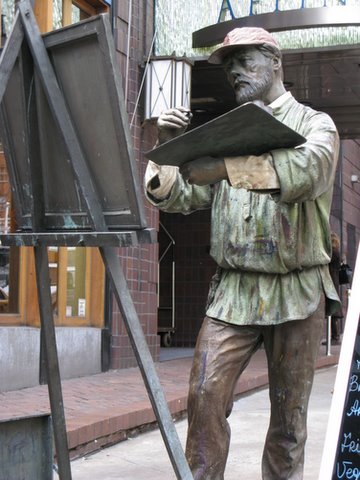
In which The Gay Recluse holds a contest. Sort of.
Today we received this submission from Ed, a reader in Murray Hill who writes:


Filed under: Architecture, Competitions, Gay, Hot Gay Statues, Letters, New York City, The Gay Recluse | 4 Comments
Tags: Eagle, Gay, Gay Statues, Hot Gay Statues, Irving Marantz, Murray Hill, New York City, Park Avenue, Peace Obelisk
In which The Gay Recluse photographs birds.

Mary-Kate and Ashley? Elliot and Silda? Tristan and Isolde? You decide. (Our Jonathan Livingston Seagull moment for the day.)
Filed under: Animals, Dream, GWB Project, Longing, Memory, Photography, The Gay Recluse | Leave a Comment
Tags: Ashley Olsen, Birds, Elliot Spitzer, Isolde, Jonathan Livingston Seagull, Mary-Kate Olsen, Seagulls, Silda Spitzer, Tristan
In which The Gay Recluse scores selected opinion pieces in The Times.
Paul Krugman/Betting the Bank
The Short Version: Economically, we’re fucked.
In his words: “I’m more concerned that despite the extraordinary scale of Mr. Bernanke’s action — to my knowledge, no advanced-country’s central bank has ever exposed itself to this much market risk — the Fed still won’t manage to get a grip on the economy.”
Score: D+ (Depressing)
This column is basically a repeat of Krugman’s last column — just with $200 billion more being offered up by the Fed — so even though the prospect of “one of history’s great financial crises” is indeed scary, we feel kind of dumb reading it. Krugman has already described the problem; it’s time to move on to the anticipated effects.
David Brooks/The Rank-Link Imbalance
The Short Version: _____ is just one of many.
In his words: “If they were used to limits in public life, maybe it would be easier to accept the everydayness of middle-aged passion. But, of course, they are not.”
The Score: B (Benign)
When we first saw the title of this article, we thought it might be about the injustice of Technorati, which at least in our case didn’t count the Gawker linkage (among others) in improving our rank. But actually it’s about _____, and we must give credit to Brooks for writing an entire column about him without mentioning his name. This is another column in which we read Brooks and basically admire his insight and prose enough to consider it a minor tragedy that he’s aligned himself with many of the biggest assholes on the right; e.g., ______, who we have to believe is hardly better than _____ in all of the respects Brooks describes.
Filed under: Capitalism, Drivel, Politicians, Resignation, Technology, The Gay Recluse, The Times | Leave a Comment
Tags: Asshole Men of Either Gender, Asshole Republicans, David Brooks, Elliot Spitzer, John McCain, Midlife Crisis, Paul Krugman, Recession, The Federal Reserve, The New York Times
In which The Gay Recluse becomes increasingly obsessed with The George Washington Bridge.
Time and Date of photograph: March 13, 2008, 7:38am.
Notes: The cloud bank this morning looked like a mountain range.
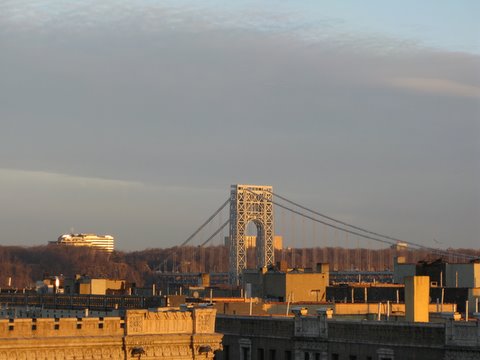
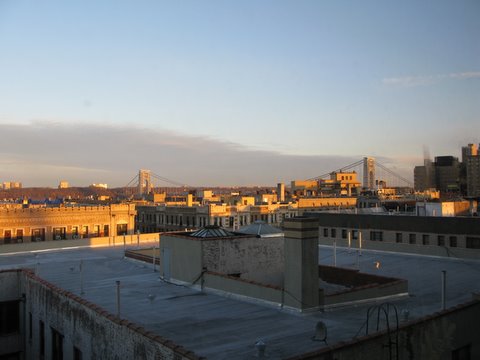
“The George Washington Bridge over the Hudson is the most beautiful bridge in the world. Made of cables and steel beams, it gleams in the sky like a reversed arch. It is blessed. It is the only seat of grace in the disordered city. It is painted an aluminum color and, between water and sky, you see nothing but the bent cord supported by two steel towers. When your car moves up the ramp the two towers rise so high that it brings you happiness; their structure is so pure, so resolute, so regular that here, finally, steel architecture seems to laugh. The car reaches an unexpectedly wide apron; the second tower is very far away; innumerable vertical cables, gleaming against the sky, are suspended from the magisterial curve which swings down and then up. The rose-colored towers of New York appear, a vision whose harshness is mitigated by distance.”
– Le Corbusier, When the Cathedrals Were White, 1947.
Filed under: Architecture, GWB Project, Photography, Technology, Washington Heights, Weather | Leave a Comment
Tags: 1947, Blue, Clouds, George Washington Bridge, Le Corbusier, March, Morning Light, Mountains
In which The Gay Recluse photographs birds.
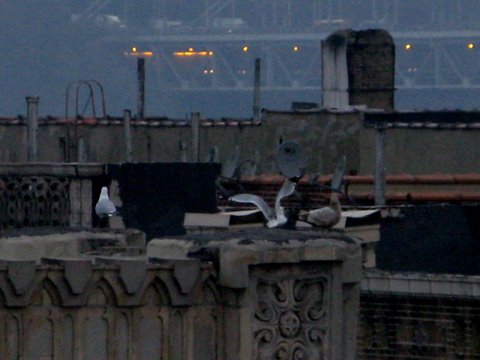
Some days we want to photograph the George Washington Bridge. Today we went for the seagulls.
Filed under: Gay, GWB Project, Infrastructure, Landscape, Photography, Technology, The London Eye, Washington Heights | Leave a Comment
Tags: Birds, George Washington Bridge, Seagulls, Trucks
In which The Gay Recluse would laugh at government doublespeak (and the media’s reporting of the same) if it were in a novel instead of the real world.
Today Jeff Weinstein sent us the following quote from an article in The Times (of London) about the British government’s decision to reopen the asylum case of Iranian gay teenager Mehdi Kazemi, who faces execution in Iran (where they like to literally hang cocksuckers, instead of just metaphorically as in advanced countries such as Britain and the U.S.):
“The department’s own guidance concedes that Iran executes homosexuals but rejects the claim that there is a systematic repression of gay men and lesbians.”
Hilarious, right? At least — when taken in context — the development nevertheless bodes well for Mehdi Kazemi and all of the gays who have (justifiably) gone berserk on his behalf. But let’s remember: This could be the United States after John McCain dies and Mike Huckabee becomes president.
For more coverage of Iran and the gays, please check out our interview last fall with President Ahmadinejad in the wake of his speech at Columbia University (the one where he said gays “don’t exist” in Iran).
Filed under: Capitalism, Communism, Disaster Footage, Gay, Government, Language, Politicians, Quotes, The Gay Recluse | 1 Comment
Tags: Ahmadinejad, Doublespeak, Executions, Gays, Iran, John McCain, Mehdi Kazemi, Mike Huckabee, Quotes, The Times of London
In which The Gay Recluse scores selected opinion pieces in The Times.
Gail Collins/Unwelcome Surprises
The Short Version: Who knew?
In her words: “Memo to future disgraced politicians: The nation has discussed this at length, and we do not want to see any more stricken spouses at the press conference. ”
Score: B (Boring)
We generally like Collins — and there’s certain a few humorous moments in this column — but much of what she has to say about Spitzer & Company sounds a few days old.
Nicholas Kristof/Do As He Said
The Short Version: Prostitution is bad.
In his words: “We do not permit indentured servitude or polygamy, or employment for less than the minimum wage. So why permit people to work in the unusually dangerous business of selling sex?”
The Score: D (Depressing)
The legalization of prostitution is a complicated issue, and though Kristof conveys some understanding, like so many of his columns, we finish this one feeling scolded and depressed.
Roger Cohen/The Global Rose as Social Tool
The Short Version: Ahh, the sweet smell of globalization!
In his words: “Look at the global economy one way and Buyaki earns the equivalent of seven bunches of roses for a month’s labor. That smacks of exploitation. Look at it another and she has a job she’d never have had until globalization came along.”
The Score: D (Depressing)
We almost always hate reading Cohen, and today is no exception. We’re not always opposed to international trade, but we don’t pretend that it’s the secret of happiness, either. Maybe this makes us “dumb,” (Cohen’s term), but we also question whether it’s really sustainable to ship flowers and many fresh food products around the world, given rising costs of energy, land and pollution.
Filed under: Capitalism, Drivel, Government, Politicians, Resignation, Stereotypes, The Gay Recluse, The Times | Leave a Comment
Tags: Elliot Spitzer, Gail Collings, Globalization, International Trade, Nicholas Kristof, Prostitution, Roger Cohen, Roses, The New York Times
In which The Gay Recluse weighs in on a “controversy.”
Obviously, when we endorsed Geraldine Ferraro for president, it was with the expectation that she would hover benovolently in the past and not say unthinking things like: “If Obama was a white man, he would not be in this position. And if he was a woman of any color, he would not be in this position. He happens to be very lucky to be who he is. And the country is caught up in the concept.”
Though we completely disagree with Ferraro with regard to Obama, we feel her general pain; just as she implicitly compares sexism to racism — to the extent that the former is clearly more tolerated in public discourse than the latter (and for no good reason) — we ourselves have often felt much the same about homophobia (e.g., why is it acceptable for so many public figures to make blatantly homophobic (bigoted) remarks, when a similarly racist viewpoint — publicly aired — would mean the end of a career?). But that said, the fact that racism is less tolerated is obviously a good thing, and has no bearing — except for inspirational purposes (to the extent anything can be truly inspirational) — to continuing problems of sexism (and homophobia). It’s really a case of apples and oranges, and we think that someone of Ferraro’s stature, intelligence and training (she’s a lawyer) should have been able to 1) make the distinction and 2) anticipate the unsavory political backlash.
We still love Ferraro, of course — she will always be a beacon as we remember some of the darkest days of our country’s history — but Obama was right to criticize the comment as being needlessly divisive. If we hadn’t already endorsed him for president, we would do so now.

Geraldine Ferraro: We’ll always love you, but only as you exist in the past.
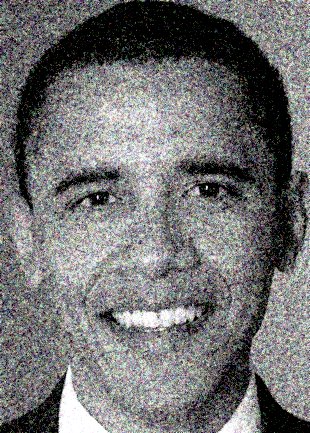
Barack Obama: We hope you win the election.
Filed under: Dissonance, Language, Politicians, Resignation, Stereotypes, The Gay Recluse | 3 Comments
Tags: Barack Obama, Endorsements, Geraldine Ferraro, Homophobia, Sexism
In which The Gay Recluse scores selected opinion pieces in The Times.
Marueen Dowd/Ways of the Wayward
The Short Version: Elliot, Geraldine — yikes — problems!
In her words: “It makes you wonder how sharp Eliot Spitzer’s pencil was on the state’s fiscal discipline.”
Score: B (Blurry)
Dowd starts out making fun of Spitzer in a way that’s already a bit fatigued but nevertheless amusing, and uses the idea of Hillary-the-bystander (during the Bill/Monica) scandal to discuss the idiotic remarks made by Geraldine Ferraro. (Yes, our heart was broken!) If this seems a bit unfocused, that’s because it is.
Filed under: Government, Politicians, Stereotypes | Leave a Comment
Tags: Barack Obama, Elliott Spitzer, Geraldine Ferraro, Maureen Dowd
In which The Gay Recluse applauds the news of uptown development.
Curbed has reported that the city’s plan to rezone 125th Street — a plan we fully endorse — has passed the important hurdle of the Planning Commission, and will now move to City Council for final approval. Curbed also links to local coverage of the event — notably in The Daily News and The Post — which no suprise trots out increasingly outdated racial stereotypes that are a disservice to those (of all ethnicities) who actually live uptown and crave the type of higher-end development our downtown (and Brooklyn) neighbors take for granted. (By higher-end, we mean something besides KFC and its downmarket equivalents across the retail and commercial sectors.) The Post, for example, interviews Shihulu Shange, 66, owner of the Record Shack, “a Harlem institution for 46 years….’The black community is devastated,’ he said. ‘The plan doesn’t count black people. Soon it will all be millionaires and the native people won’t be able to live in their homes. This city is run by a billionaire who is insensitive to people’s suffering. Soon there won’t be any black-owned businesses.'”
Look, we feel bad that the Record Shack is having business troubles — as The Times has also reported — but is it really a question of racial prejudice, or does it have more to do with the fact that sales of records and CDs have basically been eviscerated by the internet? (Tower Records went out of business, too.) We’re not trying to deny that racism exists — any more than we would deny the existence of homophobia — but the truth of the situation is that class is beginning to trump race in Harlem, which — say what you want about asshole millionaires — strikes us as more progressive than the reverse. In the end, it’s good news if you have money and bad news if you don’t. (Welcome to the U.S.A.)
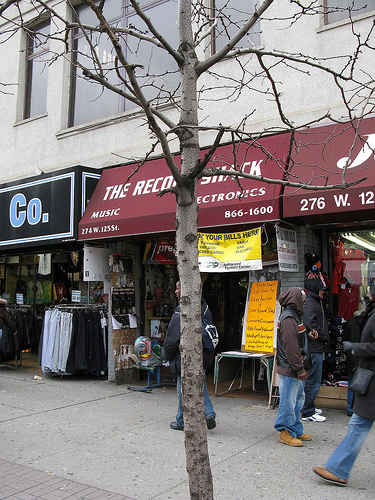
The Record Shack: Voice of the “black community” or site of an internet massacre (in the most commercial sense of the word)?
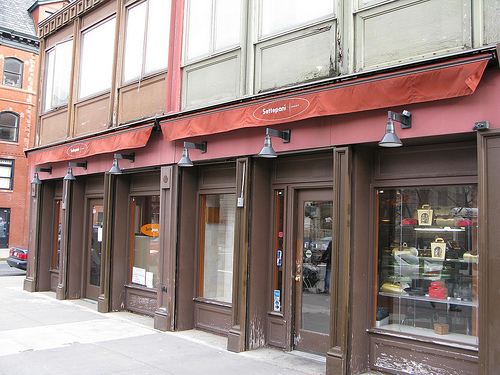
Settepani: Why was this “black-owned” small business ignored by The Post and Daily News? (Answer: it doesn’t fit the stereotype.)
Filed under: Architecture, Gentrification, Knockbusters, New York City, Photography, The Gay Recluse | 3 Comments
Tags: 125th Street, City Council, City Planning, Harlem, Record Shack, Settepani, The Daily News, The New York Times, The Post
In which The Gay Recluse shares a letter.
Robert from Ohio writes:
“I saw the article you wrote on the Corsican Mint. I live in North East Ohio, which is just as harsh a climate as NYC. I have planted the mint at several folks’ homes and it does come back every year. Sometimes the plant survives and sometimes it doesn’t, that depends on the harshness of the winter. It does however seed itself back into existence every year, so fret not Great Gay Recluse!”
Thanks, Robert! In a word: awesome. We have traveled many (many many many) times across the plains of Northeast Ohio and feel very reassured that if “the mint” can survive there, we are — as you rightly point out — in good shape in New York City. We were just out in the garden this past weekend, looking at the rocks and crevices where it had so pleasantly established itself last season; while we didn’t see any signs of life, we will stop fretting and look forward to May, when we can retire to the verdant pleasures of a garden in bloom!

This was last season. According to Robert from Ohio, we need not fret: our beloved Corsican mint will return! Obviously, we will keep you posted.
Filed under: Letters, New York City, The Spring Garden, Washington Heights, Weather | Leave a Comment
Tags: Corsican Mint, gardening, New York City, Northeast Ohio, Winter, Zone 7
In which The Gay Recluse scores selected opinion pieces in The Times.
Bob Herbert/Sharing the Pain
The Short Version: More than ever, it sucks to be poor.
In his words: “It is disgraceful that in a nation as wealthy as the United States, nearly a third of the people are poor or near-poor.”
Score: D- (Depressing)
It’s not that we don’t agree with everything Herbert has to say on some level, but we’re put off by 1) the tired prose in which he says it, and 2) the failure to really deliver any pyschological or historical insight. Reading Herbert’s column you might think the U.S. was the first society to ever confront the issue of a tyrannical elite hellbent on war and (self) destruction and an increasingly impoverished lower class that feeds the machine.
The Editorial Board/Mr. Spitzer’s “Private Matter”
The Short Version: Spitzer is an arrogant asshole. He should totally resign.
In their words: “As state attorney general, he prosecuted prostitution rings with enthusiasm — pointing out that they are often involved in human trafficking, drug trafficking and money laundering.”
The Score: A (Asshole Patrol!)
Smell you later, Elliott!
Filed under: Capitalism, Communism, Drivel, Government, Resignation, The Gay Recluse | Leave a Comment
Tags: Bob Herbert, Elliott Spitzer, Poverty, Prostitution, Recession, Scandal, The New York Times
In which The Gay Recluse holds a contest. Sort of.
Today we are extremely honored to present another hot-gay-statue submission, this one a joint effort from Jeff Weinstein/Out There and John Perreault/Artopia. Jeff writes:

Filed under: Architecture, Capitalism, Competitions, Gay, Infrastructure, Photography, Ruins, The Gay Recluse | Leave a Comment
Tags: Bronze, Gay Statues, Hot Gay Statues, Louis-Leon Cugnot, The Park Avenue Armory, Young Jupiter
On One New Alternative for LOL
In which The Gay Recluse shares a fresh expression used by an older relative new to the internet.
“I’m dead! That’s funny!”
Filed under: Landscape, Memory, Technology, The Gay Recluse | Leave a Comment
Tags: Baby Boomers, Generation Gap, Language, Relatives
In which The Gay Recluse scores selected opinion pieces in The Times.
Paul Krugman/The Face-Slap Theory
The Short Version: We’re in deep shit.
In his words: “The only way the Fed’s action could work is through the slap-in-the-face effect: by creating a pause in the selling frenzy, the Fed could give hysterical markets a chance to regain their sense of perspective.”
Score: B- (Bracing)
Krugman provides a fairly frightening look at what’s happening in the financial markets as the Fed plans to loan more money to banks facing a cash crunch as investors pull back on high-risk investments. What’s missing from this analysis is any sense of what this means to different segments/classes of people; Krugman too often writes as if we’re all in the same boat.
William Kristol/McCain’s Daunting Task
The Short Version: The Republicans seem to be fucked.
In his words: “[The] Democratic pickup suggests that, for now, we’re in an electoral environment more like 2006 than 2004.”
The Score: C- (Chilling)
Kristol is right about the demographics, but also gives chilling insight into the Republican strategy in a general election, e.g., “A sustained assault highlighting these weaknesses of Obama or Clinton could be effective,” or “[McCain] could pick a hawkish and principled Democrat like Joe Lieberman,” or “[McCain] could persuade the most impressive conservative in American public life, Clarence Thomas, to join the ticket.” Really, what else can you say but holy fucking shit? (Well, at least it would get Thomas off the Supreme Court.)
Roger Cohen/Tribalism Here, and There
The Short Version: People are divided, but Obama gives them hope.
In his words: “The main forces in the world today are the modernizing, barrier-breaking sweep of globalization and the tribal reaction to it, which lies in the assertion of religious, national, linguistic, racial or ethnic identity against the unifying technological tide.”
The Score: C- (Clammy)
Cohen’s syrupy, optimistic prose always wrecks everything. We, too, favor an Obama presidency, but less because we think he will “heal” anything than because he’s urban (and just to be clear, we’re not talking about ethnicity) and liberal.
Filed under: Capitalism, Communism, Drivel, Politicians, The Gay Recluse, The Times | Leave a Comment
Tags: Asshole Republicans, Barack Obama, Clarence Thomas, Federal Reserve, Joe Lieberman, John McCain, Paul Krugman, Recession, Roger Cohen, The New York Times, William Kristol
In which The Gay Recluse compares the Richard Wagner opera Tristan and Isolde (first performed in Munich in 1865; financed by King Ludwig II of Bavaria and now running at The Metropolitan Opera) with Loveless, the final record by My Bloody Valentine (Creation, 1991).
While the music is dissonant, it’s never abrasive; it’s just another thread in the rich tapestry of the overall work. It’s a quiet dissonance — almost undetectable, a constant yet hovering tremolo — that leaves us hypnotized by what you might call an irrational longing, the sort of thing that never really goes away no matter how perfect life might seem at any given moment. Except, oddly enough, when we listen to this! How could we crave anything when we look up in awe at the shimmering, oscillating melodies even as we are pulled deeper and deeper under the unceasing waves of sound? Does it bother you not to understand the words, or (when you do, now and again) to hear that they are simple and repetitive, more cheaply poetic than philosophical? If so, then you’re missing the point; forget what everyone else says about any theory of Gesasmtkunstwerk! It’s about music; lush, beautiful (symphonic) music. It’s about immersing yourself in the most undiluted form of love, which of course is the night and everything that symbolizes, including the most loveless state of all. In a thousand years, when people look back at the birth of modernism, this is the music they will point to for first fulfilling the premise of unfathomable beauty in utter chaos (and vice versa).
Filed under: Dissonance, Good Rock, Longing, Memory, Opera, The Gay Recluse | Leave a Comment
Tags: Bavaria, Creation Records, Gesasmtkunstwerk, King Ludwig II, Loveless, Munich, My Bloody Valenting, Richard Wagner, Tristan and Isolde
In which The Gay Recluse scores selected opinion pieces in The Times.
Nicholas Kristof/Obama and the Bigots
The Short Version: We must teach people not to be such crazy losers.
In his words: “Likewise, with countless people today spreading scurrilous rumors that Mr. Obama is a Muslim, the most appropriate response is a denial followed by: And so what if he were?”
Score: D- (Detached from reality)
Rather than express surprise and outrage that a certain percentage of people are crazy losers, let’s just accept 10,000 years of history and figure out how to minimize their wide-scale impact. Here’s a clue: it’s not by sitting down and gently pointing out that they are crazy losers. Here’s another clue: it’s not by writing about why they are crazy losers on the opinion page of The Times.
Maureen Dowd/The Monster Mash
The Short Version: Obambi II?
In her words: “[H]e will now have to come to grips with something he has always skittered away from: You can’t be elected president unless you prove you’re tough.”
The Score: A (Ass-kicking)
Dowd tells it like it is here, in language that’s clear and convincing. As much as we love Obama for his “effete and vaguely foreign” aura (Dowd’s phrase), we understand that it’s never going to sell to the masses, particularly once the Republican machine gets oiled up.
Filed under: Dissonance, Drivel, Gay, Government, Politicians, The Gay Recluse, The Times | 1 Comment
Tags: Barack Obama, Bigotry, Crazy Losers, Hillary Clinton, Maureen Dowd, Nicholas Kristof, Obambi, The New York Times
In which The Gay Recluse holds a contest. Sort of.
On the topic of hot gay statues, one of our readers — David from Queens — writes with an important observation/challenge:
Great contest, Gay Recluse. But it would be virtually impossible for our splendid nation to top the statue of Hercules and Cacus (attached) in Florence. I took pictures of this myself many years ago, but they’re all in storage in Alabama, so for now I’m sending you the Wikipedia version. (BTN–Better Than Nothing!) I’ll keep looking! David

Hercules and Caucus (courtesy of Wikipedia.)
Commissioned in the 1520s by Pope Clement VII (of the Medicis), this statue was made by Florentine artist Baccio Bandinelli. (PS. It took him ten years but was totally worth every second!) We encourage our American readers to take note: this statue is seriously gay and — from where we sit — smokin’ hot. As our once-great nation heads into decline, can we at least preserve our dignity in this critical indicator of national well-being? We’d like to tell David that he’s wrong — that the United States can “win the gold” — but we’re not feeling too confident at the moment. Are there more hot gay statues in the United States? We’re counting on you to help us find out.
The Hot Gay Statue Contest Roundup:
- Rules and Guidelines
- Dan Savage Endorsement
- Washington Heights (New York City)
- Washington, DC
- The London Eye Clarifies an Important Issue
Filed under: Architecture, Competitions, Decay, Gay, Ruins, The Gay Recluse, Travel | 2 Comments
Tags: Contests, Firenze, Florence, Gay Statues, Hercules and Caucus


 The Gay Recluse