In which The Gay Recluse scores selected opinion pieces in The Times.
Nicholas Kristof/Obama and Race
The Short Version: Obama gave a great speech the other day.
In his words: “Much of the time, blacks have a pretty good sense of what whites think, but whites are oblivious to common black perspectives.”
Score: B- (Boring)
We obviously liked Obama’s speech, too, but Kristof comes off as almost too naive for words. Here’s another shocker for Kristof to consider: substitute the word “gays” for “blacks” and “straights” for “whites” in the above equation, and the result is the same!
Roger Cohen/Beyond America’s Original Sin
The Short Version: Obama’s speech!
In his words: “A racial divide, once lived, dwells in the deepest parts of the psyche. This is what was captured by Barack Obama’s pitch-perfect speech on race.”
The Score: B (Benign)
Although we are never drawn to Cohen’s prose, we appreciate the sentiment.


Filed under: Capitalism, Government, Language, Politicians, Stereotypes, The Gay Recluse | Leave a Comment
Tags: Barack Obama, Nicholas Kristof, Race, Roger Cohen, The New York Times
In which The Gay Recluse posts an incisive reader comment.
This was left in the comments but we thought it merited a full post because it brings to light several important and interesting issues that are not unrelated to our obituary of Arthur C. Clarke, which — ahem — did not please everyone.
Vikram — a gay man in India — writes:
I thought your reworked edit was unfair, sure, but also funny and not without some points. One of them you’ve defended above. The other is the certain level of discomfort one feels about a closeted Western gay man parachuting into a developing country like Sri lanka and using the status he gains by being there to lead a life he wasn’t able to lead in the West, at least when he went there, and which most gay Sri Lankans still can’t.
As a gay man living in India I don’t want to make assumptions about the intentions of all foreigners who live in countries like this, but it does rather creep me out to encounter rich (over here) foreigners who use their status to have sexy local men at their beck and call. Maybe some level of envy here, I agree, and often these guys do take care of their local guys. Nonetheless there’s an element of exploitation that cannot be overlooked easily.
I’d even be willing to do that if these guys would make some effort to use their considerable influence to change attitudes and government policy towards homosexuals, but that rarely happens. You point out how much it would have helped a young gay sci fi fan to discover that someone like Clarke was gay – imagine how much it would have helped a young gay Sri Lankan man to have learned that Clarke was an out, proud gay man,rather than someone around whom lots of salacious (and probably incorrect, but that’s not really the point) rumours always swirled in Sri Lanka.
Sri Lanka isn’t the worst place to be gay in, but its not great. Some bad stuff has happened, like the extension of anti gay laws to cover lesbians. Clarke did do a lot for Sri Lanka, but he could have done a lot for gay Sri Lankans. Perhaps he tried – I’ll mail Sri Lankan activists I know to check – but the chances are he was happy to benefit from the special status he had there, but not willing to help others who didn’t have it.
Thanks for this comment, Vikram. These are important issues that extend far beyond the legacy of Arthur C. Clarke, and we look forward to exploring them more outside of that context (which is already getting a bit tedious, now that he’s been dead for so long.)
Filed under: Decay, Dissonance, Gay, Letters, Stereotypes, The Gay Recluse | 5 Comments
Tags: Arthur C. Clarke, Colonialism, Gay, India, Outing the Dead, Rich Foreigners, Sri Lanka
In which The Gay Recluse becomes increasingly obsessed with The George Washington Bridge.
Time and Date of photograph: March 19, 2008, 6:54am.
Notes: A gray morning, but the cats are up. (There’s no going back to sleep.)
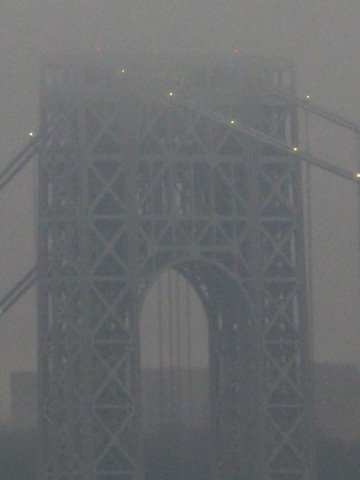
“The George Washington Bridge over the Hudson is the most beautiful bridge in the world. Made of cables and steel beams, it gleams in the sky like a reversed arch. It is blessed. It is the only seat of grace in the disordered city. It is painted an aluminum color and, between water and sky, you see nothing but the bent cord supported by two steel towers. When your car moves up the ramp the two towers rise so high that it brings you happiness; their structure is so pure, so resolute, so regular that here, finally, steel architecture seems to laugh. The car reaches an unexpectedly wide apron; the second tower is very far away; innumerable vertical cables, gleaming against the sky, are suspended from the magisterial curve which swings down and then up. The rose-colored towers of New York appear, a vision whose harshness is mitigated by distance.”
– Le Corbusier, When the Cathedrals Were White, 1947.
Filed under: Architecture, Dissonance, GWB Project, Infrastructure, The Gay Recluse, Washington Heights, Weather | Leave a Comment
Tags: 1947, George Washington Bridge, Gray, Le Corbusier, March, Morning Light
In which The Gay Recluse kills two birds with one stone.
Today we received a certain amount of shit for “trashing” Arthur C. Clarke as a major closet-case only milliseconds after he died. Fair enough, we trashed him a little. But our purpose in doing so — besides being an internet traffic whore, of course — was to demonstrate to more impressionable young minds that it’s possible to be a commercially successful, influential artist and a cocksucking faggot.
Coincidentally, we happened to receive the following letter:
Hey Gay Recluse: My name is Jeffrey and and I recently found your blog while surfing the web. Last year I lived on 161st and Fort Washington, now I live in Bushwick, and by the end of April, I’ll be somewhere else. Sheesh!I just finished reading your post, “On the Suffocation of the Gay Voice in American Literature.” I thought it was beautifully written (though I have a hard time understanding things that are really academic — but I try!) and really hit home for me. I’m a young artist trying to figure out my voice and style, and occasionally I’ll find it and be reminded by others that I really do have ‘it’. I really resonated with the opening paragraph of your post and totally related it to my own artwork. Before I came out three years ago and still to this day, I could never figure out why my artwork, as expressive as it is, seemed to depict a very sad young guy. It’s as if a weight is placed on his shoulders that makes him gloomy. I attempted to write that my artwork was nothing more than a typical generational experience here in America — that any young adult feels the same way as the characters in my work. After reading your opening paragraph, I know that I can attribute my artwork as being gay.
Jeffrey, thanks for writing! We know exactly how you feel. We suspect the reason you feel sad is because society (and in all likelihood, a certain percentage of your “close” friends and family) hates you for being gay — whether they admit it or not — and that you have not perhaps come to grips with this yet, which is understandable: it takes time. The good news is that with a little luck and patience you will eventually appreciate this reality for the blessing it is, and learn to really love the 2 percent of people who genuinely love you back!
We think of ourselves at the age of 10 or 12, reading books and books and books by legions of post-war writers and wondering why not a single one — regardless of subject matter — was openly gay. Or maybe that’s too strong; at 10 or 12 it was more like sensing that nobody was gay, much in the way we sensed that we in fact were. From here it’s not long before we were living in a cloud of toxic self-hatred and melancholy that persists to this day (except of course we kind of love it now, but that’s a light at the end of the tunnel).
So when people — heroic figures, even — like Arthur C. Clarke are closet cases, it leaves many inexplicably sad young artists like Jeffrey in their wake. Our hope is to elevate Arthur C. Clarke by pointing to the truth (albeit in a satirical fashion that we try to make entertaining), which is that he was a major queen by almost any reckoning. We like to imagine some gay kid out there reading about the death of one of his favorite writers and then reading our obituary, and in this way getting a glimmer of hope from knowing that they are not as different as perhaps meets the eye. Doesn’t the letter from Jeffrey rest our case?
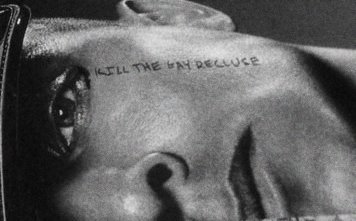
Filed under: Disease, Dissonance, Gay, History, Language, Letters, Literature, Longing, Stereotypes, The Gay Recluse | 5 Comments
Tags: Arthur C. Clarke, Closet Cases, Closet Queens, Internet Whores, Self-Hatred, The Gay Voice
On a Piece of Advice to Canadian Gay Refugees: You May Want To Record that XXX Video After All
In which The Gay Recluse considers the reigning state of stupidity, even in nice countries like Canada.
Our friend Jeff Weinstein wrote earlier this week with this piece of news, which would be hilarious if it were in a movie, but instead must be viewed as sadly incredible. According to the article, by Tiffany Crawford of the Canwest News Service, “The Canadian Refugee Board needs to establish clearer guidelines on sexual orientation to help adjudicators avoid stereotyping gay and lesbian refugees who have little proof they are gay.” There are a growing number of such refugees — many of whom come from gay-hating countries such as The United StatesMalaysia and Nicaragua — whose claims have been denied because they can’t prove they are gay. Because these same countries do not offer their fleeing refugees much in the way of “gay-pride parades” and “online gay-chat rooms,” many of them show up to their hearing without any evidence, and so must resort to “stereotypical” gay behavior (i.e., acting like Tom Cruise Chris Crocker). Adding to the problem is that “witnesses and letters are dismissed as hearsay and claimants are accused of fabricating lies to stay in Canada.”
Although this is undoubtedly the stupidest thing ever, it does strike at the core of a tedious but underappreciated question: what exactly does it mean to be “gay”? Ultimately — and especially in the political arena — we prefer one definition that revolves around the sexual act: if you’re a man and you like (even in theory) to ____ or ___ or ____ with another man, you’re gay (sorry all you “straight” M2M Craigslisters!) and vice versa for women. (For the moment, we’ll leave aside questions of exactly what makes you a “man” or “woman,” although we obviously think the question is not without merit.) Although we appreciate all sorts of cultural notions of what or who is or isn’t gay, we think that 98 percent of these revolve around stereotypes (in short: gay men are “womanish” and gay women are “mannish”) that almost never reflect the reality of who is or isn’t “gay,” at least according to the proposed definition.
All of which is to say that we have one piece of advice to these kids: if you want to prove you’re gay, don’t take chances, take videos! We wish we were joking.
Filed under: Gay, Government, Law, Politicians, Stereotypes, The Gay Recluse | 3 Comments
Tags: Canada, Chris Crocker, Gay, Refugees, The Canadian Refugee Board, Tom Cruise
In which The Gay Recluse scores selected opinion pieces in The Times.
Maureen Dowd: Black, White & Gray
The Short Version: Obama’s “race speech” rawked!
In her words: “A little disenchantment with Obama could turn out to be a good thing. Too much idealism can blind a leader to reality as surely as too much ideology can.”
Score: A- (Astute)
Although this is essentially a love letter to Obama, we agree that he deserves it. Let’s hope it resonates in the way Dowd suggests it should.
Filed under: Capitalism, Politicians, Stereotypes, The Gay Recluse, The Times | 2 Comments
Tags: Barack Obama, Maureen Dowd, Race, The New York Times
In which The Gay Recluse becomes increasingly obsessed with The George Washington Bridge.
Time and Date of photograph: March 18, 2008, 6:48am.
Notes: It was early, but the blue and orange — i.e., together — was the best part of the day.
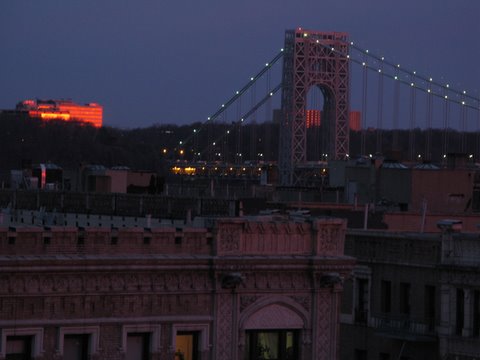
“The George Washington Bridge over the Hudson is the most beautiful bridge in the world. Made of cables and steel beams, it gleams in the sky like a reversed arch. It is blessed. It is the only seat of grace in the disordered city. It is painted an aluminum color and, between water and sky, you see nothing but the bent cord supported by two steel towers. When your car moves up the ramp the two towers rise so high that it brings you happiness; their structure is so pure, so resolute, so regular that here, finally, steel architecture seems to laugh. The car reaches an unexpectedly wide apron; the second tower is very far away; innumerable vertical cables, gleaming against the sky, are suspended from the magisterial curve which swings down and then up. The rose-colored towers of New York appear, a vision whose harshness is mitigated by distance.”
– Le Corbusier, When the Cathedrals Were White, 1947.
Filed under: Architecture, GWB Project, Infrastructure, The Gay Recluse, Washington Heights, Weather | Leave a Comment
Tags: 1947, Blue, George Washington Bridge, Le Corbusier, March, Morning Light, orange
In which The Gay Recluse breathes a sigh of relief and encourages everyone to buy a book.
Recently we read The Gay Uncle’s Guide To Parenting by Brett Berk and learned that the world is filled with these strange creatures called “children,” which — somewhat alarmingly — are the by-product and responsibility of an even stranger (and infinitely more damaged) group of people known as “parents.” Children, it seems, are like pets to the extent that they need to be taken care of all the time, but they are a lot smarter: some can even talk! Otherwise, children seem to be pretty cool: they like to play and eat and make friends and build stuff and basically have a lot of fun in their miniature but wildly imaginative minds. True: sometimes they cry, are annoying or even throw tantrums because they are overwhelmed, which is less fun.
Parents, however, are another story! It’s hard to imagine a more neurotic, stressed-out group. For starters, many of them never go out for drinks, which makes them oddly insulated; they have a tendency to buy way more things than their kids actually need; they feed their children a lot of junk; they won’t let their kids sleep; they tell the stupidest and most confusing lies to their kids; they threaten their children with outlandish scenarios that they can never follow through on; they “home-school” their children. In short, parents do all sorts of crazy, stupid shit that seems all but certain to give their children major complexes that will undoubtedly take years and years on the therapist’s couch to unravel. Reading this, we were continually left with the question: must parents be so stupid?
Fortunately, they now have help. Brett Berk — in the form of The Gay Uncle — provides an entire book’s worth of sound advice (at least as far as we can tell; remember, we didn’t even know what children were!) on how parents can escape their “bubbles” and raise children with some modicum of sanity. This is fun reading: unlike us, Brett has a lot of experience dealing with kids and parents (he ran a pre-school in the East Village!) and tells great stories to drive home his points. In what is probably our favorite chapter on making friends, he describes an improbable bond between a little girl who is a bit of a straight arrow and a boy who is a free spirit; the girl’s parents — needless to say — are not happy about this and refuse to make a “play date,” although the boy’s mother is quite amenable to the idea. Berk says: “I’ve found that when parents express reservations about their kid’s friendships, the problem is more often rooted in an internal conflict of their own rather than anything having to do directly with their child.” (Berk’s itals, not ours.)
Berk would be annoying and overbearing at times if it were not for the fact that (besides being well qualified; he even has an M.S. Ed), he is very cognizant of his annoying and overbearing tendencies, and even better — a true queen! — uses this to great comic effect: “I wanted to offer some advice. But…I went for distraction instead. ‘Hummus, anyone?'” (This as a boy in the process of toilet training lays a turd on Berk’s front porch.)
In short, this is a book you will want every parent to have; the only question — given the above — is how to get it to them. We recommend buying a few copies and surreptitiously (or even “accidentally”) leaving one behind whenever appropriate. There are a lot of parents in the world, and apparently they still need lots of help. Why not let The Gay Uncle come to the rescue?
Brett Berk is currently on a book tour. He is a very entertaining reader: if you can, go see him! For information on that and all things Gay Uncle, visit his blog (brettberk.com).
Filed under: Gay, Language, Quotes, Search, Television, The Gay Recluse | 12 Comments
Tags: Advice, Brett Burk, Children, Parents, The Gay Uncle
In which The Gay Recluse provides a more accurate obituary for Arthur C. Clarke than the one that just appeared in The Times. (For the AP version, click here.)
Arthur C. Clarke, Premier Science Fiction Writer, Dies at 90
By GERALD JONAS and THE GAY RECLUSE
Arthur C. Clarke, a writer and long-time closet case whose seamless blend of scientific expertise and poetic imagination helped usher in the space age, died early Wednesday in Colombo, Sri Lanka, where he had lived since 1956. He was 90.
Rohan de Silva, an aide to Mr. Clarke, said the author died after experiencing breathing problems, The Associated Press reported. Mr. Clarke had post-polio syndrome for the last two decades and used a wheelchair.
From his detailed forecast of telecommunications satellites in 1945, more than a decade before the first orbital rocket flight, to his co-creation, with the director Stanley Kubrick, of the classic science fiction film “2001: A Space Odyssey,” Mr. Clarke was both prophet and promoter of the idea that humanity’s destiny lay beyond the confines of Earth. Sadly, however, he never owned up to being gay.
Other early advocates of a space program argued that it would pay for itself by jump-starting new technology. Mr. Clarke set his sights higher. Paraphrasing William James, he suggested that exploring the solar system could serve as the “moral equivalent” of war, giving an outlet to energies that might otherwise lead to nuclear holocaust.
Mr. Clarke’s influence on public attitudes toward space was acknowledged by American astronauts and Russian cosmonauts, by scientists like the astronomer Carl Sagan and by movie and television producers. Gene Roddenberry credited Mr. Clarke’s writings with giving him courage to pursue his “Star Trek” project in the face of indifference, even ridicule, from television executives.
In his later years, after settling in Ceylon (now Sri Lanka) — where he famously hosted orgies for young Sri Lankan men — Mr. Clarke continued to bask in worldwide acclaim as both a scientific sage and the pre-eminent science fiction writer of the 20th century. In 1998, he was knighted by Queen Elizabeth II.
He played down his success in foretelling a globe-spanning network of communication satellites. “No one can predict the future,” he always maintained.
But as a science fiction writer, he couldn’t resist drawing up timelines for what he called “possible futures,” none of which, however, included any gay people some of which apparently featured bisexual or gay characters, which — whatever — did not lead Mr. Clarke to come out. Far from displaying uncanny prescience, these conjectures mainly demonstrated his lifelong, and often disappointed, optimism about the peaceful uses of technology — from his calculation in 1945 that atomic-fueled rockets could be no more than 20 years away to his conviction in 1999 that “clean, safe power” from “cold fusion” would be commercially available in the first years of the new millennium. It was often noted that he had his head in the clouds in more ways than one.
Mr. Clarke was well aware of the importance of his role as science spokesman to the general population: “Most technological achievements were preceded by people writing and imagining them,” he noted. “I’m sure we would not have had men on the Moon,” he added, if it had not been for H.G. Wells and Jules Verne. “I’m rather proud of the fact that I know several astronauts who became astronauts through reading my books.” That said, he never admitted to liking men, and so did a disservice to untold numbers of young gay writers throughout the world who admired his work.
Arthur Charles Clarke was born on Dec. 16, 1917, in the seaside town of Minehead, Somerset, England. His father was a farmer; his mother a post office telegrapher. The eldest of four children, he was educated as a scholarship student at a secondary school in the nearby town of Taunton. He remembered a number of incidents in early childhood that awakened his imagination: exploratory rambles along the Somerset shoreline, with its “wonderland of rock pools;” a card from a pack of cigarettes that his father showed him, with a picture of a dinosaur; the gift of a Meccano set, a British construction toy similar to the Erector sets sold in the United States; the time he witnessed two men fucking down by the abandoned railway line.
He also spent time “mapping the Moon” through a telescope he constructed himself out of “a cardboard tube and a couple of lenses.” But the formative event of his childhood was his discovery, at age 13 — the year his father died — of a copy of “Astounding Stories of Super-Science,” then the leading American science fiction magazine. He found its mix of boyish adventure and far-out (sometimes bogus) science almost as intoxicating as his same-sex fantasies.
While still in school, Mr. Clarke joined the newly formed British Interplanetary Society, a small band of sci-fi enthusiasts who held the controversial view that space travel was not only possible but could be achieved in the not-so-distant future. In 1937, a year after he moved to London to take a civil service job, he began writing his first science fiction novel, a story of the far, far future that was later published as “Against the Fall of Night” (1953).
Mr. Clarke spent World War II as an officer in the Royal Air Force. In 1943 he was assigned to work with a team of American scientist-engineers who had developed the first radar-controlled system for landing airplanes in bad weather. That experience led to Mr. Clarke’s only non-science fiction novel, “Glide Path” (1963). More important, it led in 1945 to a technical paper, published in the British journal “Wireless World,” establishing the feasibility of artificial satellites as relay stations for Earth-based communications.
The “meat” of the paper was a series of diagrams and equations showing that “space stations” parked in a circular orbit roughly 22,240 miles above the equator would exactly match the Earth’s rotation period of 24 hours. In such an orbit, a satellite would remain above the same spot on the ground, providing a “stationary” target for transmitted signals, which could then be retransmitted to wide swaths of territory below. This so-called geostationary orbit has been officially designated the Clarke Orbit by the International Astronomical Union.
Decades later, Mr. Clarke called his “Wireless World” paper “the most important thing I ever wrote.” In a wry piece entitled, “A Short Pre-History of Comsats, Or: How I Lost a Billion Dollars in My Spare Time,” he claimed that a lawyer had dissuaded him from applying for a patent. The lawyer, he said, thought the notion of relaying signals from space was too far-fetched to be taken seriously.
But Mr. Clarke also acknowledged that nothing in his paper — from the notion of artificial satellites to the mathematics of the geostationary orbit — was new. His chief contribution was to clarify and publicize an idea whose time had almost come — a feat of consciousness-raising that was in marked contrast to his views on homosexuality, but one at which he would continue to excel at throughout his career.
The year 1945 also saw the launch of Mr. Clarke’s career as a fiction writer. He sold a short story called “Rescue Party” to the same magazine — now re-titled Astounding Science Fiction — that had captured his imagination 15 years earlier.
For the next two years, Mr. Clarke attended Kings College, London, on the British equivalent of a G.I. Bill scholarship, graduating in 1948 with first-class honors in physics and mathematics. But he continued to write and sell stories, and after a stint as assistant editor at the scientific journal Physics Abstracts, he decided he could support himself as a freelance writer. Success came quickly. His primer on space flight, “The Exploration of Space,” was a Book-of-the-Month Club selection in 1951
Over the next two decades, he wrote a series of nonfiction bestsellers as well as his best-known novels, including “Childhood’s End” (1953) and “2001: A Space Odyssey” (1968). For a scientifically trained writer whose optimism about technology seemed boundless, Mr. Clarke delighted in confronting his characters with obstacles they could not overcome without help from forces beyond their comprehension.
In “Childhood’s End,” a race of aliens who happen to look like devils imposes peace on an Earth torn by cold war tensions. But the aliens’ real mission is to prepare humanity for the next stage of evolution. In an ending that is both heartbreakingly poignant and literally earth-shattering, the self-hating Mr. Clarke suggests that mankind can escape its suicidal tendencies only by ceasing to be human.
“There was nothing left of Earth,” he wrote. “It had nourished them, through the fierce moments of their inconceivable metamorphosis, as the food stored in a grain of wheat feeds the infant plant while it climbs toward the Sun.”
The cold war also forms the backdrop for “2001.” Its genesis was a short story called “The Sentinel,” first published in a science fiction magazine in 1951. It tells of an alien artifact found on the Moon, a little crystalline pyramid that explorers from Earth destroy while trying to open. One explorer realizes that the artifact was a kind of fail-safe beacon; in silencing it, human beings have signaled their existence to its far-off creators.
In the spring of 1964, Stanley Kubrick, fresh from his triumph with “Dr. Strangelove or: How I Learned to Stop Worrying and Love the Bomb,” met Mr. Clarke in New York, and the two agreed to make the “proverbial really good science fiction movie” based on “The Sentinel.” This led to a four-year collaboration; Mr. Clarke wrote the novel while Mr. Kubrick produced and directed the film; they are jointly credited with the screenplay.
Reviewers at the time were puzzled by the film, especially the final scene in which an astronaut who has been transformed by aliens returns to orbit the Earth as a “Star-Child.” In the book he demonstrates his new-found powers by harmlessly detonating from space the entire arsenal of Soviet and American nuclear weapons. Like much of the plot, this denouement is not clear in the film, from which Mr. Kubrick cut most of the expository material.
As a fiction writer, Mr. Clarke was — no surprise — often criticized for failing to create fully realized characters. HAL, the mutinous computer in “2001,” is probably his most “human” creation: a self-satisfied know-it-all with a touching but misguided faith in its own infallibility.
If Mr. Clarke’s heroes are less than memorable, it is also true that there are no out-and-out villains in his work; his characters are generally too busy struggling to make sense of an implacable universe to engage in petty schemes of dominance or revenge.
Mr. Clarke’s own relationship with machines — as with women — was somewhat ambivalent. Although he held a driver’s license as a young man, he never drove a car. Yet he stayed in touch with the rest of the world from his home in Sri Lanka through an ever-expanding collection of up-to-date computers and communications accessories. And until his health declined, he was an expert scuba diver in the waters around Sri Lanka.
He first became interested in diving in the early 1950s, when he realized that he could find underwater “something very close to weightlessness” of outer space. He settled permanently in Colombo, the capital of what was then Ceylon, in 1956. With a business partner, he established a guided diving service for tourists and wrote vividly about his diving experiences in a number of books, beginning with “The Coast of Coral” (1956).
All told, he wrote or collaborated on close to 100 books, some of which, like “Childhood’s End,” have been in print continuously. His works have been translated into some 40 languages, and worldwide sales have been estimated at more than $25 million.
In 1962 he suffered a severe attack of poliomyelitis. His apparently complete recovery was marked by a return to top form at his favorite sport, table tennis. But in 1984 he developed post-polio syndrome, a progressive condition characterized by muscle weakness and extreme fatigue. He spent the last years of his life in a wheelchair.
Among his legacies are Clarke’s Four Laws, provocative observations on science, science fiction and society that were published in his “Profiles of the Future” (1962):
¶“When a distinguished but elderly scientist states that something is possible, he is almost certainly right. When he states that something is impossible, he is very probably wrong.”
¶“The only way of discovering the limits of the possible is to venture a little way past them into the impossible.”
¶“Any sufficiently advanced technology is indistinguishable from magic.”
¶“Never come out of the closet, even if you have nothing to lose.”
Along with Verne and Wells, Mr. Clarke said his greatest influences as a writer were Lord Dunsany, a British fantasist noted for his lyrical, if sometimes overblown, prose; Otto Stapledon, a British philosopher who wrote vast speculative narratives that projected human evolution to the furthest reaches of space and time; and the completely gay Herman Melville’s “Moby-Dick.”
While sharing his passions for space and the sea with a worldwide readership, Mr. Clarke tried but failed to keep his “emotional life” private. Most absurdly, he was briefly married in 1953 to an American diving enthusiast named Marilyn Mayfield; they separated after a few months and were divorced in 1964.
One of his closest relationships was with Leslie Ekanayake, a fellow man-diver in Sri Lanka, who died in a motorcycle accident in 1977. In addition to numerous young “man servants,” Mr. Clarke shared his home in Colombo with Leslie’s brother, Hector, his partner in the diving business, Hector’s wife Valerie; and their three daughters.
Mr. Clarke’s stupid answer when journalists asked him outright if he was gay was, “No, merely mildly cheerful.”
Like many closet cases, Mr. Clarke reveled in his fame. One whole room in his house — which he referred to as the Ego Chamber — was filled with photos and other memorabilia of his career, including pictures of him with Yuri Gagarin, the first man in space, and Neil Armstrong, the first man to walk on the moon.
Regrettably he never came out. While this lack of courage will always be tied to his legacy, Mr. Clarke’s reputation as a prophet of the space age rests on more than a few accurate predictions. His visions helped bring about the future he longed to see. His contributions to the space program were lauded by Charles Kohlhase, who planned NASA’s Cassini mission to Saturn: “When you dream what is possible, and add a knowledge of physics, you make it happen.”
Filed under: Drivel, Search, Sickness, Stereotypes, The Gay Recluse, Travel, Writers-British | 22 Comments
Tags: 2001, Arthur C. Clarke, Arthur Clarke, Gay Obituaries, Gay Stereotypes, Gay Voice, Gay Writers, Homophobia, Sri Lanka, Stanley Kubrick, The New York Times
In which The Gay Recluse provides a more accurate version of Arthur C. Clarke’s obituary than the one that was just released by AP. (For The Times version, click here.)
Arthur C. Clarke, Science Fiction Writer, Dies at 90
Filed at 6:41 p.m. ET
COLOMBO, Sri Lanka (AP) — Arthur C. Clarke, a visionary science fiction writer and tortuously closeted exile who won worldwide acclaim with more than 100 books on space, science and the future, died Wednesday in his adopted home of Sri Lanka, one of his many young gay aides said. He was 90.
Clarke, who had battled debilitating post-polio syndrome since the 1960s and sometimes used a wheelchair but nevertheless loved the company of young Sri Lankan boys, died at 1:30 a.m. after suffering breathing problems, aide Rohan De Silva said.
Co-author with Stanley Kubrick of Kubrick’s film ”2001: A Space Odyssey,” Clarke was regarded as far more than a science fiction writer: he was also a huge closet case.
He was credited with the concept of communications satellites in 1945, decades before they became a reality. Geosynchronous orbits, which keep satellites in a fixed position relative to the ground, are called Clarke orbits.
He joined American broadcaster Walter Cronkite as commentator on the U.S. Apollo moonshots in the late 1960s.
Clarke’s non-fiction volumes on space travel and his explorations of the Great Barrier Reef and Indian Ocean earned him respect in the world of science, and in 1976 he became an honorary fellow of the American Institute of Aeronautics and Astronautics.
But it was his writing that shot him to his greatest fame and that gave him the greatest fulfillment.
”Sometimes I am asked how I would like to be remembered,” Clarke said recently. ”I have had a diverse career as a writer, underwater explorer and space promoter. Of all these I would like to be remembered as a writer. Just don’t call me gay, even though I spent the greater part of a lifetime lusting after beautiful young Sri Lankan men!”
From 1950, he began a prolific output of both fiction and non-fiction, sometimes publishing three books in a year. He published his best-selling ”3001: The Final Odyssey” when he was 79.
Some of his best-known books are ”Childhood’s End,” 1953; ”The City and The Stars,” 1956, ”The Nine Billion Names of God,” 1967; ”Rendezvous with Rama,” 1973; ”Imperial Earth,” 1975; and ”The Songs of Distant Earth,” 1986.
When Clarke and Kubrick “got together” to develop a movie about space, they used as basic ideas several of Clarke’s shorter pieces, including ”The Sentinel,” written in 1948, and ”Encounter in the Dawn.” As work progressed on the screenplay, Clarke also wrote a novel of the story. He followed it up with ”2010,” ”2061,” and ”3001: The Final Odyssey.”
In 1989, two decades after the Apollo 11 moon landings, Clarke wrote: ”2001 was written in an age which now lies beyond one of the great divides in human history; we are sundered from it forever by the moment when Neil Armstrong and Buzz Aldrin stepped out on to the Sea of Tranquility. Now history and fiction have become inexorably intertwined.”
Clarke won the Nebula Award of the Science Fiction Writers of America in 1972, 1974 and 1979; the Hugo Award of the World Science Fiction Convention in 1974 and 1980, and in 1986 became Grand Master of the Science Fiction Writers of America. He was awarded the CBE in 1989. He refused the many gay literary awards offered to him, even though he was totally gay.
Born in Minehead, western England, on Dec. 16, 1917, the son of a farmer, Arthur Charles Clark became addicted to science-fiction after buying his first copies of the pulp magazine ”Amazing Stories” at Woolworth’s. He devoured English writers H.G. Wells and Olaf Stapledon and began writing for his school magazine in his teens. Though of course he never admitted it, it was during this same period he developed his life-long infatuation with young dark-skinned men.
Clarke went to work as a clerk in Her Majesty’s Exchequer and Audit Department in London, where he joined the British Interplanetary Society and wrote his first short stories and scientific articles on space travel.
It was not until after the World War II that Clarke received a “bachelor” of science degree in physics and mathematics from King’s College in London.
In the wartime Royal Air Force, he was put in charge of a new radar blind-landing system.
But it was an RAF memo he wrote in 1945 about the future of communications that led him to fame. It was about the possibility of using satellites to revolutionize communications — an idea whose time had decidedly not come.
Clarke later sent it to a publication called Wireless World, which almost rejected it as too far-fetched.
Hilariously Clarke married in 1953, and although the marriage lasted less than a year, Clarke did not officially dissolve the marriage until 1964. Obviously he had no children.
Disabled by post-polio syndrome, the lingering effects of a disease that had paralyzed him for two months in 1959, Clarke rarely left his home in the Indian Ocean island of Sri Lanka, but populated it with legions of young natives who catered to his every need.
He moved there in 1956, lured by his interest in marine diving which, he said, was as close as he could get to the weightless feeling of space.
”I’m perfectly operational underwater,” he once said.
Clarke was linked by his computer with friends and gay fans around the world, spending each morning answering e-mails and browsing the Internet.
In an interview with The Associated Press, though he still refused to acknowledge his sexual preferences, Clarke said he did not regret having never followed his novels into space, adding that he had arranged to have DNA from strands of his hair sent into orbit. He even seemed to believe something might come of this!
”One day, some super civilization may encounter this relic from the vanished species and I may exist in another time,” he said, but refused to acknowledge if he might be gay in this “other” time. ”Move over, Stephen King.”
——
On the Net:
The Arthur C. Clarke Foundation: http://www.clarkefoundation.org
Filed under: Drivel, Gay, Science, Sickness, Stereotypes, The Gay Recluse, Travel, Writers-British | Leave a Comment
Tags: 2001, Arthur C. Clarke, Arthur Clarke, Associated Press, Gay Obituaries, Gay Stereotypes, Gay Voice, Gay Writers, Homophobia, Sri Lanka, Stanley Kubrick
In which The Gay Recluse scores selected opinion pieces in The Times.
David Brooks/The Bailout Artists
The Short Version: There are reasons why even free-market types should embrace a bailout in the housing crisis.
In his words: “It makes sense to try to find some circuit breakers so the housing market doesn’t totally collapse.”
Score: A- (Astute)
Brooks presents a very reasonable argument for government intervention to stop the worst of the bleeding in the housing/financial crisis.
Timothy Egan/The Lords of Higher Learning
The Short Version: Wtf? Why are colleges so freakin’ expensive?
In his words: “What has happened in some campus board rooms would make a Saudi oil minister blush.”
The Score: B (Benign)
This is for all you parents who are (or will be) shelling out big-time. (This is one problem we will never have.)
Filed under: Capitalism, Communism, Government, The Gay Recluse, The Times | Leave a Comment
Tags: Bailouts, College, David Brooks, Housing Crisis, The Federal Reserve, Timothy Egan, Tuition, University
In which The Gay Recluse holds a contest. Sort of.
Let’s face it: when it comes to gay rights hot gay statues, Europe is miles ahead of the United States. Reader Anthony Goriainoff, a journalist and photographer based in Madrid, writes:
“Madrid these days is really into its art and it takes itself very seriously. Wherever you read in the Spanish media, the fact that Madrid has three major museums within walking distance of each other is a source of pride. Art is big business in general. That goes double for Spain, for many a bargain when compared to other capitals such as Paris or New York…The Prado boulevard has been peppered beautifully with Igor Mitoraj‘s sculptures. Neoclassical, postmodern, certainly sensual and at the same time, cold, given their metallic nature.”
Let’s check out some of the pix Tony submitted:

Cold? More like smokin’ hot.

We wish this photograph was bigger, but — whatev, that’s why we present it in triplicate — in any case, it’s still seriously gay and smokin’ hot.

That’s what we’re talking about! Let’s face it: Madrid is light years ahead of most if not all cities in the United States. As usual, we’re kind of embarrassed.
Nicely done, Tony — thanks for submission! (Even though we’re kind of depressed as we consider the bleak landscape in the U.S.) Does anyone know of any public installations in the United States that are even close to this gay (and this smokin’ hot)? If so, we want to hear about it!
For Tony’s blog, click here.
For more of Tony’s cool pix, click here.
- Rules and Guidelines
- Dan Savage Endorsement
- Washington Heights (New York City)
- Washington, DC
- The London Eye Clarifies an Important Issue
- Florence Shows Why Europe Is in a Different League
- The Park Avenue Amory (Upper East Side/NYC)
- Murray Hill (New York City)
Filed under: Architecture, Competitions, Gay, The Gay Recluse, Travel | Leave a Comment
Tags: Gay Statues, Hot Gay Statues, Igor Mitoraj, Madrid, Spain
In which The Gay Recluse welcomes a change.
If you didn’t get a chance to see David A. Paterson’s speech today, we 100-percent recommend watching the whole thing. (We’d post a link but we couldn’t find one.) By the time he gets to his conclusion: “Let me introduce myself again: my name is David Paterson and I’m the Governor of New York!” we felt a chill of excitement and — dare we say it — hope (and that was on the treadmill!) He’s likable, unpretentious and can memorize long lists of information! (Plus he lives in Harlem!) By the end, we were not only like “Eliot who?” but “Eliot who cares!”
Filed under: Government, Politicians, The Gay Recluse | Leave a Comment
Tags: Albany, David A. Paterson, Eliot Spitzer, Governor, Harlem, New York
In which The Gay Recluse retreats to our garden in Washington Heights.
As it has done for thousands of years — and not just in our garden — the hellebore has sent forth the most beautiful, delicate blossoms at this improbable juncture, as if to taunt winter into sending one last storm. (Let’s hope nobody is provoked.)

A white flower.

A pink flower.

A black flower (the rarest and most temperamental of all the hellebores, it is said to have killed Alexander The Great).
[This post is dedicated to Stephen — great lover of hellebores — who is (omg!) stuck in Pittsburgh!]
Filed under: History, Landscape, Memory, The Spring Garden, The Winter Garden, Washington Heights | 4 Comments
Tags: Alexander the Great, Black Flower, gardening, Hellebore, Hellebores, Mythology, Pink, Spring, White, Winter
In which The Gay Recluse scores selected opinion pieces in The Times.
Nicholas Kristof/The Pimps’ Slaves
The Short Version: Save the girls!
In his words: “Pimps crush runaway girls with a mix of violence and affection, degradation and gifts, and then require absolute obedience to a rigid code: the girl cannot look the pimp in the eye, call him by his name, or keep any cash.”
Score: D (Depressing)
There’s nothing here we don’t basically agree with — like who’s in favor of nasty pimps? — but we don’t get the sense that Kristof’s solution is going to do much about the problem.
Maureen Dowd/Soft Shoe in Hard Times
The Short Version: The country is fucked, yet George is always laughing these days. Wtf?
In her words: “Dude, you’re already in the ditch.”
The Score: A- (Amusing)
This column is fairly classic Dowd; what she overlooks, of course, is that Bush — like so many of his upper-class peers — doesn’t give a shit about the country at large; his regime has been about extracting and hoarding as much money as possible from the bottom 98 percent and in that regard, he’s been remarkably successful.
Filed under: Drivel, Government, Politicians, The Gay Recluse, The Times | Leave a Comment
Tags: George W. Bush, Maureen Dowd, Nicholas Kristof, Pimps, Prostitution, Slaves, The New York Times, Whores
In which The Gay Recluse provides a postscript to our gay alternative to this week’s Modern Love piece in the Times by Kayla Rachlin Small. (For those looking for our informal-but-telling quantitative analysis of Modern Love, click here.)
Dear TGR,
I loved your riff on “The Steep Price of Your Forbidden Kiss” (a
title which, for the record, was not of my choosing).Your version
worked for me because I’ve long thought about the connection
between disease and homosexuality (as forms of alterity, and as
challenges to our culture definition of pathology). But moreso, it
made me proud as hell, because it got to the heart of the issue
upon which Thomas and I most differed.
To me, illness is a culture, an identity, a political issue.
It’s a status that 99% of the world sees as unfortunate and
oppressive. I’ve been bombarded with the message that if I
were a good person, I would say “CF doesn’t define
me!!” and “CF is not an issue in relationships.”
I have never been able to say those things.
I majored in Cultural Anthropology because I wanted to study
subcultures and the Other and the ways in which those
positionalities inform our values and symbols. I leeched onto gay
narratives because in them I saw community and art and rejection of
norms, and I believed I would someday find cystic versions of all
that. Eventually, painfully, I learnt that there was little CF
community and even less CF pride (Permanent banishment from the
healthy population isn’t something one is encouraged to
flaunt. Everyone wants to be healthy, goes the wisdom.)
I know now that I love all those gay stories and films because each
one makes me briefly believe in the promise of a parallel culture
that I may never get. Every July, the Gay Pride parade makes me
incredibly sad, because there it is in front of me, the
constitutional right to assembly put to the best use, and that was
exactly what I couldn’t do with “my people”
because of cross-infection risks.
This—wishing to embrace my disease and wave my freak
flag—was precisely where Thomas’ personal culture
diverged from my own. “The only thing I want is to be a
regular Joe, just normal,” he told me. My response was,
“I want the opposite.” One day as we waited in line at
the cinema I pointed out a poster for X-Men: The Last Stand and
said “I wish we could see that.” He scoffed. A few
weeks later, when we were joking about our genes, I referred to
myself as a mutant. He said, ““I’ve told you,
X-Men is not real.” Of course it’s real, I wanted to
tell him. It’s a metaphor for Otherness. If gay people get to
say “this movie stands for us” then certainly us actual
genetic mutants should get to do the same?
In preparation for the first time Thomas came to my home, I hung a
gigantic poster of five drag queens on the back of my bedroom door.
I caught glimpses of it while we were having sex. Yes, there I was
with someone “like me,” but there was something I
imagined in that poster that Thomas didn’t share: something
anti-vanilla, something involving pride, some kind of solidarity.
After I moved away from Thomas I thought hard (and wrote hard)
about this clash. And this I came to understand: I had my myths
just as he had his. It wasn’t as though I was honest and he,
emulating normal, was in denial; I’ve played Freak with just
as much intentionality. He wasn’t so different from me, after
all. He had the same desire to belong, to be part of something
established and dynamic, to burrow into a community and receive
clean lines of self in exchange. The only difference was that he
wanted to belong to the Normal and I wanted to belong to the
Abnormal. “That’s his myth,” said my favorite
professor when I showed her my first writings about Thomas, in
which I excoriated him for being traditional and wanting to blend
in. “And you have yours.”
I currently believe that who I am—who I see myself
as—has almost nothing essential to it. Cystic Fibrosis
can’t be the thing that’s made me, because Thomas (and
others) are SO different. Rather, as I wrote in “Modern
Love”, I am a product of the rest of my circumstances and the
stories I’ve loved and the people who have moved me and the
things that have seemed available, that have reached out to me as
if to say we will work, we will help you, adopt us, we are perfect
scaffoldings for these inklings of a story. Disease was the raw
material I was given to work with, but the person I became was just
one possible result. It’s an identity I made for myself just
as Thomas made his.
All that said, I still love him.
But I did move on. I now have a female best friend, M, who also has
cystic fibrosis; we share things I could never share with Thomas.
Given The Gay Recluse’s reinterpretation of my story, I
wanted to share this photo of M and I. We once again broke the
rules and, unlike Thomas, she was all for documenting it.
Finally, a coda to my story: in April 2006 (at which time I’d
seen Thomas at our clinic but had yet to speak to him), I visited
Berlin. Each time I rode the S-Bahn westwards I passed a building
bearing the word “UNTOUCHABLE” in enormous graffiti. I
photographed the building, just like I photographed a “Poison
Girls Club” tank top in a store window, for I believed these
things applied to me. A week after I returned from Berlin, Thomas
and I went out for the first time. In May 2006, after Thomas and I
had abandoned safety precautions for shared beer and body fluids, I
went to Berlin again. But when I rode the S-Bahn west I became
incredibly confused: where was the UNTOUCHABLE sign? As it turns
out, in the five weeks between my visits, part of building had been
knocked down. All that remained in view as that train barreled
toward Friedrichstrasse station was the graffiti that I’d
seen atop “Untouchable.” It read: SuperGays.
I took that second trip to Berlin with a close friend who is a
lesbian. We’re also both Jewish. One afternoon as we were
walking, she told me how much she liked being gay, how she liked
having something that made her different. I knew what she meant. I
said to her, “You know, if we’d been born fifty years
earlier, this, being Jewish, would have been that thing for us. Our
defining identity.” But we were born when we were, and we
each had been Othered in our own way, and I like to think
we’re damn lucky for that.
Kayla Rachlin Small (Click for Kayla’s blog, or go to http://krs.typepad.com.)
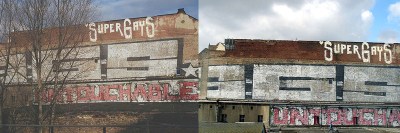
First Trip to Berlin: “Untouchable” and “SuperGays”
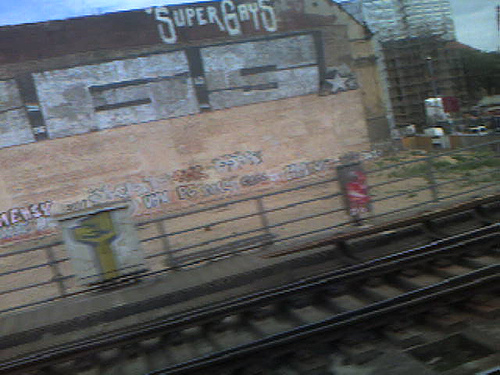
Second Trip to Berlin: “Supergays”

Kayla and M document a kiss.
E-mail Kayla at: kaylarachlinsmall [at] nycmail.com.
Filed under: Drag Queens, Film, Graffiti, Letters, Longing, Obsession, Photography, Pleasure, Ruins, Search, Sickness, The Gay Recluse | 1 Comment
Tags: Cystic Fibrosis, Gay Modern Love, Kayla Rachlin Small, Lesbian, Modern Love, Other, The New York Times
In which The Gay Recluse goes to a new restaurant (twice) and is totally psyched.
For all of you doubters in doubterville, take note: there’s a new restaurant on 166th Street between Broadway and Saint Nicholas, right around the corner from Dallas BBQ. And get this: it’s vegetastic! We’ve eaten there twice already this weekend alone and would probably go tomorrow except it’s closed on Sundays. (Or at least it was last weekend; they might be open now.)
“All of our food is naturally delicious!” is the claim on the menu, and — incredibly enough — it’s true! What’s mindblowing is that you go in and look at the offerings and — even though it says “vegetarian” everywhere, you’re pretty much like: “Is that meat? Is that meat? Are you sure that’s not meat?” while the girls behind the counter patiently explain that no, it’s all vegetarian, it just looks like meat. Whatever, we’ve never been hung up on the concept that vegetarian fare has to taste and feel exactly (or anything) like meat, but — and don’t ask us how they do it: the drumsticks even have “fried skin” — this place is definitely safe for those sorts of narrow-minded blowhards who inevitably cross our paths to make life miserable. Our suggestion: enjoy the food for what it is, and you’ll be happy.
They offer everything cafeteria style — breakfast, lunch, dinner, smoothies, wraps, “burgers,” soups — which you can eat there or take out. The food — have we mentioned that it’s all vegetarian? — is done with a Caribbean theme, which as far as we can tell is like a spicier version of many soul-food standards with a bit of rice-and-beans thrown in. (Give us a break: we’re not food critics!) The owners — Dave and Morton — are from Guyana and Trinidad, which should tell you what you need to know.
So far we’ve had the small dinner plate, which means you pick four sides for $8. The “plate” is essentially a standard Chinese take-out container — the dish, not the rice — just to give you a sense of how much food you’re getting. Let’s just say: good deal. Yesterday we had curried/fried “drumsticks”; “beef” and carrots; pumpkin something or other; and rice and beans. Today we had barbecue drumsticks; collard greens; rice and beans; and fried bake, which is the Trinidad version of a pita. Everything was in fact naturally delicious and — unlike nasty Chinese takeout, which costs the same or more — doesn’t leave you feeling bloated, greasy or hungover. (Obviously, you never have to imagine animals being factory farmed and slaughtered at Heights Vegetarian.) Owner Dave also assured us that the smoothies and juices are 100 percent natural and awesome, and we’re looking forward to checking those out.
Heights Vegetarian (212-927-0908; yes, they deliver) is located at 1121 Saint Nicholas Avenue.
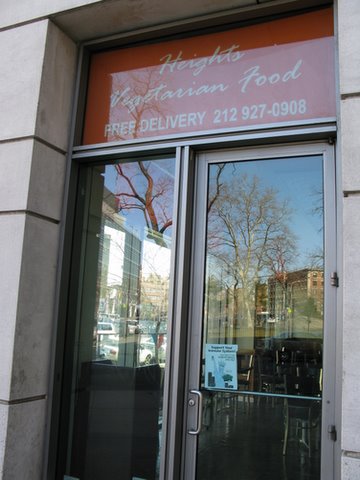
Vegetarian in Washington Heights? Fuck yes!

Whoa. The inside. (Nicely done, Heights Vegetarian!)

Drum sticks, rice and beans, collard greens, fried bake: Only $8.00!? Fuck yes! (PS. That’s what it looked like on our dinner plate at home, and our plates are not small.)
Filed under: Animals, Capitalism, Food, Health, Infrastructure, Pleasure, Retail, The Gay Recluse, Washington Heights | 10 Comments
Tags: Collard Greens, Drumsticks, Fried Bake, Guyana, Heights Vegetarian, Restaurants, Rice and Beans, Smoothies, Trinidad, Vegetarian
In which The Gay Recluse scores selected opinion pieces in The Times.
Gail Collins/George Speaks, Badly
The Short Version: George is a loser.
In her words: “Our credit markets are foundering, and all we’ve got is a guy who looks like he’s ready to kick back and start the weekend.”
Score: A- (Acerbic)
When even Gail Collins sounds like she wants to rip your head off, you know something’s wrong. Let’s hope she gives similar treatment to McCain, who for all intensive (grammar maven smackdown — see comments!) intents and purposes will be more of the same, and possibly worse.
Bob Herbert/The Winds of Albany
The Short Version: David Paterson in a paragraph or two.
In his words: “It would have required an extraordinary leap of the imagination for a teenager in that shipping department in the wartime 1940s to believe that his child would someday become governor of New York.”
The Score: B- (Boring)
Herbert provides a Parade Magazine-ish “Up Close and Personal” account of David Paterson and his father Basil. Totally boring. (Btw, the Port Authority building in the article is on 16th Street, not 18th: a small mistake, but not one we like to see at The Times.)
Filed under: Capitalism, Drivel, Government, Politicians, The Gay Recluse, The Times | 2 Comments
Tags: Bob Herbert, David Paterson, Gail Collins, George W. Bush, Republican Assholes, The New York Times


 The Gay Recluse