In which The Gay Recluse contemplates an uncommissioned masterpiece from the walls of an uptown subway station.


Filed under: Film, Gay, Infrastructure, Subway, The Gay Recluse | Leave a Comment
Tags: C-train, Dumb Movies, Emotions, Funerals, Graffiti, MTA, Rambo, Sylvester Stallone, Tears
Given the long-ascendant Manhattan real-estate market, people are often surprised to learn the extent to which abandoned, burned-out property still plagues Harlem and Washington Heights. On our block alone — which is not even close to one of the worst around here — there are three completely annihilated townhouse “shells” and several other larger buildings that are certainly “shellish” if not quite destroyed.
We see four reasons why shells languish, even in a “hot” market: 1) carrying costs are low in relation to market appreciation, 2) construction costs are high, 3) the city bureaucracy involved in digging these properties out of legal limbo is insanely complicated to negotiate, and 4) the “upside” in terms of market value is enormous when you consider the high likelihood of gentrification at some point, thanks to the crushingly gorgeous (pre-war) housing stock and (short) commute to midtown. Basically, if you can get your sleazy hands on one of these things — and given the complexities of buying one, there’s inevitably some sleaze involved — there’s no real incentive to renovate when you can just let it rot for ten more years and then sell it for ten times as much as you paid.
It’s a situation that really does cry out for city-government intervention (try not to laugh.) Owners of abandoned buildings must be heavily penalized to force them into action (i.e., sell, renovate, or lose the property in foreclosure). This would require a concerted effort by the mayor, city council and probably at least five agencies (led by the notoriously sluggish and ambivalent HPD). Like, good luck with that.
But politics aside — and on a more personal note — we live right next door to a shell (thank you, thank you!). Certain problems notwithstanding — which we shall unveil in due course – the situation is not without its advantages (namely, no neighbors and again, our longstanding obsession with ruins). People often ask us what it’s like — as if we were suffering from a chronic condition — and so in response we would like to offer a chronology of our relationship with the architectural ghost next door.
May 1999. Our first visit to the block, where we politely ignore the shell’s obvious handicaps in light of the deal we are getting on our prospective house. Someone predicts that the entire block will be “spotless” within a decade and we nod enthusiastically. We are young and hip and — having lived for so long in Park Slope — still very very naïve.
December 1999. We close on our Manhattan townhouse (the price is good). The shell next door — ugly as it is — does not seem unhappy. We think we have come to an understanding.
May 2000. With spring comes an increasing awareness that the lot next door (i.e., the backyard of the shell) — separated from our yard with a chain link fence — is in fact filled with a Fresh-Kills quantity of trash, construction debris and junkie refuse (lighters, bent spoons, dime bags, etc.) from the last however many decades people have been dumping shit there (literal and metaphorical senses of “shit”). We plant morning glories in front of our fence and try to pretend it’s not there.
December 2000. It occurs to us that perhaps we should do some investigation of the shell: like who owns it and would they consider say, giving it to us for nothing if we promised to fix it up? (Insert idiot joke here.) After doing a title search, we learn that the city has in fact brought a foreclosure action against the shell; we eventually track down the HPD attorney in charge of the case, who shockingly enough is not unfriendly; she tells us that she expects to have a judgment in the near future, at which point the property will be auctioned off to the highest bidder in the rotunda of the State Supreme Court. (Note that this is a very different process from when the city actually takes possession of land and resells it; in a foreclosure action they simply get the proceeds from a judicially administered auction. Also note that while we have some familiarity with the law — thanks to a law degree from a very prestigious institution (ahem) — we are not real-estate lawyers.) We learn from various sources that these auctions are filled with sleazy sharks but we try not to be intimidated; after all, who is going to want a shell in Washington Heights more than us? We love our shell, and it loves us! Plus, you only need ten-percent cash to bid at the auction, after which you get 90 days to line up financing. We have some savings and our credit is good; why shouldn’t we win? (Insert idiot joke #2 here.)
May 2001. It turns out that the pile of junk next door has over the course of the winter been repopulated by a proverbial army of rats, who are not deterred by the chain-link fence from entering our backyard garden, even through a screen of morning glories. (We should also mention that there is another shell three doors up in the other direction, so that our collective backyards are essentially a “Rat Disney World.”) For some reason, the rats like to shit right outside our back door, as if taunting us. On behalf of our plants, we are annoyed.
December 2001. We’re still calling our contact at HPD, who tells us that 9/11 has slowed things down. We believe her.
May 2002. After a year of calling various city agencies, we finally — by way of a local Community Board worker (thank you Deborah!) — manage to get some trash-hauling division of a city agency (not Sanitation, of course) to clear out the junk next door. It takes an entire crew of twelve men two weeks to get rid of all of it. Filled with visions of garden grandeur, we take down the chain-link fence (as we had already done with our real neighbor on the other side) and put it up on the far edge of the vacant lot above a retaining wall, effectively doubling our garden space. We subscribe to “Horticulture” magazine and become increasingly transfixed by moss, ferns and native perennials. We hire a tree service to cut down some monstrously invasive ailanthus trees (aka “Ann Coulters”) that have been looming over our garden. We plant wisteria in front of the fence, which incredibly enough covers the whole thing in about a week and jumps the alley beyond, where it starts invading an apartment — we can see the vine behind the windows, wrapped behind some ugly curtains — in the adjacent building; even more incredibly, whoever lives there doesn’t seem to care. We talk about “adversely possessing” the land we have cultivated; research, however, shows this is next to impossible in New York State.
December 2002. After two years of regularly calling our contact at HPD — who never has any information for us but (in her not unfriendly way) keeps telling us to call back in a few months — we learn that she has left on maternity leave. Nobody else can tell us anything about the house (nor do they seem at all happy to talk to us). We are too young and naïve to pursue this with the zeal of an investigative reporter; we have full-time jobs already and the work of owning (and renting a portion of) one house makes the prospect of a second less palatable. We tell ourselves that we don’t care who buys it, as long as someone does.
May 2003. The rats, of course, are also living inside of the shell, and so are not that bothered by losing the trash heap outside. Nor are they unappreciative of our fine efforts in the garden: in fact, they have grown accustomed to twilight strolls, during which Mom and Dad leisurely take in the green as the children cavort in the brush. As part of a downstairs renovation in our house, we decide to abandon the double-plot garden and erect a five-foot cement wall topped by three feet of wooden lattice to separate us from the vacant lot (we continue to leave the border with our neighbor open, thinking that most of the rats are coming from the shell next door and not the one three houses away). We later find out that the rats are laughing at us the whole time.
December 2003. We start receiving mail addressed to a woman next door, who we learn managed to acquire title to the house, but not through a foreclosure auction. Exactly how remains a — and perhaps the — longstanding mystery of the shell, given its current status and her reputation uptown. (At some later date we will mention this woman’s name to Rob Shapiro from Massey Knakal and he will turn pale.) However, our spirits are soon lifted when, around this time, an impressive looking sign from Marcus Millichap goes up on the fence in front of the shell; we call the realtor who tells us that the seller wants “only” 750k for the shell. We politely ask him to put down his crack pipe and explain the economics to him: the place (3200 square feet, just like ours) will cost at least 700k to renovate (nothing fancy mind you), which means that you would be in for like $1.5 before you even got started, or way more than any house is worth in the neighborhood. Even if best case scenario you could convert it into 4 floor-through 1BRs at $1500 per, that only pays for about 900k in financing, tops (i.e., not investment material). Basically, only an insane maniac would pay 750k for this shell, and we’re in Washington Heights, not Williamsburg. We tell him that we would consider buying it for 100k; he laughs in our face. The shell does not sell, but we do not feel vindicated.
May 2004. We go to war with the rats. We put out traps and catch one by its foot, which leads to a horrible scene in which we literally have to beat it to death with a shovel in order to put it out of its misery. Another time we throw a rock at one as it’s streaking across the yard and — because we played baseball for a few years — we actually hit it. This too we have to kill as it woozily staggers around. Like any soldier, we are shocked by the depraved lengths to which we will go in the heat of battle.
December 2004. The kids from the apartment building on the other side of the shell have turned the Marcus Millichap sign into the backboard for a basketball hoop. Eventually it falls off and it sits in the middle of the street, where it dissolves into oblivion.
May 2005. In a last-ditch effort to fend off the rats, we decide to surround our garden with an 8-foot cement/stucco wall. We start referring to the backyard as a “courtyard.” There is severe collateral damage to the existing plants, but in the end it’s worth it: for the first time we are “rat free,” a condition we continue to enjoy to this day (knock on wood), although we still see them running back and forth on the electrical wires overhead.
December 2005. We continue to write letters to everyone in the city begging them to do something about the nasty shell next door, not only because of the rats (and pigeons, which — trust us — really aren’t as bad) but because of the roof, which has by this point completely given way, so that the entire structure appears to be in danger of collapse. HPD only has jurisdiction over the front of the building, so we turn to DOB, which promptly dismisses our complaint after a “drive-by” inspection. We schedule another appointment and invite them to assess the damage from our roof, and the inspector agrees that the building looks very shaky; he takes pictures of the collapsed roof; nevertheless, our complaint is subsequently dismissed. This continues until we succeed in having the building officially classified as “unsafe.” Still nothing happens.
May 2006. The courtyard recovers with a new plant regime; the house next door continues to rot and crumble. A paper trail on the house — now available on Property Shark — shows the house is owned by some bank in Cleveland. Or maybe it’s a bankrupt construction company from Westchester. It’s hard to tell exactly what’s going on; in any case, we still couldn’t afford to renovate it, even if someone gave it to us.
December 2006. Occasionally somebody will walk by and look at the shell and let us know that they are a prospective buyer. Some of these people are Russians in fur coats. Some are from Brazil. Nobody will ever divulge who exactly is selling this property, even when we ask directly for this information. The most we can ever get is that it’s part of a “portfolio.” There is apparently a secret world that we are not a part of; we don’t exactly want in, but it would be nice to film it.
May 2007. Our courtyard/fortress endures in the back, but the rats — obviously infuriated — have now taken to the sidewalks and street with renewed strength. Garbage regulations are not exactly enforced with vigor at the apartment buildings down the street. Between the shells and these buildings, our block is rat heaven; if you visit after dark, remember to walk in the street.
December 2007. Nothing to report. Have we mentioned that our annual taxes are $0.00? We say this to let you know that the carrying costs of a shell are not exactly overwhelming, even if you factor in the thousands of dollars of tickets each year the shell gets for not cleaning the sidewalk.
Now. In our dreams, the city is about to put a roof on the shell, shore up the foundations, and charge the owner, whoever and wherever he/she/it is located. In truth it’s basically a disaster waiting to happen, and unlike the old fable, we’ve repeatedly cried wolf and meant it every time. As appreciative as we are of own our house in a rising market, we sometimes think bitterly about whoever slimed this property into their possession, and how — if it doesn’t collapse first (and maybe even if it does) — they will make a killing whenever they decide to sell it.
Sometimes the shell seems to leer at us; other times we feel sorry for it. Most of all we pray for its resurrection in the hands of someone who will restore it to the dignity with which it was built, and then — as we do in ours — live in it. Less naïve than we once were, we don’t expect this to happen very soon.
Music: Saturnine, “The Taste of Water” from Mid The Green Fields (Victoria Land Records 1998).
I’m starting to hate going outside
I’m living too much in my head
I hear these things are happening
The same ones that never get said
Of course I could read all about it
The words that flow from the pens
Of writers who think they know better
When people get shot in the head
Secrets get thrown in the fire
They’re taped to the back of a wall
My mind has been wrapped by a wire
I think I’m starting to fall
The taste for water
Has simply gone out of my mind
It’s like being in place
As the temperature’s starting to rise
It’s like waiting in bed
For something to open your eyes
Filed under: Architecture, Decay, Gentrification, Government, Landscape, New York City, Pessimism, The Gay Recluse, Washington Heights | 1 Comment
Tags: Ailanthus, Ann Coulter, HPD, Marcus Millichap, Massey Knakal, Pigeons, Rats, Real Estate, Shells, Uptown Manhattan
It is not just the old architecture of Washington Heights that sends us spinning back in time to a period that was — if nothing else — more grand and spacious than what we see now. Take the corner of 163rd and St. Nicholas, just north of Amsterdam, which is one of the ugliest intersections in the neighborhood, thanks to a pharmacy that occupies the triangular plot just to the south but which has been now abandoned for several years. (We were once informed by a Community Board 12 member that this land was slated to be turned into a city park, but a parks representative later denied the rumor, and not without indignation at the implication that the local kids lack sufficient playgrounds; in any case, like so much around here, the pharmacy sits rotting and abandoned to this day.)
Walking north past this boarded-up blight, the corner at first seems relatively unremarkable; on the west side of the avenue, under a series of decaying pre-war apartment palaces, we find the usual mix of bodegas and take-out joints, none of which lifts the barren and ominous atmosphere of the area, accentuated by the piles of trash on the sidewalks and the groups of thugs we pass on the corner. The eastern side of the street is quieter; here we find a very bland post-war housing project, which ugly as it is at least has the benefit of being no more than four stories tall and thus that much more humane than the Robert Moses monstrosities that plague uptown Manhattan.
Still, we are not here to greet the architecture, but to dream of a past some 230 years ago, when the land was part of the Morris-Jumel estate, the very spot from which George Washington watched the British take New York city in the early hours of the Revolutionary War. The mansion of course is still standing — we have discussed this before — but even older than this is what we now stop to admire; here, just north of the eastern corner of 163rd Street we confront an English Elm that is one of the oldest and tallest trees in the city; we have also heard it referred to as — simply — “The Dinosaur.”
We approach the tree in awe and reverence; we circle it slowly (it is close to six feet in diameter*) and stare up into its infinite branches (it is 110 feet tall*); we imagine George crying bitter tears of defeat in this very spot (for we know the tree was there at the time) and making vows of revenge. Time passes and the dream lifts; we remember where we are and feel indignant on behalf of the tree; it seems cruel and unfair that this remarkable specimen of infinite age and beauty should have been made to witness this most brutal transformation of the surrounding landscape from idyllic pasture to urban ghetto!
We wait a few more minutes and the feeling passes. The tree is clearly unmoved by our pity; it longs for nothing but light and water and nutrients from the soil; and doesn’t its very existence testify to the satisfaction of these longings? Suddenly, we too feel pleasantly old and resigned, unconcerned by the ongoing travails of life as it unfolds around us.

View of English Elm — aka “The Dinosaur” — at St. Nicholas and 163rd Street, looking south, taken on 11/7/07.
*Tree measurements provided by Edward Sibley Barnard, New York City Trees (Columbia University Press 2002). (We have a signed edition.)
Postscript: The New York Times City Room has also reported that this tree is one of only twenty-five from around the city that has been selected to be reproduced via tree grafting/cloning techniques with the thought to plant identical trees in a few years. Although we are disappointed that Bravo did not make this selection process a reality show, we feel honored to be acquainted with such a deserving winner!
Filed under: Architecture, Landscape, Memory, New York City, Pessimism, Resignation, Washington Heights | Leave a Comment
Tags: Edward Sibley Barnard, English Elm, Historic Trees of New York City, Morris-Jumel Mansion, Rite-Aid, Robert Moses, St. Nicholas Avenue, The Dinosaur, Washington Heights
On A Book of Memories
Today – after more than two months of reading over 700 pages of tightly wound dream and remembrance – we finally finished A Book of Memories by Peter Nadas. If you remember, it was a Michael Kimmelman interview with Nadas a few months ago that prompted us to write a diatribe against the beleaguered state of the “gay voice” in American fiction, which we defined as “a voice that resonates with perspective of the sexually-oriented ‘outsider,’ so that we come away with an understanding (and it does not have arrive by way of a literal representation) that ‘heterosexuality’ is, like certain governmental regimes, the subject of some dissonance, if not revolt… a voice that conveys an ambivalence for the present, a fundamental pessimism (in the philosophical sense) with regard to life, and an understanding that only the most obsessively detailed examination of the past can bring us any sense of reconciliation with a present in which we so obviously do not belong, or at least are not wanted by the more established and powerful elements of society.”
At the time we were outraged that Kimmelman felt comfortable locating Nadas’ book in the literary tradition of Marcel Proust and Thomas Mann, but could not be bothered to mention that this is fundamentally a gay tradition to the extent we have just outlined. Now that we have actually finished A Book of Memories and found our rage completely justified – the book is essentially a modern manifesto of the modern gay-recluse aesthetic of beauty, pessimism and psychological introspection written with a (gay) sexual frankness not possible (except for Proust, for whom nothing was impossible) in the early twentieth century – we feel less vindicated than saddened by the failure of Kimmelman and so many others to accurately and honestly describe the brilliance of this work and so many others like it (and the stifling effect this has had on American literature). It is not so much that anything said by these critics is so terribly wrong – after all, we are not oblivious to the importance of political oppression and economic concerns – but the sin they have committed is one of omission, and would be like describing the Mona Lisa without mentioning her smile (or more to the point, a masterpiece like Beloved without mentioning race).
A few words about the book itself: it is not an “easy” read (which is to say that it would never have found a publisher in the United States). The plot follows a young Hungarian living in East Berlin – where he falls in love with another man, a frustrated poet who longs to escape to the West – where he remembers both his childhood in Hungary and intersperses these memories with chapters of a belle-epoch novel he is also writing, in which the lead character closely resembles the Hungarian (in demeanor, if not circumstance). If that’s not confusing enough, both narratives are written in the first person, are rarely chronological, and involve frequent digressions and tense changes as the author moves from narrative to philosophy and exposition. For the first 250 pages or so, it can be difficult to decipher which time period you are in, as both characters spend pages and pages going over the details of their very similar childhoods. Gradually, however, differences emerge and the Hungarian narrative in particular picks up a momentum that carries you through the final 400 pages or so; most compelling were the descriptions of his adolescence, the secret love he felt for one boy in particular, along with the shifting and often brutal alliances in a group of boys and girls in their immediate circle. It is hard to imagine anyone surpassing Nadas’ depiction of both the terror and exhilaration – along with the seriousness with which games of love and treachery are played – that marks this period in our lives.
We had some problems with the book, none of which should prevent even the most mildly interested party from buying it as soon as possible and forming your own judgment! At times Nadas seemed needlessly circuitous as he would lead us up to a pivotal climax to a particular scene, only to digress away from it for a paragraph or two (easily skimmed, ahem) before getting to the denouement; nor did we love his occasional indulgence in what could loosely be called “micro” descriptions of bodily functions and secretions; in a way, it made the characters less believable in these passages, which seemed to be written not from a position of knowledge and experience but lifted from a textbook (in this regard – and this is not to be an attempt to speculate about the “real-life” Nadas – we will note that his descriptions of heterosexual scenes were far less believable than his homosexual ones).
Because this is a “book of memories,” we thought we would leave you (in the post below) with a list of our own; these are the approximately fifteen passages we felt moved enough to underline or mark as we progressed through the book. Reading these over, we feel relieved to be done with Nadas, but also grieving just a bit at the loss, as if a ghost who has been whispering in our ear — by turns oracular and cryptic — has finally been laid to rest.
Filed under: Communism, Gay, Language, Literature, Memory, Writers-Hungarian | Leave a Comment
Tags: A Book of Memories, Gay Literature, Gay Voice, Gay Writers, Hungarian Writers, Peter Nadas, Quotations
In which The Gay Recluse offers approximately fifteen quotes from a modern masterpiece written in the “gay voice.”
A Book of Memories by Peter Nadas:
“[T]here’s nothing in the world with which I have a more intimate relationship than ruination.”
“If one could learn the most important things in life, one would still have to learn how to keep quiet about them.”
“‘[I]f you let a guy suck your cock, you’ll never be able to screw a woman,’ [was] a statement that needed neither comment nor explanation; it made it quite clear that everything faggy or having to do with faggots or faggotry endangered masculinity, the very thing we were striving for.”
“I know, of course, that memory mercilessly retains everything and I do admit my weakness: some things I don’t want to remember.”
“That first moment encompassed all our subsequent moments, which is to say that in all that followed something of that first moment persisted.”
“[A] truly living city is never the mere fossil of an unclarified past but a surging flow, continually abandoning the stony bed of tradition, solidifying and then flowing on, rolling over decades and centuries, from the past into the future, a continuum of hardened thrusts and ceaseless pulses unaware of its ultimate goal, yet it’s this irrepressible, insatiable vitality, often wasteful and avaricious, destructive yet creative, that we call, approvingly or disapprovingly, the inner nature or spirituality of a city’s existence.”
“[I]n the end we could choose only between the bleak and the bleaker – that was the extent of our freedom.”
“I might say, then, that while my eyes, tongue, and ears savored the pleasure of the morning’s unchanged old-fashioned order, my mind’s eye viewed its own joys, reminiscent of its childhood, from the greatest possible distance, and as it did, I suddenly grew old.”
“And you know what you can do with your morality.”
“One of his hands was grasping mine on a leather strap, and with his other hand he was holding another strap, so that his raised arms opened wide the wings of his coat, shielding our faces, our hands, the secret gestures of our forbidden love from the other passengers.”
“I wanted to kill my love for Melchoir; and the reason I couldn’t make anything last was that deep in my soul I feared the punishment which others, in their great anxiety about their own sexuality, scrawled as warnings on bathroom walls.”
“Could she imagine the condition, I shouted at her, in which an adolescent boy cannot yet distinguish between the beauty of the body and the power of its abilities?”
“[O]ne can never satisfy the animal urge to escape, since from the chaos of one’s soul there is no place to escape to.”
“Not being filled with longing, I am moved to reflect and to remember.”
“If you’re dealing with Russians, however, you can give logic a rest.”
“There’s nothing more humiliating than a chance encounter. But not giving in to it is even more humiliating.”
“[E]very whore and every faggot had a mother and a soul-searching story.”
(A more complete review of A Book of Memories can be found here.)
Filed under: Gay, Language, Literature, Pessimism, Writers-Hungarian | Leave a Comment
Tags: A Book of Memories, Gay Literature, Gay Voice, Gay Writers, Hungarian Writers, Peter Nadas, Quotations
Back at work this morning we find our blood still coursing with the slow, oscillating melodies of last night’s third act of Die Walküre at the Met. By the end (and really, by the middle of the first act) it was sublime and transcendent, so that all of our quibbling about the final dress seemed miles away; what could we possibly say about Jim Morris that hasn’t already been said? He owns the role of Wotan and seems more than content (and completely able) to let the opera ride on his shoulders. Nor can we limit our praise to him; all of the performances thrilled us at different points as we dropped into this primordial world marked by passion and strength on one hand, and rich (but constantly mutating) psychological nuance on the other. (If it sounds like we’re describing the wonders of say, a lava lamp, our response is to shrug, for the experience is not so unlike taking a hallucinogen, to the extent that we feel altered by Wagner’s music, suddenly able to see the world around us in new ways.)
To watch it twice in such a short period — and just as the opening-night performances far eclipsed those of the final dress — gave us the chance to revisit and revise our theories about the opera’s symbolism with respect to our country’s ongoing political turmoil. While Wotan (by turns booming with anger and shattered by impotence: “Most joyless am I of all living,” says the king of the gods) can still be said to represent “America,” it quickly became clear that Fricka (sung with equally mind-blowing richness by Stephanie Blythe) does not represent any political faction — “nagging” or otherwise — but rather a concept of conservatism that exists within us all; it’s not only a nostalgia for the past and a hope for old glories to be resurrected, but an angry reluctance to acknowledge the implicit and unstoppable power of change that is coincidental to the march of time. Wotan by contrast professes to crave change but he too refuses to acknowledge his inability to control it, even as his actions — and here, unconsciously — hurtle him ever closer to his fate. Sound familiar?
Accordingly, we see the immortal Walküre sisters as high-minded but practically diffuse “concepts” or “ideals” borne of America itself; specifically we think of “freedom” and “democracy” and “pursuit of happiness” and “liberty” and all of the other foundations upon which our institutions — and not just nominally — are built. On the other side of the equation are “we the people” with our inevitable flaws and conflicts: Hunding; the mean-spirited disciple of Fricka who wants to enslave his wife; Sieglinde and Siegmund, this pair ruled far more by emotion than logic or convention as they flee blindly away from a tormented past.
When these forces are thrown together — that is, when Brunnhilde is “touched” by the immoral but undeniable love of the mortal siblings, and she is led to disobey her father’s directive to “punish” them — we see (despite the best intentions of all concerned) the inevitable corruption of our (America’s) highest ideals, so that she ends up stripped of her power and chained to a rock by her founding father. Is there anybody — conservative or liberal — who does not recognize the parallels of this to the United States today, when as a country we seem to have drifted so far away from the indisputably great principles that once fueled our story?
What pleasure we felt to see this timeless theme in an opera written so long ago and rendered so beautifully by the Met! As we confronted our fate in the dark space of the auditorium, we felt less pained than godlike, as if we were watching the world and all of its problems from a mountaintop. So the tragedy is decreed; the corruption of our ideals permanent and irrevocable. But if the situation seems dire as we sink into the impossibly sad music that marks the end of Die Walkure, we can look ahead with some hope; for while it’s true that all of the characters — and we among them — are doomed in one way or another, at least we take solace in the idea that some visionary in the future will arrive to unchain our beloved goddess from the rock, so that she can live and die with the rest of us.

Filed under: Good Rock, Opera, Pessimism, The Gay Recluse | Leave a Comment
Tags: Die Walküre, Jim Morris, Richard Wagner, Stephanie Blythe, The Metropolitan Opera, The United States
Yesterday as we approached Ft. Tryon Park for our weekly promenade in Washington Heights‘ most beautiful cliff-side heather garden, we were confronted by a small regiment of bagpipe players, apparently rehearsing for an upcoming event. We sat for a few minutes on one of the adjacent benches and observed these maneuvers, in which the band was attempting to negotiate a 90-degree turn while holding formation, all the while huffing and squeezing their strange, unwieldy instruments. There were eight players in total, led by a stern, white-haired conductor; we admired all of them and regretted that they were not in traditional garb.
Although it was clearly a rehearsal, with many screeching stops and starts, it did not prevent us from pleasantly losing ourselves in the mournful, bagpipey sounds that filled the surrounding air. While there’s no doubt that the abrasive quality of a bagpipe does not make it the perfect accompaniment for every setting, here at the entrance to the park, and on a Sunday afternoon, it was perfect; with the last hours of the weekend dwindling away, we faced the prospect of yet another week of corporate drudgery with what seemed like an appropriate measure of wistful resignation and perhaps even nobility.
It was at this moment that a thought occurred: given our enjoyment of these bagpipe maneuvers in the park, wouldn’t it be ideal if we could enjoy the same each Sunday? The more we considered this, the more it seemed like the answer was in fact that it would be more than “ideal,” it should be essential, a requirement, something to depend upon. Next turning our attention to how this might happen, we did not hesitate — given the current climate — to consider the presidential campaign, and all of the promises that have been made (and the likelihood that any of them will be kept). But this one time, we have decided to shed our cynicism! We not only believe this can happen, but that — with the right candidate in office — it will and must happen!
In light of the above, let us now make clear our one non-negotiable demand: henceforth we will limit our support of presidential candidates to those who promise — upon assuming the office — to mandate the playing of bagpipes at the entrance to our favorite park each Sunday afternoon. Candidates, take heed! Do not take this lightly! Of all the demands we have made — marriage equality, environmental protections, universal healthcare, improved public transportation, redistribution of wealth — this is the one you should approach most carefully, for we would never be willing to negotiate or “water-down” its essence. Perhaps if we had we asked for daily bagpipe maneuvers in the park, we could understand the need to compromise, but we feel — and this should likewise be clear to all — that our position is perfectly reasonable; in short, we have no intent of endorsing any candidate who proposes monthly bagpipe maneuvers in the park, or even Sunday morning maneuvers in the park, because that would completely defeat the purpose of having them weekly on Sunday afternoons, would it not?
We have thus made our one and only non-negotiable demand in this election: Sunday bagpipe maneuvers in the park. As anyone can see, it is a worthy and — unlike so many others — “achievable” cause. Candidates for the presidency of the United States, we look forward to your response.

Filed under: Government, New York City, Politicians, The Gay Recluse | Leave a Comment
Tags: 2008 Presidential Campaign, Bagpipes, Bette Midler, Ft. Tryon Park, Heather Gardens, Parade Maneuvers
[Note: Click here for our review and revised analysis from opening night.]
In musical terms, Friday night’s final dress rehearsal of Die Walküre (and with the understanding that it was just that, i.e., a rehearsal) at the Met seemed problematic; first Jim Morris (Wotan) canceled, which when announced sent the expected sigh of disappointment across the auditorium (not that his cover didn’t do an admirable job filling in, but some shoes are just too big to be comfortably worn at just a moment’s notice). Then the tempo was excruciatingly slow at times, as if the conductor — Lorin Maazel, back at the Met for the first time in 45 years — wanted to constrain his singers; this was unfortunate, because Adrianne Pieczonka (Sieglinde) and Clifton Forbis (Siegmund) resonated quite convincingly with the dramatic torment of the first act, and when allowed to really unleash their instruments (e.g., Siegmund’s “Wälse! Wälse!”) offered real power. Even in these trying conditions, Lisa Gasteen — who understandably marked many of her lines — brought a very moving sense of tragedy to the transformation of Brünnhilde from naive to rebellious and ultimately resigned soul who confronts her father’s eternal wrath. Of all the singers, Stephanie Blythe (Fricka) seemed the least perturbed; in her relatively brief appearance as Wotan’s hypercritical (but powerful and hypnotic) wife, she dominated the stage in every respect and gave us a glimpse of the huge potential of this cast for the actual run, which opens tomorrow night (and yes, we’ll be there to report).
It was while enraptured by Fricka, in fact, that the idea occurred to us that we might view Die Walküre as a metaphor for the American trajectory, particularly in the growing heat of the presidential campaign. For what is Fricka but the nagging (but powerful and hypnotic) voice of the fundamentalist right, exhorting her husband Wotan, the king of the gods (namely, the United States) to “do something” about the “immoral” love of Sieglinde and Siegmund (representing us queens and freaks who Huckabee & Company love so much)? And what does Brünnhilde represent if not hope and democracy (and rebellion), best embodied by Barack Obama and his winds of change?
Of course, that Brünnhilde ends up tied to a rock, stripped of her god-like power while her father grieves — and we should also note that Siegmund is dead, while Sieglinde has fled into the woods to hide — seems to imply a future of shattered dreams and unfulfilled promise under any election scenario. (Of course, much Wagnerian opera is built upon such pessimistic foundations.) Which isn’t to say we should be disconsolate; rather, we must remember the end of Götterdämmerung (two centuries operas later), in which Fricka, Wotan and the rest of the gods all go down in flames, making way for a new world to begin.

Filed under: Capitalism, Government, History, Opera, Pessimism, Politicians, The Gay Recluse | Leave a Comment
Tags: Adrianne Pieczonka, Arthur Schopenhauer, Barack Obama, Clifton Forbis, Die Walküre, James Morris, Lisa Gasteen, Lorin Maazel, Mike Huckabee, Richard Wagner, Stephanie Blythe, The Metropolitan Opera
In which The Gay Recluse writes in highly attenuated metaphors (but with uncharacteristic optimism) about the Democratic election results in Iowa.
In the past month, we were given the opportunity to engage in a high-stakes “taste-off” between upstart Sweetie® Clementines from Mulholland Citrus and longstanding front-runner Cuties® California Clementines from Sun Pacific. As we all know, both Clementine brands have their advocates — we were inundated with mail arguing the various points of contention — but we ignored the marketing hype (and in some cases, threats) and were ultimately swayed by one consideration only: which brand offers the most refreshing and delightful Clementine “experience”? Our answer, after careful consideration of the factors listed below, is that the reign of Cuties has indeed ended and the Sweetie is the superior Clementine.
The Peel: Both brands tout their respective peeling qualities, with Cuties emphasizing a “zipper skin” and Sweetie an “easy-peel rind.” Although we in fact found the Cuties easier to peel, there was a saggy and withered quality to the skin that was slightly off-putting in this context; while the Sweetie does not “fall” out of the rind with nearly as much ease, in no instance did we find the peel “sticking” to the fruit in a problematic manner; rather, like a nicely fitted article of clothing, it showcased the body without making it seem exaggerated or uncomfortable.
Seeds: Sun Pacific promises that Cuties contain a “minimal seed content, to be sure it satisfies the grade requirements so that it can be packed under the Cuties® brand.” Does this seem like a bit of a hedge to you? If so, you’ll understand how we felt on countless occasions upon biting into a segment only to find — following the expected citrus burst — the disappointing crunch of a seed (or worse, more than one)! Mulholland Citrus somewhat more modestly claims that “Sweetie Clementines have very few if any seeds,” and we have yet to find one!
Sweetness: In the same way an opera singer must always be judged above all else on the quality of the voice, the same holds true of the Clementine. Ultimately, what do we care about a saggy skin and a few extra seeds if — as the Cuties literature claims — “[e]ach piece of fruit goes through a rigorous inspection to ensure a good eating quality”? But the truth was, too many of the Cuties were barely sweet at all, so that they could only be considered average eating quality, hardly the “delicious seedless gems” we had been promised! As for the Sweetie, each one was so delightfully sweet and juicy that in a burst of nostalgic remembrance we were immediately taken back to Paris, where we used to enjoy an after-class snack of Petit-Beurres and Spanish Clementines. In what could be considered an audacious claim under other circumstances, Mulholland Citrus states that “Sweetie Clementine’s sweet zesty flavor and fragrance make it impossible to eat just one.” Yet you no longer have reason to doubt: the Sweetie strove for greatness and — at least for now — has achieved it.
Filed under: Gay, Government, Nostalgia, Politicians, The Gay Recluse | Leave a Comment
Tags: Barack Obama, Cuties, Hillary Clinton, Mulholland Citrus, Sun Pacific, Sweetie Clementines, Zipper Skin
On Repulsion
As we watch Repulsion, the Roman Polanski film starring “the young” Catherine Deneuve, it’s hard not to be impressed by the way Polanski — like so many great artists — seems to predict the future. Released in 1965, the film presents a tightly wound portrait of a London which — and as a metaphor of Western society — is about to experience a complete meltdown, a freak-out of extreme hallucination on the order of what Deneuve delivers with such imperious beauty and sang-froid. To think of it in these terms makes the film even more terrifying than it already is, particularly as we note the homosexual undercurrents in the film — the way Deneuve seems only at ease in the company of her sister or female co-worker, and how she is repeatedly and brutally molested by rather average-looking men (both real and imagined) — and our suspicion that well, things just aren’t that much different now. When it’s finally over, we feel some relief at being relinquished from the grip of such claustrophobic terror (most of the “horror” effects have aged pretty well, especially the man in the mirror), yet as we reflect on it further, we are suddenly shaken as an even more disturbing thought arises: what if “the future” Polanski was foretelling — you might even say creating — was not the late 60s, but a nervous breakdown we are just about to experience? What if, for example, underneath the cheap optimism on display since Iowa, it turns out that we have already begun an inexorable and merciless descent into madness?
Filed under: Film, Government, History, The Gay Recluse | Leave a Comment
Tags: Catherine Deneuve, Horror Movies, Iowa Caucus, Nervous Breakdown, Repulsion, Roman Polanski
Did you see the story in today’s Times about the man — the window washer — who fell 47 stories (500 feet) and survived? He’s in the hospital and while basically a bag of broken bones, doctors say he should be walking within a year. Incredible. It reminds us of when we were at Cornell and that sorority girl (totally drunk) was stumbling back to Collegetown one night and managed to fall off Cascadilla Bridge, the one where everyone goes to commit suicide. Equally miraculous as the window-washer scenario, however, was that she landed on a raccoon, which happened to be ambling along some 250 feet below at the water’s edge; not only did the raccoon cushion her fall, but she was too drunk to die from fright, which is what we were told usually happens to those traveling at accelerating speeds toward an unforgiving earth. In any event, the girl suffered only scrapes and a concussion while — for all you animal lovers out there — the raccoon was treated at the veterinary school and survived with a broken paw. We wish that this was the end of the story — it’s almost enough to make you believe in something, right? — or that we could tell you about the many ways this woman went on to repay the karmic debt she had so obviously incurred. But alas, we are here to report that in an incredibly sad twist of fate, she grew up to become Ann Coulter.
Filed under: Addiction, Animals, Drag Queens, Faith, Memory, Sickness, The Gay Recluse | Leave a Comment
Tags: Ann Coulter, Cascadilla Gorge, Cornell University, Miracles, Raccoons, Tragedies
As we have discussed before, some of the best art in Washington Heights is in the subway stations. Here we pause to admire the genius of a delicate, floating (if raw and mildly distorted) line drawing of Jack Nicholson, which miraculously transforms a garish Hollywood poster into something subversive and entertaining, which is to say the complete opposite of our expectations for the movie itself (not that we plan to see it). This, unlike so much graffiti — the bulbous and illegible kind — is so fucking great, we are left craving more.
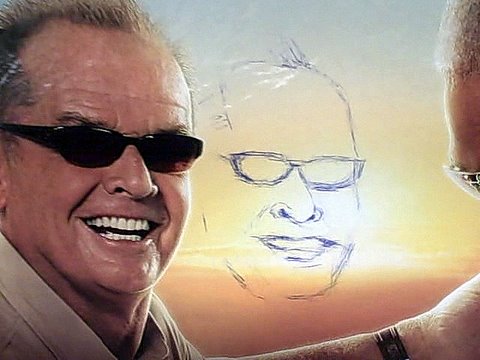
Actual dimensions are approximately 5 feet wide by 4 feet high.
Filed under: Graffiti, Infrastructure, Subway, The Gay Recluse, Washington Heights | Leave a Comment
Tags: Art, Graffiti, Jack Nicholson, MTA, Posters, The Bucket List
That cloud overhead — you really don’t recognize it? That hovering and inescapable dread, which makes New Year’s the longest Sunday of the year, particularly now that we no longer have to endure the last day in August before returning to school? No, it’s not so much the prospect — or let’s be honest, the reality — of our aging bodies, but the knowledge that, starting tomorrow, we must once again give ourselves completely over to unlimited productivity and change (together the essence and bane of our existence).
Still, now that we’ve recognized this fate for what it is, we feel that much calmer, more able to reflect on the flurry of activity that marked these past several weeks, the parties we wanted to both host and attend, the long stretches of anticipation and preparation interrupted by the events themselves, compressed hours in which (like our youth) time flew by in a second. We gossiped with friends and acquaintances, all of whom (and here, unlike our youth) expressed dismay at the direction of our country and all of whom — except for a few brittle, shiny exceptions — expressed the same (albeit with much more resignation) about their lives. We recollect from these conversations a general admiration expressed for (and in some cases, jealousy of) dogs and cats — and even trees — who are not tormented by the need to understand exactly who or what contrived to bring them to this point in their lives; whereas we — except for the very moment that has just passed and the one that is about to follow — remain so uncertain about not only what lies farther ahead, but also what has already occurred; more often than not, it seems that to find any clue, we must force ourselves to walk through the expanding desert of our dreams and memories.
But then again, who are we to deny the value of this search? Even now, we think about the beautiful table you set a few weeks ago, and how each fork and spoon, each glass and pitcher, was truly a work of art. And the food! The breads and cheeses, the meats and smoked fish, the olives and cucumbers, even the pickled herring and cream sauce (which for once was appreciated by all present, even the Englishman who to everyone’s squeamish delight poured it all over his bagel); all of it seemed lifted from a 19th-century urbane portrait we have long admired, and which was suddenly — miraculously — brought within our grasp.
For us, it was an extreme (by which we mean rarefied) experience that makes other elements of our past — the squalid apartment in Brooklyn, the longstanding mediocrity of the band, our closeted longings — somehow more palatable, as if it (i.e., the past) were a prism instead of a black box; just to acknowledge this potential spectrum of color is to allow a certain forgiveness for the lives we’ve both led and not (and — it must be admitted — never will); most of all, as we consider the death of one year and the birth of another, we feel more alive than not, certain that these same memories will predict the future.
When the meeting brought us outside
No one seemed to have the patience to begin
Falling back into the river of a dream
Waking up to hear the screams
Even when the room was empty
Distant sirens rang out softly through the night
The coat was hanging in the corner all alone
No one thought about the cold!
Floors are wooden by the bedroom
Numbers hanging like some last shot at the cards
It’s a painting of life, which
Hangs flat on the wall
It’s a silence the brings us at all
When the room is gone forever
Red’s the color of your eyes in the night
I don’t need to find the name of forgiveness
I just need a place to start
Music: “Painting of Life,” courtesy of Saturnine, Mid the Green Fields (VictoriaLandRecords 1998).
Filed under: Brooklyn, Memory, New York City, Pleasure, The Gay Recluse | Leave a Comment
Tags: 2008, New Year's Day, Resolutions, Saturnine
With the official debut of the presidential primaries this week in Iowa, we would like to offer — after careful consideration of each candidate and his or her respective platform — our endorsement of the one we think would best be suited to run the United States beginning in January, 2009.
Those familiar with The Gay Recluse will not be surprised to learn the extent of our disinclination for any of the Republican offerings; the country has now been plagued by Republican presidents for close to forty years running (notwithstanding moderate Republicans Jimmy Carter and Bill Clinton), and though we recognize the tedious nature of the cliché, it is in fact “time for a change.” Perhaps most discouraging in this regard is that none of the candidates seems to represent traditional Republican values of small government and fiscal conservatism but have instead embraced a form of religious fundamentalism that caters to a lowest common denominator of societal fears about immigration, gay marriage and terrorism.
Although for these reasons we seriously shudder to think of a Republican victory this fall, the prospect does at least bring into sharp relief (as we turn to the Democratic field) what must be considered a real choice in the 2008 election. More than any election since 1968, the country is at a crossroads, and the next president will have the chance to a) accelerate the downward trajectory of the United States on both domestic and international fronts or b) begin a process of restoration to bring our country into the 21st century and beyond. All of the Democratic candidates have the advantage of playing “the outsider” with respect to the debacle that is our current regime; our job as voters is to decide which is most likely to “mean” it. The last thing we want is another president (and we don’t have to mention names) to blow into Washington with the promise of change and to seep out eight years later with his tail between his legs.
It is for this reason that we cannot completely trust Hillary Clinton, whose record (and not just on the war) has too often shown her — like her husband — to be a great compromiser, unwilling to make a stand and therefore, somehow, soulless and mercenary. Nor can we take John Edwards at face value; though we like his apparent willingness to take on “corporate greed,” we are dismayed by the ostentation that has marked his personal life, and fear that he ultimately has an insufficient backbone to resist the materialistic temptations (both literal and not) of the presidency. Admittedly, Barack Obama has much to recommend; he has proven himself to be a man of exceeding intellect and personal courage, and who could ignore the powerful symbolism of an African-American in the position of leader of the free world? Yet ultimately we cannot endorse him for the job he seeks; although we are willing to forgive his insults to the gay community, we remain concerned that he — like his nemesis Hillary Clinton — is too much of a political animal; his spotty (by which we mean largely absent) voting record and his reckless dealings with real-estate developers in Chicago also make us wonder if he has the integrity to be the sort of president he likes us to envision, or if he would not also be too corrupted by the power of the office.
Thus, of all the Democratic candidates, it seems that there is only one who truly espouses both diversity and change; only one has the necessary depth of experience and “real-world” savvy — both as a business leader and Washington insider — to actually help get introduced and passed a legislative agenda of progressive substance; only one understands the political and cultural dynamic — you might even say the inherent beauty and dissonance — of the urban collective that makes it the most important engine of social evolution and economic growth on which our country depends; finally, only one fills us with a comforting, almost wistful nostalgia that makes us paradoxically — it is against all of our inclinations — proud to be an American.
It is for the above reasons that we endorse Geraldine Ferraro for President of the United States. No other candidate is more qualified or — and this is important — sincere; no other candidate offers us the one attribute — hope — that above any other, we so desperately need.

Filed under: Government, Longing, Memory, Nostalgia, Politicians, The Gay Recluse | Leave a Comment
Tags: Barack Obama, Election 2008, Geraldine Ferraro, Hillary Clinton, John Edwards, John McCain, Mike Huckabee, Mitt Romney, Presidential Primaries, Ron Paul, Rudy Giuliani
Although the year — and our annual ceremony — is fast winding down, we felt that we could not let it slip by without acknowledging 2007’s most remarkably opaque book review, which today appeared — just under the wire! — in The Times Sunday Book Review. Because this was easily the most remarkably opaque book review of the year and — like Wayne Gretzky in his prime — nullified any notion of competition, we accordingly have decided to not even consider runner-ups in the category but instead turn your attention directly to the gold-medal champion: Kathryn Harrison for her review of J.M. Coetzee’s newly published Diary of Bad Year (Viking, 2007).
Before we turn to the review itself, we would first like to note the home-page call-out (and here we refer to the on-line version of The Times), which opaquely declares: “J. M. Coetzee’s latest protagonist is a mirror of the author himself,” a remarkably opaque statement (in the context of a review) we can contrast with the call-out for an AO Scott film review, which offers us language that — sadly — is far less opaque: “The Orphanage, a diverting, overwrought ghost story from Spain, relies on basic and durable horror movie techniques.”
Unable to resist, we immediately clicked through to the review, the title of which — “Strong Opinions” — gave us some concern that Harrison might actually have some opinions — and furthermore, want to convey them — but our fears were quickly assuaged as the review quickly unfolds into a masterpiece of the shadowy and abstruse: “Diary of a Bad Year is not the first among J.M. Coetzee works of fiction,” Harrison begins, “to force readers to consider the friable boundary between fiction and nonfiction. Elizabeth Costello reveals its eponymous heroine, a literary celebrity, through a series of lectures given by Costello, their content familiar from essays published previously — by J. M. Coetzee.” What an opening! Such a simple concept, but — and we had to read it three times to get the gist — such incredible opaqueness!
Harrison spends the rest of the review describing the machinations by which Coetzee has managed in his past works to include thinly veiled essays (written by him) on all sorts of topics along with the skeleton of the plot. [Briefly, we learn that the main character is a Coetzee stand-in (namely, an old man) who hires a nurse with “a derrière so near to perfect as to be angelic,” (Coetzee’s language, quoted by Harrison) and basically lusts after her while subjecting her to his boring essays (this from a writer who won the Nobel and the Booker twice, but we digress: our subject is the review, not the underlying book, annoying as it sounds).]
What does Harrison think of the book (namely, did she like it)? Obviously she works hard to give us no hint, although at one point she asserts: “[T]he book compels us to ponder the relationship between Coetzee and his characters.” While this statement is not so remarkably opaque, the genius of Harrison is that even with regard to this bland generality she backtracks and contradicts, so that nothing is ultimately made clear: “In this most recent ‘novel’,” Harrison tells us, “… it’s hard not to conclude Coetzee is more invested in his relationship with his readers than in his characters’ credibility and interactions with one another.”
What does it all mean? Should we read this book? Harrison gives us absolutely no clue as we head into her concluding paragraph, which appropriately enough is even more opaque than all the rest: “Diary of a Bad Year coerces us to harden what Coleridge identified as ‘that willing suspension of disbelief for the moment, which constitutes poetic faith’ into a willed suspension of disbelief, an act that is conscious, purposeful and informed. To want to be told a story built up ‘out of nothing,’ to have our edification with a spoonful of fiction, would seem to be an old-fashioned, even prelapsarian desire. This novel’s fall from the grace of a purely imagined world is a matter of self-conscious nakedness, of insisting we see undisguised rhetorical tricks we might prefer cloaked with artifice.”
Perhaps in recognition of the stature of Harrison’s accomplishment here, The Book Review editors offer us a separate “Up Front” article about Harrison, in which she is quoted as saying that “Coetzee is never sentimental, and he pushes his characters right up against the problem of mortality and the inescapable cruelty of life. It’s not so much that he doesn’t spare the reader from pain as that he doesn’t spare himself. And then there’s the writing, which is clean and stark, beautiful as the desert is beautiful, an ecosystem in which nothing is wasted. Coetzee understands that a writer’s restraint is the catalyst for a reader’s emotional response, and his sentences feel less written than rendered, subjected to a heat or pressure that removes all but the essential.”
While this translation is disappointingly clear — we not only are made to understand that Harrison admires Coetzee, but also why — it really serves to highlight the true accomplishment of her review, in which — like a dimly lit jungle full of shadows and specters — we were left with only the murkiest understanding of what confronted us! Congratulations, Kathryn, on your unexpected but very deserving victory!
Filed under: Drivel, Literature, The Times | 1 Comment
Tags: Diary of a Bad Year, J.M. Coetzee, Kathryn Harrison, The New York Times Sunday Book Review
We could not look back at 2007 without offering our appreciation to all of the scientists out there whose groundbreaking research has done so much to perpetuate our society’s most cherished and deeply held gay stereotypes. It is most remarkable how in every instance, such research continues to ignore a — if not “the” — fundamental truth about gay sex, which is that 99.9 percent of it occurs outside of the sphere of public or scientific knowledge, which is to say it occurs between men or women of the same gender (leaving aside gender gradations for the moment) who do not in any way identify as “gay” (or if they do, are not about to admit it — even anonymously — to a scientist). But thanks to your admirable thirst for attention, you have marched forward and shown no qualms whatsoever about extrapolating results from your stunningly narrow pools of “subjects” and applying them to the gay “community” at large. In this way you provide the most useful service to society, because not only do you help reassure the public with regard to the essential “otherness” of your subjects, but you also reaffirm and justify their — or, we should say “our” — existence in society. Nor is anybody, we can add to our group of scientists, better positioned to provide such an important service: for while we regularly encounter gay stereotypes in venues as diverse as television and film, almost any family gathering with children present (the exception of gay parents here is obvious), all election campaigns and of course debates about the military (or really, anywhere gays are supposedly not welcome but are oddly and insidiously pervasive), what is most remarkable about this group of scientists is that you — in this regard, very much like your equally skilled cousins in the arts, journalists — are able to present your findings with a varnish of “objectivity” that truly sets the stereotype in place for all the world to admire and behold. So without further ado, we present our 2007 awards for scientific research used to perpetuate gay stereotypes:
Fifth Best Finding of the Year: Researchers at NYU and Texas A&M used a 3-D motion-capture system like those used in Hollywood to create animated figures from live models, then analyzed the amount of shoulder swagger and hip sway in the subjects’ gaits. They found that both gay men and lesbians tended to move in gender-incongruent ways. They also analyzed body types and found more “hourglass” shapes among gay men and “tubular” shapes among lesbians than in the general population. (Source: Science Daily 9/12/07, by way of The Gay & Lesbian Review.)
Stereotype in action: “Look at the hips on that queen — are you kidding me — he’s not out yet?” or “That chick is flat as a board — what a total lez!”
Fourth Best Finding of the Year: The odds of being gay go up by a factor of 1.5 with each male birth, attributable to the production of testosterone “antibodies” that build up in the mother’s womb with each subsequent male birth, suppressing the amount of male hormones available to the developing fetus. (Source: various studies, by way of The Gay and Lesbian Review.)
Stereotype in action: “All of his older brothers played on the football team but he signed up for theater. He can’t help being such a queen, though — that’s what happens when you’re the youngest.”
Third Best Finding of the Year: “One study, involving tape-recordings of gay and straight men, found that 75 percent of gay men sounded gay to a general audience. It’s unclear what the listeners responded to, whether there is a recognized gay “accent” or vocal quality.” (Source: undisclosed, by way of New York Magazine.)
Stereotype in action: “Child: ‘Mom, there’s some lady on the phone.’ Mother: ‘That’s not a lady, it’s your Uncle Felix!’ She mouths the explanation as she picks up the phone: ‘he’s gay.'” or “Check out that chain-smoking dyke — she’s only 22 and already has a voice like Patty Bouvier!”
Second Best Finding of the Year: “The index fingers of most straight men are shorter than their ring fingers, while for most women they are closer in length, or even reversed in ratio…[while] gay men are likely to have finger-length ratios more in line with those of straight women, and a study of self-described “butch” lesbians showed significantly masculinized ratios.” (Source: undisclosed studies, by way of New York Magazine.)
Stereotype in action: “Dude, better hit the chopping block with that lengthy indexer!” or (wife to husband) “Honey, I don’t want to alarm you, but I have some potentially disturbing news: Mrs. Lane sent a note home with Julie’s report card saying that she noticed how short her index finger is and … (her voice quavers) … I checked and it’s true.” (Source: undisclosed studies, by way of New York Magazine.)
The So Fucking Best* Research Finding of the Year: Homosexuality can be turned on and off. In the words of Dr. David Featherstone, a neuroscientist at the University of Illinois at Chicago: “As for our ability to switch homosexual behavior on and off in flies, a Harvard study this past summer showed that it could also be done in mice (interestingly, it, like our study, also involved changing the ability to sense pheromones). So the question is not if we will understand the biological basis of homosexuality enough to alter it, but when. And what people will choose to do with the knowledge. If there is a demand, I guarantee some pharmaceutical company will make the stuff.” (Source: Dr. Featherstone, by way of Science of the Times’ Tierney Lab blog)
*”Best” meaning “worst”: Although the fruit-fly study and others like it can obviously be distinguished because of the use of animal (as opposed to human) subjects, we could not help but admire how far it goes to perpetuating the “best” — meaning worst — stereotype of all: that homosexuality is less desirable than the heterosexual alternative.
Stereotype in action: Doctor to pregnant couple: “Well the amnio results are in and while there’s no indication of Down Syndrome, we’ve picked up a positive for homosexuality. Before you react, I just want you to know that while many couples will terminate — and I respect your decision if that’s what you ultimately decide — quite a few have actually gone ahead and have reported back with happy, fulfilling lives with such children — as you probably have heard, there’s a ton of support out there if you choose to go that route. Or a third option, which works about 75 percent of the time, is a drug therapy which will effectively “turn off” the homosexual inclination, the only downside being that such children typically have an IQ of between 30 and 40 points less than what they otherwise might have had.”
Filed under: Drivel, Gay, Government, Language, Law, Science, Stereotypes, The Times | Leave a Comment
Tags: Best of 2007, David France, gay fruit flies, gay mice, Gay Research, Gay Science, Gay Stereotypes, John Tierney, New York Magazine, The Gay and Lesbian Review
In our daily travels, we are regularly confronted by some of our more clever but literal-minded critics with the question of why we would ever want to publish our thoughts and observations, if in fact it is our unending desire to be reclusive, or to obtain — in our own lexicon — a “community-free” existence. Then, after we offer a justification for the endeavor — namely, to promote our longstanding interest in the tiniest forms of perennial groundcovers — the discussion inevitably turns to the more practical question of how one goes about finding a gay recluse. With a thought to answer this question, we now present our 2007 Search of the Year Awards, which reflect some of our favorite (and least favorite) routes taken by readers to “click-through” to the pages of The Gay Recluse.
Most Obviously Gratifying Search: “the gay recluse” or “gay recluse” or “he gay recluse” or “gay rclse”
We wonder, are you looking for us specifically, or do you reflect a groundswell of interest in an aesthetic way of life encapsulated by the words “gay” and “recluse.” (Which, by the way, we wholeheartedly embrace.) Now that we are using Site Meter to monitor our traffic, we have noted the growing number of you who “visit” from the largest swaths of desert in the world, including the Sahara, the Arabian and the Gobi, which leads us to believe that you have fled civilization, an impulse we can understand if not endorse. (NB: A true gay recluse can be found only in the metropolis.)
Most Disturbing Search: “gay men gangraping little boys”
We shiver to picture whoever typed this into his (or her) search engine, and wonder what led you to click through to The Gay Recluse. In any case, we are certain that you were disappointed with what you found, and we are not sorry for that.
Most Sweetly Pathetic Search: “things to do on christmas eve as a gay man”
We who long for a life of resignation and reclusion never lack for things to do — so long as we are within reach of our library — but we were touched that in your search, you were intrigued enough to immerse yourself for just a few seconds into the ethos of The Gay Recluse. We would love to hear what you actually ended up doing on Christmas Eve, and if your search was influential in the decision process. (As we do every year, we stayed home with the cats.)
Most Guilt-Invoking Search: “recluse ‘Shut in’ forum”
For what it’s worth — and admittedly, probably not much — we would like to go on record to say that it is not our intention to mislead any of you who are in fact agoraphobic, which we — with jobs and subway commutes and other terrorizing responsibilities — are not in a position to truly understand. We hope that you were not misled by our appearance in your search results.
Most Redemptive Search: “Corsican mint”
Each day it seems that more and more of you arrive at The Gay Recluse by way of a search for “corsican mint,” and given our underlying mission — namely, to promote our longstanding interest in the tiniest forms of perennial groundcovers — we will always consider this, our second-page search rank on Google for this term, to be one of our greatest accomplishments. For this we award you — the term “corsican mint” — The Gay Recluse 2007 Award for Search of the Year.

(Although not completely on point, given that this award is for the search term as opposed to the ‘object-in-itself,’ we would like to report that despite our fears with regard to its Zone 7 hardiness, the Corsican mint in our garden appears to be thriving, even after being assaulted by not insignificant amounts of ice and snow this December. Naturally, we will keep you posted on its progress.)
Filed under: Gay, Infrastructure, Philosophers, Resignation, The Gay Recluse, The Winter Garden, Weather, Writers-German | Leave a Comment
Tags: Best of 2007, Community, Corsican Mint, Deserts, Gy Rclus, Gy Rcluse, Gy Recluse, Kant, Schopenhauer, Search Engines, Site Meter
Though we’ve long planned to honor the genus Picea — or more commonly, the spruce — for playing such a pivotal role in the continuing drama that is our backyard garden, we felt that it would be even more appropriate to offer a special acknowledgment to three of these trees who have graced us under circumstances that are often far from ideal. Each of these award winners has gone far and above the expected line of duty — that is, a mere longing for air, light, water and nutrients — to become so much more than your average tree and thus an invaluable member of the community in which they so tirelessly exist.
The winners:
Bronze: The Columnar Norway Spruce (Picea abies “Cupressina”)

Cupressina, you are cold hardy to -20 degrees and better able to withstand the weight of snow than some of your more fragile relatives. You have an exquisitely narrow (fastigiate) form that puts you in “high-demand” among more refined urban gardeners and makes us all the more appreciative of your willingness to work with us in Washington Heights. Despite technically being a dwarf species, you are fast growing — we can expect a foot of growth per year — and we have already noted with pleasure the many swelling buds on the tips of your outstretched boughs. In just a few years, you will gracefully block some of the most unpleasant vistas that our garden has to offer. For this service and more, we hope that you will accept this bronze medal as a measure of our appreciation.
Silver: The Hillside Upright (Picea abies “Hillside Upright’)
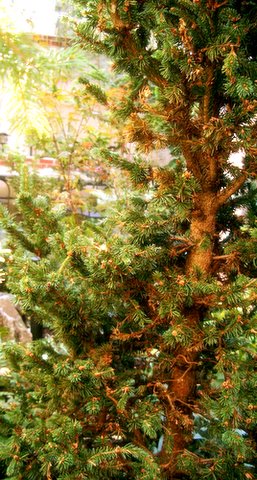
Hillside Upright, you are also narrow, columnar and — as your name implies — upright, and one of the cold-hardiest trees we’ve ever met, with an ability to withstand temperatures as low as -40. Admittedly, this has been a cause for concern at the other end of the spectrum, but your resilience through the humid summer months has been an inspiration. Your needles — said to be among the darkest green of any conifer — add unceasing interest to both the summer and winter garden, and your irregular but always elegant growth habit never fails to hypnotize us, as if you were always casting a spell under which we never cease to fall.
Gold: The Weeping Serbian Spruce (Picea Omorika ‘Pendula Bruns’)

Picea omorikia ‘Pendula Bruns’ — as we tend to call you, because yours is a name that rolls so deliciously off the tongue — you have brought an almost mythological presence to the garden. Your effortless weeping and columnar form is a source to all who must reconcile conflicting impulses and emotions; the resigned dignity of your skirt as it brushes against the ground likewise inspires all who seek to engage the world and somehow rise above it. Like those expired souls of 19th-century France who were so mystified by the mystical allure of your forebears, in 2007 we never once tired of contemplating your grace and beauty, and for this we declare you “Spruce of the Year.”
Filed under: The Autumn Garden, The Gay Recluse, The Winter Garden | Leave a Comment
Tags: Norway Spruce, Picea Abies Cupressina, Picea Abies Hillside Upright, Picea Omorike Pendula, Weeping Serbian Spruce
More than any other neighborhood in Manhattan, Washington Heights — except for a few enclaves north of the George Washington Bridge — has existed in a state of commercial paralysis, so that as we stroll up and down Broadway, we are tempted to say (and with the expected derision) that nothing has changed for at least 30 years, and anyone who thinks otherwise needs to check out Gloria, the 1980 John Cassavetes film in which we find an eerily familiar (and in some cases identical) version of Broadway. If anything, this strip of Broadway (and we are specifically talking about 155th up to 168th) has gotten worse over time as the neighborhood lost — to give a few examples — a kosher butcher, a German deli and a Gristedes, any of which would be most welcome today among the predominating theme of cheap pharmacies, understocked bodegas and “phone-booth” storefronts that open and close with alarming (which is to say, drug-money laundering) regularity.
Yet, as we reconsider this now, during a traditional time of reflection and anticipation of the new year, we must acknowledge that this section of Broadway (the one we know best) was in 2007 marked by some fairly significant — relatively speaking, of course — improvements. (For those wanting an assessment of areas to the north, we offer our sincere apologies, along with the expectation that this will be covered as our staff expands.)
So without further apology, explanation or ado, we present our Gay Recluse Washington Heights Award for the Most Improved Corner of the Year.
Fifth Place: Southwest Corner of 161st and Broadway (Vantage Property Leasing and Management Center).

What was replaced: A “furniture” store specializing in plastic-coated Empire reproductions.
What we like about Vantage: The dignified blue tone and white stripe of the awning (cloth, not plastic) and confident, unpretentious font; the clean and uncluttered window front, with simple photographs of properties for rent.
What this means going forward: Finally, the chance to talk to a broker who actually lives and works here (note to Corcoran and Douglas Elliman: we’re not impressed by your brokers who try to tell us how “great” the neighborhood is after spending all of 15 minutes here.)
Fourth Place: Southeast corner of 164th and Broadway (Washington Mutual and Joa)

What was replaced: A decent fish store (*tears*) and a hardware store (which can now be found at the northwest corner of 160th and Broadway).
What we like about Wamu/Joa: If we were living in almost any other neighborhood, it would be difficult to get excited about a bank, but we appreciate the unprecedented uniformity of this block, the lack of any awning at all and the clean window treatments. And while it doesn’t really have anything to do with the corner, we also welcome Joa, a Korean BBQ and teriyaki take-out joint new to the strip.
What this means going forward: Proof that Washington Heights can be just as blandly corporate as (and eventually, just slightly less expensive in comparison to) our soul-stripped neighbors on the Upper West Side. The transition will be (thankfully) slow but like Harlem is now imminent.
Bronze: Northwest corner of 160th and Broadway (the closing of Super Extra)

What was replaced: N/A.
What we like about the closing: Super Extra will always have a place in the Washington Heights Architectural Hall of Shame for simply existing as a horribly dirty and understocked bodega of epic proportions in what was once a grand movie palace.
What this means going forward: It’s too early to tell, but rumors abound with regard to the future of this block. At one point a sign went up saying that a certain Madison-Avenue based “chemist” (i.e., high-end haircare and cosmetic products) was moving in, but that seems to have disappeared; others claim that like so many buildings in the area Columbia has scooped this one up, and point out that every single storefront (except two) on the entire block is vacant, which may be indicative of a larger deal. In short, nothing would surprise us, but we cannot pass the shuttered doors of Super Extra without breathing a huge sigh of relief.
Silver: The Northwest Corner of 168th and Broadway (Starbucks)
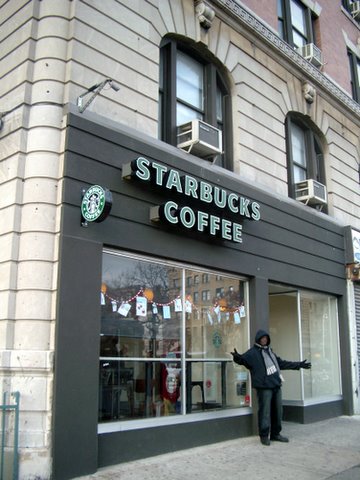
What it relaced: A ladies bra and undergarment store (we think).
What we like about (this) Starbucks: The lack of an awning, most obviously, and the bourgeois aesthetic, which (as tired as it might be elsewhere) is actually quite a pleasure to behold in this context. The place is continually packed, and not just with medical students and doctors; almost as much as Dallas BBQ on 165th, it is where you can find a true cross-section of the neighborhood.
What this means going forward: Pick your cliche about Starbucks and gentrification, with the understanding that all change proceeds glacially in Washington Heights for reasons too complicated to address in this awards ceremony.
Gold: The southeast corner of Broadway and 161st Street (Los Amigos flower stand).
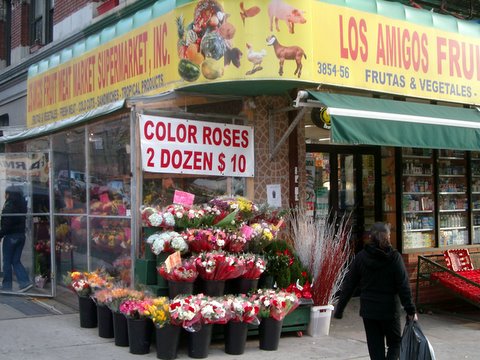
What this replaced: a graffiti-covered wall.
What we like about Los Amigos: The site underwent a renovation over the summer, and while they unfortunately did not consult us on the design of their new awning, we have been pleased with the upgrade in terms of last-minute grocery items (i.e., what we forget to order from Fresh Direct). Best of all, however (and the reason for this award), is the flower stand (open 24 hours), which immediately transformed a dark and scary drug-dealer infested corner into one that is now well, flowery.
What this means going forward: Finally, we don’t have to remember to buy flowers before getting on the subway train downtown. Los Amigos, thank you for making us feel that much more civilized, as if we really do live in Manhattan. We hope you will wear your “Gay Recluse Gold” proudly!
Filed under: Architecture, Capitalism, Gentrification, Landscape, New York City, The Gay Recluse, Washington Heights | Leave a Comment
Tags: 2007 Awards, Broadway, Columbia Medical, Florist, Joa, Starbucks, Uptown, Vantage Properties, Washington Mutual
True, there’s a part of us that wants to mock this display in the entrance to our parking garage in Washington Heights; to note with derision the odd juxtaposition of the toy sports-car bear with the postcard portrait of a baby Jesus; to look with disdain at the tree itself, oddly pathetic and completely garish, as if such a thing could ever mask the reality of the oil-stained floors and the heaps of trash in the corner. But we are touched by the bleak humor of this display; the way it elevates the utter futility of life into something artistic; how it makes us pause to consider our desire to hope, even when logic tells us otherwise.
Filed under: Capitalism, Longing, New York City, The Gay Recluse, Washington Heights | Leave a Comment
Tags: Christmas, Faith, Jingle Bells, Logic, Outsider Art, Parking Garage


 The Gay Recluse