In which The Gay Recluse provides an alternative to this week’s more tedious and stereotypical Modern Love offering in The Times.
“The April Fools’ Joke I Played on Myself”
by Jay Ruttenberg and The Gay Recluse
MY boyfriend and I were descending into the Eighth Avenue L train subway station when I remembered it was April Fools’ Day. I am not a big fan of this day; I’m not an office jokester, always ready with a back slap and witticism. But the realization gave me the urge to contact my little brother.
My brother is five years younger than I. Whenever I mention him to people, I roll my eyes and explain how different we are. It’s a habit I developed when I was in college and my brother was in junior high, buying me beer and teaching me about boys.
We’re still pretty different. He reveres capitalist heroes while I relish seeing handcuffed C.E.O.’s and their weeping husbands being paraded before cameras. He keeps his television on full blast through the night, saying reading is a waste of time. I like nothing more than to curl up with a good book and pretend to read a page before turning on the television.
Still, I’ve always liked him — not so much because he’s my brother but because I enjoy his sense of humor, which is quick and unapologetically mean. Over the years, we have communicated mostly in pranks, inside jokes and observations about family friends and their ugly children.
I’d be hard-pressed to tell you a single emotionally cherished moment from my brother’s life. But ask me about his favorite Adam Sandler movie, and I will answer without batting an eye.
I am neither corny nor crafty enough to pull off a prank on April Fools’ Day. I merely wanted to reach out to my brother and acknowledge the day; it somehow seemed appropriate for a rapport built on nothing but shared blood and vulgar jokes. To ward off any attempt he might make to con me, I dashed off a text message, the most poetic medium of our era. “Consider yorself fooled!” I wrote, excising the pesky u for modern efficiency. Then my boyfriend, Frederico, and I boarded the L train.
When we emerged eight blocks later, there was a message waiting on my cellphone. “If you do indeed know whats going on,” my brother wrote, “I am never speaking with you ever.”
I showed the message to Frederico, who rolled his eyes. “Please don’t call your brother,” he said. “We’re already running late.”
I called my brother. He immediately started yelling at me in a torrent of abrasive words, the kind unfit for even an R-rated movie.
“I admire your crying,” I told him. “Very believable.”
“What the …?” he asked. “Why’d you send that text?”
“Oh, come on: it’s April Fools’ Day.”
“Oh,” he said in staged shock. “Just … never mind. I’ll talk to you later.”
“No, no. Tell me what it is.”
He sobbed unconvincingly. “He broke up with me.”
I swore at him for trying to fool me and hung up the phone.
The “he” in question was my brother’s boyfriend, but their relationship was longer and more complex than many marriages. He’s now 27, and they began dating at 14 and 12. His parents are divorced and mine are gullible, which meant that he largely grew up in our house like a little “sister” who happened to covet my little brother.
I had heard nothing about their relationship being in peril; the notion that they would split up was preposterous. I could more easily envisage Mother Teresa winding up in hell, or Mister Rogers joining the Kiss Army during a drunken bender.
Frederico and I were meeting friends for dinner in the East Village, at an Israeli joint that specializes in hummus. I stared into my plate of mush and contemplated the exchange with my brother. I showed his text message to our friends. “This seems like a joke, right?” I asked.
They weren’t so sure.
As the night wore on, I began to worry. If my brother was telling the truth, life as he knew it was forever changing; a singular relationship of heroic endurance had crumbled. But if I was about to be the butt of a spectacular joke, my family and friends would finally discover how stupid I am, my longstanding fear. This seemed much worse.
We returned home to four answering-machine messages from my mother. She sounded even more distressed than usual. “It looks like there’s trouble in paradise with your brother,” she said.
Had he managed to trick her, too? Or was my own mother in on the joke? My mind reeled.
April Fools’ Day passed. Whoopee cushions were deflated.
Yet my mother continued with these absurd updates. My brother’s boyfriend had moved into his father’s house. My brother, meanwhile, had taken up residence in the same childhood bedroom where the two of them had spent their teenage years.
All the while, not a single snickering family member called to mock my credulity and divulge their clever ruse.
Eventually I even started hearing about new boyfriends whose names I studiously avoided learning. As time passed, these boyfriends were never unmasked as actors who had been retained at drifter wages to punk me, and neither was his barren new apartment ever revealed to be on loan from a conspiring “bachelor” pal.
“I’ve been doing some thinking about my brother,” I told Frederico one day. “It seems they really have broken up.”
My boyfriend stared at me. “Really?” he said, his voice thick with equal parts sarcasm and pity. “You really still thought this was some stupid prank? Have you lost your mind?”
I hadn’t really. But my denial was hard to deny.
I simply had no precedent for this. My parents are baby boomers, yet the customs of their contemporaries, at least when it came to splitting up, somehow skipped over them, which meant I grew up not knowing of alimony and visitation rights but rather two parents stuck together with Super Glue.
My experience with disturbing breakups mostly extends to celebrities I admire. Now I was confronted with a breakup so traumatic it was taking me months to merely accept its validity. More than my parents — more, even, than Howard Stern and his ex-wife — my brother and his boyfriend seemed to complete each other’s DNA. I guess that’s what happens when you start dating in adolescence and stay together into your mid-20s.
I was away, in college and beyond, for much of their courtship. Yet the facts, tracked by my mother as if she were one of the paparazzi and they Brangelina or TomKat, became household lore.
They met at an event for young Jewish tennis players, began phone-dating, became “an item” and, much to everybody’s surprise, stayed that way, attending the same college, sharing an apartment, building an impenetrable repository of their own shared experiences and inside jokes. My brother’s boyfriend even learned to yell at my parents as if they were his own and he was the “daughter” they never wanted.
At various times, every parent, friend and yenta-confidante opposed their relationship (“Too much, too soon!” the chorus echoed), but I always found it wholeheartedly sweet and inspiring. I admired how their union was so durable in the face of opposition, like a frat house John and Yoko.
My own friends could never make heads or tails of it: My reckless little brother — the same one who beat me up when I was 20 and he 15 — had been devoted to the same boyfriend from puberty through graduate school. Cupid himself seemed to have some weird couple-crush on them. Until, of course, that fateful April Fools’ Day, when he split their arrow in two, the punch line of a lifetime.
I should probably mention that my brother’s boyfriend and I never got along very well. Because I once bought a pair of used pants, she considered me a hippie. And I saw him as a spoiled brat whose shopping habits would make Paris Hilton blush.
But if we didn’t like each other, it was in the same way my brother and I don’t like each other — the same way, in fact, that all siblings don’t like each other and yet remain bonded for life.
But now he had wrenched himself away from my brother and, hence, from his family.
EVENTUALLY I learned that their romance had fallen victim to a notorious relationship-buster: a meddling psychiatrist (his), who suggested that because they had bonded so young, they suffered from co-dependency, arrested development and all sorts of ailments frowned upon by Freud. The psychiatrist prescribed some “time off,” which quickly atrophied to “breakup.” Had Romeo and Juliet survived, and Juliet retained a therapist, I bet they would have received a similar diagnosis. The chorus of naysayers had turned out to be right.
I gleaned this information from my parents. In my sporadic conversations with my brother, we almost never broached his romantic loss. When the following April 1 arrived, I found myself on the phone with him again, talking our usual scatological nonsense.
I could hear his new boyfriend in the background. I do not like him. He could hoist my shivering body from icy waters, broker a peace accord in the Middle East and grant me all credit, pilot a spaceship to Mars and plant a flag on which he has painstakingly needlepointed my portrait … and still I would not like him.
After all, I never witnessed this new guy entering my childhood home without a knock, his long hair bouncing, in search of a Popsicle; I never heard him yell “But that’s so unfair!” at my parents before storming from a room; I did not argue with him about the holding rights to a TV remote control with righteous fervor; and I never, ever inadvertently introduced him as my baby sister.
I desperately wanted to explain all this to my brother. I wanted to tell him how, since his breakup, a small but fundamental hole had opened in my life and that, in being so abruptly and permanently disconnected from his old boyfriend, it felt as if my sister had died.
But those are not the type of things my brother and I speak about. And it was, after all, April Fools’ Day.
And so, with the heaviest of hearts and the slightest hint of poignancy, I made an off-color remark about a relative. We laughed; then I rushed off the phone to cry.
Jay Ruttenberg is editor of The Lowbrow Reader and a staff writer at Time Out New York.


Filed under: Drivel, Gay, Stereotypes, The Gay Recluse, The Times | Leave a Comment
Tags: Daniel Jones, Fashion & Style, Frat Boys, Gay Modern Love, Jay Ruttenberg, Stereotypes, The New York Times
In which The Gay Recluse reads the usually dependable City Room and says wtf.
Yesterday City Room crapped out an astoundingly bad (and factually inaccurate) propaganda piece called “Should All of 125th Street Be Declared Historic?” in which they discuss a “proposal” — until now, completely unheard of (and for good reason) — being put forth by Adam Leitman Bailey, a “lawyer who was born in Queens and grew up in New Jersey … to halt gentrification in Harlem.” The proposal, we are told, would have 125th Street, from river to river, declared a “Harlem Historic Zone” to make it more “difficult to tear down the neighborhood’s old buildings and replace them with new ones.”
In the post, we are supposed to be impressed because Bailey talks fast (we are told twice), “is adept at multitasking [and] receives 30 to 40 e-mail messages each business hour.” Bailey, who represents “House of Seafood, Manna’s Restaurant and Million Nail Salon” (bold/ital ours) in what in reality is a humdrum real-estate dispute (that should receive no press whatsoever) wants us to believe that if these two restaurants and nail salon were to move, it would be akin to losing “the homes of the Founding Fathers.” [Seriously. This is the quote: “When the Brooklyn Bridge was built, they tore down George Washington’s house,” Mr. Bailey said by telephone this afternoon, speaking rapidly. “Was that a good idea?” (note the “speaking rapidly” part: like, wow — he must be a real expert!).]
Then City Room goes on to tell us that according to Mr. Bailey, “by tearing down the building, history will be forever lost, including the site of W.E.B. Du Bois’s first office space, and the backdrop for some of the speeches of Malcolm X (who was assassinated 43 years ago today at the Audubon Ballroom in Harlem).”
Ok, City Room, listen up: The Audubon Ballroom is on 165th Street in Washington Heights, which is approximately two miles north of the building/street in question. Yes, Malcolm X made speeches in Harlem: does that mean that the whole fucking thing should be preserved in a blightastic time capsule? We — and 95 percent of Harlem, according to our informal survey — think not. As for Bailey, he’s a rich white asshole lawyer (and we feel very comfortable saying that, given that we share three of those attributes) who doesn’t even live in Harlem, much less shop there. That the following words even left his lips, much less made it to the New York Times (even on a blog) is an embarrassment to you, City Room, and — frankly — pretty much everyone who’s ever lived. “Mr. Bailey [invoked] the names of Abraham Lincoln and Branch Rickey, the Dodgers executive who signed Jackie Robinson, making him Major League Baseball’s first African American player. ‘Just because I’m not black doesn’t mean I’m not a good advocate and I can’t understand what you’re going through,’ he said [and then added that] his grandfather, a taxi driver, grew up in the neighborhood before it became an African-American mecca.’ ‘This is Harlem’s last stand,’ said Mr. Bailey. ‘I don’t think you can ever recreate it. If you are black, you feel proud to be there.'”
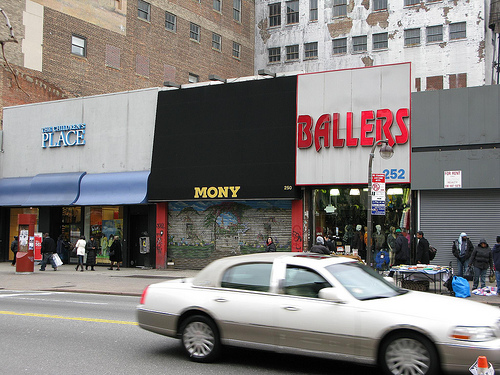
According to Mr. Bailey/City Room, if you’re black, you should be proud of this incredibly historic strip of 125th Street, only one of many to be found there.
Filed under: Architecture, Capitalism, Communism, Drivel, Gentrification, Knockbusters, New York City, Retail, The Gay Recluse, Uncategorized | Leave a Comment
Tags: Adam Leitman Bailey, Audubon Ballroom, City Room, Crap, Harlem, Knockbusters, Lawyers, Malcolm X
On the Extinction of Golf
In which The Gay Recluse ponders the dinosaurs.
In today’s New York Times, in a shocking piece that has vaulted all the way to number one on the “Most Popular” chart, we learn that golf is on the way out; declining in a popularity, with too many courses built in the 90s, it’s no longer feasible for men to spend their weekends on the green when they have to be home for lunch on Saturdays. Equipment is expensive, Tiger Woods hasn’t sparked such a big revolution after all; according to Zzzzzzzzzzzzzzzzzzzzzzzzzzzz.
The truth is, we have always been bored to tears by the game, which makes us think mostly of 1) our asshole Republican relatives who do insane things like get up in the dark so they can squeeze in two rounds in a single day, and 2) that bitch in the clubhouse who yelled at us in junior high, when our confidence was not exactly overflowing, because we had (unintentionally) chopped up a little bit of the fairway (and this at a public course) on the fifteen-or-so strokes it took us to complete the final hole. (Wherever you are now, feel our vindictive wrath!)
But our memories of golf are not all bad; it occurs to us the some of the greatest snow sledding in history has taken place on golf courses, and isn’t that a testament to some higher calling? Or what about the inevitable “woods” next to or behind the golf course? Here is where the derelicts and the outsiders gather to drink beer and get wasted (and have sex) beyond the sightlines of their suburban parents. Awesomely, in the debris of such a party, we once found fifty dollars — or in today’s dollars, $100,000 — mixed in with the empty bottles of tequila and cigarette butts, and it was easy to believe for the next ____ years that our life really was charmed. Or we always like to think about wandering through the woods looking for all of the lost golf balls; buried in the underbrush or wedged between rocks, each one is small and hard and usually a bit too damaged to be used for anything except for driving practice. But still, how exciting to collect a bag of these and bring them back to the clubhouse, where someone might give you a dollar or two! These are the little truths in the world, which collectively add up to just something more than nothing.
Filed under: Dissonance, Memory, Resignation, The London Eye, The Times | Leave a Comment
Tags: Asshole Republicans, Extinction, Fifty Dollars, Forest, Golf, Golf Balls, Sledding, Tiger Woods, Woods
On V (x4)
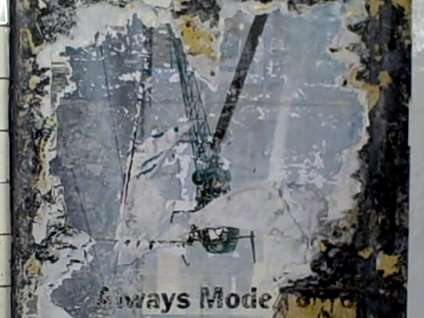
In which The Gay Recluse contemplates four uncommissioned masterpieces from the walls of an uptown subway station and finds evidence of paranoia, conspiracy and entropy.


Filed under: Addiction, Conspiracy, Decay, History, Infrastructure, Obsession, Subway, Technology, The Gay Recluse, Washington Heights | Leave a Comment
Tags: 163rd Street, C-train, Graffiti, Modern Art, MTA, Thomas Pynchon, V
In which The Gay Recluse appears on the back of a tattered subway poster in the post-apocalyptic dungeon that is the 163rd Street subway station.

Filed under: Capitalism, Graffiti, Infrastructure, New York City, Subway, The Gay Recluse, Washington Heights | Leave a Comment
Tags: 163rd Street, C-train, Dungeons, Graffiti, MTA, Neglect, Post-Apocalypse, Ruins, Shitholes, Washington Heights
In which The Gay Recluse reads an acclaimed book of contemporary fiction and is more than disappointed.
When we first received our copy of Call Me By Your Name (FSG, 2007) by Andre Aciman, we were a bit startled (but pleased, to be sure) that a book about a love affair between a 17-year-old boy and a 27-year-old man had received such rave reviews: was there anyone who didn’t love this story, which was “hot” and “sensuous,” yet “literary” and — omg! — “Proustian”? On the cover we noted a rather homoerotic photograph of a young man, with his forehead lying on his crossed arms in a position of torpid anguish. (In short: pretty fucking gay awesome, right?) Given what we know about the ongoing suffocation of the gay voice in American literature, we wondered: how did Aciman pull it off?
The answer, it turns out, is simple: he’s not gay! Married with kids, “[h]e lives with his family in Manhattan.” (The quote is from the “about the author” blurb on the inside cover, which was literally the first thing we read, as if to dispel any fears we might have that he is really gay and not just pretending.) We know we’ve been overusing this expression lately, but if you can bear with us this one last time: wtf?
We’re not here to tell you that Aciman can’t write, because obviously he can, and at times he does so with passion and beauty. More than once he captures a spirit of genuine anguish that can arise from hidden and unrequited love; and at times we were moved by the plight of a 17-year-old who is intellectually gifted but unable to express the one thing he truly wants.
Yet ultimately we are left wanting to slide this book into the fire. The first problem we noted was an exasperating (but oddly unconscious) sense of privilege that clings to these pages; besides his annoying man-crush, the narrator’s life is ridiculously perfect: he lives in a mansion on the Italian coast; he takes daily swims in the pool and the ocean; there are servants to prepare the food, some of which is cultivated in the fields around the estate. He has a hot girlfriend he can fuck whenever he feels like it. Meanwhile, both of his parents adore him; they are intellectuals with intellectual friends; there is never the least bit of resentment expressed toward either parent; in fact the only displeasure expressed toward anyone is a slight ridicule for a pair of queens from the United States who can’t speak perfect Italian; meanwhile, books and classical music abound, and the town itself features a book store that is packed for a poetry reading.
All told, it makes us wonder: if it’s such a fucking utopia, why is this kid so tormented about a little gay sex? The answer of course, is that the torment is implied, which — ok — is often the case in society (particularly in homophobic quarters), but does not really serve our purposes here; ultimately, the narrator’s lack of insight or resolution into this most critical of issues — namely, exactly what holds him back and why — makes his love-making (when it finally happens) with the older guy seem less revelatory than simply indulgent, another treat for a privileged brat. Thus, while the author has impressed critics with his ability to describe anal sex or a blow-job — without presumably having ever indulged in M2M sex (OMG, what powers of imagination!) — he fails to convey the concurrent psychological conflict that makes these acts so despicable, forbidden and — ultimately — interesting.
This flaw, of course, is exacerbated by the fact that the narrator is writing 20 years after the fact and his attitude about the affair hasn’t changed one iota! (Proustian? We think not.) In fact, we are left in the dark about the narrator, who may or may not be “out,” but in any case is still pining after his closet-case lover who [SPOILER ALERT] after fucking the narrator for a few weeks on a summer idyll returns to the States to marry some faceless woman with whom he has two children, all of whom are kept in the dark about his past, which we are led to believe is kept under lock and key with no apparent repercussions.
All of which is to say that, for those readers who like their fiction to reflect some deeper truth about the human condition, this book ultimately disappoints and must ultimately be regarded as only slightly more serious than your average after-school special. Although the prose is rich, deeper insights about the human condition are kept to a strict minimum, and we are left to wonder how anyone could be so immature. Then we remember who wrote it, and it all makes sense.
Filed under: Drivel, Gay, Literature, Pessimism, The Gay Recluse, Writers-American | Leave a Comment
Tags: Andre Aciman, Bad Books, Call Me By Your Name, Closet Case, Gay Voice, Homophobia, Stereotypes
In which The Gay Recluse is inspired by a classic.
Of all the French photographers who documented Paris at the turn of the last century (and we don’t mean 8 years ago), we are most obsessed with Eugene Atget. Who can resist his urban streetscapes, his ghostly renderings of the city of light? And his trees — such grandeur and endless striving from these magnificent roots!
On a recent walk in Washington Heights, we succumbed to the urge to document the gnarled twists and turns of a similar feat of nature, as if one of Atget’s trees had landed right in front of us. Of course — as if to prove our point about the past always being better than the present — these beautiful roots were covered in litter and debris. Wtf. We took the photograph anyway.

Filed under: Dissonance, Memory, Nostalgia, Pessimism, Photography, Pleasure, The Winter Garden, Washington Heights | Leave a Comment
Tags: Eugene Atget, Litter, Paris, Roots, Trees
On Our Secret Longing for Janice Dickinson To Run Unopposed for President of the United States
In which The Gay Recluse becomes fatigued with the general election before it’s even started.
We begin by admitting that we came extremely late to the Janice Dickinson party, having only just caught up in the last few weeks with seasons two and three of her reality television show on Oxygen, “The Janice Dickinson Modeling Agency.” At first we were somewhat horrified by her brash but startlingly exuberant voice and the rather extreme amounts of plastic surgery on display, to the point where we were whispering “oh my god” repeatedly under our breath, as if we were watching a horror movie and she was about to reach through the television screen and wrap her hands around our neck.
Yet as we persevered and one episode passed into the next, not only did we find ourselves increasingly intrigued by Dickinson and the business of her modeling agency, but — as we compared her to the current crop of candidates — we began to secretly wish that she was running unopposed for President of the United States.
Let’s discuss a few of the many ways in which Janice Dickinson would make the better commander-in-chief.
1) She’s tough but pragmatic. She’s a good negotiator. Seriously, as nasty as politics is, would John McCain, Barack Obama or Hillary Clinton have been able to last for 35 years in the high-fashion modeling industry? We think not.
2) She’s principled but understands capitalism. We think of when Dickinson insists to her business partner that she wants the agency to aspire to French Vogue more than its trashy (but more profitable) down-market counterparts like Maxim. Do any of the candidates ever claim to hold this kind of higher aesthetic ideal (and moreover, take concrete steps to make it happen)? Score another point for Dickinson.
3) She treats her models like people. Over and over in the past season, we saw Dickinson insist that her clients treat models with respect, and not to needlessly objectify or dismiss them.
4) She’s not afraid to be “liberal.” What Republican would declare her modeling agency “fur-free” and take part with her models in a PETA demonstration on Hollywood Boulevard? She repeatedly claims that she wants her agency to be “inclusive” and then puts her money where her mouth is by actively recruiting models of every ethnicity and sexual orientation.
5) She’s gay-friendly and sex-friendly. She’s extremely comfortable with nudity. She claims to have slept with over 1000 men (including Grace Jones) and generally brings a forthright candor to discussions of sex and nudity that is sadly lacking among the current crop of candidates.
6) She’s compassionate without being dictatorial. When Dickinson suspects that her models are not eating enough or cutting themselves, she confronts them and urges them to get help; at the same time, she does not make it her mission to “save” anyone who is unwilling to hear what she has to say; in this respect, she shows remarkable restraint.
7) Her models look professional. Compare a Janice Dickinson model to anyone on Bravo’s “Make Me a Supermodel” and you’ll see how superior Dickinson’s models are to these “reality” contestants. Dickinson’s ability to identify talent and nurture it is exactly what we need in an executive leader.

Our next president? We wish.
Filed under: Capitalism, Fashion, Government, Politicians, The Gay Recluse | Leave a Comment
Tags: Barack Obama, Grace Jones, Hillary Clinton, Janice Dickinson, John McCain, Oxygen, The Janice Dickinson Modeling Agency
In which The Gay Recluse updates his informal but rather telling quantitative analysis of Modern Love, the weekly Style Section (of The Times) column in which openly gay writers almost never appear, and even less frequently describe a romantic relationship.
This week’s piece: I Married a Republican: There, I Said It
Subject: A (bland, suburban) Democrat marries a (bland, suburban) Republican and writes about the challenge of attending cocktail parties. “On my first date with Lorne, over black ink pasta and Chianti, I ranted about union busting.” Rather than subject yourself to this degree of tedium and convention, we suggest our own alternative, “I Married a Lesbian Republican: There I Said It.”
Filed under: Straight Woman on Relationships
The updated tally (or why we feel like animals in the zoo): 6 out of 166 columns by openly gay writers; 1 out of 166 on female gay relationships; 0 out of 166 on male gay relationships. In what is arguably the “gayest” section of The Times, more women have written about gay men than gay men have.
Outstanding question to Daniel Jones, editor of Modern Love: wtf?
Straight Woman on Relationships iiiii iiiii iiiii iiiii iiiii iiiii iiiii ii (38)
Straight Woman on Family iiiii iiiii iiiii iiiii iiiii iiiii iiiii (35)
Straight Woman on “Looking for Love” iiiii iiiii iiiii iiiii iiiii iiiii ii (32)
Straight Woman on Breaking Up iiiii iiiii iiiii iiiii iii (23)
Straight Man on Relationships iiiii iiiii (10)
Straight Man on Breakup iiiiii (6)
Straight Woman on Gay Men iiiii i (6)
Straight Man on Family iiiii (5)
Straight Man on “Looking for Love” iiii (4)
Gay Man on Family ii (2)
Gay Woman on Relationship i (1)
Gay Woman on Family i (1)
Gay Man on Self-Hatred i (1)
Gay Man on Prom Date i (1)
Ambiguous/Nurse on Drugs i (1)

Filed under: Drivel, Politicians, The Times | Leave a Comment
Tags: Daniel Jones, Fashion & Style, Gay Modern Love, Gay Stereotypes, Gay Voice, Gay Writers, Homophobia, Modern Love, Republicans, The New York Times
In which The Gay Recluse provides a fresh alternative to this week’s particularly bland and tedious Modern Love offering in The Times.
“I Married a Lesbian Republican: There, I Said It”
by Ann Hood and The Gay Recluse
IT was happening again. I was at a cocktail party where the hosts were people I had just met, people I wanted to become friends with, and was sipping chardonnay and nibbling papadum chips when a woman said, “Oh, the people next door! They’re …,” she paused and lowered her voice, “ … Republican.”
Everyone grimaced. The conversation quickly turned to complaints about the current administration. Before long it wasn’t just the administration being bashed but Republicans in general.
I stood there nodding, my dirty secret lodged in my throat like a golf ball.
The woman I wanted to befriend looked at me conspiratorially and shook her head. “Can you imagine?” she said. “Right next door!”
“No,” I lied.
Not only could I imagine a Republican in my neighborhood, I could imagine one in my bed. Every night. I’m a Democrat whose lesbian lover is a Republican.
And I am not just an average Democrat — I lean way, way left. I marched along Fifth Avenue protesting the 1991 Persian Gulf war. I rode a bus to Albany to march against the death penalty. When I enter a voting booth, I choose all the candidates in the same column, without hesitation. My last love, before my current lesbian lover, Lorne, had grown up in Berkeley, Calif., in the 60s. She was so far left, she made me look centrist.
On my first date with Lorne, over black ink pasta and Chianti, I ranted about union busting.
“Wow,” she said. “You’re pretty passionate about this.”
If she had said, “Wow, you must be a Democrat,” would I have ended the date? Maybe. I had never had an actual relationship with a Republican. Wisely, she did not confess that night. But after I ranted some more, I had a strange feeling that she might disagree with me.
“You’re a Democrat,” I said, “right?”
My lesbian lover has a beautiful face, and right then she leaned her beautiful face close to mine and said: “I vote for the best candidate. I read everything I can. I listen to them speak. And I vote for the person who can do the best job.”
“Really?” I said. I didn’t know anyone who did that. Everyone I knew only read about and listened to and voted for Democrats. I remember thinking that she was a good person, a fair person, a better person than I was with my rigid values and unwavering commitment to liberal politics.
Here was how Republican she was: in the early ’90s, she was drafted to run for lieutenant governor of our state on the Republican ticket. But here is how open-minded she has always been: her candidacy was undone when a reporter discovered she had been a registered Democrat since college, and although she had long since stepped to the other side of the aisle, she had never gone to the trouble of undoing that. (She soon did.)
Whatever her current politics, it was too late: I had already fallen in love with her combination of whimsy and steadfastness, her ability to fix broken doors, her wanderlust and just plain lust.
What can I say? Love can sidetrack a person. Still, it did not feel good when I told myself: I love a Republican. It felt, in fact, like I had betrayed someone. Or many people.
Slowly, my close friends and family met Lorne. And slowly, one by one, they took me aside. “Ann,” they would hiss, “she’s a lesbian and a Republican.”
“But she’s pro-choice,” I would say, hanging on to the one political stance she and I actually shared.
“But she’s a lesbian Republican,” they would say.
Slowly, I met her lesbian Republican friends. Clinton was president then, popular and charismatic. But at my first dinner party with her three oldest friends and their partners, I had to listen to them complain about Clinton. This was before Monica. What was there not to love about Clinton before Monica? Well, I guess if you disagreed with what she stood for, there was a lot not to love. But how could you not agree with what she stood for? Such was my worldview.
Everyone I knew felt optimistic about the United States back then. Except those people. I stared at the strange new faces, faces I imagined I would have to see for the rest of my life. They fell from moderate to very conservative — all of them right of center. How had I ended up here?
“You told me you voted for the best candidate!” I said to her later.
“I do,” she said. “They just happen to be mostly Republicans.”
Angry with her and myself, I began to argue about every political issue that landed on our doorstep with the morning paper. The more I argued, the more I saw how little we agreed. Being in favor of abortion rights was important, necessary even. But was it enough?
Whenever we were with my friends, I would silently tally who was on which side. Inevitably it was my friends, blue; my lesbian lover, red. The opposite was also true. Almost without exception, her friends voted red, and I was a minority of one.
Tired of clenching my teeth during their dinner debates about the evils of the Democrats — their flawed policies and lack of morality — I began to fight back. I screamed about partial birth abortion and defended President Clinton over the Monica debacle during an endless dinner at a country club, then cringed at their party-line responses. Lorne at least isn’t as conservative as these people, I told myself. But that offered little solace.
When a lesbian friend and I were hosts to a John Kerry fundraiser, she breezily talked about having Lorne and her (that is, my friend’s) lesbian lover pick up the wine and gather signatures.
I swallowed hard. “Lorne isn’t coming.”
“Is she out of town that night?” she asked, her face so innocent and open.
I shook my head, avoiding her gaze. “She’s on the other side,” I managed.
“Huh?”
“She goes the other way,” I tried.
Now she was frowning at me. I had no choice. “She’s not a Democrat,” I finally said. Easier, I figured, than saying the “R” word out loud. Even so, I had rendered her speechless.
The night of the fund-raiser, Lorne and I had a fight about whether she could go at all. “Why would you?” I asked, imagining her explaining to everyone why she didn’t want Kerry to win. She did end up going but kept characteristically quiet about her politics. Maybe I imagined the looks of pity that people shot my way that night?
Then we invaded Iraq, and nobody was able to find any weapons of mass destruction, and I knew Lorne would see the error of her ways. Rather than gloat, I decided to forgive. I pointed to a front-page article and said, “Now that we know Bush misled us. … ” I looked at my lesbian lover’s face and stopped. “You don’t still support him, do you?”
“Well,” she started, “until we know all the facts. … ”
As luck would have it, we had dinner that night with a group of her old lesbian Republican friends. Without politics, these friends always strike me as being warm and caring. But whenever that line is crossed, they seem insane to me, rabid and unreasonable. That night, however, when I heard myself screaming, “Even if Condoleezza Rice is a lesbian, she’s a liar! Rumsfeld is a war criminal!” it became clear that it was not her stridency that was causing this rift in our marriage, but mine.
On the way home, I vowed to stay away from political discussions with this group or any of Lorne’s friends, forever. As we sped through our little blue state, I sneaked a glance at her driving. True, Lorne avoided these arguments. But it didn’t matter. I knew where she stood, and where I stood, and it was not on the same side. Could a lesbian relationship survive such a solid barrier of disagreement? How many bipartisan couples did I know? Absolutely none.
We have other differences, of course, but they are trivial: Lorne likes to climb mountains, I like to knit; she always orders biriyani in Indian restaurants, I don’t much care for it. Not exactly the stuff of great conflict. But a lifetime of tolerating, even embracing, such philosophical opposition seemed harder to imagine.
But tolerate it we did, mostly by not talking about it. When I read about President Bush’s low approval ratings, and when Alberto Gonzales resigned, I gloated privately. Then, the inevitable happened: a new presidential election was upon us. Lined up on one side: Obama, Clinton, Edwards and me. On the other side, McCain, Romney, Huckabee and Lorne. I wanted to know whom she was supporting. I needed to know.
“I like Edwards,” I said one morning, then held my breath.
She grinned, shaking her head. “I haven’t decided yet.”
A brief respite. But I knew there was no avoiding it. Things would heat up. From where I sat, the divide seemed huge and unnavigable, yet also narrow enough to reach across and hold hands. So that’s what I did. I took her hand: my lesbian lover, my Republican, my love.
AND then a few weeks ago I came home from a business trip, pulled my politically correct car into our driveway, and stared hard at the sign in our yard. I blinked. I looked again. It was not a mirage.
The sign said, “Vote Obama.”
I shouted. I actually whooped. I couldn’t believe my eyes. Had one of my children put it there? A neighbor? It couldn’t have been Lorne.
Inside, I approached her cautiously. “There’s a sign in our yard.”
She shrugged and cast a broad smile my way. “He’s the best candidate.”
Now my whole body was grinning.
I sneaked off to call my cousin. “Lorne is supporting Obama,” I whispered.
“No!”
“She put a sign in our yard.”
“No!”
A few days later, Lorne sent me a text message: “KENNEDY HAS ENDORSED OBAMA!!!” I counted the exclamation points. Three could only mean giddy excitement. I gazed at the words on my cellphone and remembered how, 15 years earlier, I fell in love over black ink pasta and Chianti with a woman who was thoughtful and independent (all right, and an excellent kisser).
It would be nice to think I had changed her, but I hadn’t: if anything, she had just proved that she’s more thoughtful and independent than ever. And I, for better or worse, remain just as passionate and stubborn. Which is maybe (let’s hope) a big part of why she fell in love with me.
Whatever the case, I can already see the bumper sticker: “Barack Obama: Uniting America, One Bipartisan Lesbian Relationship at a Time.”
Ann Hood lives in Providence, R.I. Her latest novel is “The Lesbian Knitting Circle” (Norton).
Filed under: Drivel, Government, Stereotypes, The Gay Recluse, The Times | Leave a Comment
Tags: Daniel Jones, Fashion & Style, Gay Modern Love, Gay Stereotypes, Gay Voice, Gay Writers, Homophobia, Lesbian, Modern Love, Republican, The New York Times
In which The Gay Recluse looks at the suffocation of the gay voice at The New York Times and other hallmarks of the new dark ages.
For those who missed it, we would like to point you in the direction of a recent post by Jeff Weinstein, in which he compares a truth about Jasper Johns and Robert Rauschenberg — namely, that they were boyfriends/lovers/partners for approximately seven years, from 1954 -1961 — with recent descriptions of this same relationship by Roberta Smith and some of her fellow critics, who all use the word “friend” (or some variation) instead of an explicitly romantic term. (Seriously Roberta, wtf? And you wonder why so much criticism seems like it was written in a crypt.)
And while we’re on the subject of Weinstein, we would like to recommend his book of essays (it really doesn’t do them justice to call them “reviews”) he wrote as a restaurant critic for the Village Voice in the 1980s. Things we learn about New York City 25 years ago include: 1) people still actively discussed things like labor unions as a way to mitigate against the effects of capitalism, 2) Mary Tyler Moore reruns were very popular among a certain set, and 3) food was a lot cheaper then (it makes us wonder what the numbers would be in today’s currency, i.e., adjusted for inflation; we have a sneaking suspicion that eating out has gotten more expensive, but that’s probably what people always say). More seriously, what we like about these essays — the book is called Learning To Eat — is that while Weinstein writes with authority and grace (and — yes, Roberta — honesty) about any given subject (and food is often tangential), he has a constant awareness of doubt and remembrance that gives the book a surprising timelessness; or perhaps timeliness is a better description, given our sense after reading it that in many ways, we have regressed over the past 25 years and are even less enlightened now than we were then. (And have we not — via Weinstein — also provided the evidence for this?)
Filed under: Capitalism, Communism, Literature, New York City, Nostalgia, Pessimism, The Times, Writers-American | Leave a Comment
Tags: Food, Jasper Johns, Jeff Weinstein, Robert Rauschenberg, Roberta Smith, The Gay Voice, The New York Times
In which The Gay Recluse ponders a sampling of recent search terms used to find the very pages you are now reading. Note: All search terms listed are in the exact form provided by WordPress.com, which is the host (at least for a while) of this blog. Hyperlinks to relevant posts included.
Search: two headed cat
Comment: We love ours very much.
Search: no exit washington heights gay
Comment: We too have used Washington Heights as a metaphor for hell.
Search: dress up a gay jesus
Comment: This is the best way to celebrate the holiday season.
Search: spacemen 3
Comment: Blow yourself away, and tell them we sent you.
Search: retirement pleasures
Comment: Wherever you are, Glitza Gardenia, we hope that you are happier now than you were then.
Search: gay edwardian
Comment: They existed. Some were named Henry James. Some were hot bears. (This is indisputable.)
Search: rapes in pittsburgh
Comment: At least the Super Bowl is over for now.
Search: cat shadows
Comment: We laugh at Zephyr even as we do the same thing ourselves.
Search: “valley of misery between peaks of joy”
Comment: It’s not a horrible metaphor, but Daniel Jones & Company have a way of taking the fun out of everything.
Search: ge monitor top fridge broken
Comment: Even the greatest of empires must eventually come to an end.
Search: photographing couples with pets
Comment: Science has proven that those who do it (photograph couples with pets) are almost always gay.
Search: grant hart
Comment: Someone on Gawker didn’t even know who/what/when Hüsker Dü was, which fills us with both pleasure and regret.
Search: john mccain misshapen temple
Comment: We wanted Geraldine Ferraro but ultimately endorsed Barack Obama.
Filed under: Animals, Architecture, Good Rock, Government, Infrastructure, Language, Search, Technology, The Gay Recluse, Washington Heights | Leave a Comment
Tags: Barack Obama, Edwardian, Gay Bears, Gay Modern Love, General Electric, Geraldine Ferraro, Grant Hart, Hüsker Dü, Henry James, Jesus, John McCain, Modern Love, No Exit, Pets, Pittsburgh, Retirement Pleasures, Shadows, Spacemen 3, Steelers, Two-headed cats
In which The Gay Recluse responds (in italics) to reader comments.

Filed under: Architecture, Capitalism, Communism, Decay, Gentrification, Government, Infrastructure, Knockbusters, Letters, New York City, The Gay Recluse, Washington Heights | Leave a Comment
Tags: Amsterdam Avenue, Boston Market, Columbia University, Curbed, Development, Rent-Stabilization, Rite-Aid, Saint Nicholas, Uptown, Useless Shit, Washington Heights
In which The Gay Recluse pays tribute to his friends in Inwood.
Of all the kind words and comments we received in response to our Gay Modern Love piece, we must acknowledge our friend Sayd in Inwood, who wrote this on Manhattan’s Peak:
your story on gawker today was absolutely perfect. if i rub my big boobs on you the first time i meet you, it wont be an accident.
:: swoon ::
Thanks, Sayd! Between you and Rose Fox, we’re thinking that Inwood is pretty much the shit these days. (But you already knew that.) Someday, if we ever come out of hiding, we’ll look for you near Skorakopock Rock.
Filed under: Gay, Gentrification, Good Rock, The Gay Recluse, Washington Heights | Leave a Comment
Tags: A Garden in Riotous Bloom, Big Boobs, Gawker, Gay Modern Love, Inwood, Manhattan's Peak, Mutual Admiration Societies, Skorakopock Rock
On Gay Modern Love (or Thanks to Stephen, I Came Out Twice: First as Gay, Then as a Recluse)
In which The Gay Recluse — as part of a Valentine’s Day special feature — encourages readers to visit Gawker.
For those of you who have followed our informal-but-rather-telling quantitative analysis of the “Modern Love” column in The Times — in which openly gay writers almost never appear and even less frequently write about romantic relationships — we are happy to report that Gawker a) launched their own version of (Gay) Modern Love and b) to kick it off, today published an essay we wrote on the subject called “Thanks To Stephen, I Came Out Twice: First as Gay, Then as a Recluse.”
You can read the essay (and for the most part, the miraculously snark-free comments) here.
Thanks, Gawker! We would like to wish you and everyone else a Happy Valentine’s Day (to the extent that’s ever possible, of course.)
Filed under: Dream, Gay, The Gay Recluse, The Times | Leave a Comment
Tags: Daniel Jones, Gawker, Modern Love, The Gay Recluse, The New York Times, Valentine's Day
In which The Gay Recluse celebrates the demolition of an eyesore.
Location: The intersection of Amsterdam and Saint Nicholas, between 162nd and 163rd Streets, in Washington Heights.
Previously: We wish we had a photograph, but — alas! — a search through The Gay Recluse archives came up empty. Thus you will have to imagine a most heinous and jail-like cinder-block structure — (construction costs=10 cents) — one-story tall with the usual Rite Aid signage and details, all working together to create a suburban-wasteland sense of desolation completely not in keeping with the pre-war ruins that mark the rest of the neighborhood. This depressing contrast was accentuated by a location that places it in sight of Jumel Terrace, home of Manhattan’s oldest freestanding mansion, and the monstrously awesome, aged and enormous English Elm of Washington Heights, which graces the corner of 163rd Street. For several years the building was abandoned, after it was apparently declared structurally unsound (it sits atop the abandoned portion of the 163rd Street subway station). Thankfully, it was finally demolished about a week ago.
The future: At one point we were told by a Community Board member that the city planned to buy the land for a playground, but this was later denied (and with petulance) by a Parks representative who claimed to know nothing of the matter. A garden would be ideal, but a skateboard park would also be cool, given the burgeoning numbers of skate punks we see hanging around 168th Street. (Take the skinheads bowling!)
For now: A cement patch, which all things considered is a lake of serenity in comparison to what it replaced. Behold the new vista:

Note the English Elm in the middle left. A Columbia University facility can be seen in the distance. (A potential buyer? There could be worse fates.)

A close-up: imagine the aisles of useless shit that used to stand in this very spot. Now feel the bliss of knowing it is gone forever!
Filed under: Architecture, Capitalism, Knockbusters, Landscape, Photography, Subway, The Gay Recluse, Washington Heights | Leave a Comment
Tags: Amsterdam Avenue, Camper Van Beethoven, Columbia University, English Elm, Knockbusters, Rite-Aid, Saint Nicholas, Useless Shit, Washington Heights
In which The Gay Recluse — with help from our United Kingdom correspondent, The London Eye — examines life abroad (instead of just dreaming about it all the time).
Today, this breaking news from The London Eye:

We also note the regrettable lack — at least to our knowledge — of a “Bakerloo” in the New York City region, and would accordingly like to propose the renaming of the “B-Line” to “The Bakerloo Line.” We also like the use of “whilst” and encourage the MTA to adopt it in all of its official communications.
Filed under: Infrastructure, Subway, The Gay Recluse, The London Eye, Travel | Leave a Comment
Tags: Advertising, Bakerloo, London, MTA, Picadilly Circus, Television Screens, Underground, Vandalism
On the Gawker Executions
In which The Gay Recluse — in case you missed it — reports on today’s media frenzy.
So get this: today Gawker “executed” four of its “more-stupid-than-funny” commenters, three of whom we specifically targeted in the post we wrote yesterday about (get out your pencils and paper) Gawker’s original post about Chris Crocker. Say what you will about free speech, homophobia, conformity (or the lack thereof) or whatever else may or may not get dredged up in the mix, but Gawker’s “audition” policy for commenters makes it very clear that the site maintains a velvet rope at all times, and it was pretty fucking awesome to see them use it.
Filed under: Dissonance, Drag Queens, Faith, Gay, Law, Stereotypes, The Gay Recluse | Leave a Comment
Tags: Chris Crocker, Conformity, Executions, Free Speech, Gawker, Homophobosphere, Velvet Rope
In which The Gay Recluse enjoys a game of “Would You Rather,” the elementary school game in which you must choose one of two offered alternatives and explain why.
The Set-up: You are at the gym over lunch, about to get on to the treadmill for fifteen minutes when you realize — fucking-shit! — that you forgot to recharge your iPod, which is totally, 100-percent, dead.
The Challenge: Would you rather: a) listen to twenty minutes of Charlie Rose and his five asshole-Republican guests on PBS talk about what a “hero” and “good man” John McCain is, how “fathers are going to be reading chapters of McCain’s book to their sons in the coming months,” how McCain should nominate Condileeza Rice for his vice-presidential candidate, because she’s one “of the greatest human beings in America” (did we tell you that this is on PBS?), and other asshole-Republican topics du jour; or b) simply watch Charlie Rose and listen to the gym’s sound system, which during the fifteen minutes in question features a “rock block” including The Allman Brothers (“Sweet Melissa”), Bruce Springsteen (“Thunder Road”), The Liverpool Band (“I Am a Walrus”), The Rolling Stones “Miss You,” and 38 Special (“Caught Up In You”)?
The Rules: These are your only two choices, no variations permitted; changing the channel or simply listening to nothing may be options in reality, but not while we’re enjoying a game of Would You Rather.
Our Choice: Option A
Our Reasoning: True, Option B offers us a certain nostalgia as we think of all the time we spent listening to WDVE in Pittsburgh, when we used to spend summers working on the assembly line in our father’s company. Such unimaginable tedium it was to use the electric screwdriver for five or six hours, to screw perhaps a million temples onto half as many frames as we bantered with the older girls — oddly, they were both named “Cindy” — from Bethel Park who ran the lens-inserting machines. How are heart would sink — even then — to hear 38-Special or the Allman Brothers, but what choice did we have? The Cindys ruled the radio, and it’s not like anything else was any better. Plus, as many times as we’ve heard these other songs, isn’t there something slightly redeeming about the fierce momentum of Bruce, the cold psychedelia of John, and the sassy disco phase of Mick, all of which in any case would be much better company for us than suffering through that windbag Charlie Rose and his asshole-Republican guests? Perhaps, but today we wanted to remember exactly what’s wrong with this picture, and how fucking hard it’s going to be to correct it, even for a little while.
Filed under: Dissonance, Government, Memory, Pessimism, Politicians, Television, Would You Rather | Leave a Comment
Tags: 38-Special, Bethel Park, Bruce Springsteen, Charlie Rose, Condileeza Rice, Dead Battery, iPod, John McCain, Pittsburgh, Republicans, The Allman Brothers, The Beatles, The Rolling Stones, WDVE
On Gawker Commenters: Pretty Much Just as Homophobic, Ignorant and Self-Hating as YouTube Commenters
In which The Gay Recluse celebrates The New Dark Ages.
Last night Gawker posted a piece about Chris Crocker, who has released a new video in which he responds to YouTube comments such as the following:
–Next time you are walking in the street I hope you get run over by cancer
–I WANNA KILL YOU! GIMME UR FUCKING ADDRESS YOU COCK FUCKING FAGGOT! AND ILL MURDER YOU! god damn it!
–dude or chick or watever JUST STFU u r so gay and howd that sex change go for you haha seriously who is wit me is this guy or girl i cant tell for myslef creepy or wat
[Which doesn’t even begin to scrape the surface of the bazillion “Chris Crocker Is a Faggot” videos also floating around YouTube; search “Chris Crocker” and “Faggot” and enjoy the bounty!]
We were, however, slightly more surprised to find Crocker receiving similar treatment from more than a few Gawker commenters, who despite their witty and urbane pretensions turned out to be pretty much just as homophobic, ignorant and self-hating as their “down-market” YouTube corollaries.
Again, we offer you a sampling of Gawker comments (along with — bonus feature — our response):
Gawker Commenter: Is it so wrong that I desperately and sincerely want him to get the aids and die?
TGR Response: Such wit, referring to “the AIDS” instead of just AIDS, playing off the trademark Gawker reference to “The Gays.” Brilliant! Get this man (and we assume it’s a man) an agent and a book deal asap!
Gawker Commenter: “I think a chronic case of bum herpes would be better. Itching and burning 24/7, he’ll never be able to bottom again. Now that would be worse than death for someone like him.”
TGR Response: Another comic genius, whipping out ex tempore such a hilarious term like “bum herpes”! Book deal number two! We’d love to see this guy do a reading at the Dugout some Sunday afternoon and tell a bunch of 250-lb bears what he thinks about bottoming.
Gawker Commenter: “If I can be of any comfort here…for many of us that can’t fucking stand this kid, it has nothing to do with his sexuality. No, us progressive, educated types approach him more from a sort of — how shall I put it — “loudening death knell of American culture” kind of place. Just to, ya know, throw that out there.”
TGR Response: Thank you, wit number three! We especially love the “ya know,” which almost disguises the perverse self-hatred on display in your first sentence. In your case, progressive + educated = sadly warped. Better just to tell the truth, which is that Chris Crocker embarrasses you because you think it’s better to act like a suburban Republican than a prissy queen.
Gawker Commenter: When a guy is gay and has media exposure, he has the opportunity to advance things. Poor Chris has not… But! many mainstream gay guys (like me!) feel a bit of gratitude towards the queeny types for making us more visible. For lots of bigoted straight folks, it’s all about “I hate Richard Simmons and Chris Crocker, but I love the Coop and that gay rugby guy whose John Deere I borrowed. Guess I’m a fag-lover.”
TGR Response: Incredibly, we have another conformist/loser here who is even more warped (and unconscious of exactly how much) than wit number 3. His comment epitomizes the bullshit notion that anyone gay should conform to a standard of behavior that is “acceptable” to the bland and generic mainstream to which he so obviously aspires to belong.
Gawker Commenter: But you are dementional blanche, ya are! This boy needs to be punish fucked. And then tossed, like the media has. Loser.
TGR Response: Here we have yet another self-hating “tough gay guy” with pretensions of wit (the “blanche”/Baby-Jane reference, so clever!) on display for your entertainment. We bet this guy can bench press over 200 pounds! What a man!
Gawker Commenter: “that chick needs to shave her mustache … oh wait, she’s a he?!?! Oh now I’m just all majorly fucking confused.”
TGR Response: It’s kind of sad (for all of us) that this could have been lifted straight from YouTube.
Gawker Commenter: “I don’t get it, Um… if you put yourself “out there”- you open yourself up to criticism, hate, etc. If you don’t like it, then stop making videos for attention. You can’t demand only good responses and attention from videos that you willingly put online. people have something called free will, and you can’t make them feel how you want them to feel. If you don’t like it, stop making videos that you know will get negative responses. There, problem solved. Move on.”
TGR Response: This is like saying, “If Hillary Clinton doesn’t like being called a stupid cunt all the time, she should stop running for president.” Such oblivious presumption is truly a spectacle to behold!
Please note: it was not our intention to in any way indict Gawker (who we love) or the site’s writers/editors — all geniuses (seriously) — but to simply lambaste the more idiotic commenters; and to be fair, we note that other Gawker commenters also pointed out similar flaws. We just wanted to make a point that no enclave is immune from the same sort of YouTube treatment that Chris Crocker rails against.
Filed under: Drag Queens, Gay, Language, Sickness, Stereotypes, Technology, The Gay Recluse | Leave a Comment
Tags: AIDS, Chris Crocker, Gawker, Homophobia, Homophobosphere, Self-Hatred, The Gays, YouTube


 The Gay Recluse