It was the sight of a civil war hat — blue wool, with the truncated black rim and a small leather band across the front — on a fellow C-train passenger that made us think of the time, almost twenty years earlier, when we had last worn such a hat (yes, it is called a “kepi”); it was a surprise masquerade/costume party for our father’s sixtieth birthday party and we had decided to go as an enlisted man from the North. A hall had been rented and as with the great Venetian galas of the 18th century, there was a dress rehearsal, notable for an incident in which Mr. ___ (in drag as Marie Antoinette)’s wig had been knocked off by the entrance chandelier and rolled down a flight of adjacent stairs into the kitchen where upon encountering a blast of hot air from the oven it had erupted into a ball of fire (leaving the poor Mr. ____ no choice but to alter his costume to a more Elizabethan vintage).
But the actual event was flawless: the guests arrived and arranged themselves, followed a few minutes later by our father. Under the impression that he was arriving for someone else’s party, he began his walk down the promenade, nodding and waving until the masks fell away and it slowly dawned on him that he knew every one of these guests, including his many children, each one of whom had made the trip, in the case of our brother coming all the way from ___ . The shock of recognition was too much; he fell to his knees, where after a moment he raised his tear-streaked face to the silvery light. A hush crossed the room and the band lurched to a stop: “My god, ___!” our mother cried, as she too knelt down beside him, “what’s wrong?”
“Sixty years,” he whispered as he put his hand to his chest and staggered to his feet. “Isn’t it profane?”
“It is,” our mother agreed as she steadied him, “but some girls are bigger than others.”
Nobody moved as he slowly turned in a circle. “Friends, children, colleagues,” he finally managed, “tonight we are here to forget.”
Our mother — dressed in sequins — waved at the band, which on the count of four began a somewhat-tortured-but-nevertheless-touching waltz; there was a tremendous shout as if from a claque, followed by a fusillade of champagne bottles being uncorked. The wool of our hat — which we had removed from our head as we watched our father fall to his knees — began to itch our hands and we did not resist the impulse to throw it into the air, where it disappeared into the hazy dim space above the rafters.
Though we had presumed it lost forever, as we looked at the passenger on the train, we suddenly knew that this was the same hat, for why else would this man return our glance with such an intense stare? And weren’t his eyes slightly too bloodshot and teary? As the train slowed, we took a tentative step toward him — our mind reeling with questions — but by the time we reached our destination, the doors were open and he had already melted into the throngs pouring out onto the platform.
Filed under: Drag Queens, Dream, Good Rock, Memory, Subway | Leave a Comment
Tags: Birthdays, C-train, Dreams, Memory, The Queen Is Dead, The Smiths
On The OC Bakery and Cafe
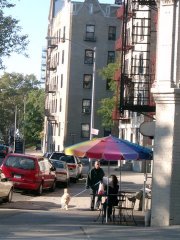
Have you not seen the latest symptom of this noxious scourge of gentrification, this affront to our community? Have you not been outraged as you approach the corner of Edgecombe Avenue and 159th Street by the sight of a rainbow-colored umbrella and outdoor tables, where you can drink a cup of coffee and enjoy a freshly baked raspberry scone while contemplating the curving line of linden trees that gently give way to the southern tiers of Highbridge Park? Have you not scoffed with disdain at the lesbian couple and their baby carriage also parked out front, chatting aggressively with a bearish man walking his poodle? Inside, of course, it gets worse: here you are confronted by gleaming display cases stocked with pain au chocolat and pear crossaints, tarts, pies, and an array of breads, including baguettes, flour-dusted ciabatta and a sesame-covered pain rustica. Next are the chalkboards on which you see — in quirky handwriting that reeks of youth and irreverence — lists of coffees, ciders and teas, as well as an array of salads, sandwiches and quiches. Behind the counter, of course, you will be nauseated by the friendly bakers who pause in the midst of rolling dough or taking trays in or out of the hot ovens to take your order.
Filed under: Capitalism, Drivel, Gay, Gentrification, Pleasure, Washington Heights | Leave a Comment
Tags: Community, Croissants, Gay, Gentrification, Patisserie, Sugar Hill, The OC Bakery and Cafe, Washington Heights
Those arriving in Washington Heights for the first time are often surprised to hear splintering, cracking sounds in the distance, sounds which like breaking bones or the felling of ancient trees barely need to be identified to be recognized. “Oh yes,” we nod impassively, but then feel compelled to elaborate. “The shoreline is rocky and treacherous for those unfamiliar with its jagged contours, and what you hear is the slow wreckage of some poor soul who has strayed too close, perhaps after being caught in the terrible riptide of the Hudson. Such reminders of our fate — though you are right to presume that some are more literal than others — are pervasive in Washington Heights; to live here you must learn to appreciate this fundamental truth.”

Filed under: Infrastructure, Resignation, The Gay Recluse, Washington Heights | Leave a Comment
Tags: Gay, George Washington Bridge, Hudson River, Washington Heights
Of all the critics and columnists in recent history at The Times, Herbert Muschamp and Cathy Horyn are the only ones who have succeeded in gripping us with every sentence that ever appeared under their respective names. Now, of course, Muschamp is dead, returned to the same infinite folds as an entire generation of gay geniuses and visionaries to which he belonged, the premature loss of whom seemed to ultimately exhaust him (after all, he was only 59) as he cast his eye across a landscape he came to recognize as brittle and bereft.
Today in a fit of sorrow and nostalgia, we read the last article he wrote for The Times, a piece sadly (but not surprisingly) relegated to a travel supplement in which he laments the impending destruction of a Richard Neutra-designed visitor center in Gettysburg, Pennsylvania (one of the most haunted states, we can report with confidence). Built in 1962 and designed in the same “modern idiom” as the United Nations, Muschamp tells us that “the building is a time capsule from a period of optimism about the capacity of humans to settle their disputes by civil means. Its present state of dilapidation all too aptly symbolizes the decay of that post-World War II ideal.” He concludes — and these, his final words — that “Neutra’s building is a ghost also, a specter possibly more haunting than the others for the contemporary imagination. Gettysburg is dedicated to the idea that the soldiers gave their lives for a good cause. But the Cyclorama [i.e., Neutra’s building] is a monument to a good cause that died for no good reason. Like many works of postwar architecture, it sits in judgment on a society that has gone far toward dismantling the framework of Enlightenment values that once made this country attractive in the eyes of the world. Since it’s painful to be reminded of our own broken promises, we may as well dismantle the memories too.” How we wish that such earnest resignation and pessimism could be found on the op-ed page of The Times, instead of the same tired, recycled, vaguely condescending and/or pedantic observations to which we have become so inured!
Thus we are left with Cathy Horyn, about whom — as a preliminary note — we offer our thanks to whatever power that she was not born a gay man, for surely she, too, would be dead by now. We highlight just a few of our favorite sentences from a recent review: “The models, in fact, were more covered-up than exposed. Certainly they looked very sexy in the clothes, with armbands that seemed to continue the stripe effect of a garment and flat black sunglasses that made you think of censor bars. The modernist drive of the collection was relentless,” she concludes, “as though [the designer] had found a legitimate window to fashion’s future and was going through it.” So like Muschamp, she is always careful to place her observations in a larger context of culture and history; true, she is unapologetically obsessed with her craft — and that of those she writes about — yet (and this the miracle) so unstinting in her obsession, so that it hardly matters if you have never been to a fashion show or understand her references to say, ________ or _______; she shines her light for us on a refined and idiosyncratic (and yes, decadent and artificial) society, where a handful of souls are fortunate enough to be illuminated by her brilliant prose for just a few precious seconds before they recede into the fabric of irrelevance.
Filed under: Capitalism, Gay, Obsession, The Times, Writers-American | Leave a Comment
Tags: Architecture, Cathy Horyn, David Brooks, Fashion, Gail Collins, Gay, Herbert Muschamp, New York Times, Walter Benjamin
Thank you, Human Rights Campaign, not only for sending us such a meaningful letter this week encouraging us to come out, but for being so discreet about it! There was not a single thing on the plain-white envelope — not even your name! — that could have identified either of us as “gay”! (But thank you for addressing us in such a coy little font, as if it were a letter from an old friend, though one who may or may not be gay!) Thank you for enclosing a sticker of your wordless, corporate logo that also would not in a million years be ever read as “gay” by someone not familiar with your vaunted past! Most of all, thank you for being named “Human Rights Campaign,” which so effectively conveys your secret mission!
Filed under: Drivel, Gay, Pessimism, Politicians | Leave a Comment
Tags: Gay, Human Rights Campaign, Junk Mail, National Coming Out Day
On Burma
Our heart goes out to the Burmese monks of Myanmar but our mind drifts back to the post-hardcore band from Boston. As much as any other band in our collection, Mission of Burma was one whose impenetrable mystique electrified us at an age when we were still anxious to be electrified. The songs were angular and dissonant, angry and emotional in a manner that — like the name of the band itself — could only be described as political, but never preaching. Their existence was short — they broke up after just a few years — and their slender catalog strangely unobtainable; songs were passed to us via tapes and compilations featuring gruesome hand-drawn artwork on cheap construction paper. Nobody we knew had ever seen them live; Roger Miller was said to be a recluse (though regrettably, not a gay one) and Clint — “That’s When I Reach for My Revolver” — Conley a family man.
In retrospect, the reunion show at Irving Plaza was revelatory, but for reasons that had little to do with the performance; the band played with passion — in Miller’s case, a bit too much passion — and sent us and perhaps 2000 other souls (oddly, we seemed to know them all) spinning through an amazing and agonizing time warp: we were confronted by music that had once inspired us to write angry protest songs of our own, to send streaks of electric distortion ripping across the sky, to punch through the heavy curtain of conformity that always seemed to hang around us. To hear these Mission of Burma songs a decade or more after we first encountered them was to acknowledge the utter failure of our grandiose plans of revolution; this was both a source of sadness and — ultimately — great relief. Mission of Burma marked both the beginning and end of our youth, and only by relegating them to the past could we begin to understand the looming complexities of a future far different than the one we had previously envisioned.
Filed under: Good Rock, Memory, Opera, Politicians | Leave a Comment
Tags: Boston, Democracy, Mission of Burma, Myanmar, Post-hardcore
Since we last saw the hills around Saratoga a few days ago, they have become drab and mundane, the color of an unwatered suburban lawn, while further south the Catskills have grown equally tired and pedestrian. Did we really talk with any enthusiasm about wanting to visit either of these spots? Even the Hudson River Valley, where we have so often fantasized about moving to start an organic farm and/or a record shop (with a focus on opera and post-hardcore from the 1980s), has become impossibly tedious to consider; a grove of gnarled apple trees visible from the highway appears severely two-dimensional and disposable.
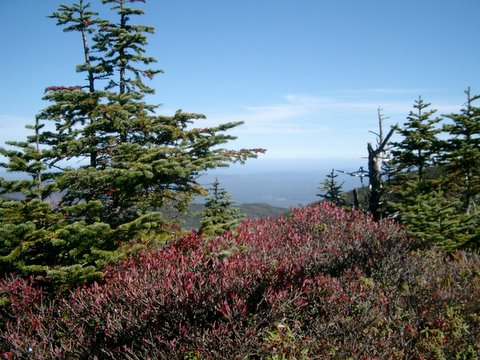
Only the sight of the George Washington Bridge, the magnificent towers of which hover over the Palisades Parkway, gives us courage; though the traffic is heavy on the bridge, the skyline in front of us is operatic to the extent that we can both contemplate it with a certain rapture even as our mind drifts back to Marker #2 on Whiteface Mountain:
“While conditions are so severe that trees cannot grow in our exposed alpine garden, the ground on the opposite side of the trail is sufficiently sheltered from the wind to allow Balsam Fir trees to survive. Awareness of these small differences in wind and temperature can have a practical application when, for example, you are choosing and planting flowers, shrubs and trees around your home.”
Suddenly we reach an understanding: the remote and extreme landscape of the mountain top is replicated in the eroded beauty of Washington Heights; just as one provides a refuge to the Balsam fir, the other offers us a (sheltered) alpine garden in which to bury our hidden life.
Filed under: Good Rock, Memory, Obsession, Opera, The Autumn Garden, Travel, Washington Heights | Leave a Comment
Tags: Adirondacks, Catskills, George Washington Bridge, Hudson River Valley, Palisades Parkway, Saratoga Springs, Washington Heights
Whenever the gay recluse leaves home, we find our dreams inhabited by those we have left behind. Several times in the passing nights we feel the slight pressure of paws walking across the terrain of the bed, pausing now and again to balance on our legs, as if to ask us if anything we have witnessed could ever compare to the vast and timeless universe contained in the depths of their emerald eyes.

Filed under: Dream, The Russian Blue, Travel, Writers-French | Leave a Comment
Tags: Baudelaire, Dream, Russian Blue, Spleen, The Clock
In the introduction to the Emile Zola work Nana — which we have recently been reading — we are given the following insight into the French author: “Zola tried to establish an analogy between literature and sciences, arguing that imagination had no place in the modern world, and that the novelist, like the scientist, should simply observe and record, introducing characters … into a given environment … and then noting down the progress and results of his ‘experiment’ for the attention of legislators and the ultimate benefit of mankind.”
As with any introductory text, we took this with barely a grain of salt as we began the work, yet found after several chapters that we could not shake our memory of this observation, particularly as we confronted the thousands of words that still awaited us with what could only be described as a certain dread. While there is undoubtedly a masterful quality to much of Zola’s prose, particularly in his ability to direct our attention to the smallest details of say, a night at the opera in Paris in the year 1880 or the different styles of furniture in a drawing room, there is nevertheless something distasteful and ultimately tedious going on here. We are reminded of so many articles in The Times (and, of course, The New Yorker) that leave us feeling deflated and depressed, not for a lack of description or analytical insight — or even compassion, as is clearly the case with Zola as he describes the downward trajectory of his leading actress/prostitute — but for a measured, reasonable and appropriate tone that in its journalistic detachment seems both voyeuristic and bourgeois.
Here too we can turn for insight to the great Huysmans, who writes of his alter ego Des Esseintes and his search for books of interest: “[O]nly the working of the brain interested him, regardless of the subject … each person naturally goes to the works which most intimately correspond with his own temperament, and ends by relegating all others to the rear…[these works] enabled him to penetrate farther into the depths of the temperaments of these masters who revealed in them the most mysterious transports of their being with a more sincere abandon; and they lifted him far above this trivial life which wearied him so.”
Filed under: Obsession, The Times, Writers-French | Leave a Comment
Tags: Emile Zola, Joris-Karl Huysman, The New York Times
The thuds you hear on the roof? No, it is not rain or sleet or thunder, or at least not in the meteorological sense of these terms; rather, it is a rain of debris brought down upon us by the merciless gods who throw garbage from the windows.

Filed under: Decay, Infrastructure, Politicians, Sickness, Washington Heights | Leave a Comment
Tags: 311, Garbage, Gentrification, New York City, Rats, Washington Heights
According to an article in The Times today, “[h]omophobia directed at the elderly has many faces.” We learn of home health aides who “must be reminded not to wear gloves at inappropriate times, for example while opening the front door or making the bed, when there is no evidence of H.I.V. infection.” We learn of an “openly gay man without family or friends” — i.e., a gay recluse — who was “recently moved off his floor to quiet the protests of other residents and their families” and “given a room among patients with severe disabilities or dementia.” We learn that “[t]he most common reaction, in a generation accustomed to being in the closet, is a retreat back to the invisibility that was necessary for most of their lives, when homosexuality was considered both a crime and a mental illness.”
We think of post-war American fiction and recently visited towns in the Adirondacks, and reassess our conclusion that both landscapes are less hostile than oblivious to our presence. We feel strangely tongue-tied and sullen as we consider the present and — even worse — the future; are you really so surprised that our preference is to have tea in Venice with Henry James? Or that our most fervent prayer — the one we repeat every night and every morning — is to die alone in our garden, after our fingertips have been granted one final caress by the weeping Serbian spruce (picea omorika pendula) we have so tenderly nurtured?

Filed under: Dream, Longing, Pessimism, The Autumn Garden, Writers-American | Leave a Comment
Tags: Adirondacks, Aging, American Fiction, Death, gardening, Henry James, HIV, Picea Omorika Pendula, The New York Times, Weeping Serbian Spruce
Our first impressions of Lake Placid are oddly and unexpectedly reaffirmed by our continuing explorations, which reveal the existence of a completely inaccessible series of estates — here they are called “camps” — that ring the shoreline of the lake. Still filled with a naive optimism after descending from the nearby mountain, we had succumbed to a boat tour, on which we are informed that such-and-such property is owned by ___, an important business leader and industrial tycoon; like many of the the region’s most elite residents, he uses his property — said to be worth $___ millions — only a few hours each year.
All of this is familiar and tedious, and we are quickly lulled to sleep. Now dreaming, we find ourselves in a strange field amid the beautiful ruins of a time we would rather forget.

Filed under: Capitalism, Decay, Dream, Memory, Pleasure, Travel | Leave a Comment
Tags: Adirondacks, Aristocracy, Class, Helicopters, Lake Placid, Lakes, Segregation, The Pleasure of Ruins
Yes, we exalt at the view offered by the summit of Whiteface Mountain! Here from New York State’s fifth-highest peak we see nothing but a carpet of trees — both deciduous and coniferous — rolling over an ancient, haunted landscape interrupted by exquisite lakes and bands of cirrus clouds that hover ambivalently over the horizon. But it is not just the obvious bliss of our insignificance that literally elevates our thoughts above the more pedestrian concerns that occupy most of our days, but an odd, antiquated sense that money and class distinction are irrelevant up here on this particular mountain. In other words — to put it in crass terms — there is not a corporate logo in sight; not one company has sponsored this “opportunity.”
We are in the clouds: here is a woman, perhaps 120 years old, leaning out of her car to reinforce her hair with a coat of shellac before taking the elevator up to confront the eternal winds up high; here is a group of exceedingly well-behaved children from Quebec chirping in French; here is a thick American biker musing about what a great picture it would make if he could only throw a match down to light all the dead trees of the entire mountain face on fire; here is a desperate housewife posing with her poodle next to the sign marking the elevation of the summit.
For once we are not disposed to petty criticisms; the mountain fills us with an unprecedented sense of kinship toward our our fellow souls, all of whom have traveled the same road as us — built by Franklin Delano Roosevelt in the 1930s — to reach this utopia. We are reminded of Benjamin’s piece on Moscow in the wake of the revolution; how he romanticized the proletariat and yearned to see a new world arise in the wake of such violence and upheaval! Only here, on the summit of the mountain, do we allow ourselves a similar sense of possibility, a belief that change is imminent and the boundless treasure of the earth will for once be divided equally.

Filed under: Capitalism, Good Rock, Longing, Philosophers, Travel | Leave a Comment
Tags: Adirondacks, Democracy, Desparate Housewives, Franklin Delano Roosevelt, Populism, Walter Benjamin, Whiteface Mountain
Today on the way up Whiteface Mountain, we stopped to take in the view and were surprised when a hawk suddenly appeared above the treeline. It flew toward us and landed on a nearby boulder; in its beak it carried a single sheet of paper, which we were equally surprised to learn — after the sleek brown-and-orange bird had left its missive for us — contained an extract from The Curtain, Milan Kundera’s recently published essay about the art of the novel.
We quickly absorbed this staggering piece of prose, in which Kundera explains how, after he discovered Proust in Czech translation as an adolescent (but without knowing anything about the French master), Albertine was “the most captivating of all female names” for him. Unfortunately, he goes on to tell us with something between an embarrassed cough and a sly wink, this bliss (one we readily admit to sharing) did not last: “I myself lost the privilege of that lovely ignorance, when I heard it said that Albertine was inspired by a man, a man Proust was in love with. But what are they talking about!… [O]nce I’d been told that her model was a man that useless information was lodged in my head… A male had slipped between me and Albertine, he was scrambling her image, undermining her femininity. One minute I would see her with pretty breasts, the next with a flat chest, and every now and then a mustache would appear on the delicate skin of her face.” Kundera thus concludes: “They killed my Albertine,” and Proust is thereafter relegated — or so we were informed by the hawk before it flew away — to less than a footnote in Kundera’s estimation of great novelists.
Strange as it was to have received this on today of all days, we did not pause for very long to consider it. Dark clouds now encroached on the horizon, and we arrived at the summit just seconds before the thunderstorm. By this point, we had constructed a paper airplane out of Kundera’s work; we stepped out onto the observation deck and released it into the wind. For a second it seemed to hover, unsure of which direction in which to travel, until a bolt of lightning brazenly ripped through the sky and instantly incinerated it. The rain stopped and we watched the ashes float down into the valley, where we felt reassured to know that his words would sink to the bottom of the lake and be buried under a million years of sediment.
Filed under: Drivel, Memory, Travel, Writers-French | Leave a Comment
Tags: Adirondacks, Albertine, Marcel Proust, Milan Kundera, Whiteface Mountain
This from a July, 1906 newspaper article — “Chicago Woman Physician Alone All Night on Mt. Whiteface” — on display at the summit of Whiteface Mountain:
“Dr. J. D. Merrill, a prominent woman physician of Chicago, is reported to have ‘got lost’ and stayed all night alone on the top of Mount Whiteface one night last week and that after being found by a searching party she was assisted back to Lake Placid, suffering from exposure and the terrible nervous strain incident to passing the night alone on the breeze swept summit.
“It is now early in summer and we hasten to admonish all, especially ladies, about going into the Adirondack wilderness to do mountain climbing without a guide. Better have someone along who knows the way.”
Filed under: Drag Queens, Travel | Closed
Tags: Adirondacks, Mountain Climbing, Physicians, Wilderness, Women
On What Is Confirmed at Auto Tour Stop #9 on The Whiteface Mountain Veterans Memorial Highway
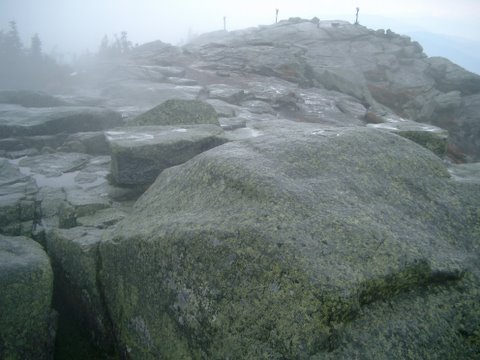
“If you turn around now, and face the mountain, notice how dwarfed the trees just above the parking lot are; small, contorted by the wind, branches broken from the load of ice in the winter, spring growth killed off by late spring frosts, soil so thin and impoverished as to defy definition, the whole scene one of struggle for survival in the inhospitable environment, yet still a proof that life persists whatever the hardships.”
Filed under: Longing, Pessimism, Philosophers, Travel | Leave a Comment
Tags: Adirondacks, Nature, Schopenhauer, The Smiths, Whiteface Mountain
There is a tawdry quality to the buildings lining the main street into town that even we find it difficult to romanticize, as it does not recall an excess of abandoned grandeur (in this regard we have been literally ruined by Washington Heights) but a desperate, opportunistic desire to skim off the hordes (us among them) flocking here to take in the natural monuments on display. There is concrete brick in abundance, a completely unrestrained excess of over-sized, italicized fonts on the storefront signs; there are billboards for “luxury townhouse condominiums” starting in the “300’s.” There is an incongruous amount of traffic; we end up behind a purple, double-decker tour bus that inches forward and spews exhaust. We leave Lake Placid for the somewhat more forgotten town of Saranac Lake, where we pass a village square and note a group of goth punks who have collected under a small gazebo; they stare vacantly back at us, not knowing that we can see through this facade of boredom to a deeper longing to escape these confines for the anarchy of the metropolis.
Filed under: Capitalism, Longing, Travel, Washington Heights | Leave a Comment
Tags: Goth-Punk, Lake Placid, New York City, Saranac Lake, Washington Heights
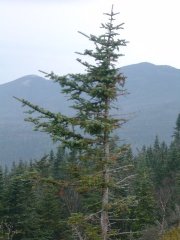
The Eastern White Pines cover the rolling hills like a sphagnum moss, dotted with patches of silver (the Quaking Aspens, shimmering like schools of fish) and the burned red of the Sugar Maples. A little higher up these give way to spruces — tall, drooping and dignified — hemlocks, birches — whose gnarled white trunks twist up out of the rocks — and finally the balsam fir (Abies balsamea), the hardiest of all these trees. The thin air smells of fallen needles and decaying leaves. As we follow the river up the mountain, we are struck by the incredible longing on display; there is no sense of repose in the stark beauty of these mountain vistas, where each tree and each rock seems to strive for its existence on a scale of time completely removed from our own.
Filed under: Good Rock, Longing, Pessimism, The Autumn Garden, Travel | Closed
Tags: Adirondacks, Maple, Route 87, Schopenhauer, Spruce, White Pine
It is not only that the C delivers us to Washington Heights, while the B veers east at 145th Street to the Bronx; there are, most notably, the seats; on the B they are oddly flat without the slight trough that allows us to lean back, to settle in and resume our contemplations. And is it just us, or does the lighting on the B seem a bit too bright, so that the passengers appear a bit ghoulish in the fluorescent haze? Or perhaps we are simply put off by the groups of eager and optimistic baseball fans — hats and jerseys proclaiming an undying love for a corporate trademark — on their way to ____ Stadium. Why do they talk so loudly, and with such terse, robotic enthusiasm? Needless to say, we are happy to note that these striving souls only rarely appear on the C, and will inevitably abandon us at 125th Street. The remaining stops on the C — 135, 145, 155, and 163 — before its terminus at 168, are always serene; the cars have emptied out, and the air is now filled with the resignation of yet another day gone by, and the certainty that an infinite number of others still await.
Filed under: Infrastructure, Pleasure, Resignation, Subway, Washington Heights | Leave a Comment
Tags: B-train, C-train, Ergonomic Design, MTA, New York Yankees, Washington Heights
Thank you so very much for your keen insight and generosity, your willingness to come all the way up here to protect us! Your words have been so reassuring; we feel so much better knowing that you will do everything in your power — including next week’s important meeting with the mayor — to prevent any form of gentrification from taking hold: we shudder to think of the loss of neighborhood “character” you have described, the horrible influx of obsessive-compulsive gardeners and opera queens who can be expected to descend upon the streets of Washington Heights like a plague of locusts. (And you’re right: we’ve already seen a few parading up and down Broadway; as if they have any right to be here.) On a more personal note, how you must suffer, living on the Upper West Side in your rent-stabilized classic six amid such a nauseating array of restored townhouses and apartment palaces situated on curving and quiet tree-lined streets, just steps away from Riverside Park to the west and Pan Asian restaurants and gourmet delis to the east. But rest assured that your years of sacrifice will not be in vain; you have done so much to bring the local community together! We don’t know a single person in Washington Heights whose skin doesn’t crawl at the thought of sterile (we like your term for it: Teutonic) sidewalks — no dealers, no rats, not even a chicken bone in sight — and a dead night bereft of stereos and fire crackers, filled with nothing but the occasional rustle of leaves and the lonely click of heels passing under an open window.

Filed under: Capitalism, Decay, Drivel, Gentrification, Washington Heights | Leave a Comment
Tags: Gentrification, New York City, Washington Heights


 The Gay Recluse