In which The Gay Recluse — with help from our United Kingdom correspondent, The London Eye — examines life abroad (instead of just dreaming about it all the time).
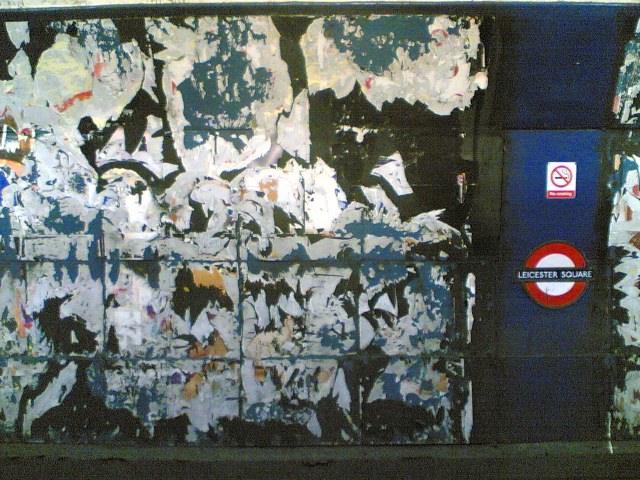
Here we contemplate another wall from the Leicester Square station and note striking similarities to the uncommissioned masterpieces of New York City.


Filed under: Decay, Infrastructure, Subway, The Gay Recluse, The London Eye | Leave a Comment
Tags: Leicester Square, London Underground, New York City MTA, Ruins, Subway Walls, The London Eye
In which The Gay Recluse updates his informal but rather telling quantitative analysis of Modern Love, the weekly Style Section (of The Times) column in which openly gay writers almost never appear, and even less frequently describe a romantic relationship.
This week’s piece: A Valley of Misery Between Peaks of Joy
Subject: In this column — an annual Valentine’s Day feature — Modern Love editor Daniel Jones muses about how horrible life is (except for the very old and frail, for whom it cannot be expected to last much longer) and expresses wonder at this most obvious of truths. We were more interested to note his assertion that: “This [sense of happiness exhibited by the old and frail] is in stark contrast to what I hear from those in middle age, where in most cases the writer’s spouse or partner (whether the couple is straight or gay, married or not) registers as barely a blip on the radar, and the prevailing mood is one of anxiety.” (Italics ours.) Thus we have evidence that Jones is in fact hearing from gay couples, and yet he has been inclined to print exactly one column (out of 165) written by an openly gay person about life as a part of a couple (this by a lesbian about her Ozzie-and-Harriet relationship, over three years ago.)
Jones also uses today’s column to announce a “Modern Love College Essay Contest” open to “college students nationwide.” (Btw, the contest has the dumbest logo ever, with the words written out over an elementary-school heart.) He frames the challenge in the following manner: “What is love, in this age of 24/7 communication, blurred gender roles and new ideas about sex and dating? (Italics ours.) Hmm. Are we the only ones struck by his interest in blurred gender roles when you consider his dismal record publishing same-sex relationship stories? Does it not seem to imply that gender-bending belongs to college kids and not adults, who like him should be married with children, ensconced in the misery of a suburban existence? And does this not seem to be his problem with the gays, who actively flout this ethos in our obsessive zeal for the decorative arts, cats and alpine gardening (instead of growing up and having children)?
To those three college students who may be actively considering Jones’ contest, we offer the following advice: Submit your essays but beware! Jones and his column represent the worst pressures of stereotypical conformity, mired in shallow optimism that ultimately gives way to a few seconds of dull relief and resignation before you die. Far better to embrace a philosophic pessimism, so that you can at least appreciate the pleasures of true introspection, the very specter of which is so terrifying to Jones and his narrow-minded ilk.
Filed under: n/a [We did not count this column (or any of his previous ones) in our ongoing tally, which remains the same.]
The updated tally (or why we feel like animals in the zoo): 6 out of 165 columns by openly gay writers; 1 out of 165 on female gay relationships; 0 out of 165 on male gay relationships. In what is arguably the “gayest” section of The Times, more women have written about gay men than gay men have.
Outstanding question to Daniel Jones, editor of Modern Love: wtf?
Straight Woman on Relationships iiiii iiiii iiiii iiiii iiiii iiiii iiiii ii (37)
Straight Woman on Family iiiii iiiii iiiii iiiii iiiii iiiii iiiii (35)
Straight Woman on “Looking for Love” iiiii iiiii iiiii iiiii iiiii iiiii ii (32)
Straight Woman on Breaking Up iiiii iiiii iiiii iiiii iii (23)
Straight Man on Relationships iiiii iiiii (10)
Straight Man on Breakup iiiiii (6)
Straight Woman on Gay Men iiiii i (6)
Straight Man on Family iiiii (5)
Straight Man on “Looking for Love” iiii (4)
Gay Man on Family ii (2)
Gay Woman on Relationship i (1)
Gay Woman on Family i (1)
Gay Man on Self-Hatred i (1)
Gay Man on Prom Date i (1)
Ambiguous/Nurse on Drugs i (1)

Filed under: Drivel, Gay, Language, Obsession, Stereotypes, The Gay Recluse, The Times | 1 Comment
Tags: College Students, Daniel Jones, Fashion & Style, Gay Stereotypes, Gay Voice, Gay Writers, Homophobia, Modern Love, Modern Love College Essay Contest, The New York Times
In which The Gay Recluse — with help from our United Kingdom correspondent, The London Eye — examines life abroad (instead of just dreaming about it all the time).
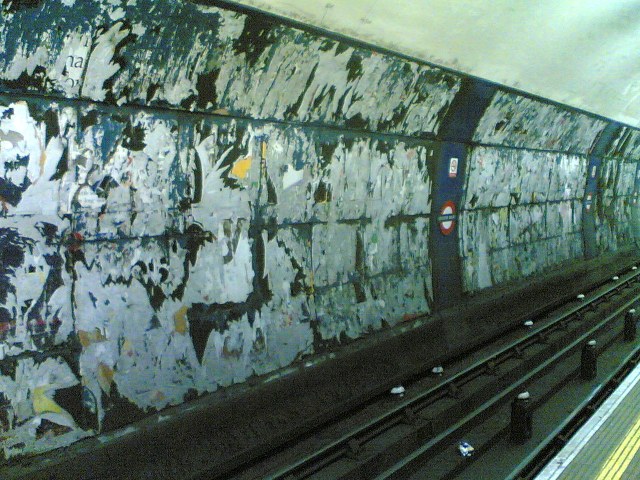
Today, we contemplate the wall of a London Underground station and note striking similarities to some of the greatest uncommissioned masterpieces of New York City.
Filed under: Architecture, Decay, Infrastructure, Subway, The London Eye | Leave a Comment
Tags: London Underground, New York City MTA, Ruins, Subway Walls, The London Eye
In which The Gay Recluse ponders a sampling of recent search terms used to find the very pages you are now reading. Note: All search terms listed are in the exact form provided by WordPress.com, which is the host (at least for a while) of this blog. Hyperlinks to relevant posts included.
Search: the winter garden new york gay
Comment: The snow came very early this year; of all the evergreens in the winter garden, the Blue Atlas Cedar seemed to love it most.
Search: gay sex in the seventies
Comment: Some of the footage was interesting, but the focus was off.
Search: british authors gay
Comment: Denton Welch is one you should read.
Search: will washington heights be gentrified
Comment: Not as long as there are abandoned buildings everywhere.
Search: garage washington heights new york
Comment: Here we encounter ruins of a less romantic type.
Search: gay bears master
Comment: We are doing what we can to end the ridiculous perception that Henry James–in addition to being a master of the gay voice–was in his personal life anything but a hot gay bear.
Search: barack obama endorsements
Comment: It’s not that we have so many problems with Hillary, but the music in Barack’s Super Bowl ad was so much better than a shitty Celine Dion song (and sometimes that’s all it takes.)
Search: gay geniuses
Comment: We hope that the genius who drew Jack Nicholson is gay.
Search: audubon terrace architecture
Comment: The ruins here are exceedingly beautiful (and heartbreaking).
Search: sweetie clementines
Comment: We found them extremely refreshing and easy to peel, but then pondered a disturbing development: are they too juicy for work?
Search: edwardian + gay + pornography
Comment: Was this person looking for Gukanjima, aka pornography for ruins-obsessed?
Search: grant hart is gay
Comment: Sometimes it’s hard to believe that Hüsker Dü is no longer with us, to describe for us, in such seething terms of beauty, exactly how fucked up the world really is.
Search: haircuts boys
Comment: To watch the Super Bowl is to emerge deadened from the commercial onslaught; to watch In the Mood for Love is to remember exactly what it means to be alive.
Filed under: Addiction, Capitalism, Decay, Dissonance, Gay, Gentrification, Good Rock, Government, Graffiti, Infrastructure, Science, Search, Subway, The Gay Recluse, The Winter Garden, Traffic | Leave a Comment
Tags: Audubon Terrace, Barack Obama, Blue Atlas Cedar, Denton Welch, Edwardian Architecture, Endorsement, Gay Sex in the Seventies, Gentrification, Grant Hart, Hüsker Dü, In the Mood for Love, Jack Nicholson, Parking Garage, Ruins, Snow, Super Bowl, Sweetie Clementines, Vacant Shells, Washington Heights
In which The Gay Recluse posts a photograph of a two-headed cat.
 Dear readers: We invite you to submit photographs of two-headed cats to us at thegayrecluse@gmail.com.
Filed under: Animals, Photography, Technology, The Russian Blue | Leave a Comment
Tags: Double Exposure, Flickr Test Blog Post, Russian Blue, Two-headed cats, Zephyr
In which The Gay Recluse ponders the transformation of the monumental into the mundane (and vice versa).
Date of Incident: February 6, 2008
Time: 7:14 am
Causes of Disaster: Undetected crack in containment vessel.
Remarks: A crack in the single-hulled design of the containment vessel went undetected overnight, leading to nasty seepage all over the shelves of the refrigerator. Due to the early hour of the incident, extensive emotional trauma was inflicted during the clean-up operation. Although legislation requiring double-hulled containment vessels has been proposed, industry lobbying makes passage unlikely. Voluntary adoption appears equally unlikely, given that implementation costs are expected to remain prohibitively expensive.

Dear readers, we invite you to submit disaster footage and any relevant information (background conditions, attribution, etc.) to thegayrecluse@gmail.com.
Filed under: Disaster Footage, Infrastructure, Law, Photography, Technology, The Gay Recluse | Leave a Comment
Tags: Disaster Footage, Double Hull, Emotional Trauma, Homeland Security, Oil Spills, Paper Towels, Refrigerators, Rock'n Serve, Single Hull, Tupperware
In which The Gay Recluse contemplates an uncommissioned masterpiece from the walls of an uptown subway station.
Dear readers: we invite you to submit any particularly inspiring (or uninspiring) examples of subway graffiti to us at thegayrecluse@gmail.com.
Filed under: Graffiti, Infrastructure, Pessimism, Subway, The Gay Recluse | Leave a Comment
Tags: C-train, Color Palettes, Graffiti, MTA, Veggie Tales
On the Rainbow Room
In which The Gay Recluse writes metaphorically about life.
Let’s say you were invited to a cocktail reception in the Rainbow Room, hosted by ____ and featuring a talk by _____, a political hero of yours who now works at a prestigious law firm. And even though it was a corporate event, which is never as thrilling as _____, you nevertheless accept the invitation with some anticipation, because you’ve never been to the Rainbow Room or heard _____ speak in person. The day arrives and to honor the occasion you dress up in a suit and tie; you get your shoes shined. You are even glad that you got your haircut a few days earlier, so that your shaggy hair won’t offend anyone.
The day passes and the late afternoon comes; you leave work a few minutes early and take the subway to midtown, where you navigate your way from the subway to the lobby of 30 Rockefeller Center, which resonates with a deco grandeur you have to imagine will be that much greater 65 floors above in the Rainbow Room. You check your coat and the guard escorts you to the elevator after you describe the event you’re here to attend.
In the elevator, there are two buttons: 64 and 65. You are told to exit at 64, which you don’t really think about but do as you’re told; you turn left down a hall and find your name on a badge set up on a folding table. Yours is one of perhaps 100 badges and you feel very generic as you pick it up and are directed into the reception space. This is not the Rainbow Room, you realize, but a small conference room underneath it! You head to the wine bar and accept a crab cake from one of the waiters as he glides by.
You wander to the window and gaze out at the city, which is splayed out in front of you under a veil of fog. You wonder if the view is that much better one floor up, and who exactly is speaking up there. By this point, the political hero you have come to hear is talking, and though you are suitably impressed by his oration and charisma, you are saddened to hear him talk about Reagan in such glowing terms. When the talk ends, you nevertheless shake his hand and head to wine table for a refill; at the window you contemplate your shadowy reflection in the glass and try to decide whether you were right to come this high.
Filed under: Dissonance, Government, Longing, Memory, Politicians, The Gay Recluse | Leave a Comment
Tags: Crab Cakes, Law Firms, Midtown Manhattan, Rockefeller Center, Suits, The Rainbow Room, Ties, Wine
On Maiden Voyage
It was difficult to read Maiden Voyage, the 1943 novel by Denton Welch, although not in any of the usual ways. For starters, the prose is relatively simple, marked by compact sentences — very much in keeping with the voice of a sixteen-year-old — but deceptively elegant; sincere and direct without ever being vulgar or blunt; nor, in the great English tradition, is Welch afraid of adverbs. (“In post-war American fiction,” we sigh heavily, “adverbs are ‘gay’.”) Language aside, there is a spirit to this book that makes us think of Holden Caulfield, and we regret that it is not nearly as well known as Catcher in the Rye; in any world but our own, it would be.
The story follows a somewhat troubled (but good-natured) British student who leaves school to spend a year with his father in colonial China (this in the 1930s). We are led by the narrator through a series of adventures as he leaves England, sails to China, travels inland with an antiques collector, and makes friends (and enemies) with some of his fellow colonialists. Through all of this, Welch perfectly captures the mix of hatred, passion and longing that lurks just beneath the surface of the adolescent heart, ready to be expressed in a given situation. We are aware that he is not disposed toward girls but is rather attracted to certain men who fall outside of his social sphere: a sailor, a soldier, and one or two others are introduced with the same lack of remorse or inhibition the author uses to describe say, his hatred for a garish item of clothing or his love of an antique watch.
None of these episodes involve anything more than a few drinks or a conversation, but nevertheless make clear the place from which the adult Welch is writing. It’s ultimately this ebullience that makes the book difficult to read, particularly — and it’s almost unavoidable — as we ponder the more tortured scenes from our own youth. How we wish we could have more more like Welch: artistic, uninhibited, questioning (but never presumptuous or arrogant)! How we wish we could have brushed off the conformity of adults instead of engaging in such tortured attempts to please them all! But at least when we read Denton Welch, we can put aside the more brutal memories and replace them with ones more spontaneous and alive, as if we had magically entered the pages of this perfect story.
Filed under: Literature, Memory, The Gay Recluse, Writers-British | Leave a Comment
Tags: Catcher in the Rye, Denton Welch, Holden Caulfield, Maiden Voyage
In which The Gay Recluse live-blogs the Super Bowl.
5:58. Our friend T___ arrives to give us haircuts. He tells us that his mother, who is only 64 years old, has just been diagnosed with an inoperable form of brain cancer. She has just begun chemotherapy, and to give him encouragement, we tell him about another friend of ours who underwent a similar procedure a few years ago and whose cancer is now in complete remission. Still, how can he — or his father — be anything but devastated? He says it helps to talk about it though, and we listen as best we can.
6:45. We ask him if he is following the election, and he jokes that he thought we were going to ask him about the Super Bowl, about which he knows even less than we do. “I was in Dunkin’ Donuts,” he says, “and some straight boy asked me what I thought about the game. I told him, ‘uhhh, it’s going to be close’.” He tells us he is voting for Barack.
6:52: We ask T___ about the gay sex club that’s been operating in the building where he runs his hair-cutting salon. He had complained about it in the past because he doesn’t like men hanging around in the same hallway through which his clients must pass to get to his space. Apparently someone from the club confronted him: “So you’re the closet-case who’s been complaining about us?” T___ corrected him: “I’m an openly gay man, but I can’t have tweaked-out Chelsea Boys eating pizza in front of my business.”
7:06. T___ leaves. What else can we say to him besides “courage”?
7:34. Apparently the Giants are losing. We finish writing up our endorsement of Barack.
8:14. Take-out arrives from Tawaa, a new Indian restaurant on Broadway between 168th and 169th Streets, a few doors up from the Starbucks.
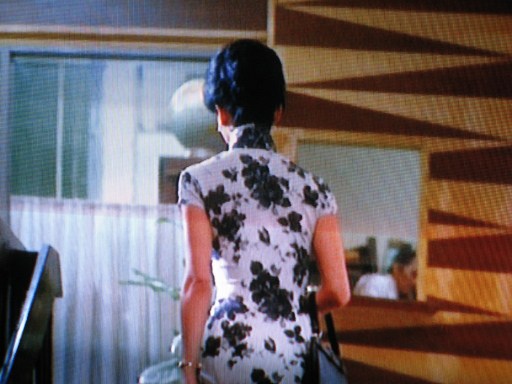
8:28. We begin watching In the Mood for Love, the 2000 film by Wong Kar-wei. Set in Hong Kong in 1962, we are introduced to two married couples who rent neighboring apartments; not long into the film, we learn that the off-screen husband of one of these couples and the wife of the other (we also never see her) are having an affair; the film meanwhile follows the relationship between the non-cheating husband and wife (Tony Leung and Maggie Cheung), who are obviously very attracted to each other but who resolve not to give into their desire, so as not to repeat the actions of their respectives spouses. From the first frame of the movie we are entranced; there is an obsessively sumptuous quality to the movie reflected in every detail of every set, from the lamp shades to the curtains to — most hypnotically — Maggie Cheung’s beautiful dresses, each one in exactly the same cut — high neck, sleeveless, hemmed just below the knee — but in a completely different fabric, ranging from lush floral motifs to geometric designs in 1960s neon green. Certain scenes are presented in slow motion to the same haunting music — in waltz time — and we are reminded of Contempt, the Jean-Luc Godard film that featured a similar (and similarly haunting) device.
8:56. The disk freezes — fucking Netflix! — and we have to take it out and clean it.
10:02. We finish the movie with only a few rough patches in the disk; oddly enough these technical malfunctions don’t really impact the film, which is already filled with repeated scenes and frozen stills. By the end we are completely stunned by the poetic beauty and resignation of this work. We want to inhabit its style and its ruins; it is a masterpiece.
10:05. We can’t bear the thought of leaving this movie completely behind, so we decide to take photographs of it on the television screen. We try to time it so that the crazy bars don’t interfere too much with the shots.
11:14: Apparently the Giants won. Come-from-behind victory. Hearing this news, we feel somehow vindicated. It’s time for bed.
Filed under: Addiction, Dissonance, Dream, Film, History, Landscape, Photography, Technology, Television, The Gay Recluse, Washington Heights | Leave a Comment
Tags: Contempt, Giants, Haircuts, Hong Kong, In the Mood for Love, Jean-Luc Godard, Le Mepris, Maggie Cheung, Netflix, Patriots, Super Bowl, Tawaa, Tony Leung, Wong Kar-wei
Until now we’ve been careful not to endorse either of the leading Democratic candidates — preferring to hold out for Geraldine Ferraro — but with the New York State primary upon us, we have decided to end our prevarication and officially endorse Barack Obama. Our decision is not based on any particular issue — for practical purposes, Obama and Clinton are largely the same — and it goes without saying that we will happily support either in a general election over any Republican. So why Obama? What ultimately moved us into his camp was not his cloying message of change and hope and progress, or any particular antipathy toward Hillary’s personality or brand of experience, but something far less logical. In short, what settled it for us was Barack Obama’s Super Bowl ad, which seriously rocks in a way that nothing put forth by Hillary Clinton has, and especially not the shitty Celine Dion song — “You and I” — she chose last spring for the theme of her campaign.
How exactly — and yes, how seriously — does this Obama video rock? For starters, the footage is unpretentious and uncomposed; it feels like it was taken on a hand-held camera by someone who was part of the action but also removed from it, hovering and analytical (here we think of “alone in a crowd,” the refrain of the timeless R.E.M. song “Camera”.) No doubt it was calculated to appeal on these exact grounds, but if we’ve been played, we still appreciate the gesture, because it cuts across the grain of 99 percent of political ads, not to mention the usual craptastic Hollywood fare.
More impressive still is the music, which (though we don’t who’s playing it) is only 1,000,000,000,000,000 (one trillion) times better than a shitty Celine Dion song. Essentially an indie-rock jam, it has a drumbeat that vaguely recalls the Modern Lovers and a surfy guitar riff redolent of the Ventures. (And how fucking awesome is that? Like all great songs, we almost passed out when we heard it.) There is a whining dissonance to the guitars that touches us, for what better way to acknowledge the daily turmoil of life? And thanks to the (relatively) edgy music and video, the lyrics — we hear Barack’s voice, mixed in from a campaign speech — magically work. For the duration of the ad, we don’t care if they are cheesy and hippie-sounding (“End war!” “Save the environment!”), and we actually want to “join” his cause (“Join” is the title of the clip, which also strikes as somewhat less presumptuous than “You and I,” as if we’re already on the team.)
Is it wrong to admit this matters to us? Perhaps it’s superficial, but we would be lying if we said that this single thirty-second Obama ad didn’t move us in a way that Hillary never has. And when the candidates are this closely aligned, isn’t it the small things that push us over the edge? After all, this is a song fragment we have played with our own fingers for hours and hours in the many basements of our youth; likewise, we have heard the beat of these drums — and here, in some of the greatest moments of our life, when we have felt most alive — as we’ve surfed over mosh pits with a thousand hands holding us aloft.

Filed under: Dissonance, Good Rock, Government, Memory, Politicians, The Gay Recluse | Leave a Comment
Tags: Barack Obama, Endorsement, Geraldine Ferraro, Hillary Clinton, Modern Lovers, R.E.M., Ventures
In which The Gay Recluse writes about the Democratic primaries in highly attenuated metaphors.
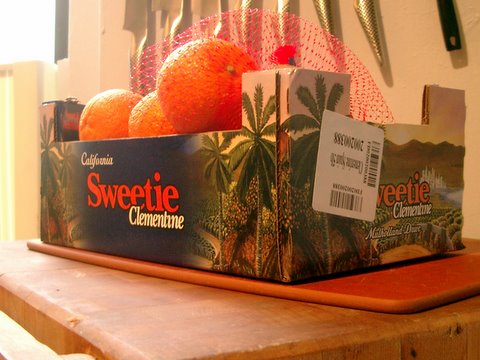
Regular readers of The Gay Recluse know that we have reported on the fierce and unsettled debate over which Clementine — the Sweetie® from Mulholland Citrus or Cuties® from Sun Pacific — provides the most delightful and refreshing citrus “experience.” Initially we weighed in on the side of the Sweetie but were subsequently thrown into a crisis when we were presented with a shipment of Clementines that were not only bruised and misshapen, but dry and fibrous, virtually impossible to eat; although we suspected that these were Cuties, it was impossible to confirm given that the fruit — to the extent we can use a word to describe such abominations — had arrived in a generic mesh bag.
Given all of this, you can imagine our relief when several days ago we received a new box clearly marked with the California Sweetie label, the very one we have come to identify with the most delightfully sweet and juicy Clementine. We immediately peeled one, separated it into segments and began to eat; despite our high expectations we were not disappointed; we found that each piece possessed a perfectly zesty flavor and fragrance that made it impossible to stop at just one. How we exalted at such consistently seedless masterpieces! What blissful affirmation as we considered our initial judgment!
We brought two Sweetie Clementines to work the next day and spent the entire morning anticipating the joy they would bring us at lunch; nothing could derail our high-spirited contemplation and the hours of work passed in seconds. We literally could not have been happier as we finished our sandwich and turned our attention to the fruit, which rested so peacefully on top of our desk. We picked one up and admired the depth of its orange tone, which vibrated against the bland tedium that so often hovers like a stagnant air pocket in any work environment.
As we began to peel, however, we found that the rind was adhering to the fruit and could not be removed without rupturing the delicate membrane of the segments inside, so that within seconds, the fruit was not only pulverized, but dripping all over our fingers and — most disturbingly — onto the desk itself. After finally managing to remove the bulk of the rind, we were forced to most unceremoniously shove the entire fruit into our mouth, which effectively destroyed the experience for us. It wasn’t that the Sweetie lacked in sweetness or — obviously — juiciness, but we suddenly realized that we would have traded these attributes (or some portion thereof) for a more pragmatic Clementine; namely one possessing the “zipper-skin” peel we have come to associate with Cuties!
So for the moment we remain resigned to indecision; obviously Sweeties are the superior fruit at home, while Cuties are a better choice for work. How we loathe society, for forcing us to choose just one Clementine! We wonder why even the smallest choices have to be laden with such doubts, and why any sense of achievement — much less perfection — is always so fleeting, tarnished by the mere passage of time.
Filed under: Gay, Government, Longing, Obsession, Politicians, Resignation, The Gay Recluse | Leave a Comment
Tags: Barack Obama, Clementines, Cuties, Democratic Primaries, Fresh Direct, Hillary Clinton, Juicy, Mulholland Citrus, Sun Pacific, Sweetie Clementines, Work
In which The Gay Recluse updates his informal but rather telling quantitative analysis of Modern Love, the weekly Style Section (of The Times) column in which openly gay writers almost never appear, and even less frequently describe a romantic relationship.
This week’s piece: An Open and Shut Marriage
Subject: Married woman describes doubts about “open” marriages, remembers flirting with a guy and then basically having a nervous breakdown where her husband admitted to doing the same.
Filed under: Straight Woman on Relationships
The updated tally (or why we feel like animals in the zoo): 6 out of 165 columns by openly gay writers; 1 out of 165 on female gay relationships; 0 out of 165 on male gay relationships. In what is arguably the “gayest” section of The Times, more women have written about gay men than gay men have.
Outstanding question to Daniel Jones, editor of Modern Love: wtf?
Straight Woman on Relationships iiiii iiiii iiiii iiiii iiiii iiiii iiiii ii (37)
Straight Woman on Family iiiii iiiii iiiii iiiii iiiii iiiii iiiii (35)
Straight Woman on “Looking for Love” iiiii iiiii iiiii iiiii iiiii iiiii ii (32)
Straight Woman on Breaking Up iiiii iiiii iiiii iiiii iii (23)
Straight Man on Relationships iiiii iiiii (10)
Straight Man on Breakup iiiiii (6)
Straight Woman on Gay Men iiiii i (6)
Straight Man on Family iiiii (5)
Straight Man on “Looking for Love” iiii (4)
Gay Man on Family ii (2)
Gay Woman on Relationship i (1)
Gay Woman on Family i (1)
Gay Man on Self-Hatred i (1)
Gay Man on Prom Date i (1)
Ambiguous/Nurse on Drugs i (1)
Filed under: Drivel, Gay, Landscape, Stereotypes, The Gay Recluse, The Times | Leave a Comment
Tags: Daniel Jones, Fashion & Style, Gay Stereotypes, Gay Voice, Gay Writers, Homophobia, Marriage, Modern Love, Relationships, Straight Women, The New York Times
In which The Gay Recluse reports to the Board of Directors.
Summary
Results for January 2008 surpassed budgeted forecasts and represented significant growth for The Gay Recluse. It is expected that as editorial and production capacity of the site continues to expand, traffic will continue to trend upward, justifying additional capital investment into the operation.
Traffic Metrix
Technorati: As of January 31, 2008, we had achieved a rank of 263,682 with an “authority” of 31 and had been named a “favorite” of four other users. Unfortunately we didn’t make a note of where we stood at the beginning of the month, but our first Technorati ranking in October 2007 was over 4 million.
WordPress: The total number of views at the end of January 31, 2008 was reported to be 13,258, which on a per-month basis breaks down accordingly:
September: 68
October: 1959
November: 3528
December: 3112
January: 4591
SiteMeter: This account was not activated until the end of December 2007, but the numbers roughly mirror the WordPress stats, with “visits” for January calculated to be 3112 and “page views” 5512. Performance charts are reproduced below:

Feeds
Feedburner: RSS and e-mail subscriptions increased from 14 on January 1, 2008 to 33 on January 31, 2008.
Links
Sweet linkage: Sweet linkage to The Gay Recluse has been a major source of traffic to the site, and any growth strategy going forward will have to account for continued support from external operations. In this regard we note the following links for special appreciation:
NYT Columnist Just Pasting In The Same Crap Every Week [Cut And Paste] (Wonkette/Gawker)
What Made Washington Heights More Tolerable in ’07 (Curbed)
Monday PM Linkage/Entertaining church vs. SUVs war on West 161st Street in WaHI (Curbed)
Old Trees of New York, Reborn (NYT City Room)
Our love for ESPN isn’t universal. In fact, some people hate their pottery ad campaign (Jossip/Queerty)
Forecast
January was marked by the introduction of several “features” — or recurring posts — that resulted in more consistent traffic patterns to the site and increased exposure to “literary” and “philosophical” posts. In February we will continue this strategy and introduce several new features, most notably one written with reporting from a London correspondent who has recently been added to the staff. We have also just completed a capital upgrade to our photography equipment that will improve the visual and graphic quality of the site.
Filed under: Architecture, Capitalism, Communism, Gay, Infrastructure, Technology, The Gay Recluse, Traffic | Leave a Comment
Tags: Business Revenue, Feedburner, Feeds, Internet Traffic, Linkage, Metrix, Monthly Report, RSS, SiteMeter, Technorati, WordPress
In which The Gay Recluse ponders a sampling of recent search terms used to find the very pages you are now reading. Note: All search terms listed are in the exact form provided by WordPress.com, which is the host (at least for a while) of this blog. Hyperlinks to relevant posts included.
Search: gay aristocracy
Comment: We prefer to align ourselves with the Washington Heights intelligentsia.
Search: washington heights+architecture
Comment: Two possibilities come to mind: already in ruins or 85 percent there.
Search: Closing Night for My Bit Part modern love
Comment: We suppose some people might be happy that only 1 out of 164 columns in Modern Love (the weekly column in the Style Section of The Times) has considered the question of same-sex love from the vantage point of a gay writer. It is safe to say that we are not among these people. (Welcome to the new dark ages.)
Search: gay male gut punching
Comment: This is what ESPN had in mind when they ran their let’s-make-fun-of-the-faggots pottery ad campaign. (As with the Modern Love informal-but-rather-telling quantitative analysis referenced one entry above, we seem to be the only ones bothered by this, however. Welcome to the new dark ages — Part 2.)
Search: cutie clementines
Comment: The interest in this election has surprised even us.
Search: Tufts University stereotypes
Comment: If you’re interested in reinforcing gay stereotypes, Tufts wants to hear from you.
Search: cannanes a love affair blog
Comment: There are times when — despite everything we’ve learned — we still hope that something might magically appear and change everything that seems miserable about our lives. At such moments we often think of the song “Vivienne” by the Cannanes; that is, we imagine a girl — no, a young woman, at least — in a small town in Australia longing for New York City and resigning herself to the idea that she will never get there. What is magical is how transformed we are by the sad beauty of her resignation as we realize it mirrors our own.
Search: gay politicians
Comment: We’re pretty sure that none of the openly gay ones are running for president.
Search: Russian gay blues
Comment: Our male cats are not related but they like to sleep together. Does this make them gay?
Search: gay baseball jock
Comment: Is there anything more annoying than listening to some Republican policy wonk go on and on about the “genius” of baseball and its identification with the most sanitized (i.e., non-gay) version of American culture? Actually, there is, in the form of a suburban troglodyte (female) from New Jersey who used to do the same thing just one cubicle over from ours (thankfully we’re no longer affiliated with that workplace).
Search: gay.sex.gay.sex
Comment: Look, we’re all for it, but sometimes you have to get a grip and resign yourself to the allure of one of the greatest works of post-war American fiction. Friends, feed yer soul.
Search: BRITISH WRITERS WHO WERE GAY
Comment: [AS A PRELIMINARY NOTE, WE ALMOST NEVER RECOMMEND ALL CAPS, EVEN FOR SEARCHING]. More substantively, we are dismayed that Henry James — who toward the end of his life officially renounced his American citizenship and became a Brit — is not recognized as the hot bear he so clearly was.
Search: what does mta stand for frisbee players
Comment: Sometimes we joke that mta stands for “shitty D-train service” but it never occurred to ask if it stands for frisbee players.
Filed under: Architecture, Athletes, Gay, Infrastructure, Language, Search, Stereotypes, The Gay Recluse, The Times, Traffic, Writers-British | Leave a Comment
Tags: A Love Affaire with Nature, Architecture, Aristocracy, Beatrice, Cuties, Daniel Jones, ESPN, Frisbee, Gay Athletes, Gay Politicians, Gay Sex, Gay Stereotypes, Henry James, Hot Bears, Modern Lover, MTA, Pottery, Stereotypes, sweeties, The Cannanes, Tufts University, Vivienne
In which The Gay Recluse ponders the transformation of the monumental into the mundane (and vice versa).
Date of Incident: January 31, 2008
Time: 7:23 pm
Causes of Disaster: Sprawling development in dwindling reserves of space.
Remarks: Unplanned and haphazard growth has resulted in dangerous towers of material. Falling debris has already made the area dangerous and unpredictable, and without a reallocation of resources, a collapse is likely imminent.

Dear readers, we invite you to submit disaster footage and any relevant information (background conditions, attribution, etc.) to thegayrecluse@gmail.com.
Filed under: Disaster Footage, Health, Infrastructure, Landscape, Photography, Technology, The Gay Recluse | Leave a Comment
Tags: Books, Disaster Footage, Homeland Security, Magazines, Paper, Shelving
There is something oddly unsatisfying about The Master, Colm Toibin’s 2004 treatment of the life of Henry James. Odd because we almost always love Toibin’s prose, which is elegant but unpretentious, and — unlike so much contemporary fiction — never shifts tenses or otherwise calls attention to itself in a distracting or superfluous manner. Occasionally we were perturbed by the occasional Hallmark moment — such as when Toibin writes that James “would treasure hearing of their lives and activities” (italics ours) — but these were few and far between, and we found ourselves much more frequently underlining passages that pleased us; Toibin himself is a master of capturing the regret and nostalgia that comes with any serious introspection, and relays this in a subdued but beautiful tone that feels entirely in keeping with James.
Other things we loved about the novel include the structure, which proceeds chronologically through a five-year period of the author’s life — at which point he is already in his fifties — but fills it out with memories of his youth, and the way Toibin effortlessly relays events in James’ life that had the most impact on his fiction, including some of our favorite novellas — The Aspern Papers and The Beast in the Jungle come to mind — as well as his most popular novels, including The Portrait of a Lady and The Wings of The Dove. We thus emerge from the novel with a much better appreciation of at least some of the people who mattered to James, including his older brother William (the philosopher), his cousin Milly Temple (who died of cancer in her twenties), his precocious and bitter sister Alice (whom Toibin more than insinuates was gay, and who also died young), and a handful of high-society types with whom he associated in London and abroad, on the continent.
Toibin’s overarching theme, however, is that James’ life was marked by an anxious desire to indulge in life — even as he remembers it — and what we are told in every instance is an unwillingness to do so; thus we are presented with a man whose longings never once cross over the carefully constructed walls of restraint he builds around every aspect of his life, except for — obviously — his fiction, into which he pours everything. It is this thesis that strikes us as problematic, because it just doesn’t seem plausible that a man of James’ wit, insight and — frankly — experience could have made it through his long life with no more than a single night in the arms of another man (in this case Oliver Wendell Holmes, when as teenagers they shared a bedroom one night in New Hampshire on their way to visit Milly Temple). Yet this is all that Toibin gives us; a few times he describes James’ platonic interactions with similarly inclined men with whom he shares an attraction — there is a servant and a young sculptor (Hendrik Anderson) who even visits James in his country house in Rye — but with whom (Toibin is careful to point out) nothing physical ever happens, so that we as readers practically feel our own eyes brimming with the same tears of frustration as we are told that Henry lies in bed listening to the movements of his guest or servant one room over.
The problem with this treatment, of course, is that it seems less rooted in any kind of truth than a contemporary pressure to “downplay” the homoeroticism — and the real-life events that inspired it — that courses through so much James’ work. This is a shame because we feel that Toibin’s sensitivity as a writer (and a gay man) would have done great justice to this facet of Jame’s life, and might have made other episodes of the book feel less strained, such as the stilted description of James’ friendship with Constance Fenimore Woolson and her resulting death (to wit: it seems highly dubious to us that she killed herself (as Toibin implies) as a result of an unrequited love for James — whose interest in men was hardly a secret — than her depressive, artistic nature).
So we are left with the sense that Toibin wrote this book for an audience that did not include many gay men, which may have been commercially pragmatic — though we have our doubts — but nevertheless impairs the integrity of the book. Even the cover of our paperback edition somewhat bizarrely features not an image of James (or any other character in the book) but one of his fictional heroines (presumably Milly Theale) staring out over the Grand Canal in Venice. (Seriously, wtf?)
By contrast, when we see photographs of James taken during the era in which the book is set, we are not confronted with an asexual dandy but rather a man with an intensely thoughtful and — yes — virile expression, who in modern terms more than sets off our “gaydar”; in short, a “hot bear.” (Not that we’re advocating use of the term in a piece of period fiction, but merely making a point that he exudes far more than the pinched asexuality Toibin gives us.)
Nor along the same lines can we believe that his relationship with Hendrik Anderson (and many others) did not extend beyond a yearning from one bedroom over. These were men, after all, who had fled the social puritanism of Boston for London, Paris and Rome; and if James was not as “flagrant” as say, Oscar Wilde, it cannot be denied that they traveled in the same (gay) circles. In the history of civilization, has there ever been such a circle whose members did not have a deep (and first-hand) appreciation for the physical dimensions of what gave them their outsider status, regardless of how they talked about it publicly? (We suspect not.) Rather than describe his characters in the code of James’ era — which is more or less to pretend that such things don’t exist — we wish that Toibin (as he did with every other aspect of James’ life) would have given us a greater window into the truth.
Here are some photographs. You decide.
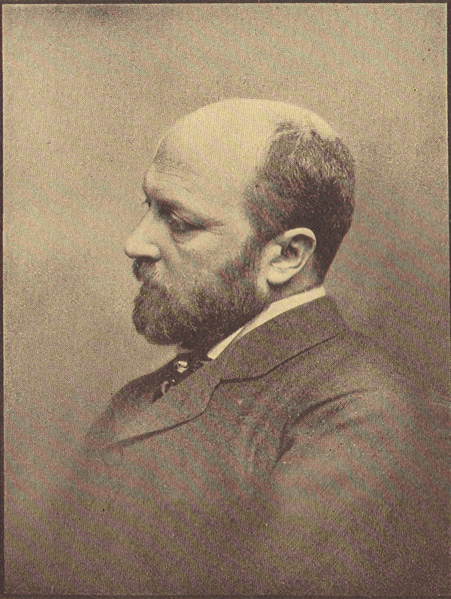
Henry James in 1890 at the age of 47. Asexual or hot bear?

Henry James on the beach in 1897 at the age of 54. Asexual or hot bear?
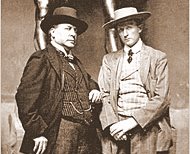
Henry James in 1907 at the age of 64, with “young friend” Hendrik Anderson. Asexual or hot bear?
For our thoughts on a recent book review in The Times that also suffers from this brand of coy and insidious homophobia, click here.
Filed under: Gay, History, Literature, Longing, Memory, Resignation, The Gay Recluse, Writers-American, Writers-Irish | 1 Comment
Tags: Bear, Colm Toibin, Daddy Bear, Gay Bear, Hendrik Anderson, Henry James, Homophobia, Hot Bears, The Master, William James
In which The Gay Recluse documents the exceedingly beautiful ruins of Washington Heights.
Location: Audubon Terrace
Address: Broadway between 155th and 156th Streets
Remarks: Of all the exceedingly beautiful ruins in Washington Heights, perhaps none is more heartbreaking than Audubon Terrace. Not quite dead, it is like a great whale stranded on a beach; as much as we admire its sheer size and power, we are incapable of helping, and so must observe in an atmosphere shrouded in doom.

The south facade of Audubon Terrace.
Founded by Archer Milton Huntington in 1904, the site is an improbably grand Beaux Arts complex that originally housed The Hispanic Society, The Museum of the American Indian, The American Numismatic Society, the American Academy of Arts and Letters, the National Institute of Arts and Letters, and the American Geographical Society.

We are always alone here, except for the statues.
But today — as we see on a pathetic sign near the entrance, on which the letters have been painted over like a perverse tombstone — only two of the original tenants remain (The Hispanic Society and the American Academy of Arts and Letters); the others, apparently, could not tolerate the idea of carrying out their respective missions in a neighborhood marked by crime, poverty and immigrants, whose established history of collective ambivalence to the site is tragic but in many ways understandable. (As recently as 2006, it was reported in The Times that even the Hispanic Society would be moving downtown to escape Washington Heights.)

Welcome to the ruins.
Although a new tenant — Boricua College — has repaired some of the brickwork near the entrance, the plaza as a whole reeks of an institutionalized neglect we generally associate with the cities of Eastern Europe that languished for so long under Soviet bureaucracy. It is of course a supreme irony that one of the most magnificent repositories of Hispanic art and literature lies largely abandoned in the middle of a Dominican neighborhood; what seems most unforgivable is that the respective factions (neighborhood leaders, city officials, representatives of institutions) have not succeeded in collaborating to preserve these last members of a species so obviously on the verge of extinction.

Another sign: the missing word is “glows.”
We climb the stairs toward the entrance of The Hispanic Society, and feel a certain dread at the thought of ever having to say goodbye. And to those incapable of expressing sympathy for us and the neighborhood at large — and yes, we have even encountered disdain, as if to say that Washington Heights doesn’t deserve such a treasure — we have a simple message: fuck you and your soulless downtown neighborhoods that reek of money and privilege! Why don’t you come uptown for a change to see art that’s literally struggling for life? Why don’t you walk across the crumbling bricks and cracking limestone facades of Audubon Terrace and tell us why you’re so much better equipped to appreciate this beauty than we are?

Still waiting for the tech boom.
Why don’t you stare into the eyes of El Cid (or better yet, Don Quixote) and tell him that he doesn’t belong in such a poverty-stricken wasteland?

El Cid (1942), by Anna Hyatt Huntington
But the anger passes and we are left alone on the plaza, where we walk among the warriors, who look past us with dull, metallic eyes. Though uniformly colossal, they too seem less anxious to fight than drained and weary, resigned to whatever fate may bring.
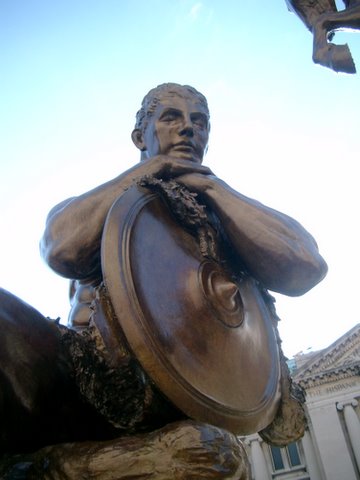
“Oh, please don’t drop me home…”
For more photos of Audubon Terrace, click here.
Filed under: Architecture, Capitalism, Communism, Decay, Government, New York City, Politicians, Resignation, The Gay Recluse, Washington Heights | Leave a Comment
Tags: American Geographical Society, Anna Hyatt Huntington, Archer Milton Huntington, Audubon Terrace, Beaux Arts, Dominican Neighborhoods, The American Academy of Arts and Letters, The American Numismatic Society, The Hispanic Society, The Museum of the American Indian, The Smiths, Washington Heights
In which The Gay Recluse ponders the transformation of the monumental into the mundane (and vice versa).
Date of Incident: January 29, 2008
Time: 6:04 pm.
Causes of Disaster: Heedless galloping of invasive species across fragile ecosystems.
Remarks: A once pristine landscape has been ruined, and is seen here with buckled terrain and dangerous fault lines. Although the damage is not expected to be irreparable, additional erosion of the crumbling terrain is likely inevitable.

Dear readers, we invite you to submit disaster footage and any relevant information (background conditions, attribution, etc.) to thegayrecluse@gmail.com.
Filed under: Animals, Disaster Footage, Landscape, The Gay Recluse | Leave a Comment
Tags: Cats, Dante, Disaster Footage, Homeland Security, Pouncing, Rugs, Zephyr
In which The Gay Recluse ponders the transformation of the monumental into the mundane (and vice versa).
Date of Incident: January 28, 2008
Time: 5:39 pm.
Causes of Disaster: Careless and possibly blatant disregard of invaluable records; ongoing acts of civil disobedience.
Remarks: After a long and exhaustive search, an historic document of invaluable worth and strategic importance was found. It could not be recovered, however, due to its placement (and by unknown means) in a heavily guarded location. All attempts to alternately appease or combat the enemy have thus far proved futile.
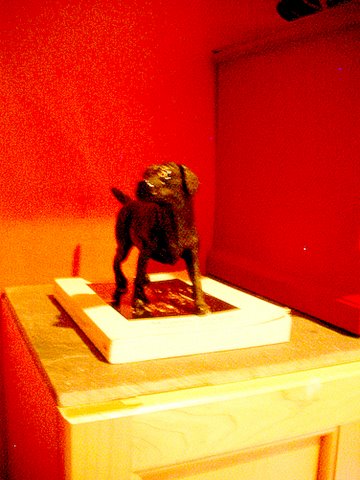
Filed under: Animals, Disaster Footage, Photography, Technology, The Gay Recluse | Leave a Comment
Tags: Cast Iron, Denton Welch, Disaster Footage, Dogs, Homeland Security, Maiden Voyage


 The Gay Recluse