In which The Gay Recluse becomes obsessed with orange tiles.
We recently spent some time in Berlin at the conference center, much of which was done in orange tiles.
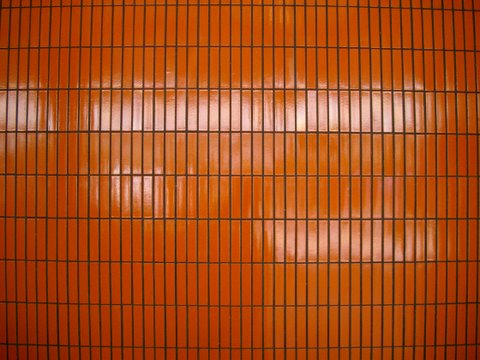
Yes it was garish but there was something appealing about it. Maybe it’s just because it seems like nothing you ever see on this side of the Atlantic, and like the song used to go: we’re so bored with the U.S.A.

All we could think about was how excited the orange-tile company must have been when they landed the contract however many years ago.

This was an underground passage that you can take if you don’t want to cross the street aboveground at a busy intersection: obviously the orange-tile company had a few very good years.
Filed under: Architecture, Capitalism, City Pattern Project, Communism, Infrastructure, Subway, The Gay Recluse | 3 Comments
Tags: Berlin, ICC, Orange Tiles, The Clash
In which The Gay Recluse remembers life in Washington Heights.
We’re in Berlin, which means we’re nostalgic for the George Washington Bridge. Let’s take a walk down memory lane, shall we?
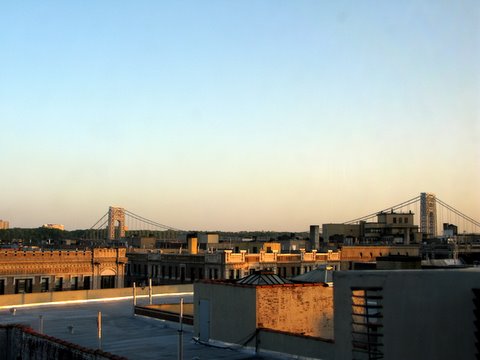
This was last Sunday morning, as in May 11. We don’t remember it, either.
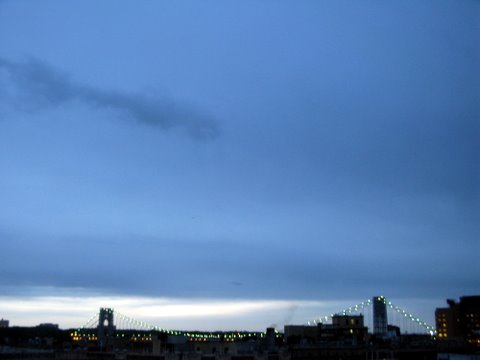
This was at the end of the day Monday, which was a really shitty day. It was like ten degrees out.
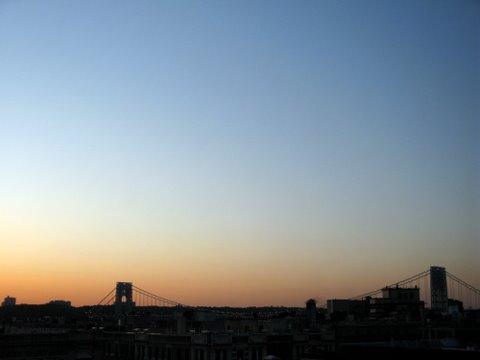
Tuesday was amazing, though!

So was Wednesday!
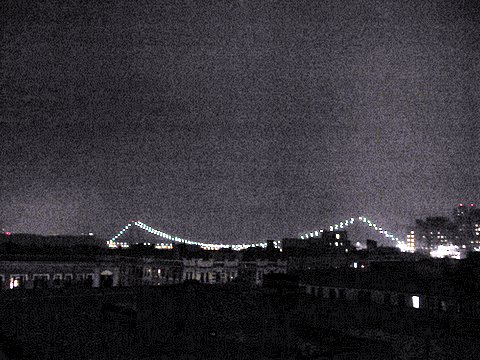
Thursday we didn’t take a picture, but Friday was also really miserable.
But this is home, so we miss it.
I, too, have an obsession with the George Washington Bridge. However, mine involves a nagging compulsion to complete a football pass from the deck of the bridge to a buddy on the ground below.
Filed under: Architecture, GWB Project, Infrastructure, Landscape, Longing, Nostalgia, Obsession, The Gay Recluse, Travel, Washington Heights, Weather | Leave a Comment
Tags: Berlin, Friday, Monday, Sunday, The George Washington Bridge, Tuesday, Wednesday
In which The Gay Recluse has shaky hands and doesn’t regret it.

There’s a saying among serious gardeners.

Annuals are gay! “Friends don’t let friends buy annuals.”

We can appreciate that. The colors are sometimes kind of gay garish!

But then again, we hate to be austere about anything.

And perennials can be very temperamental!

We enjoy our gay annuals.

Especially when we squint.

And remember what it was like to be young and on drugs carefree.
Filed under: Gay, GWB Project, Longing, Photography, The Gay Recluse, The Spring Garden, Washington Heights | 1 Comment
Tags: Annuals, Botany, Drugs, Eight, LSD, orange, Pink, Yellow
In which The Gay Recluse rather quickly dies of lung cancer as he becomes increasingly obsessed with birds.

The oily black smoke of 100-year-old boilers disperses daily across the rooftops in Washington Heights, heedless of those (including birds) who suffer from pneumonia, asthma and tuberculosis. Officials and politicians? Not even footnotes in this story, which is about the aggregation of capital and the relentless rise of the metropolis.
–The Gay Recluse, 9/29/07
Filed under: Animals, GWB Project, Infrastructure, Photography, Politicians, Sickness, The Gay Recluse, Washington Heights | Leave a Comment
Tags: Asthma, Birds, Bridges, Cancer, George Washington Bridge, Rooftops
In which The Gay Recluse updates his informal but rather telling quantitative analysis of Modern Love, the weekly Style Section (of The Times) column in which openly gay writers almost never appear, and even less frequently describe a romantic relationship.
This week’s piece: May I Have This Dance? by Owen Powell
Subject: A soldier in Iraq dreams of Natalie Portman. We enjoyed this essay, in which the author reveals a thoughtful and romantic heart beneath the necessarily hard exterior of a soldier. For our gay version, in which he dreams of Johnny Depp, click here.
We thought it was interesting that Daniel Jones would select this essay as a winner of his “college essay” contest — given that the writer seems to be in his late 20s and is enrolled at an “online institution” — which seems to indicate an admirable willingness on Jones’ part to stretch the rules, and yet he seems so reluctant to do the same with regard to gay-authored essays.
Filed under: Straight Man on “Relationships”
The updated tally (or why we feel like animals in the zoo): 7 out of 179 columns by openly gay writers; 2 out of 179 on female gay relationships; 0 out of 179 on male gay relationships. In what is arguably the “gayest” section of The Times, more women have written about gay men than gay men have.
Straight Woman on Relationships iiiii iiiii iiiii iiiii iiiii iiiii iiiii iiiii ii (42)
Straight Woman on Family iiiii iiiii iiiii iiiii iiiii iiiii iiiii i (36)
Straight Woman on “Looking for Love” iiiii iiiii iiiii iiiii iiiii iiiii iiiii (35)
Straight Woman on Breaking Up iiiii iiiii iiiii iiiii iii (23)
Straight Man on Relationships iiiii iiiii ii (12)
Straight Man on Breakup iiiiii (6)
Straight Woman on Gay Men iiiii i (6)
Straight Man on Family iiiii i(6)
Straight Man on “Looking for Love” iiiii (5)
Gay Man on Family ii (2)
Gay Woman on Relationship ii (2)
Gay Woman on Family i (1)
Gay Man on Self-Hatred i (1)
Gay Man on Prom Date i (1)
Ambiguous/Nurse on Drugs i (1)
Filed under: Gay, Search, Stereotypes, The Gay Recluse, The Times | Leave a Comment
Tags: Daniel Jones, Gay Modern Love, Iraq, Modern Love, Owen Powell, Soldiers, The New York Times
In which The Gay Recluse presents a gay/impressionistic alternative to this week’s Modern Love offering in The Times. Those looking for our quantitative analysis should click here.
May I Have This Dance?
I SPENT most of last year and a decent-size chunk of the year before in Iraq. For the last half of that sojourn I was stationed at a combat outpost on the east side of Baghdad.
That may sound impressive in a military sort of way, but it actually consisted of being locked up in a burned-out shell of a building surrounded by several hundred thousand deeply antagonistic Iraqis, many of whom had fervently tried to kill me on a number of occasions, and nearly succeeded once, as proved by the hole in my helmet.
As if being hated by my neighbors wasn’t bad enough, the outpost was severely limited in amenities. Well, perhaps “amenities” is too positive a word; how about severely limited in the basic necessities of life?
And love? There isn’t a whole lot of love floating around Baghdad, particularly when you have an American flag on your shoulder and you’re driving seven tons of armor along the local alleyways. No, my concern was much more tangible and, at the outpost, apparently just as unlikely to be fulfilled.
For the first two months of my “lease,” there was no electric power or running water. The ground floor had been torched in the ecstatic looting at the start of the war, and the walls were charred with a thick black soot.
The basement was choked with algae-green water, diesel fuel and sewage. The medics had pulled out at least two bloated corpses the first week we moved in, and we were reasonably sure that there were others down there, judging by the odor.
Daytime temperatures exceeded 120 degrees, which gives you an idea of just how appealing that smell was. I didn’t smell much better. I got a shower every 6 to 12 days, depending on luck and whether the little inflatable shower tent had sprung another leak.
Meals consisted of the execrable MREs, which we often wolfed down to the chorus of incoming mortar rounds.
It was everything I had ever hoped to experience in the military. It really was. Not that I would ever choose to do it again.
I would stagger in from a six-hour patrol, peel off my grease-slicked 80 pounds of body armor, ammunition, grenades and assorted firearms, and collapse on my rickety aluminum cot. Privacy was unknown, as was air-conditioning. I would lie on the cot, listen to the competing voices of 600 or so of my closest friends, stare at the bone-gray concrete ribs of the ceiling, and let sleep flow into me.
If I was lucky, I would dream of Johnny Depp. Lord only knows why, but again and again he walked through my subconscious: serene, unsullied, good, like honeysuckle on a cool summer night.
Now I’m not some pimply fanboy in camouflage. I’m married, devoted to my relationship partner. I have a home and a dog named Winston who loves me as only a black Lab can.
It wasn’t even that my dreams of Johnny were particularly notable, at least not in the usual soldier sense of notable. It was the texture within the dreams that mattered, and how that flowed into the rotisserie hell of another Baghdad morning.
He and I would have dinner in a darkened restaurant, somewhere hip and stratospherically expensive, thick with the smell of polished wood. The swirling flashbulb-pop taste of something unpronounceable on my tongue; looking up, smiling and feeling the shivering joy of having him laugh at a witticism of mine.
That smile! I had seen it a hundred times, on movie screens, on television sets, that sudden heart-skip pulse stabbing from glimpsing his image on a magazine stand.
Guarding an Iraqi police station in the glare of the midday sun, my carbine ready for the next catastrophe, I would cradle that smile in my mind, cherish it, grasp at it even as it faded and blurred and swam out of focus.
Dancing together, somewhere crowded, humid with perfume, the electronic beat of the music, and the pulse of a foreign city. The air twisting with a sort of water-shimmer light. Strobes, laser beams, the lightning-fast shot of an impossibly high cheekbone, frozen for a glimpsed eternity; the suggested promise of Johnny’s eyes, intoxicating, piercing.
Dreams of dancing? I can’t dance at all. Still, who am I to argue with my subconscious? Some people fly in their dreams — in mine, I dance.
I clung to those visions. Out on patrol, encased in the steel and Kevlar frame of the Humvee, my ears buzzing with the tinny voices on the radio, I eyed the burqa-clad locals outside the thick locked door, along with every single piece of roadside refuse.
In the Humvee, I searched for that elusive image of Johnny from the night before; I hunted for him through the blood-warm passages of my mind, chased the feeling of him down tunnels collapsing with the weight of status reports and threat conditions.
The thick brushstroke of a single arched eyebrow. A glance across that crowded dance floor, somehow simultaneously sharp and accusatory and mesmerizing. It was as if I had something secret and untouchable that was wholly mine, a delicate and perfect gift in a city that seemed to feast on hate.
My reveries weren’t all Lifetime TV romance, though. In a personal touch, sometimes the dream would be of losing him, or of desperate searches unfulfilled. The breakup argument in the spotless white penthouse apartment. Recriminations, tears. Running down rain-slicked city streets, locked doors, impassive doormen, and always that perfect angelic face; leaving with someone else, or seen in a blank stare through a limousine window.
Life on Baghdad streets is dominated by boredom, paroxysms of anger and the constant throbbing beat of resentment. Hatred and rage boil up from the shell-pocked concrete — you can feel yourself changing, morphing, becoming mean.
Even the specter of losing Johnny Depp was better than that; even the memory of imaginary heartache is preferable to the slow feeling of turning into a vampire. Perhaps it is the curse of all men; the sad final truth that the male half of the human race might only confide in one another over a few too many beers: you only truly love a man when he walks out the door.
BUT like I said, none of the details really mattered. What mattered was that I would wake up in that green morass of mosquito nets, amid the faint ichor glow of the chemlights, and for one long delicious moment, I would not know where I was.
The logical waking side of me worried a bit about this imaginary romance playing out inside me. Was I losing it? Was this some bizarre form of post-traumatic stress disorder, forgotten from the field manuals, omitted from the obligatory psych journals? Wasn’t it bad enough that I was trying to hold together a marriage (thank you Massachusetts) across 5,000 miles through crackling cellphone calls in the middle of the night or, wonder of wonders, Yahoo Messenger?
But my obsession wasn’t so strange. After all, we live in a world where we know more about Marc Jacob’s boyfriends than anything our next-door neighbor is doing. Human beings have always set beauty upon a pedestal through paintings, sculpture or literature, and moreover we covet what we see every day. Classic art may have faded in the last 100 years, but the archetypes of beauty have merely been repackaged, reinvented — far more effectively than anybody but Andy Warhol could ever have imagined.
We are told exactly what we should look like, whom we should be, and most important, whom we should desire. The cultural legends of our past have faded, and now Hollywood packages the new deities in digital halos.
It’s almost a year later and I’m home now, home in the larger sense of the United States, instead of in the suspect sense of the world at large. Baghdad has receded in my mind, remembered now only by the names of my dead friends, tattooed forever on my arm.
Most improbably, I’m here in New York, an offhand and completely unexpected gift of the Army. Thanks for getting shot; we’re sending you to Brooklyn. I didn’t know if I should laugh or … well, laugh some more. It’s everything a soldier could ask for. No field training. Home every night. Easy duty.
Best of all, non-deployable — that legendary status combat vets dream of (at least any vet with a shred of common sense). No one trying to kill you. I get a nice rent-free three-bedroom house, plenty of parking, in New York. Culture and entertainment and handmade cannoli. Plenty of time to explore. Someone even told me that Johnny Deep once filmed a movie around here.
Problem is, I don’t dream about him anymore. Ten years ago I would spend my weekends flinging myself out of airplanes; now I spend Saturdays on the couch with my partner. I remember Friday nights roaring though Seoul on my motorcycle, blitzed and helmetless and immortal; now my free-time adventures are on an Xbox. Worst of all, I feel reasonably happy with the shifting winds of domesticity.
Call it the double-edged sword of contentment.
This is my new reality. Working the graveyard shift, alone. Sitting in my patrol car on the bluff above the water, I watch the cargo ships slide silently past in the silver-white light of the Verrazano-Narrows Bridge. Smoke what seems like my hundredth Camel of the night. Take another sip of lukewarm convenience-store coffee. Yawn the edge of sleep from my eyes; I know it holds no wonders for me tonight.
Staring across the cold water, I feel the end out there, somewhere, sidling past the buildings across the river, circling in. Not death — something subtly worse, in its own way. The growing certainty: I will probably never dance the lambada with Johnny Depp.
Filed under: Gay, Stereotypes, The Gay Recluse, The Times | Leave a Comment
Tags: Gay Modern Love, Johnny Depp, Modern Love, Owen Powell, The New York Times
In which The Gay Recluse loves ferns.

Sometimes it seems that ferns are seriously underrated.

Which is kind of odd, considering they almost always look great!

We recommend getting rid of your lawn and replacing it with ferns and birch trees.
If everyone did this it would obviously solve most of the world’s problems.
Here’s another good thing about ferns: if a guy says he’s really into ferns, chances are he’s gay.
After all, we’re gay and we love ferns.
Filed under: City Pattern Project, Landscape, Stereotypes, The Gay Recluse, The Spring Garden | Leave a Comment
Tags: Birches, Ferns, Lawns, Problems
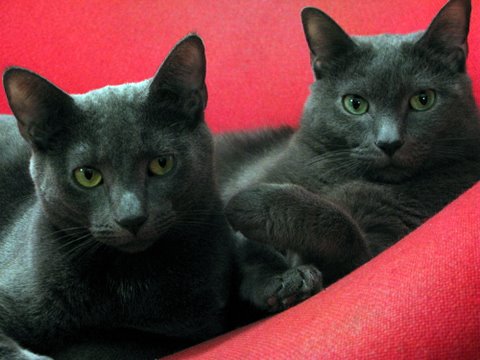
In which Dante and Zephyr take over The Gay Recluse.
Friends! We would like to draw your attention to the following comment and conundrum we received today from Reader GhengisKuhn, who writes:
Having tracked “not every cat is a lolcat” back to its root, I (a sporadic reader) would like to present you with a link and a conundrum. The Link: http://www.catsinsinks.com, which features, if nothing else, a memorable button. The Conundrum: I have noted that lolcats use many of the same linguistic markers present in African American Vernacular English (the durative ‘be’, for example: http://farm2.static.flickr.com/1221/1341009905_b99dd8f46c.jpg?v=0). Does this, combined with their clownish buffoonery, mean that lolcat lingo taps into subtle undercurrents of linguistic racism?
Thank you, GhengisKuhn, for presenting all of us with an admittedly interesting question. We will present one answer with the hope that readers will not feel shy about weighing in with their own. So without further ado: it seems to us that in keeping with the spirit of saying that every cat is not a lolcat, we think that while it is entirely plausible that some lolcats tap into the stereotypical (and racist) buffoonery and the linguistic markers you describe — and moreover so effectively illustrate in your link — we would not want to go so far as to brand every lolcat as a racist lolcat, since some lolcats strike us as legitimately cute and funny without being offensive. Readers, what do you think? Can you help GhengisKuhn with his conundrum?
Meanwhile, as you ponder your answers, we invite you to consider this:
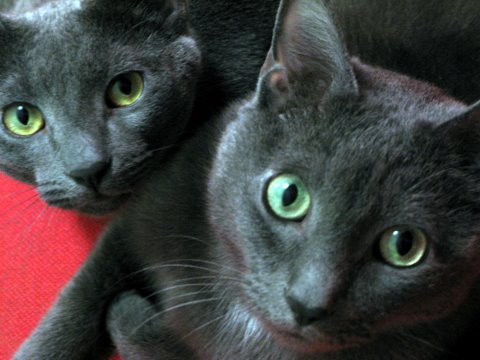
Friends! We may be handsome, irresistible and even possess a highly refined sense of humor, but let’s be perfectly clear: not every cat is a lolcat!
Filed under: Animals, Dissonance, Letters, Not Every Cat a Lolcat, The Gay Recluse | 2 Comments
Tags: Assistants, Dante, Linguistics, Lolcat, Not Every Cat a Lolcat, Racism, Zephyr
In which The Gay Recluse scores selected opinions in The Times.
Nicholas Kristof/The Terrified Monks
The Short Version: Friends! Behold the Indiana Jones of opinion page!
In his words: “I sneaked through these Tibetan areas in Gansu and Qinghai Provinces, eluding the troops by taking a local car with curtains pulled over the windows.”
Score: D (Depressing)
We feel bad for anyone living under a politically oppressive regime, but we never get the sense that Kristof is in this for anyone but himself.
Gail Collins/A Victory Plan for Hillary
The Short Version: Hillary…ha.
In her words: “Hillary’s tendency to describe herself and her supporters as “hard-working” is getting a little irritating.”
The Score: B- (Blah)
There’s a cloud of malaise hovering over this column that makes us look forward ton the general election.
Filed under: Drivel, Government, Politicians, The Gay Recluse, The Times | Leave a Comment
Tags: Gail Collins, Hillary Clinton, Indiana Jones, Monks, Nicholas Kristof, The New York Times
In which The Gay Recluse tries to convey some semblance of the truth, as opposed to this obituary, written by Michael Kimmelman, one of the most notoriously oblivious critics at The Times.
Robert Rauschenberg, the irrepressibly prolific American gay artist and rather typically homophobic queen who time and again reshaped art in the 20th century, died on Monday night at his home on Captiva Island, Fla. He was 82.
The cause was heart failure, said Arne Glimcher, chairman of PaceWildenstein, the Manhattan gallery that represents the quite gay Mr. Rauschenberg.
Mr. Rauschenberg’s work gave new meaning to gay sculpture. “Canyon,” for instance, consisted of a stuffed bald eagle attached to a canvas. “Monogram” was a stuffed goat girdled by a tire atop a painted panel. “Bed” entailed a quilt, sheet and pillow, slathered with paint, as if soaked in blood, framed on the wall. All became icons of postwar modernism during a period that will always be noted for its extreme homophobia.
A gay painter, gay photographer, gay printmaker, gay choreographer, gay onstage performer, gay set designer and, in later years, even a gay composer, the gay Mr. Rauschenberg defied the traditional idea that a gay artist stick to one medium or style. He pushed, prodded and sometimes reconceived all the mediums in which he worked.
Building on the legacies of Marcel Duchamp, Kurt Schwitters, Joseph Cornell and others, he helped obscure the lines between painting and sculpture, painting and photography, photography and printmaking, sculpture and photography, sculpture and dance, sculpture and technology, technology and performance art — not to mention between his gay art and his gay life. Oddly, however — and like so many of his generation — he never could really bring himself to discuss just how gay he really was.
Mr. Rauschenberg was also instrumental in pushing American art onward from Abstract Expressionism, the dominant movement when he emerged, during the early 1950s. He became a transformative link between artists like Jackson Pollock and Willem de Kooningand those who came next, artists identified with Pop, Conceptualism, Happenings, Process Art and other new kinds of art in which he played a signal role. One thing for which he will always be remembered: Rauschenberg definitely helped pave the way for Andy Warhol!
No American artist, his totally gay lover Jasper Johns once said — with the obvious exception of Warhol — invented more than Mr. Rauschenberg. Mr. Johns, John Cage, Merce Cunningham and Mr. Rauschenberg, without sharing exactly the same point of view, collectively defined this new era of experimentation in American culture. No coincidence, all of these artists were major queens.
Apropos of the gay Mr. Rauschenberg, the gay Cage once said, “Beauty is now underfoot wherever we take the trouble to look.” Cage meant that people had come to see, through Mr. Rauschenberg’s efforts, not just that anything, including junk on the street, could be the stuff of art (this wasn’t itself new), but that it could be the stuff of an art aspiring to be beautiful — that there was a potential poetics even in consumer glut, which Mr. Rauschenberg celebrated.
“I really feel sorry for the many straight people who think things like soap dishes or mirrors or Coke bottles are ugly,” he once said, “because they’re surrounded by things like that all day long, and it must make them miserable.”
The remark reflected the optimism, slyly hilarious bitchiness and generosity of spirit that Mr. Rauschenbergbecame known for. His work was likened to a St. Bernard: uninhibited and mostly good-natured. He could be the same way in person. When he became rich, he gave millions of dollars to charities for women, children, medical research, other artists and Democratic politicians. But even though he was a huge queen, he continued to be embarrassed throughout his life by any public association with the laughably obvious identity, even going so far as to criticize an exhibition of his work organized by a gay-and-lesbian-studies program at Yale. “”I am not happy with it,” said Mr. Rauschenberg in an interview with The Times. ” It was organized by the gay studies department, whatever that is. It’s not an approach that makes sense.” Though generally correct in an idealistic way, this kind of statement ignores the reality of hundreds of years of rather extreme homophobia — and the corresponding need to study and rectify this sad state — and so can be likened to say, the statements of those who like to fight against affirmative action in any context. But whatevs, not everyone’s perfect!
A brash, garrulous, hard-drinking, open-faced gay Southerner, he had a charm and peculiar Delphic felicity with language that masked a complex personality and an equally multilayered emotional approach to art, which evolved as his stature did. Having begun by making quirky, small-scale assemblages out of junk he found on the street in downtown Manhattan, he spent increasing time in his later years, after he had become successful and famous, on vast international, ambassadorial-like projects and collaborations.
Conceived in his immense studio on the island of Captiva, off southwest Florida, these projects were of enormous size and ambition; for many years he worked on one that grew literally to exceed the lengthof its title, “The 1/4 Mile or 2 Furlong Piece.” This and many of his latter works were widely deemed to be “a bit much.” Even so, he maintained an equanimity toward the results. Protean productivity went along with risk, he felt, and risk sometimes meant failure.
The process — an improvisatory, counterintuitive way of doing things — was always what mattered most to him. “Screwing things up is a virtue,” he said when he was 74. “Being correct is never the point. I have an almost fanatically correct assistant, and by the time she re-spells my words and corrects my punctuation, I can’t read what I wrote. Being right can stop all the momentum of a very interesting idea.”
This attitude also inclined him, as the painter Jack Tworkov once said, “to see beyond what others have decided should be the limits of art.”
He “keeps asking the question — and it’s a terrific question philosophically, whether or not the results are great art,” Mr. Tworkov said, “and his asking it has influenced a whole generation of artists.” This is probably overstating the case somewhat.
A Wry, Respectful Departure
That generation was the one that broke from Pollock and company. Mr. Rauschenberg maintained a deep but mischievous respect for macho Abstract Expressionist heroes like de Kooning and Barnett Newman. Famously, he once painstakingly erased a drawing by de Kooning, an act both of destruction and devotion. Critics regarded the all-black paintings and all-red paintings he made in the early 1950s as spoofs of de Kooning and Pollock. The paintings had roiling, bubbled surfaces made from scraps of newspapers embedded in paint.
But these were just as much homages as they were parodies. De Kooning, himself a parodist, had incorporated bits of newspapers in pictures, and Pollock stuck cigarette butts to canvases.
Mr. Rauschenberg’s “Automobile Tire Print,” from the early 1950s — resulting from Cage’s driving an inked tire of a Model A Ford over 20 sheets of white paper — poked fun at Newman’s famous “zip” paintings.
At the same time, Mr. Rauschenbergwas expanding on Newman’s art. The tire print transformed Newman’s zip — an abstract line against a monochrome backdrop with spiritual pretensions — into an artifact of everyday culture, which for Mr. Rauschenberg had its own transcendent dimension.
Mr. Rauschenberg frequently alluded to cars and spaceships, even incorporating real tires and bicycles into his art. This partly reflected his own restless, peripatetic imagination. The idea of movement was logically extended when he took up dance and performance.
There was, beneath this, a darkness to many of his works, notwithstanding their irreverence. “Bed” (1955) was gothic. The all-black paintings were solemn and shuttered. The red paintings looked charred, with strips of fabric akin to bandages, from which paint dripped like blood. “Interview” (1955), which resembled a cabinet or closet with a door, enclosing photos of bullfighters, a pinup, a Michelangelo nude, a fork and a softball, suggested some black-humored encoded homoerotic message.
There were many other gay/outsider images of downtrodden and lonely people, rapt in thought; pictures of ancient frescoes, out of focus as if half remembered; photographs of forlorn, neglected sites; bits and pieces of faraway places conveying a kind of nostalgia or remoteness. In bringing these things together, the art implied consolation. Although he was loathe to admit it, much of his work was rife with homosexual allusions that clearly represented the core of his artistic vision.
Mr. Rauschenberg, who knew that not everybody found it easy to grasp the gay open-endedness of his work, once described to the writer Calvin Tomkins a decidedly non-sexual encounter with some bitch who had reacted skeptically to “Monogram” (1955-59) and “Bed” in his 1963 retrospective at the Jewish Museum, one of the events that secured Mr. Rauschenberg’s reputation: “To her, all my decisions seemed absolutely arbitrary — as though I could just as well have selected anything at all — and therefore there was no meaning, and that made it ugly.
“So bitchy queen that I was, I told her that if I were to describe the way she was dressed, it might sound very much like what she’d been saying. For instance, she had feathers on her head. And she had this enamel brooch with a picture of ‘The Blue Boy’ on it pinned to her breast. And around her neck she had on what she would call mink but what could also be described as the skin of a dead animal. Well, at first she was a little offended by this, I think, but then later she came back and said she was beginning to understand.”
Growing Up Closeted With Scraps
Milton Ernest Rauschenberg was born on Oct. 22, 1925, in Port Arthur, Tex., a small refinery town where “it was very easy to grow up without ever seeing a painting,” he said. (In adulthood he renamed himself Robert.) His grandfather, a doctor who emigrated from Germany, had settled in Texas and married a Cherokee. His father, Ernest, worked for a local utility company. The family lived so frugally that his mother, Dora, made him shirts out of scraps of fabric. Once she made herself a skirt out of the back of the suit that her younger brother was buried in. She didn’t want the material to go to waste. In Texas at this time, there was no internet or Will & Grace, so like many of his brethren who grew up in the dark ages, young Milton thought he was a massive freak.
But like a true queen, for his high school graduation present, Mr. Rauschenberg wanted a ready-madeshirt, his first. All this shaped his art eventually. A decade or so later he madehistory with his own assemblages of scraps and ready-mades: sculptures and music boxes made of packing crates, rocks and rope; and paintings like “Yoicks,” sewn from fabric strips. Like so many sad closet-cases of the era, he loved making something out of nothing.
Mr. Rauschenberg studied pharmacology (Zzzzz) briefly at the University of Texas at Austin before he was drafted during World War II, where like so many others it is believed he had a lot of gay sex. He saw his first paintings at the Huntington Art Gallery in California while he was stationed in San Diego as a medical technician in the Navy Hospital Corps. It occurred to him that it was possible to become a gay painter.
He attended the Kansas City Art Institute on the G.I. Bill, traveled to Paris and enrolled at the Académie Julian, where he met Susan Weil, a young painter from New York who was to enter Black Mountain College in North Carolina. Somehow he managed to keep the whole gay thing a secret from her, at least at first. Having read about and come to admire Josef Albers, then the head of fine arts at Black Mountain, Mr. Rauschenberg saved enough money to join her. Obviously he was still very much in the closet at this point.
Mr. Albers was a disciplinarian and strict modernist who, shocked by his gay student, later disavowed ever even knowing Mr. Rauschenberg. He was, on the other hand, recalled by Mr. Rauschenberg as “a beautiful teacher and an impossible person.”
“He wasn’t easy to talk to, and I found his criticism so excruciating and so devastating that I never asked for it,” Mr. Rauschenberg added. “Years later, though, I’m still learning what he taught me.”
Among other things, he learned to maintain an open mind toward materials and new mediums, which Mr. Albers endorsed. Mr. Rauschenberg also gained a respect for the grid as an essential compositional organizing tool. Kinda like cities.
For a while, he moved between New York, where he studied at the Art Students League with Vaclav Vytlacil and Morris Kantor, and Black Mountain. During the spring of 1950 he and Ms. Weil married. (Lol!) The marriage lasted two years, during which they somewhat miraculously had a son, Christopher, who survives him, along with Mr. Rauschenberg’s “companion” — by which we mean gay relationship partner — Darryl Pottorf. (Companion!? Wtf? Yuck.)
Being John Cage’s Gay Guest
Mr. Rauschenberg experimented at the time with blueprint paper to produce silhouette negatives. The pictures were published in Life magazine in 1951; after that Mr. Rauschenberg was given his first solo show, at the influential Betty Parsons Gallery.
“Everyone was trying to give up straight European aesthetics,” he recalled, meaning Picasso, the Surrealists and Matisse. “That was the struggle, and it was reflected in the fear of collectors and critics. John Cage said that fear in life is the fear of change. If I may add to that: nothing can avoid changing. It’s the only thing you can count on. Because life doesn’t have any other possibility, everyone can be measured by his adaptability to change.”
Cage acquired a painting from the Betty Parsons show. Aside from that, Mr. Rauschenberg sold absolutely nothing. Grateful, he agreed to “host” Cage at his loft. As Mr. Rauschenberg liked to tell the story, the only place to sit was on a mattress. Cage started to itch. He called Mr. Rauschenberg afterward to tell him that his mattress must have bedbugs and that, since Cage was going away for a while, Mr. Rauschenberg could stay at his place. Mr. Rauschenberg accepted the offer. In return, he decided he would touch up the painting Cage had acquired, as a kind of thank you, painting it all black, being in the midst of his new, all-black period. When Cage returned, he was “not amused” and totally bitch-slapped Rauschenberg.
“We both thought, ‘who is this bitchy queen?’ ” Mr. Rauschenberg recalled. In 1952 Mr. Rauschenberg switched to all-white paintings which were, in retrospect, spiritually akin to Cage’s famous silent piece of music, during which a pianist sits for 4 minutes and 33 seconds at the keyboard without making a sound. Mr. Rauschenberg’s paintings, like the music, in a sense became both Rorschachs and backdrops for ambient, random events, like passing shadows.
“I always thought of the white paintings as being not passive but very — well — hypersensitive, you know — kinda gay,” he told an interviewer in 1963. “So that people could look at them and almost see how many people were in the room by the shadows cast, or what time of day it was.”
He left for Europe and NorthAfrica with his gay lover Cy Twombly for a few months after that, where Mr. Rauschenberg began to collect and assemble objects — bits of rope, stones, sticks, bones — which he showed to a dealer in Rome who exhibited them under the title “scatole contemplative,” or thought boxes. They were shown in Florence, where an outraged critic suggested that Mr. Rauschenberg toss them in the river. He thought that sounded like a good idea. So, saving a few scatole for himself and friends, he found a secluded spot on the Arno. “‘I took your advice,” he wrote to the critic.
Yet the scatole were crucial to his development, setting the stage for bigger, more elaborate assemblages, like ‘“Monogram.” Back in New York, Mr. Rauschenberg showed his all-black and all-white paintings, then his erased de Kooning, which de Kooning had given to him to erase, a gesture that Mr. Rauschenberg found astonishingly generous, all of which enhanced his reputation as the new enfant terrible of the art world. This was a few years before Andy appeared on the scene, obviously.
Around that time he also met Mr. Johns, then unknown but seriously gay, who had a studio in the same building on Pearl Street where Mr. Rauschenberg had a loft. The intimacy of their relationship — i.e., they were inseparable lovers — over the next years, a consuming subject for later biographers and historians, coincided with the production by the two of them of some of the most groundbreaking works of postwar art. Again, that they were gay in an extremely homophobic society has to be considered by any serious critic in any assessment of these works of art.
In Mr. Rauschenberg’s famous words, they gave each other “permission to do what we wanted.” Living together in a series of lofts in Lower Manhattan until the 1960s, they exchanged ideas and like many queens supported themselves designing window displays for Tiffany & Company and Bonwit Teller under the collaborative pseudonym Matson Jones.
Along with the combines like “Monogram” and “Canyon” (1959), Mr. Rauschenberg in that period developed a transfer drawing technique, dissolving printed images from newspapers and magazines witha solvent and then rubbing them onto paper with a pencil. The process, used for works like “34 Drawings for Dante’s Inferno,” created the impression of something fugitive, exquisite and secret. Obviously this was tied to his largely unacknowledged — at least to the public — homosexual inclinations. It let him blend images on a surface to a kind of surreal effect, which became the basis for works he made throughout his later career, when he adapted the transfer method to canvas.
Instrumental in this technical evolution back then was Tatyana Grossman, who encouraged and guided him as he madeprints at her workshop, Universal Limited Art Editions, on Long Island; he also began a long relationship with the Gemini G.E.L. workshop in Los Angeles, producing lithographs like the 1970 “Stoned Moon” series, with its references to the moon landing.
His association with theater and dance had already begun by the 1950s, when he began designing sets and costumes for Mr. Cunningham, Paul Taylor and Trisha Brown and for his own productions. In 1963 he choreographed “Pelican,” in which he performed on roller skates while wearing a parachute and helmet of his design to the accompaniment of a taped collage of sound. This fascination with collaboration and with mixing art and technologies dovetailed with yet another endeavor. With Billy Klüver, an engineer at Bell Telephone Laboratories, and others, he started Experiments in Art and Technology, a nonprofit foundation to foster joint projects by artists and scientists.
A Gay World of Praise
In 1964 he toured Europe and Asia with the Merce Cunningham Dance Company, the same year he exhibited at the Whitechapel Gallery in London and the Venice Biennaleas the United States representative. That sealed his international renown. The Sunday Telegraph in London hailed him as “the most important American artist since Jackson Pollock.” He walked off with the international grand prize in Venice, the first modern American to win it. Mr. Rauschenberg had, almost despite himself, become an institution that really did pave the way for the most important artist of the twentieth century, Andy Warhol.
Major exhibitions followed every decade after that, including one at the Pompidou Center in Paris in 1981, another at the Guggenheim in 1997 and yet another at the Los Angeles Museum of Contemporary Art that landed at the Metropolitan Museum in 2005.
When he wasn’t traveling in later years, he was on Captiva, living at first in a modest beach house and working out of a small studio. In time he became that Gulf Coast island’s biggest residential landowner while also maintaining a town house in Greenwich Village in New York. He acquired the land in Captiva by buying adjacent properties from elderly neighbors whom he let live rent-free in their houses, which he maintained for them. This was obviously a nice thing to do. He accumulated 35 acres, 1,000 feet of beach front and nine houses and studios, including a 17,000-square-foot two-story studio overlooking a swimming pool. He owned almost all that remained of tropical jungle on the island. Most of the world was officially jealous.
After a stroke in 2002 that left his right side paralyzed, Mr. Rauschenberg learned to work more withhis left hand and, with a troupe of assistants, remained prolific for several years in his giant studio.
“I usually work in a direction until I know how to do it, then I stop,” he said in an interview there. “At the time that I am bored or understand — I use those words interchangeably — another appetite has formed. A lot of people try to think up ideas. I’m not one. I’d rather accept the irresistible possibilities of what I can’t ignore.”
He added: “Anything you do will be an abuse of somebody else’s aesthetics. I think you’re born an artist or not. I couldn’t have learned it. Just like being gay. And I hope I never do because knowing more only encourages your limitations.”
Filed under: Drivel, Gay, Language, Search, Sickness, Stereotypes, The Gay Recluse, The Times | 3 Comments
Tags: Gay, Homophobia, Obituaries, Robert Rauschenberg, The New York Times
In which Dante invents a new twist on an old game.
Friends! Rest assured that somewhere in this picture can be found an editorial assistant, albeit one who is very carefully camouflaged.
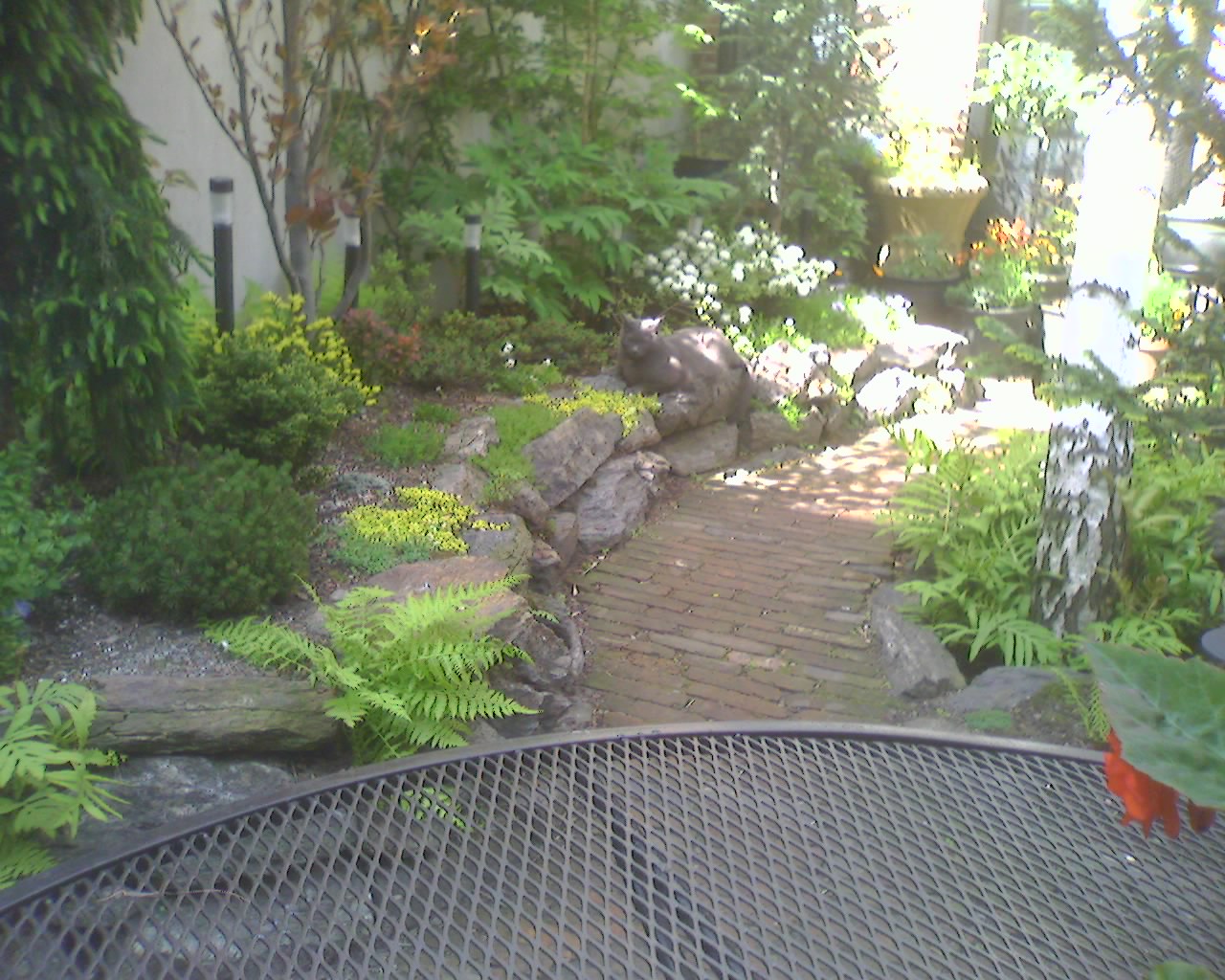
Have you looked long enough? Do your eyes feel strained and fatigued? Don’t worry, below you’ll find what you’ve been looking for.
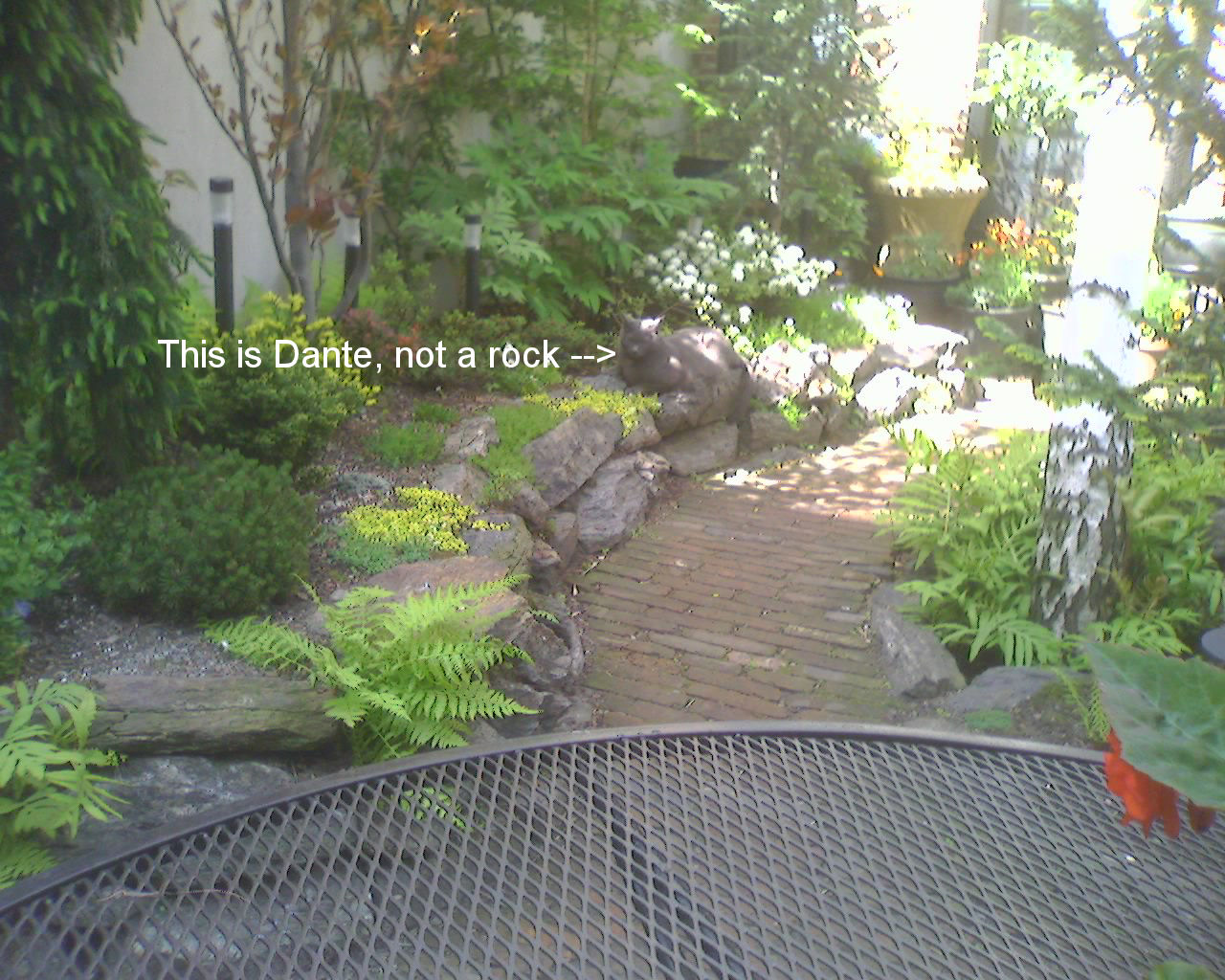
Friends! Please remember that not every cat is lolcat.
Filed under: Animals, Not Every Cat a Lolcat, Stereotypes, The Gay Recluse, The Spring Garden | 3 Comments
Tags: Dante, Editorial Assistants, Guest Blogging, Lolcats
In which The Gay Recluse scores selected opinions in The Times.
Bob Herbert/Here Come the Millennials
The Short Version: The youngs are seriously fucked, which is why they should vote for Obama.
In his words: “This is a generation that is in danger of being left out of the American dream — the first American generation to do less well economically than their parents.”
Score: D+ (Dumb)
Although it’s a relief to see the election viewed with a different lens than race, we’re pretty sure that Gen X was the first generation to understand that we would never exceed the olds in terms of McMansions, second SUVs and other indices of prosperity that have long defined boomers (aka the olds). But we’re also used to being completely ignored by boomers like Herbert, so we’re not that offended.
David Brooks/The Neural Buddhists
The Short Version: Hey, guess what?! There’s an element of “the unknown” — let’s call it the soul, or God — that science will never be able to measure!
In his words: “Scientists have more respect for elevated spiritual states.”
The Score: F (Fuck!)
It’s basically a crime that Brooks can write this column without once mentioning Arthur Schopenhauer, who effectively ended all of these arguments almost two hundred years ago in “The World as Will and Representation,” in which he (among other things) shows the limits of any purely materialistic view of the world, i.e., the obvious limits of atheism. Our personal theory is that Schopenhauer would be even more celebrated than he is but for the fact that he writes like a deliciously bitchy queen, which scares away conservative pseudo-intellectuals like Brooks. Still we are consoled by the idea that two hundred years from now, people will still be reading Schopenhauer, but nobody will be reading Brooks.
Filed under: Drivel, Government, Philosophers, Politicians, The Gay Recluse, The Times, Writers-German | Leave a Comment
Tags: Arthur Schopenhauer, Bitchy Queens, Bob Herbert, Boomers, David Brooks, Generation X, The New York Times
In which The Gay Recluse becomes increasingly obsessed with trees.

We were waiting a long time for the copper beech (Fagus sylvatica “Dawyck Purple”) to open this spring.

We had only planted it last year so didn’t know what to expect.
We were worried when everything else was in bloom and the beech showed no signs of life. We were like: “Wake up, Mr. Beech!”
But last weekend it happened.
After all this shitty weather, we bet it’s kind of regretting not taking another few days off.
But we’re happy it’s here.
And not just because it’s beautiful and can live for thousands of years.
But so we pretend we don’t live next to an abandoned shell, which is going to take a thousand years to be fixed.
It’s a good reminder that sometimes covering up a problem really is the best way to handle it.
Filed under: Decay, Dissonance, GWB Project, Landscape, The Gay Recluse, The Spring Garden, Washington Heights, Weather | Leave a Comment
Tags: Beech, Copper Beech, Dawyck Purple, Fagus sylvatica, Lies, Problems, Shells
In which The Gay Recluse scores selected opinions in The Times.
William Kristol/The Jewish State at 60
The Short Version: Happy Birthday, Israel. You are surrounded by crazies.
In his words: “Still, even though the security of Israel is very much at risk, the good news is that, unlike in the 1930s, the Jews are able to defend themselves, and the United States is willing to fight for freedom.”
Score: D (Disingenuous)
We’re pretty sure it’s possible to aggressively support Israel but not hawkish Republicans like George W. Bush and the Maverick.
Paul Krugman/The Oil Nonbubble
The Short Version: High oil prices are never going away. Deal with it.
In his words: “France consumes only half as much oil per capita as America, yet the last time I looked, Paris wasn’t a howling wasteland.”
The Score: A- (Agree)
We drive a 1990 Toyota Corolla that gets better gas mileage than most new cars today. Pathetic. As Krugman sort of says, it’s time for Americans stop treating cheap gas like an entitlement: there is far more good (on both political and environmental fronts) that can come from higher energy prices than bad. (One note: we don’t support France’s increasing reliance on nuclear power. )
Filed under: Drivel, Government, Politicians, The Gay Recluse, The Times | Leave a Comment
Tags: George W. Bush, Hawks, Israel, Oil, Paul Krugman, The Maverick, The New York Times, William Kristol
On Washington Heights Monopoly: Condominium for 573-575 West 161st, 577-579 a Mystery Excavation
In which The Gay Recluse provides an update on a beehive of activity at 573-579 West 161st Street.
So it’s official, if “official” means by way of an unnamed receptionist at the architects’s office: 573-575 West 161st Street is going to be a 6-story condominium. We’re trying to scrounge up a rendering, but in the meantime, check out the pit:
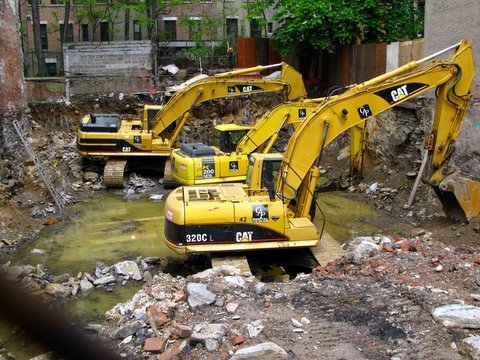
Sweet. Shit, these guys aren’t fucking around!
But one question remains: The construction permit is for 573-575, and yet the excavation extends not only through 577 but — if you look carefully — behind the building at 579.
Here’s a pre-construction pic to get you oriented:

579 is to the left of 577, obvs! It’s also owned by the evil doctors.
Here’s another frontal pic:
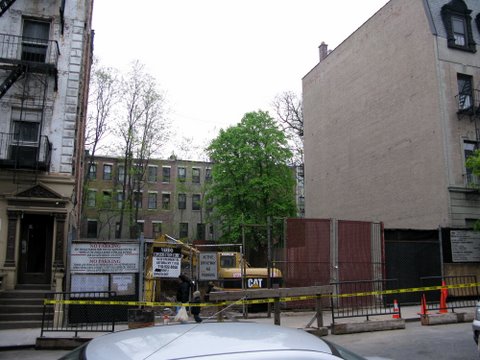
Permits are posted here, but only for 573-575! 579 is kinda hurting, in case you can’t tell from the pic.
So what’s going on here? If anyone knows why these two lots are also being excavated — and apparently without a permit — we’d like to solve this mystery.
Filed under: Architecture, Capitalism, Gentrification, Government, Knockbusters, Monopoly, The Gay Recluse, Washington Heights | Leave a Comment
Tags: Church, Condominiums, construction, Doctors, Excavation, Permits
In which The Gay Recluse rather quickly gets lung cancer.
Time of Photographs: May 10, around 8:30.
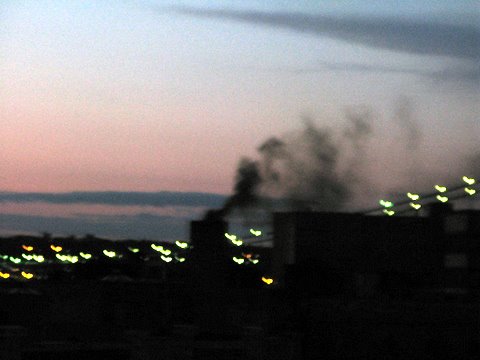


The oily black smoke of 100-year-old boilers disperses daily across the rooftops in Washington Heights, heedless of those who suffer from pneumonia, asthma and tuberculosis. Officials and politicians? Not even footnotes in this story, which is about the aggregation of capital and the relentless rise of the metropolis.
–The Gay Recluse, 9/29/07
Filed under: Government, GWB Project, Health, Sickness, The Gay Recluse, Washington Heights | Leave a Comment
Tags: Asthma, Breathing, Rooftops, Smoke
In which The Gay Recluse scores selected opinions in The Times.
Frank Rich/Party Like It’s 2008
The Short Version: Friends, thank you! I, Frank Rich, have won the Democratic primary!
In his words: “This is not 2004, when another Democrat from Massachusetts did for windsurfing what the previous model did for tanks.”
Score: B- (Blather)
Given that we endorsed Obama in January, we’re quite pleased to see him as the nominee. Less pleasing is Rich’s meandering “gee whiz, times are different” column, which comes off as presumptuous after all the anti-Clinton hysteria he served up in the past few months. You almost get the sense that Rich thinks he was nominated for president after a long battle, and this is his acceptance speech. Yuck.
Thomas Friedman/Call Your Mother
The Short Version: My mother was quite a character.
In his words: “But every time life knocked her down, she got up, dusted herself off and kept on marching forward, motivated by the saying that pessimists are usually right, optimists are usually wrong, but most great changes were made by optimists.”
The Score: B (Benign)
Although we are a little perturbed by Friedman’s (mis)characterization of the true essence of pessimism, we were touched by this portrait of his mother, who recently died after what sounds like a fairly incredible life.
Nicholas Kristof/Saving the World in Study Hall
The Short Version: Kids do the greatest things!
In his words: “But even when greedy, self-absorbed cynics take on some worthy cause for the most selfish motives, they often learn and grow from the experience.”
Score: D (Dopey)
We’re all for kids doing stuff to save the world, but what we don’t like is the implication that it can be a substitute for effective government. But mostly this column made us want to sit around and get high and watch teevee, which is the ultimate goal of advanced civilizations like ours.
Maureen Dowd/Is She a Trojan Rabbit?
The Short Version: OMG! Hillary as veepee? I’m funnee!
In her words: “Obama will never be at his best around Hillary; she drains him of his magical powers.”
The Score: D- (Draining)
Dumping on Hillary Clinton at this point feels makes Dowd seem like a zany stand-up comic playing to an empty room at two in the morning. Sad.
Filed under: Drivel, Government, Politicians, The Gay Recluse, The Times | 2 Comments
Tags: Clinton, Frank Rich, Maureen Dowd, Mother's Day, Nicholas Kristof, Obama, Teen Spirit, Thomas Friedman


 The Gay Recluse