In which The Gay Recluse takes pictures and displays ignorance.
First, a note from our new friend and GreenCine film critic James Van Maanen, who writes (with regard to the below shot):
Is that first picture of a hawk, maybe? (I ask, because we are getting a number of here out here in Jackson Heights of late. Much to the dismay of our pigeons and other smaller birds & rodents….)
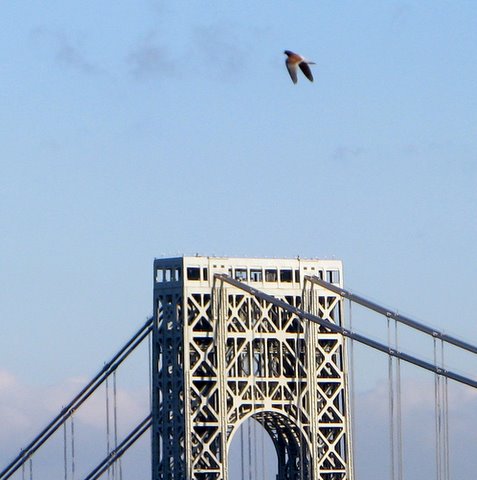
Thanks for the note, Jim! We were kind of hoping that it was an American Kestrel, mostly because it’s the title of a record our band once released. What we really need is for someone like the guy who wrote this post to point us in the right direction! We love this guy, not only for his enthusiasm for the birds of Upper Manhattan, but for his appreciation of the ruined state of affairs that marks our existence up here:
As we walk along the neglected park, I can only wish that the wealth of the Central Park Conservancy could somehow also adopt these little green strips and return them to the glory of years past. Northern Manhattan deserve parks without crack pipes, weeds and broken glass.
So true! But since we’re here to talk about birds and not ruins, we now present our latest batch of photographs, all taken on Saturday afternoon as we hiked along the forgotten piece of land that lies between the train tracks and the Hudson, north of the bridge and south of Dykeman. It is an oddly desolate place, filled with debris, gnarled trees and — yes! — birds.

This is Manhattan!? Believe it.

Could you be a white-breasted nut-job nuthatch?

Another view. Different bird. Beautiful tail.

Is this the same as number one above? Or something different? (How clueless are we?)

Could these be chicks? Or wrens? Or sparrows? (Thankfully, our field guide is in the mail.)

We might not be cut out for birding, after all, at least the up-close variety. We’re pretty sure this is a lowly seagull, but we still love to watch them fly.


Filed under: Animals, GWB Project, Landscape, New York City, Obsession, Ruins, Science, Stereotypes, The Gay Recluse, Washington Heights | Leave a Comment
Tags: American Kestrel, Birds, Dykeman, George Washington Bridge, Hudson, Manhattan, Seagulls, Sunset, White-Breasted Nuthatch
In which The Gay Recluse holds a contest. Sort of.
Today we present a submission from Seth Tisue, who sends in an entry from the 30th Street Station in Philadelphia.
Let’s check it out, shall we?
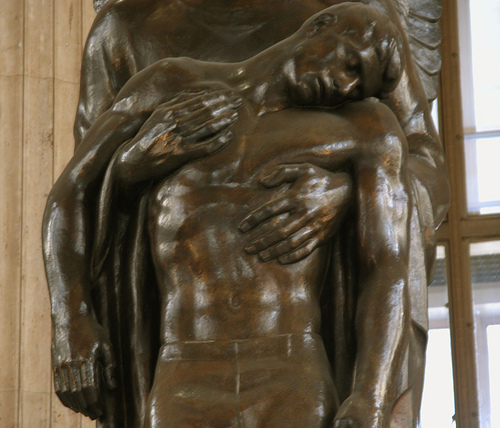
Hot or not…? Are you kidding!!? This is seriously gay and smokin’ hot. Nicely done, Philadelphia! You have not been tentative in your first entry on the boards.
Thanks for the submission, Seth. We like this pic because it raises many questions that extend beyond the implicit gayness and hotness of the sculpture. In short: we consider it for a second and immediately want to know more.
We encourage everyone to check out Seth’s cool web site here (http://tisue.net), but be forewarned: the first page features a photograph of one of Louise Bourgeois’ awesomely creepy (and ginormous) spider sculptures, which is guaranteed to give you nightmares for weeks!
For those in other cities, we await your submissions. There’s still plenty o’ time in the contest — it’s longer than the Democratic primaries (LOL!!!) — to scour your local venues for the best in hot gay statuary.
- Rules and Guidelines
- Dan Savage Endorsement
- Washington Heights (New York City)
- Washington, DC
- The London Eye Clarifies an Important Issue
- Florence (Italy)
- The Park Avenue Amory (Upper East Side/NYC)
- Murray Hill (New York City)
- Madrid (Spain)
- Los Angeles
Filed under: Architecture, Capitalism, Communism, Competitions, Gay, Government, Hot Gay Statues, Infrastructure, Resignation, Ruins, The Gay Recluse | 5 Comments
Tags: 30th Street Station, City of Brotherly Love, Gay Statuary, Gay Statues, Hot Gay Statues, Louise Bourgeois, Philadelphia
In which The Gay Recluse scores selected opinion pieces in The Times.
Paul Krugman/Taming the Beast
The Short Version: We need financial reform. So far none of the candidates seem to have noticed.
In his words: “But you don’t have to be an economic radical, or even a vocal reformer like Representative Barney Frank… to see that what’s happening now is the quid without the quo.”
Score: B- (Barely)
We’ve seen all of this before from Krugman, and though the points he makes about regulating financial markets are valid (particularly when we’re bailing them out), we’re not sure why he dumbs it down so much. We propose a moratorium on the use of “Let me explain.”
William Kristol/Let’s Not, and Say We Did
The Short Version: Obama’s race speech was politically expedient, but not what we really need.
In his words: “The last thing we need now is a heated national conversation about race.”
The Score: B- (Begrudging)
Although we hate the smarmy, superior tone of Kristol’s column, we reluctantly must agree with his larger point that a national conversation about race is not exactly of paramount importance, and in some ways only serves to reinforce negative stereotypes that — as Kristol rightly points out — are increasingly outdated as time passes. Although we would never deny the existence of racism, we tend to think a more accurate picture of the haves and have-nots in this country — and any attempt to close the gap between the two — must begin with class. Obviously the rural poor (let’s call them “white”) and the inner-city poor (“black”) have more in common with each other than with their upper-class counterparts of the same ethnicity.
Roger Cohen/A Second Life in Champagne
The Short Version: Readers! Gather round! Let me redeem you.
In his words: “Philipon, 45, has brown eyes of a boyish candor. He is bereft of self-pity, a man who’s come home. The stoical are discreet.”
The Score: D (Depressing)
Cohen treats us to the depressing story of a French executive who lost three (of four) children in the Thai tsunami three years ago, but has since come back to France, where he and his wife (devout Catholics, we’re told) have had two more. Although we have no desire to belittle the loss in question, we’re left less-than-inspired by Cohen’s nauseatingly sentimental and optimistic prose, which leaves us cruelly hardened to what in reality must have been the most harrowing experience imaginable.
Filed under: Drivel, Faith, Gentrification, Government, History, Language, Politicians, The Gay Recluse, The Times | Leave a Comment
Tags: Cohen, Death, Financial Markets, Kristol, Krugman, Obama, Race, Reform, The New York Times
In which The Gay Recluse celebrates Easter.
It was not until eleventh grade — in Mrs. S____’s English class — that we began to appreciate the obsessive and illogical side of literature, which of course is to say we were reading Wuthering Heights. Do you remember Mrs. S____? How thin and small and severe she was? How nobody in any of her classes — even E.B. the genius and teacher’s pet — ever got more than a B+ (and how he almost had a nervous breakdown as a result)? We hardly need to mention how she kept her hair pulled back in a tight bun; how she wore those awful brown skirts and high-necked blouses (we all wondered: who exactly was her husband?); or how 98 percent of her classes were deadly boring. That was all a given.
What we didn’t expect was that on a cold spring day much like we’ve been having lately, when everything is still barren but the light betrays a certain expectancy, Mrs. S___ would suddenly pivot around from where she had been writing something irrelevant on the chalk board to address us in a harsh, desperate tone that seemed to belong to someone else entirely. We were about to make the transition to the less passionate half of the book — the second generation — and Mrs. S____ wanted to emphasize exactly what we were leaving behind; she began to describe the moors, and how she liked to visit every few years, not because she wanted to see where Emily Brontë had lived and died — that she had already done — but to remember how the landscape was haunted by the spirits of Heathcliff and Catherine; and then she defied any of us to walk through the moors in the fading twilight, as the mist begins to meander above the heather, and tell her that we didn’t believe that these characters were so much more than words on a page, that they weren’t windows into the deepest recesses of the human soul, where love and hate could rip you apart.
It was an episode that always remained with us; we remembered it today, in fact, as we walked through the heather gardens in Washington Heights. We thought of all the thousands of hours we spent in the classroom, both before and after this this strange incident — although in retrospect, it was probably a performance — and how only this stayed with us. This is why we feel so grateful to Mrs. S____. At least for those two or three minutes, she unveiled herself as someone completely — and unapologetically — possessed by her love for something irrational and unobtainable; and really, what else could you ever want (or need) to know?





There is no life higher than the grasstops
Or the hearts of sheep, and the wind
Pours by like destiny, bending
Everything in one direction.
I can feel it trying
To funnel my heat away.
If I pay the roots of the heather
Too close attention, they will invite me
To whiten my bones among them.
Sylvia Plath, from “Wuthering Heights”
Filed under: Dissonance, Dream, Landscape, Language, Literature, Memory, Obsession, The Gay Recluse, The Spring Garden, Washington Heights, Weather, Writers-British | 1 Comment
Tags: Catherine, Easter, Emily Bronte, Fort Tryon Park, Heathcliff, Heather, Sylvia Plath, The Moors, Wuthering Heights
In which The Gay Recluse does some investigative reporting and follows up with a complaint.
As we’ve documented many times, thick black smoke — a function of improperly maintained or outdated boiler systems — is pretty much a constant of life in Washington Heights. (No coincidence, asthma rates are pretty much through the roof.) Although any number of apartment buildings are guilty of the offense, one in particular has been issuing an almost constant stream of noxious exhaust for the past 100 years few months. Here are some pix.
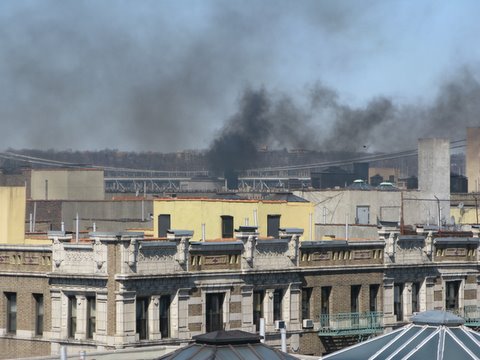
This was fifteen minutes ago, but it’s happening again as we type (wtf.)
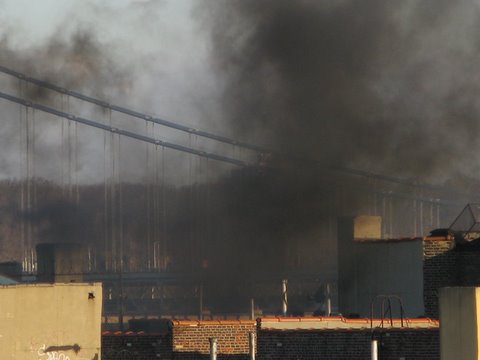
Here’s a “greatest hit” from a few days ago.

We like this one, too.
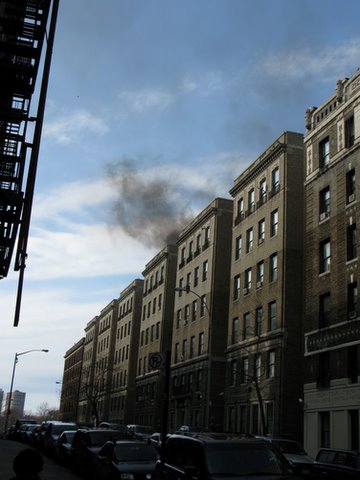
This was street level, yesterday.
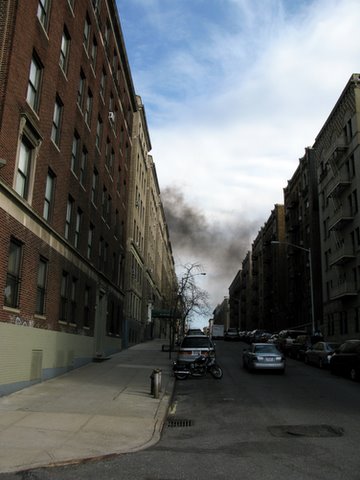
We love how people were making fun of us as we took the pix: “Oooh, a fire!” said some kid with derision and sarcasm. Whatever, we probably did look kind of stupid.
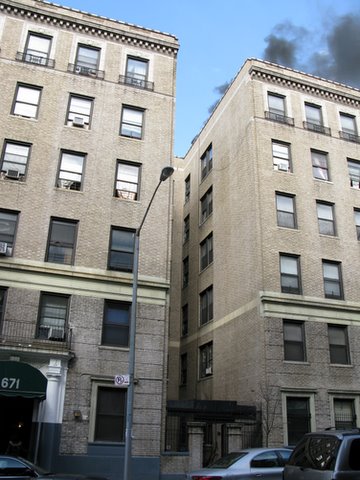
Thanks for all that smoke, 671 West 162nd Street!
We called 311, who turned it over to 911, who — somewhat embarrassingly (for us) — turned it over to the fire department. We emphasized that it wasn’t exactly an emergency, but that there was a regular stream of thick, black smoke from a nearby chimney. (In short, we felt like a hysterical queen, especially when the fire department called us back and gruffly said: “You’re reporting a fire?” and we were like: “no, but there’s an excessive amount of thick black smoke and it’s giving us lung cancer!” We didn’t mention that our cat Dante actually does have asthma, poor little guy!)
It seems like this problem should go somewhere else besides the fire department: department of health, or buildings? HPD? (LOL!!!) We’re at a loss if anyone has any ideas (and to preempt any wiseacres: don’t tell us to move; “that joke isn’t funny anymore.”) Somehow we don’t see this situation improving anytime soon, but we’ll keep you posted.
Filed under: Animals, Architecture, Conspiracy, Disease, Government, GWB Project, Health, New York City, The Gay Recluse, Washington Heights | 10 Comments
Tags: 311, 671 West 162nd Street, Asthma, Boilers, Exhaust, Fire Department, Investigative Journalism, Lung Cancer, Rooftops, The Smiths, Tuberculosis
In which The Gay Recluse makes a clarification.
Reader Gary Budlong (apparently new to The Gay Recluse) wrote the following comment in response to our most recent “mash-up” of the Modern Love column in The Times.
dear pete, thank you. i’m 61, disabled, retired and gay. my partner has died 5 years ago. knew i was different [gay] at an early age. my family situation was totally screwed up. your writing as you did struck accord with me and wished to express my appreciation. happy easter, happy spring…
Gary, thanks for the comment. Though brief, we found it moving in a way that many of the actual Modern Love columns (which is to say, those in The New York Times) are not.
Your comment also exposes some confusion about what’s actually going on with our “gay” version of the Modern Love column, so we wanted to clarify a few things, both for your benefit and that of other new readers:
- The operating rule of the Modern Love column (i.e., the one in The Times) is that it must always be written by those who — whatever their sexual orientation — are not openly gay (or if they are, must not describe a romantic relationship). We have done an informal quantitative analysis of the issue, which can be found here. This week’s Modern Love column in The Times, by Pete MacDonald, is not an exception to that rule. That said, we encourage everyone to read MacDonald’s piece, which nicely exposes a process of grief and acceptance that so often seems to arrive with any true acknowledgment of the (inevitable, and sometimes extreme) failures of our parents.
- All of the “gay” content in our version of the Modern Love has nothing to do with Pete MacDonald but was added by us in an attempt to highlight the psychological dissonance we have often noted is integral to the “coming out” process and so again frames our ability to understand/forgive/forget our parents.
- Although the overall intent of the Gay Modern Love column is to satirize The Times by highlighting their obvious discomfort with “the gays,” we mean no disrespect to Pete MacDonald and are happy to see that the gay version of the work is resonating in exactly the way we think the real column ought to do every once in a while. As we have said before, our stories are here within us, we shouldn’t have to beg to have them recognized, or apologize to have them told.
As Gary so appropriately put it: happy easter, happy spring…

Filed under: Disaster Footage, Faith, Gay, Landscape, Language, Letters, Resignation, The Gay Recluse | Leave a Comment
Tags: Fashion & Style, Gay, Gay Modern Love, Gay Stereotypes, Gay Voice, Gay Writers, Homophobia, Lesbian, Modern Love, The New York Times
In which The Gay Recluse scores selected opinion pieces in The Times.
Frank Rich/The Republican Resurrection
The Short Version: 1) Obama’s the man; 2) Clinton’s a monster, 3) McCain is loving it.
In his words: “Instead of enhancing her own case for the presidency, she’s going to tear him down.”
Score: B (Bit much)
In part one of his column, Rich argues that Obama’s speech essentially ruled and that Clinton continues to be rather hideously phony at times. (Rich makes the case in predictably stronger terms.) We agree for the most part; obviously, we prefer Obama as a candidate. But in part two of his column Rich effectively shows what a clueless idiot McCain is, which undercuts his theme of a Republican resurrection. Once September rolls around, McCain will still be a clueless idiot, whether he’s running against Clinton or Obama.
Nicholas Kristof/Iraq, $5000 Per Second?
The Short Version: Who knew? The Iraq war is expensive.
In his words: “So as we debate whether to bring our troops home, one central question should be whether Iraq is really the best place to invest $411 million every day in present spending alone.”
The Score: F (Failure)
There’s not a single thing in this column we haven’t already heard 50,000 times (and since before the war even began) and yet the war, like Kristof’s tired, pedantic prose, goes on and on and on.
Maureen Dowd/Haunting Obama’s Dreams
The Short Version: If it comes down to superdelegates — as it must — Clinton’s probably fucked.
In her words: “If Jimmy Carter, Al Gore and Nancy Pelosi are the dealmakers, it won’t take Hercule Poirot to figure out who had knives out for Hillary in this Murder on the Orient Express.”
The Score: B
The first half of this column is the same rant against the Clintons we’ve heard over and over from Dowd; whatever, she’s clearly incapable of restraint in this regard. The second half is more interesting when Dowd discusses the importance of Carter, Gore and Pelosi in the delegate equation and how they are all leaning toward Obama. As much as the idealist in us thinks the voters should decide, we appreciate this glimpse from Dowd into how the real world works.
Filed under: Drivel, Infrastructure, Politicians, The Gay Recluse, The Times | Leave a Comment
Tags: Barack Obama, Bill Clinton, Frank Rich, Hillary Clinton, Iraq, John McCain, Maureen Dowd, Nicholas Kristof, The New York Times
In which The Gay Recluse becomes increasingly obsessed with The George Washington Bridge.
Time and Date of morning photograph: March 21, 2008, 5:15pm-ish.
Notes: This is the view of the George Washington Bridge from the north, in the remotest and most abandoned part of Manhattan. We see the pilings of an old pier and — most bizarrely — the remains of a sidewalk. There is some sort of twisted metal carcass, somewhat grotesquely left behind by the tide. Everything is rusting and the rocks are a disturbing tone of green. We get the sense that this is what New York City will look like in 10,000 years.
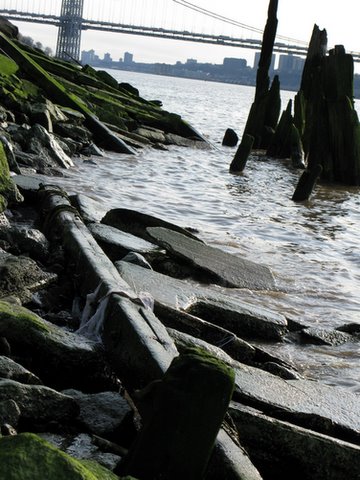
Did this sidewalk wash ashore, or did it just collapse? In either case, we weren’t expecting to see it.

This was the first attempt at the George Washington Bridge, which as you can see didn’t quite work out. We’re not sure why they put it here.
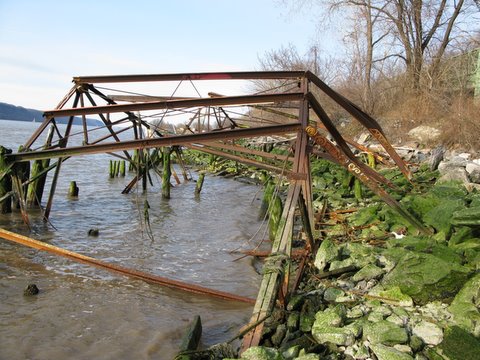
Another view of the discarded “first draft” of the GWB. More importantly: who took the time to paint patterns on the rusted beams?
Filed under: Architecture, Capitalism, Communism, Decay, GWB Project, History, Infrastructure, Landscape, Photography, Ruins, Technology, The Gay Recluse | Leave a Comment
Tags: Carcass, Green, Hudson River, Nasty Algae, Pilings, Rust, Sidewalks, The George Washington Bridge
In which The Gay Recluse scores selected opinion pieces in The Times.
Gail Collins/A Catered Affair
The Short Version: Paterson should have left his wife at home.
In her words: “Everybody knows there’s only one revenge affair to a customer.”
Score: A- (Amusing)
We began this column a bit fearfully, but gradually succumbed to Collins’ witty take on the Paterson follow-up to the Spitzer debacle.
Timothy Egan/Donner Party Democrats
The Short Version: Ye Olde Democrats: Why hath thou not finished thine primaries yet? (I’m hilarious!)
In his words: “The original Donner Party made history for one reason: by eating their dead. Cannibalism — it was all they could do to stay alive.”
The Score: D-(Deadly)
We guess this is supposed to be funny, but any humor is of the sad and unintentional variety: “He was joined by a grizzled old cuss named Cheney.” (We are reminded of the painfully unfunny “Law Revue” musical they used to put on every spring at our law school.) So stupid. Wtf. When Bob Herbert retires goes on vacation, we wish The Times would hire someone decent to replace him: Dan Savage is the obvious choice.
Filed under: Capitalism, Communism, Conspiracy, Government, Politicians, The Gay Recluse, The Times | Leave a Comment
Tags: Cannabalism, Cheney, David Paterson, Democrats, Donner Party, Eliot Spitzer, Gail Collins, Law Revue, The New York Times, Timothy Egan
In which The Gay Recluse updates his informal but rather telling quantitative analysis of Modern Love, the weekly Style Section (of The Times) column in which openly gay writers almost never appear, and even less frequently describe a romantic relationship.
This week’s piece: Mom, It’s Me, Your Son, Finally
Subject: A man in mid-life crisis tries to come to terms with a hateful but lonely mother as he visits her grave site. For our gay alternative, click here.
Filed under: Straight Man on Family
The updated tally (or why we feel like animals in the zoo): 6 out of 171 columns by openly gay writers; 1 out of 171 on female gay relationships; 0 out of 171 on male gay relationships. In what is arguably the “gayest” section of The Times, more women have written about gay men than gay men have.
Outstanding question to Daniel Jones, editor of Modern Love: WTF?
Straight Woman on Relationships iiiii iiiii iiiii iiiii iiiii iiiii iiiii iiii (39)
Straight Woman on Family iiiii iiiii iiiii iiiii iiiii iiiii iiiii (35)
Straight Woman on “Looking for Love” iiiii iiiii iiiii iiiii iiiii iiiii iii (33)
Straight Woman on Breaking Up iiiii iiiii iiiii iiiii iii (23)
Straight Man on Relationships iiiii iiiii i (11)
Straight Man on Breakup iiiiii (6)
Straight Woman on Gay Men iiiii i (6)
Straight Man on Family iiiii i(6)
Straight Man on “Looking for Love” iiiii (5)
Gay Man on Family ii (2)
Gay Woman on Relationship i (1)
Gay Woman on Family i (1)
Gay Man on Self-Hatred i (1)
Gay Man on Prom Date i (1)
Ambiguous/Nurse on Drugs i (1)
Filed under: Dissonance, Infrastructure, Pessimism, Resignation, Search, Stereotypes, The Gay Recluse, The Times | Leave a Comment
Tags: Daniel Jones, Fashion & Style, Gay Modern Love, Modern Love, Stereotypes, The New York Times
In which The Gay Recluse provides a gay alternative to this week’s Modern Love offering in The Times.
Mom, It’s Me, Your Gay Son, Finally
By PETE MacDONALD and THE GAY RECLUSE
Published: March 22, 2008
A YEAR after my partner Alan left me, and on the day before my estranged mother would have turned 77, I was flying into San Francisco for work. I had been back to the city many times since my childhood, but never in such a state of grief and confusion.
My “marriage” had ended suddenly—brutally even, given that there was a (much much) younger man involved—and while Alan and I were getting along well enough now, I had finally acknowledged that reconciliation was not an option. But I was still deep in an existential crisis: I hadn’t expected at age 49 to be asking once again, “Who am I?”
As the plane descended through a white bank of clouds to offer a view of the city, I gazed upon my old neighborhoods, the catastrophes of my youth as familiar to me as if I had just watched them on YouTube.
Decades before, when I was a 15-year-old juvenile delinquent, I was sent away from San Francisco. Returning as a lawyer, I noted how far I appeared to have come – at least superficially – from the chaos and distress of my youth, yet I suddenly knew that all of those old urges remained inside of me, more latent than extinct.
As much as I hated to admit it, I still felt as alone and alienated as I did when my divorced parents, unable to agree on much of anything, found common ground that summer of 1973 and turned me over to the juvenile authorities of the State of California. I had been arrested for LSD possession and was, admittedly, completely out of control. Had it been ten years later, there’s little doubt I would have been exposed to HIV, and in all likelihood would not be alive to write about this now.
As I got into my rental car, the afternoon was somber and gray, but the horizon was nevertheless infused with the soft, warm light of early autumn. I had intended to head straight to the city, but as I pulled onto the 101 and headed north, I “remembered” it was my mother’s birthday – funny how we block these things out – and felt compelled to visit her grave.
My mother died a couple of months after my 24th birthday, when I was living in New York City, trying to become the next New York Doll. Things had not been good between us for a long time. I don’t remember sending her so much as a single card in the five or six years before her death. I never called her.
Now, I owed her a visit.
I took El Camino Real into Colma and stopped for a bouquet at a flower shop, located in the middle of several cemeteries. I drove around, unable to remember which was my mother’s. Finally, a helpful employee asked the right question (“Was your mother Jewish?” “No, Catholic.”) and pointed me in the right direction.
The receptionist there looked up the location — Section U, Row 47, Grave 22 — and gave me a map with the route highlighted in yellow. It occurred to me that I was on a treasure hunt, a thought that however perverse at least distracted me from the adrenaline of what I suddenly suspected was going to be a long-overdue confrontation.
My mother was in the cheap section, far beyond the spires and mini-architectural wonders at the bottom of the hill. In the past this had embarrassed me, but I was now glad that her spot was clean, unadorned by what I saw were the gaudy trappings of the rich. I parked and walked gingerly along the row of graves to where, on a characteristically sunny mid-February morning a quarter-century earlier, my two brothers and I had buried her. At the time, the brightness of the day had seemed to represent closure: I remembered expressing relief that her troubled life was finally over.
My father left my mother when I was 11 (and my brothers were 12 and 8), on the first Saturday after the school year ended that June. We were at our grandmother’s house for the weekend.
When we returned, our mother was waiting at the front door wearing only her slip, looking crazed. “Your father left me,” she said as we approached. “He says he doesn’t love me. He says he’s never loved me. And you know why? He’s a faggot! And now you have to choose who you want to live with. I want to know right now!”
Later I learned that she had tried to overdose on pills the day before. In the following years this threat of suicide would become fairly common. “I’m going to kill myself,” she would say to us every few months. “And none of you little faggots can stop me.” That’s what she called us – and to be fair, many others – at her most deranged, and if it hurt me a little bit more than my brothers, I wasn’t about to tell anyone why (and especially not my father, who I hated just as much as my mother did, and probably even more, knowing exactly what I had inherited from him).
Her occasional attempts, always with pills, were surely aimed more at getting attention than actually killing herself, but it took me several years to understand the modus operandi of a true drama queen. Before this realization, each instance thoroughly terrified me, especially the time I was the only one home to try to stop her.
Over the last year, in the wake of the disintegration of my relationship with Alan, I had contemplated a kind of passive suicide myself. Many times, as I took long walks around my Seattle neighborhood, I hoped I would be the accidental point-of-impact of a car gone out of control, or the target of a mistaken-identity drive-by shooting. I went to sex clubs for the first time in decades and groveled for the affection of strangers.
Standing at my mother’s grave, I felt guilty about this, but didn’t know why. My body cast a shadow over the grave like a blanket placed there for a picnic. There were no other visitors, no gardeners, no gravediggers. All I heard were the bumblebee drone of a small plane and the wind in the eucalyptus trees that bordered the cemetery to the east.
“Happy birthday, Mom,” I said somewhat ridiculously, but then realized I had effectively broken the tension. I was not going to scream at her, after all. I looked away, my eyes following the path of the plane as it disappeared beyond San Bruno Mountain, which hovered over all those Colma cemeteries. At this time of year they were barren and brown and awful, as dead as the dead.
It occurred to me that my mother and I had not been alone together in more than 30 years. I was 16 the last time, released on a half-day pass from juvenile hall so she could take me to buy clothes. The following day I would fly to Los Angeles, to the boys’ home where I would live until I turned 18. I had run away from the first home I had been sent to, an outpost run by a pair of alcoholics in the hills east of Healdsburg, and then turned myself into juvenile hall after taking a near-fatal overdose of Nembutal after turning a trick with sadistic lawyer from Albany. (I wish I was joking.)
The half-dozen times I saw my mother after that – although I never came out to her – I always brought a friend. At the time I felt that I did this to keep her baser instincts under control, but I now think it was to check my own: I had good reason to want to kill her, but hadn’t yet come to terms with why. Even after she died, I couldn’t face her alone: the few times I had been to her grave, I was accompanied by someone: Alan, a friend or my daughter.
I put the flowers at her headstone, kneeling and cleaning out the little stone cups on either side that were designed to accommodate small vases. It took me years to understand and appreciate how difficult her life had been and to realize that the trouble was not that she was weak or mean-spirited or even homophobic – although she certainly was all of those things – but that more than anything else, she was mentally ill. As a public defender, it’s one of the lessons I have learned from working with my clients, whose problems are often alarmingly similar. It only now occurred to me that for all these years – on some psychological level – I had been defending my mother as much as my clients, and for the first time I was beginning to understand why.
The last time I spoke to her she was so drunk that I could barely make out her words. She slurred something about cussing out a cop who had stopped her on the highway. Sitting alone in the drafty hallway of my Lower East Side apartment, I held the phone at arm’s length, saying every minute or so, “Yeah, mm-hmm,” until I couldn’t bear it anymore and hung up.
A few weeks later, my older brother called in the middle of the night to say she had died of heart failure as she pulled out a hideaway bed for my visiting sister-in-law.
Cleaning out her apartment with my brothers, I found a journal she had kept during her last year. I flipped through the pages, reading inconsequential entries written in a scribble that only vaguely resembled the elegant handwriting I had known from my childhood. I came across an entry from around the time we had last spoken, when I couldn’t listen to her. It was written in pencil, as if one day she might erase it if her life changed for the better. It said: “I am so lonely.”
I don’t believe in ghosts, or in the notion that my mother is in heaven or hell. But that day in the cemetery, I felt her with me as I wept in the afternoon sun, which now seemed more warm than brittle. Even so, after telling her about my recent troubles, speaking aloud to her felt more like speaking to the grave itself, or to the air. Increasingly self-conscious, I started to walk away. But something drew me back, perhaps simply my need to come to terms with the hollowness and unease – and most of all, the depths of anger – that had always pushed me away.
And standing by her once again, I remembered something I had not thought of in many years. When I was little and my mother was feeling good, she would tell the story of how she’d had German measles when she was pregnant with me. Her doctors believed there was a high likelihood that I would have serious birth defects, and they advised her to have an abortion. But she wouldn’t hear of it. She told them she knew I’d be a beautiful, healthy child, full of spirit, someone who would make the world a better place. She would kiss me while telling me this story, her eyes smiling, full of love, the kind of tenderness that, in her later years, would resurface only rarely, reminding me always of what we had lost.
I knelt upon her grave, placing my hands in the grass, my fingers spread wide so as to touch as much of the earth above her as possible. I knew then why I had come, and why I had been unable to leave before that moment. For the first time, as I compared the vision of what she had been to what she later became, I understood that she, like all of us to some degree, had been crippled by the pain of life. That it had been a psychological condition only made it that more difficult to comprehend. As my anger finally began to dissolve like a giant block of ice tossed into a raging sea, I not only began to forgive her for being so hateful, but myself for hating her back in return.
I STILL had one more stop. Until my parents’ separation, we lived in Daly City, just south of San Francisco. Ours was a small house on a hill overlooking the Pacific Ocean, with hundreds of acres of undeveloped land as our backyard. The beach was a half-mile walk on sandy paths that wound through ice plant and wind-battered forest. It was where my friends and I had gone to play.
The drive there took less than 15 minutes. I parked in front of our old house and got out, smelling the salt air and sage that were a constant presence in my youth. The sun was an hour from setting. The street was quiet. Memories no longer swept over me in a torrent, but in clusters; the sky was clearing.
I stood on the sidewalk where my father – a future casualty of AIDS, which is another story – and I had played countless games of catch, and on the spot where I had first kissed another boy on a beautiful afternoon just like this. For nearly an hour, as the sun bled into the horizon, shining a russet light over the still-wild hills, I stood before that house and yard, watching myself between ages 4 and 11, playing and dreaming before it all went bad; I was oblivious but full of hope and belief, my actual future unfathomable.
I had already said goodbye to Alan. I had finally managed a proper goodbye to my mother. It was time to say goodbye to that boy, too.
I was ready then for the five-mile drive into the city.
Pete MacDonald is a public defender in Seattle. He is working on a novel.
Filed under: Dissonance, Landscape, Language, Longing, Memory, Search, Sickness, Stereotypes, The Gay Recluse, The Times | 4 Comments
Tags: Anger, Daniel Jones, Drama Queens, Fashion & Style, Forgiveness, Gay Modern Love, Pete MacDonald, Psychology, Redemption, Stereotypes, The New York Times
In which The Gay Recluse photographs birds.
Hmm…what kind of bird is this? (We need to do some homework.)

Hi everyone! What kind of birds are you? You kind of look like seagulls. (Omg! Is that an insult!?)

Sometimes you just want to be left alone.
Filed under: Animals, GWB Project, Infrastructure, Longing, Search, The Gay Recluse | Leave a Comment
Tags: Birds, George Washington Bridge, Homework, Seagulls
In which The Gay Recluse rather quickly gets lung cancer.
Time and date of morning photograph: March 21, 2008, 7:54am.
Time and date of evening photograph: March 21, 2008, 7:34pm
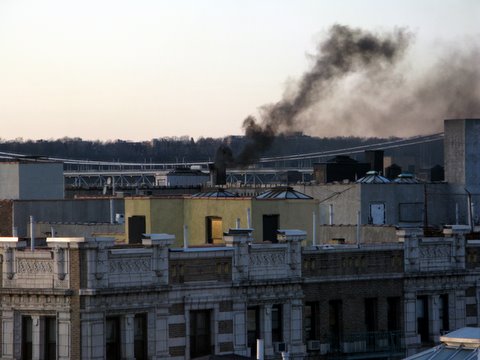
The oily black smoke of 100-year-old boilers disperses daily across the rooftops in Washington Heights, heedless of those who suffer from pneumonia, asthma and tuberculosis. Officials and politicians? Not even footnotes in this story, which is about the aggregation of capital and the relentless rise of the metropolis.
–The Gay Recluse, 9/29/07
Filed under: Architecture, Capitalism, Communism, Government, GWB Project, Health, Pessimism, Photography, Sickness, The Gay Recluse, Washington Heights | Leave a Comment
Tags: 311, Asthma, Boilers, Exhaust, Lung Cancer, Rooftops, Tuberculosis
In which The Gay Recluse becomes increasingly obsessed with The George Washington Bridge.
Time and date of photograph: March 21, 2008, 7:54am.
Notes: The blue sky, almost completely windswept.
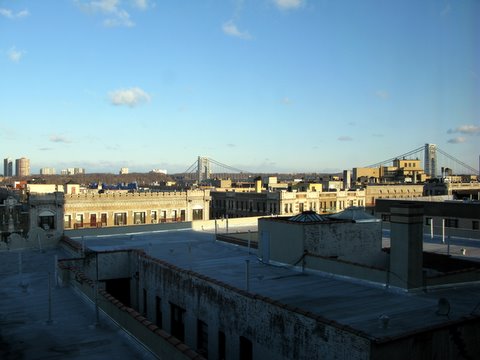
“I, too am obsessed with the George Washington Bridge, and have been ever since as stoned youths me and my friends cavorted in the park on the New Jersey side that is directly below the place where the roadway meets the land. We were convinced that the Bridge is the largest thing in the world. For a true enthusiast such as yourself, I strongly recommend a stroll across the span, and then a picnic lunch along the walking paths underneath. Disclaimer: individual results may vary; inebriants are recommended to enhance the forcefulness of the desired optical effects.”
– Steve, 2008.
Filed under: Architecture, Capitalism, GWB Project, Search, Technology, The Gay Recluse | Leave a Comment
Tags: 2008, Blue, George Washington Bridge, March, Morning Light, Steve
In which The Gay Recluse promotes remembrance of things past.
Today we received this letter from reader Steve in Manhattan:
I, too am obsessed with the George Washington Bridge, and have been ever since as stoned youths me and my friends cavorted in the park on the New Jersey side that is directly below the place where the roadway meets the land. We were convinced that the Bridge is the largest thing in the world. For a true enthusiast such as yourself, I strongly recommend a stroll across the span, and then a picnic lunch along the walking paths underneath. Disclaimer: individual results may vary; inebriants are recommended to enhance the forcefulness of the desired optical effects.
Thanks, Steve! We encourage everyone to follow your advice and get in touch with their inner GWB. It is truly awesome to behold, and preferably on a regular basis! [Note to readers: If you have a sweet pic of the GWB, send it our way along with a note and we’ll be happy to post; or if you find something you think is larger — in the admittedly subjective sense of the word — send that along and we’ll post that, too.]

We always suspected it was the best bridge in the world. Now, thanks to Steve, we suspect it’s the largest thing in the world, too.

Faites attention! The extreme beauty of the GWB is like a true siren of yore: in its presence, many great heroes have lost their bearings.
Filed under: Architecture, GWB Project, Infrastructure, Letters, Memory, Photography, Pleasure, The Gay Recluse | 3 Comments
Tags: Drugs, New Jersey, Parks, Paths, Picnics, Readers, Stoners, The Gay Recluse, The George Washington Bridge, Walks, Youth
In which The Gay Recluse scores selected opinion pieces in The Times.
Paul Krugman/Partying Like It’s 1929
The Short Version: We’re fucked, the only question is exactly how much.
In his words: “The financial crisis currently under way is basically an updated version of the wave of bank runs that swept the nation three generations ago.”
Score: B- (Boring)
Krugman’s made this point continually over the past few years months, so we’re not sure why he writes as if we’re all just meeting him for the first time. A little less dumbing down — e.g., “To grasp the problem, you need to understand what banks do” — would also be nice.
David Brooks/Thoroughly Modern Do-Gooders
The Short Version: Who needs government when you have social entrepreneurs!
In his words: “Earlier generations of benefactors thought that social service should be like sainthood or socialism. But this one thinks it should be like venture capital.”
The Score: D (Disingenuous)
Although we almost never disagree with anything these so-called social entrepreneurs are doing — helping single moms, increasing literacy, etc. — we still get the sense that they are flourishing as a consequence of bad government, not all government, as Brooks implies. The other annoying thing about this column is that it’s a total repeat of what Kristof wrote on social entrepreneurs two months ago; basically, Brooks could have written his in one sentence: “What Kristof said in January — gotta run, see you next time!”
Filed under: Drivel, Gentrification, Government, Politicians, The Gay Recluse, The Times | Leave a Comment
Tags: Copying, Crash, David Brooks, Depression, Economy, Nicholas Kristof, Paul Krugman, Social Entrepreneurs, The New York Times
In which The Gay Recluse watches the sunset, craves a gin-and-tonic and converses with a higher power.
Time and Date of Photographs: 7:15ish, March 20, 2008
Notes: All sunset photos are inherently cheesy — obviously — but sometimes we have to get in touch with our inner tourist.

God: Don’t let your youth go to waste!
Us: Ughh — it’s too late! We’re turning “30” next week!!!

God: Do you like Netflix?
Us: Yes!!!

God: What’s up with that shitty-looking building on the left (I mean, right)?
Us: Good question!! It costs a lot of money to live there!!!
Filed under: Architecture, Capitalism, Conspiracy, Gentrification, New York City, Photography, The Gay Recluse | Leave a Comment
Tags: Birthdays, Gin and Tonic, God, Jonathan Richman, Middle Age, Netflix, New Jersey, Sunsets, Youth
In which The Gay Recluse rather quickly gets lung cancer.
Time and Date of morning photograph: March 20, 2008, 6:54am.
Notes: One benefit of living in Washington Heights is that it’s truly like the 19th century, not only in the architectural grandeur that splays across the rooftops, but the daily emissions of 100-year-old boilers in apartment buildings owned by slumlords who exist completely outside the purview of city government.

Time and Date of evening photographs: March 20, 2008, 6:54pm.
Notes: Usually the exhaust in intermittent, but today this one was pretty much constant. Rest assured that nobody will do anything about it.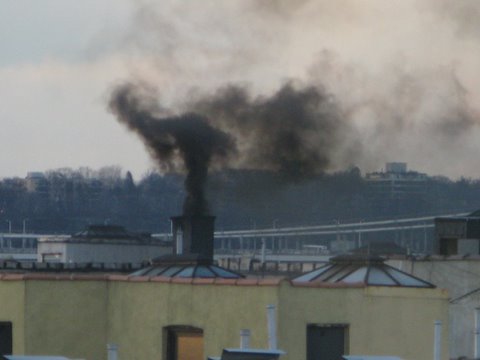

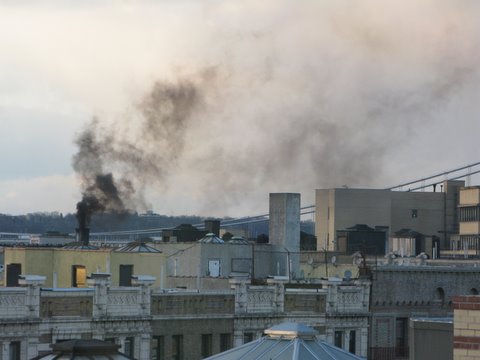
The oily black smoke of 100-year-old boilers disperses daily across the rooftops in Washington Heights, heedless of those who suffer from pneumonia, asthma and tuberculosis. Officials and politicians? Not even footnotes in this story, which is about the aggregation of capital and the relentless rise of the metropolis.
–The Gay Recluse, 9/29/07
Filed under: Architecture, Capitalism, Conspiracy, Decay, Government, GWB Project, New York City, Resignation, Sickness, The Gay Recluse | Leave a Comment
Tags: 2007, Asthma, Boilers, George Washington Bridge, Gray, March, Morning Light, Pneumonia, Slumlords, The Gay Recluse, Tuberulosis, Twilight
In which The Gay Recluse becomes increasingly obsessed with The George Washington Bridge.
Time and Date of morning photograph: March 20, 2008, 6:54am.
Notes: Seriously, don’t these clouds look a little “Poltergeisty”?

Time and Date of evening photograph: March 20, 2008, 6:54pm.
Notes: We appreciate the black smoke, which is so good for our asthma.

“The George Washington Bridge over the Hudson is the most beautiful bridge in the world. Made of cables and steel beams, it gleams in the sky like a reversed arch. It is blessed. It is the only seat of grace in the disordered city. It is painted an aluminum color and, between water and sky, you see nothing but the bent cord supported by two steel towers. When your car moves up the ramp the two towers rise so high that it brings you happiness; their structure is so pure, so resolute, so regular that here, finally, steel architecture seems to laugh. The car reaches an unexpectedly wide apron; the second tower is very far away; innumerable vertical cables, gleaming against the sky, are suspended from the magisterial curve which swings down and then up. The rose-colored towers of New York appear, a vision whose harshness is mitigated by distance.”
– Le Corbusier, When the Cathedrals Were White, 1947.
Filed under: Architecture, Capitalism, Communism, Decay, Disease, GWB Project, Resignation, Ruins, Sickness, The Gay Recluse, Washington Heights | Leave a Comment
Tags: 1947, George Washington Bridge, Gray, Le Corbusier, March, Morning Light, Poltergeist, Twilight
In which The Gay Recluse holds a contest. Sort of.
For those of you who haven’t heard of it, Los Angeles is kind of like New York City except it’s in California, and instead of subways you have to drive everywhere! Crazy, right? But that said, like New York City, there are LOTS of gay men there, so we were very pleased to receive our first official entry from L.A. resident Will who writes:
I am attaching photos from a recent trip to the Getty Villa in Los Angeles. The statues are in a quasi-public place since it is free to get into the Getty Villa museum, you just have to make a reservation for timed tickets to visit (see http://www.getty.edu/visit/). Hope you enjoy them.
Let’s check out ’em out:
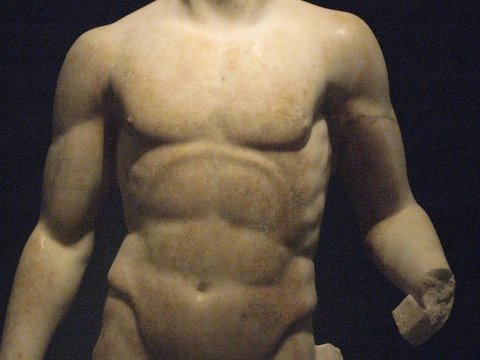
Uhh, yeah. We’d say that pretty much qualifies.

Here we have (in duplicate) a traditional shot of a pitcher and a catcher. (H-O-T!)
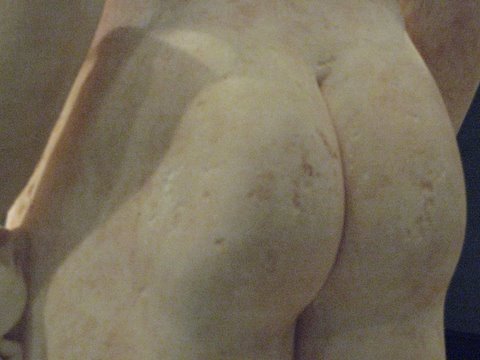
What more can we say? Gay. Naked. Smokin’ hot. It’s official: Los Angeles is now in serious contention.
Nicely done, Will! You should seriously be a hero to the millions of gay men who live in Los Angeles, who unlike those in so many other cities in the United States have yet to submit a single hot gay statue. (That said, it’s not too late!)
Finally, Will asked us to post the following, and given his smokin’ hot submission, how could we refuse?
I also wanted to share a video I made with some friends and posted on YouTube this week. It would be excellent if you shared it with your readers. Even though it relates to immigration, there is a gay angle since it was written, directed, and performed by gay men. (http://www.youtube.com/watch?v=-30BZtpvaTY)
We enjoyed this. It has a 1980s goofball-comedy quality to it that’s very charming, even as it makes a good point about how archaic our immigration system is.
- Rules and Guidelines
- Dan Savage Endorsement
- Washington Heights (New York City)
- Washington, DC
- The London Eye Clarifies an Important Issue
- Florence (Italy)
- The Park Avenue Amory (Upper East Side/NYC)
- Murray Hill (New York City)
- Madrid (Spain)
Filed under: Architecture, Competitions, Gay, Hot Gay Statues, Infrastructure, Landscape, Law, Letters, Longing, Obsession, Ruins, The Gay Recluse | 1 Comment
Tags: Gay Statues, Hot Gay Statues, Immigration, Los Angeles, The Getty Museum


 The Gay Recluse