We turn again to New York Times critic Edward Rothstein — who today wrote about the “irrelevance of gayness” with regard to the fictional wizard Albus Dumbledore –and shake our heads in wonder and dismay: how did such an arrogant, presumptuous blockhead get a PhD? a job with the Times? We must conclude that it was through favors and friends, and recommend that not another minute be wasted over the scribblings of such a shallow mind.
For to read through his past columns is to become quickly angry and depressed, as it becomes clear that in Rothstein’s world, to be gay or “homosexual” (his regular use of the word as a noun a symptom of his larger problem) is to be inferior or “diminished.” So with regard to Dumbledore, he writes: “The question is distracting, which is why it never really emerges in the books themselves. Ms. Rowling may think of Dumbledore as gay, but there is no reason why anyone else should.” This — again — is the line typically used by inept historians who in their attempt to avoid the truth ask why it even matters if say, Lincoln or Washington or Melville or Hawthorne slept with men, as if it were the equivalent of learning that they had a longstanding appreciation for chocolate cake.
Or you can turn to Rothstein’s 2002 column, in which he asks: “Is There a Gay Basis To Nietzsche’s Ideas?” The short answer, he tells us, is yes, there is overwhelming evidence that Nietzsche was in fact — like us! — a gay recluse, but is this a good thing? Noooo. It leads Rothstein to conclude: “Is it possible, after so long serving as a prophet of dismantlement, that Nietzsche has become just such an idol himself? Are his ideas now entering their own twilight? And don’t they gleam with too inhuman a light? If so, Mr. Köhler’s book may be seen as an attempt not to diminish Nietzsche but to restore him to daylight and perspective, showing that beneath his posturing and prophecy, Nietzsche was, to use one of his own phrases, ‘human, all too human.'”
Reading such blather, can you not see Rothstein trembling in the face of this “inhuman” philosophy, which as anyone who has read more than a sentence or two can attest is infused with the turbulent, demented energy of obsessive (i.e., homosexual) longing? This is what gives Nietzsche his destructive power, and in this age of religious zealotry, his power is hardly diminished for having been gay (to the extent we can apply the label retroactively, by which we mean his desire to have sex with men). Rather, his homosexuality is an inspiration to all serious thinkers who profess the same desire to dismantle the moribund systems of our own times; Rothstein is so far removed from this that he cannot even write about a gay wizard without obscuring the truth.
Filed under: Drivel, Gay, Obsession, Philosophers, The Times, Writers-German | Leave a Comment
Tags: Albus Dumbledore, Edward Rothstein, Gay, Nietzsche, Schopenhauer
In today’s Times, we are told by critic Edward Rothstein with regard to Albus Dumbledore that the question of the wizard’s “gayness” is “irrelevant” and “distracting” given the character’s later vows of celibacy and his more high-minded efforts to save the world. Here we have a perfect example of the sort of tepid, mediocre and ultimately prim (bourgeois) analysis that has come to typify so much of The Times, particularly since the phasing out and eventual death of Herbert Muschamp (for whom gayness, we might add, was never irrelevant).
Nor is this a harmless exercise in self-delusion! All one has to do is scan the barren desert of post-war American literature to understand how misguided and ultimately destructive Rothstein’s analysis is for its refusal to acknowledge a fundamental truth of the human condition (and the implications of this truth), which is that sexual desire informs every aspect of our development, particularly when such desire is prohibited or censured (as it always it with gay desire). For those willing to open their eyes, we can see this force manifest itself in ways both disturbing (e.g., Hitler) and inspirational (e.g., Abraham Lincoln). (And yes, we choose historical figures for a reason.)
The critic of substance never loses sight of the fact that the world is filled with an obsessive desire, which — and whether we give in to it or not — bends our minds and shapes the fabric of our daily interactions, not to mention the ultimate trajectory of our lives. For Rothstein to claim that these forces are “irrelevant” — even (or especially) in a fictional context — is to describe a world as uselessly fantastic as the one in which our contested wizard was so unfortunately doomed to inhabit.
Filed under: Drivel, Gay, History, Obsession, The Gay Recluse, The Times, Writers-American | 1 Comment
Tags: Albus Dumbledore, Criticism, Edward Rothstein, Fiction, Gay, History, The Times, Writing
Like Ann Coulter, the ailanthus tree is noxious, unsightly and invasive, and can be found almost everywhere in the United States, not only in vacant lots and highway meridians, but in once pristine forests, where it wreaks havoc on local ecosystems. It does not favor diversity or nuance, but — and with just the most trace amount of nutrients — manages to endlessly replicate, with no regard to the more sensitive and robust beauty offered by the species it so mercilessly replaces.
In the past we have tended to view this tree with nothing but disdain, wishing that we could wave a magic wand and erase it from the landscape. But now we are not so sure; at this time of year, there is a vermilion tone in its autumn leaves that speaks to us of fire and the certainty of death. It reminds us that no matter how much we wish to think otherwise, in this final result we are all the same.

Correction: A kind reader possessing serious qualifications in the science department (obviously this was not Ann Coulter) wrote to us and pointed out that the tree featured in the photograph is in fact a sumac (Rhus sp.), a relative of the ailanthus. The sumac is a native species, whereas the ailanthus is orginally from Asia (both are commonly found in vacant lots and on highway meridians); the leaves of the smaller sumac turn red, whereas those of the ailanthus become a “rather bland yellow” (our reader’s most excellent characterization). What — if anything — this means to the above analysis we will leave to speculation (and beg your indulgence in our poetic license), but we do appreciate the comment/clarification. For more information on the two species, click here.
Filed under: Drag Queens, Landscape, Resignation, Sickness, The Autumn Garden, The Gay Recluse, Washington Heights | Leave a Comment
Tags: Ailanthus, Ann Coulter, Bronx Tree, Death, Fire, Invasive Species, Vermilion
In a profile included in this month’s Poets & Writers Magazine, Benjamin Percy — a young American genius said to have written the “story of the year” in 2006 — tells us: “I am interested in this new masculinity in today’s society, what distinguishes us as men and as women besides our biology. No longer do men head off into the wilderness to slaughter large animals. No longer do women stay home and tend to the fire and the vittles. It’s more about, I don’t know, going to the gym and lifting so many weights that your veins rip out of your skin like pencils and your muscles are the size of softballs. It’s not earned muscle in that way but why are you doing it? You do it to sort of remember what it used to be to be a man.”
By way of contrast we next turn to an extract from Alan Hollinghurst, the British author of the The Swimming Pool Library: “[Bill, a boxing instructor] was looking forward then, building up his body like a store, a guarantee of his place in the future. Now [twenty or thirty years later] the future had come [and] he still hoarded and packed it. It sat opposite me, massive, gathering bullishly at the shoulders, the open shirt showing a broad V of black hair, the thighs splayed ponderously on the slashed and stitched upholstery of the banquette. I knew I could never love it or want it, but it was an achievement, this armor of useless masculinity.”
Filed under: Drivel, Gay, Literature, Sickness, Writers-American, Writers-British | Leave a Comment
Tags: Alan Hollinghurst, Benjamin Percy, Masculinity, Refresh Refresh, Swimming Pool Library
On Autumn Dreams
In winter we had no dreams; it was too cold to consider anything but the brittle landscape outside and the frozen tributaries of our past within. In spring we were nervous and agitated, our thoughts scattered like cherry-blossom petals in the wind. Summer came and we were boldly confident, perhaps even arrogant; who could not succumb to the magical allure our our dreams? Soon we would be crowned king of the world! But now it is autumn: the streets are damp and the sky is gray and heavy; our dreams are vague and distant, specks of fading light on the horizon. We resign ourselves to dim afternoons and dead nights, filled with only the soft whisper of turning pages.
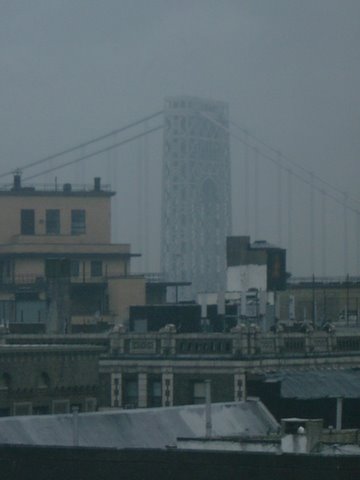
Filed under: Dream, Landscape, Resignation, Washington Heights | Leave a Comment
Tags: Autumn, Books, Dreams, Fog, George Washington Bridge
On Albus Dumbledore
Last night at the midtown bistro ______, we were pleased to find Des Esseintes at the bar, his thin hand clutched around a tumbler of amber-colored liquid. We asked about this, and he confirmed it was a single highland malt from the ____ distillery, which he had long professed to be the most burnished yet penetrating of all the whiskeys offered by the establishment (a number said to exceed 200).
We joined him for a round, and then another, and were well into a third when there was a disturbance at the front entrance. The long velvet drapes were pushed aside to make way for a thin, bedraggled old man who suddenly appeared, his frantic expression oddly disturbing as the tranquil murmur of the room gave way to a moment of stunned silence; behind him we detected shouts and white flashes issuing forth from what we had to assume was a mob of paparazzi and reporters, all of whom were thankfully barred from coming in.
“Who is that?” we asked absently — perhaps even rhetorically — as we observed the harangued man walk with restored composure to the bar, where he sat down and removed his hat.
“You really don’t know?” Des Esseintes raised an eyebrow as he addressed us. “Vraiment pas?”
“Am I supposed to?”
“That depends — it’s Albus Dumbledore.”
We looked a little closer. Having ordered a drink, he was now smoothing down a long white beard that could only be described as “wizardly,” but none of this triggered any spark of recognition. “Sorry, no clue.”
Des Esseintes signaled the bartender for a refill. “Don’t worry about it,” he shrugged. “He was a professor or a scientist or something — I think the story is that he made a lot money in a tech start-up in Silicon Valley or something tedious like that.”
“So why the hordes outside?”
“When he died he gave all of his money to the opera,” Des Esseintes laughed a bit ruefully. “It was supposed to have been anonymous — like those of us from a certain era, he did not care to envision his name written on the parterre — but management is now insisting that he walk the red carpet for their next premiere.”
Filed under: Drag Queens, Dream, Gay, Opera, Writers-British, Writers-French | Leave a Comment
Tags: Albus Dumbledore, Aristocracy, Opera, Paparazzi, Whiskey
One day on the street in Washington Heights we passed an old man who invited us into his garden. Though barely the size of three parking spaces, the garden contained a vast array of unusual trees, including columnar varieties of a blue atlas cedar, a purple beech (the most magisterial of all trees), a Norway spruce, and — most impressively, for it was already 300 feet tall — a dawn redwood. These trees provided a canopy through which only the most dappled light could pass, although apparently this was enough for several species of Japanese maple to thrive, and we spent several minutes admiring the intensely variegated leaves of the most unusual specimen. Nor did we fail to note our appreciation for the delicate ferns and mythic hellebores that populated the lowest regions of the garden, or the Corsican mint that crept so luxuriantly among the crevices of the rocks. In the center of it all stood a single white birch, the golden leaves of which — for by this point it was already October — fell around us like snowflakes.
When we expressed the depths of our admiration at this display, the old man nodded. “I will give it all to you on one condition.”
“Anything,” we said without a thought.
“You must pick up each of the million twigs and leaves that fall each season, so that the bricks will stay clean and the moss will not be too invasive.”
“That doesn’t sound like much,” we responded, still eager to take him up on the offer.
He laughed somewhat wryly. “Yes, well — neither does life for the first hundred years,” he shrugged. “But when the second hundred arrive, you will know the meaning of both tedium and eternity.”

Filed under: Dream, Longing, Resignation, The Autumn Garden, The Gay Recluse | Leave a Comment
Tags: Art, Beech, Blue Atlas Cedar, conifers, Dawn Redwood, Gardens, Hellebores, Life, Norway Spruce
Here we take offense with Andrew Sullivan‘s unthinking assertion that “[f]or all his many faults, [Rudy Giuliani] turned a city around.”
Rather than rebut this ourselves, however, we turn to the infinitely more eloquent and compelling words of Herbert Muschamp, who sadly is no longer with us to tell the truth, which resonates in ways that we hope Sullivan — a gay intellectual, after all — might consider in the future:
“More than 80,000 New Yorkers have died of AIDS so far, according to city figures. That number represents more memory than a city can afford to lose. It stands for the collective memory of an audience – the seasoned gay audience, perhaps the most culturally receptive group any city has ever seen.
Early on in the AIDS crisis, the city registered the cultural impact caused by the loss of gay artists. The effect produced by the loss of the gay audience is more insidious, however. An audience retains the memory of a performance. What happens to that memory when the audience is gone?
Imagine the World Series without veteran sports fans. You could still fill the stadium. The crowd would still roar. But a certain resonance would have vanished, the vibrations of a social instrument devised for the precise purpose of detecting a historically outstanding performance. How could this instrument function without a data base of past scores?
Now imagine that the game is a great city. What happens to a city when it loses reliable points of comparison with exceptional moments in its past? A void occurs, and before long, the vacuum starts to fill up with myths of dubious worth. The fantasy that Rudolph W. Giuliani ‘saved’ New York becomes conventional wisdom. The corollary fable that the 1960’s and 70’s were the nadir of New York’s existence…”
Filed under: Drivel, Gay, Infrastructure, Memory, Sickness | Leave a Comment
Tags: Andrew Sullivan, Giuliani, Herbert Muschamp, New York City
On One Important Difference Between Pets and Children and What It Tells Us About U.S. Foreign Policy
Let’s assume for the sake of argument that we have two couples, roughly similar in every indicator of socioeconomic status, and that money is not a determinative factor in this hypothetical. Let’s also assume that both are offered the opportunity 1) to have (or adopt) a child, or 2) to adopt a pet. A further condition is that the choice of one will preclude the other, which is to say that this is a one-shot deal, i.e., never again will our hypothetical couples be given the chance to add to their families, and there will be no “test-run” with a dog or cat in advance of having a child (although we heartily endorse the idea in principle, so long as the pet is not tossed onto the street or made to suffer any greater indignity than a demotion to second-class citizen).
Now, let’s say that “Couple A” choose the child, and “Couple B” choose a dog. What does this tell us about our respective couples? Couple A can be thought of as optimistic, whereas Couple B can be viewed as pessimistic.
This conclusion is rooted in the understanding that in almost every case, the decision to have a child is accompanied by the expectation — or at least the hope — that barring unforeseen sickness or accident, the child will outlive the parents, whereas the decision to adopt almost any pet — except for certain species of birds, which however much we admire them (i.e., birds) we will leave aside for the moment — must, unless the prospective owners are very old (and in this case we will tell you that they are not), be accompanied by a certainty that — again, barring unforeseen sickness or accident — the pet will die before its caretakers, i.e., no matter how much a pet is loved (and we can attest that many of them are loved very much) and cared for and pampered with gourmet foods and deliciously fishy treats, the day will come when we must close their eyes to the world and consider the stark landscape of our own lives without them.
We note in this regard that lifelong “bachelor” Arthur Schopenhauer, patron saint of all pessimists and — let’s be honest — one of the most formidably bitchy queens of all-time, was extremely devoted to a succession of poodles he owned, and that he bequeathed his estate to disabled Prussian soldiers and the families of those killed in the service of a government fueled by optimism instead of grief.
Filed under: Drag Queens, Gay, History, Pessimism, Philosophers, Writers-German | Leave a Comment
Tags: Children, Ethics, Foreign Policy, Iraq, Pets, Schopenhauer, USA, War
Poets, pundits, philosophers and politicians, take note! This is not the story of nations or other one-hit wonders, nor is it the story of religion, for which so many millions have died in futile anger and delusion. It is certainly not the history of capital, although this too has been a scourge; no, friends, these are distractions from the real story, which is the slow but relentless rise of the city.
Incomprehensible beauty and despair! Inexplicable dissonance and distortion! Inalterable repudiation of all political philosophers and religious zealots who would explain our existence without acknowledging the seething allure of the trains and tunnels, the buildings and bridges of this endlessly mutating labyrinth into which we must cast ourselves to find civilized life!
How sorry and sad — which is to say, irrelevant — are the candidates — which is to say, all of them — who fail to discuss the implications of this truth; how tiresome the critics and commentators who obscure it with egocentric jargon about freedom and community. Is it not immediately obvious who among them has or has not walked the streets, and not only in the tedious safety of the day but in the more barren and remote hours of the night, when we are possessed by creaking gates, distant gunshots and — most of all — the pounding, subterranean space we learn to call our heart?


Filed under: Capitalism, Infrastructure, Obsession, Philosophers, Poets, Politicians | Leave a Comment
Tags: Capital, Civilization, History, Meat Puppets II, Nationalism, Religion, The Cannanes, The City, Walter Benjamin
Although we admire the spirit in which Andrew Sullivan — inspired by Nietzsche’s timelessly apt tirade against moral crusaders — compares America to a “very insecure adolescent” we feel the analogy is nonetheless somewhat off the mark. We by contrast would prefer to compare America to a brittle (but dangerous) old man, unwilling to resign himself to the inevitable fate that awaits us all.
Filed under: Philosophers, Politicians, Resignation, The Gay Recluse, Writers-German | Leave a Comment
Tags: Andrew Sullivan, Morality, Nietzsche, Schopenhauer
On Reagan National Airport
The taxi dispatcher blew his whistle: “Reagan National?” he asked, referring to the airport just outside of the city.
We shuddered visualizing a similar exchange twenty years in the future and the many monuments that would inevitably be erected to honor our current leaders. But as the cab pulled into the circular drive of the hotel, we reconsidered in light of the passage of time, which had been hanging so heavily upon us these past few days.
We wanted to atone for this display of weakness. “If you know,” we asked the man, “can you tell me who or what Reagan was?”
“Of course.” The whistle dropped from his mouth as he explained. “Reagan was a great intellect who five hundred years ago ushered in the Age of Enlightenment. He freed the slaves and invented flight. When he died, thousands upon thousands tore out their hair and gnashed their teeth, all of which — that is to say, the hair and the dust of their teeth — is memorialized in a display case at the airport, just past security in Terminal C but before you arrive at the food court.”
“Thank you for that information,” we said, stepping into the car. “We have been living in a foreign country for some time now, and these historical facts are no longer familiar to us.”

Filed under: Decay, History, Infrastructure, Travel | Leave a Comment
Tags: Airports, Marriott Wardman Park, Ronald Reagan, Spleen, Washington DC
A young runner — perhaps twenty years old — had stopped to stretch at one of the Parcourse installations in Rock Creek Park; it did not take more than a single glance to realize why he looked so familiar. In a short conversation, he confirmed that he had in fact just this year graduated from ____ and was now working at _____, an environmental group with offices on L Street. He planned to go to law school at some point, although when pressed as to exactly why, he confessed to being far more interested in music.
“And do you have a boyfriend?” I asked.
“What makes you think I’m gay?” he responded, though less fearful or angry than genuinely curious.
“You’re not?”
“No,” he said, although in a tone I found too indifferent to be convincing.
I shrugged. “Do you have have a girlfriend, then?”
“No,” he sighed and rubbed his hands together in a gesture I also recognized from long ago. “You’ve told me so little about yourself,” he finally managed.
“What would you like to know?”
He considered me for a few seconds. “Who do you love best: your father, your mother, your sister or your brother?”
“I have no father or mother or sister or brother.”
“Then who are your friends?”
“The concept means nothing to me.”
“So you’re a capitalist?”
“I hate capitalism almost as much as I hate nationalism.”
“What about music?”
“I once loved the Smiths and the Meat Puppets and many others who have long since disappeared; I now try to console myself with the grand opera, painful as that can be.” I addressed him more intently. “What else?”
“What’s left for you?”
“Many things!” I answered vehemently, though I also smiled at him. “For one, I love this park and others like it, vast and forested and urban, where decades flow like water through the haunted ruins of the past.”

Filed under: Capitalism, Decay, Good Rock, Infrastructure, Landscape, Memory, Nostalgia, Opera, Pleasure, The Gay Recluse, Travel | Leave a Comment
Tags: Center for Marine Conservation, Cornell University, Institute for Local Self-Reliance, Parks, Rock Creek Park, Running, Stretching, The Meat Puppets, The Smiths, Washington DC
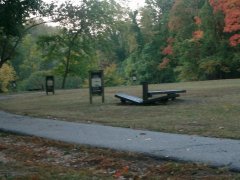
On the Rock Creek Park Parcourse
AMERICA’S NEW OUTDOOR FITNESS SPORT IS FOR EVERYONE. Join the millions of participants who enjoy Parcourse regularly to maintain overall physical fitness and good health.
Parcourse consists of a series of fitness stations (where you perform specific exercises) which are spaced along a jogging and walking path in this area, as you can see from the Parcourse map. Simply follow the WALK or JOG direction signs to each fitness station until you reach the FINISH sign at the end of the Parcourse.
As the name Parcourse implies there is a recommended “Par” or number of repetitions suggested on each sign for each of three different “fitness levels.” As you select your fitness level — Starting Par, Sporting Par, or Championship Par — remember that the Par merely represents recommended goals, based on you own physical condition.
YOU CAN CHALLENGE YOURSELF.
Good Luck & Good Health
Copyright (c) 1975
Filed under: Decay, Infrastructure, Landscape, Memory, Nostalgia, Travel | Leave a Comment
Tags: 1970s, Democracy, Exercise, Parcourse, Populism, Rock Creek Park, Washington DC
On Die Tote Stadt
The modern hotel is a mammoth, sprawling fortress on a hill; its endless hallways are dim and silent and uniform except for the temporal, scattered remains of room service left outside a door. If we see anyone at all — and this is rare, although we have been told the hotel is fully occupied — we hurry past with downcast eyes, sullen and vaguely ashamed; we never want to be remembered for having set foot here.
After perhaps five miles of wandering through this labyrinth, we arrive at our designated room and unlock the door with the plastic “keycard.” It slides into the slot above the handle with a surreptitious ease that ironically enough reinforces the sense that we are the one being watched. Inside, we greet brass fixtures, sheets and towels of the highest thread counts, specialty soaps and lotions, and a mountain range of pillows in every different size.
We set down our books on the mahogany desk and walk to the windows, which are large and panoramic and cannot be opened. Standing behind them, we begin to suffocate in the stagnant, recirculating air; we would be tempted to scream if not for the overwhelming sense of being just one of thousands locked away in this suburban nightmare of conformity and despair.

Filed under: Capitalism, Infrastructure, Opera, Travel | Leave a Comment
Tags: Keycard, Marriott Wardman Park, Paranoia, The Dead City
On the Cotillion Ballroom
As we descend the wide, curving stairs to make our entrance into the Cotillion Ballroom, we look up and observe six — no, eight! — crystal chandeliers hovering above us, massive structures roughly the shape of upside-down umbrellas, each one magically suspended under the 30-foot ceiling. This is a grand interior space reminiscent of those we have seen in movies and photographs of the old world; walls are covered in damask and adorned by a series of equally massive sconces, bisected versions of the chandeliers that lie flat against the wall; tall potted palms complete the effect.
We are far from alone in this promenade; the air is heavy with gossip and expectation. Have we arrived for a wedding or a dance? No, it is a collection of attorneys gathering to discuss the nuances and implications of a recent decision handed down by the Supreme Court; it is the aristocracy of the new gilded age, with titles bestowed by chief executives instead of kings and queens.

Filed under: Capitalism, Film, Infrastructure, Pessimism, Politicians, Travel | Leave a Comment
Tags: Aristocracy, Law, Marriott, The Supreme Court, Visconti
On Flight
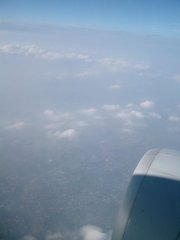
The bleak and vaguely militaristic atmosphere of the terminal is now behind us; we have endured the stifling tedium of the runway and the paralyzing terror of the lift-off, during which we considered the high likelihood of our imminent death and regretted our many missteps. We thought with great tenderness of Dante and Zephyr and the Weeping Serbian Spruce, and hoped that they would somehow thrive in our absence.
But we survived this trial and now blithely hurtle through the sky at unfathomable speeds; problems — not only ours, but those of the world at large — seem distant and trivial, easily resolved. Even death no longer terrifies us; to the contrary, the blue and amber sheen of the ethereal world outside makes the prospect of our annihilation and subsequent dispersal into the clouds almost welcoming, an eternal dive into a serene mountain lake.
Filed under: Dream, Infrastructure, Resignation, The Autumn Garden, The Russian Blue, Travel | Leave a Comment
Tags: Cats, conifers, LGA, US Airways
I sat down in Terminal C next to an older woman, who in a long black dress and ostrich-feather hat appeared oddly elegant among all the business suits.
“I hope it’s not too crowded,” I remarked in a somewhat stilted attempt to engage this mysterious woman in conversation, as if we were both waiting to be seated at an exclusive French restaurant.
“I wouldn’t know,” she responded archly, but with an exquisite diction that seemed to resonate with years of stage training.
For the first time I dared to look directly into her pale, distant eyes, the gray color of which recalled the high peaks of the Bavarian Alps. “Were you by any chance a singer?”
“I was.” She folded her gloved hands onto her lap before she responded. “In fact, 100 years ago this very evening, something interesting happened to me — would you like me to tell you about it?” She paused as if to gauge my interest and apparently satisfied by a vigorous nodding on my part continued, her voice soft but expectant. “It was at the Palais Garnier in Paris, where I had been spent perhaps fifteen years as a cover. I don’t say this with pride, but I had probably learned fifty roles and never once performed any of them — or at least not at the Garnier, which had always been my only dream in life. On this night, I arrived at the theater expecting more of the same; or even more than usual, given that the opera was Tristan und Isolde — do you know it?”
“Intimately,” I confirmed.
“One never knows these days,” she sighed and waved her hand in front of her face, as if to clear an unpleasant odor. “So it happened that the lead Isolde — Greta Glockner, if that means anything to you — had fallen ill with a sore throat — there had been a snowstorm — and so the role was given to me.” She lowered her voice even further. “Do you know what happened next?”
I shook my head, not wanting to interject my markedly untrained voice into this unexpected aria.
“It was a triumph! Each of the three acts was more miraculous than the next! I had never dreamed such perfection could be possible, and I could hardly believe it even as it happened! Rockets and bombs could have fallen around me and I would have brushed them away without a second thought! And the Liebestod? Even more sublime than the rest — I swear to you that some small number of souls in the audience were extinguished that night as a result of my devastating beauty, not that it really belonged to me. With the last note of the last chord hanging in the air, I fainted, and felt sure that I would also die. Not that I cared — I craved it! — for I had sung Isolde at the Palais Garnier. What else was there to live for?”
“I’m sorry I missed it,” I offered indirectly, and when she didn’t reply, impulsively added: “But you didn’t die.”
“No, but it was the death of my career,” she confessed. “And I knew it even as it happened. It was too impossibly grand and terrifying, but what choice did I have? You only get one or two such moments in a lifetime, you know, and sometimes not even that.”
“I wouldn’t doubt it,” I admitted. “Not that I’m a performer.”
She responded in a tone I found both cold and thrilling: “Are we not all performers on the stage of life?”
I exhaled, as if to cede the point, even as I countered: “I resist the impulse whenever possible.”
This seemed to both appease and confuse her somewhat. “And then what do you live for?”
“I’m afraid I can’t offer you anything that won’t sound very trite.”
She shook her head slowly and ambiguously. “As with anything profound, it’s the tone in which you offer it.”
A few seconds passed and before I could respond, the air crackled with the announcement of my boarding call. The spell had been broken, and I stood up to arrange my luggage. “You never told me where you were going,” I noted, wanting to exit the conversation, but with some grace.
She threw her head back and laughed, and I was amazed to see that all of her teeth — except for the ones in front — were made of gold. “I’m not going to ____, if that’s what you mean,” she stated, and then narrowed her eyes. “But like you, my final destination is in the past.”

Filed under: Dream, Gay, Memory, Opera, Travel | Leave a Comment
Tags: LGA, Liebestod, Opera, Spleen, Tristan and Isolde, Wagner
We pull and tug at the blanket — the first cold night of the year is upon us — but it doesn’t move even an inch: it is trapped under the leaden weight of cats in the night. We shiver at the edge of the bed, longing to be covered and warm, to retreat to the bliss of sleep, but are caught in this purgatorial state. The clock chimes and our mind begins to race. Why can’t we move the sleeping cats? (During the day, a flick of the finger would be enough to send them scurrying away.) Is it that we have become weak in our sleep, or rather that they have become heavier? Science has once again failed us.
We would like to shift a few inches to the right, but feel paralyzed; all of our energy was wasted in the initial effort to gather in the blanket. We have never felt so utterly exhausted. Our throat is parched — it hurts to swallow — but the idea of walking even ten feet fills us with despair; we also know that to drink water now would ensure a restless night of up and down to the bathroom, a vicious cycle of insomnia and thirst. In the distance someone turns up a stereo, callously destroying the fragile integrity of the night. Our ears are filled with whispers of rage as we suddenly consider the many failings that have brought us to this juncture.
Slowly we resign ourselves to the idea that sleep itself is a fading dream. We gradually awake, still cold but more focused; by now the cats have disappeared into the gray dawn, ceding the territory they had so recently occupied. But it is too late; thoughts of the day have encroached, and we begin to harness the accompanying dread of all we can expect to face. We are used to this, however, and already are enticed by the allure of the following night and the redemption it (inexplicably, given what we have just endured) seems to offer.
Filed under: Addiction, Dream, Longing, The Russian Blue | Leave a Comment
Tags: Cats, Day, Insomnia, Night, Science, Sleep
On Our Interview with Ann Romney
Today, as part of our continuing series of garden interviews in Washington Heights, we spoke with Ann Romney — wife of Republican presidential candidate Mitt — about some of her favorite films and “the focus” they have brought to her husband’s campaign.
——————————-
The Gay Recluse: Ann, we noticed in the press materials that you prefer to start off every interview with a few words about the French filmmaker Jean Renoir — why?
Ann Romney: Renoir is such a huge inspiration to both of us, and he represents a turning point in our decision to run. One night around the time we were first considering it, we watched The Golden Coach, which against all expectation turned out to be our all-time favorite Renoir film. Until then, I had only seen La Regle Du Jeu and La Grande Illusion, which — OK — are cocktail-party masterpieces but had always left me feeling a little unconvinced–there’s just something a bit plodding about them, you know? (But don’t tell anyone I said so!) Laughs. But seriously, there’s a pervasive sensuality to The Golden Coach I find intoxicating on so many levels; the politically subversive manner in which Camilla goes from suitor to suitor, the fantastic colors, the constant acrobatics of the performers — I could go on and on! The point it, all of it moved us more than words can say. It was one of those moments when you cast logic to the side and say “life, I’m here — take me!”
TGR: Would it be wrong to say that your campaign is really a form of commedia dell’arte?
Ann: No, that’s exactly it! And you know, politicians are actors, too. I’ll never forget the scene at the end of the movie when the stage manger says to Camilla [Ann later provided us with the exact language]:
“You were not made for what is called life. Your place is among us, the actors, acrobats, mimes, clowns, jugglers. You will find your happiness only on stage each night for the two hours in which you ply your craft as an actress, that is, when you forget yourself. Through the characters that you will incarnate, you will perhaps find the real Camilla.”
When we saw that, Mitt and I looked at each other — we both had tears in our eyes — and I didn’t even have to say it; we both knew that we were going to run! We’re really only happy up on the “American stage,” forgetting and finding ourselves at the same time.
TGR: You’re obviously a big fan of Anna Magnani.
Ann: “Big fan” does not begin to express the depths of my admiration for Anna Magnani and her work! Laughs. When my sons were growing up, I always told them not to fall for superficial beauties — and sadly there are so many — but to search for someone with soul, which may sound trite but which I think encapsulates Anna. When I’m First Lady, you can be sure I’ll be promoting her legacy in all of the schools.
TGR: Talk a little bit more about your five sons. Is it true that the idea for their Five Brothers blog was inspired by Lina Wertmüller’s Seven Beauties?
AR: Did I say that? Laughs. It’s funny, I give a lot of speeches and interviews these days, and that’s probably the number-one question people ask me.
TGR: And the answer is…?
AR: Well, yes, of course! I know it’s become almost a cliche for campaign spouses to mention Lina Wertmüller as an inspiration — remember how overplayed Virginia Woolf was in 2004? — but I don’t care. These are precarious times in the U.S., and the tone that Wertmüller struck in her harrowing treatment of fascism — the ridiculous, grotesque quality that sometimes leaves you no choice but to laugh through the tears — is exactly what Mitt and I want to strike on the campaign trail, and ultimately in office. It’s not one of hope, exactly, but an understanding of the human condition and a sort of artistic revelation that springs out of it at our most dire moments.

Filed under: Capitalism, Drag Queens, Film, Gay, Politicians | 2 Comments
Tags: Ann Romney, Election 2008, Jean Renoir, Lina Wertmüller, Mitt Romney, Virginia Woolf


 The Gay Recluse